Topics (384k) Articles (398k) Users (410) Discussions (242) Comments (383) Files (13k) New article

FAT32 is a File Allocation Table filesystem variant using 32-bit table entries with fewer bits available for cluster numbers. A directory entry stores file size in a 32-bit unsigned field, limiting one ordinary file to bytes. This limit is distinct from a volume's capacity, which also depends on sector and cluster layout and implementation restrictions. FAT32 is widely interoperable but lacks native per-file security ACLs and metadata journaling of the kind provided by NTFS. Filesystem limits should be distinguished from a formatting tool's additional limits.[ref]
https://learn.microsoft.com/en-us/windows/win32/fileio/filesystem-functionality-comparison. Microsoft, file-size limits and security comparison
// Target: computer-science.bigb
A triangular number counts rows of objects, with a nonnegative integer:The first values are . The empty arrangement contributes zero, by the empty sum convention. Adding one more row gives the triangular number recurrence for . The row lengths form an arithmetic progression, while their running totals are triangular numbers.
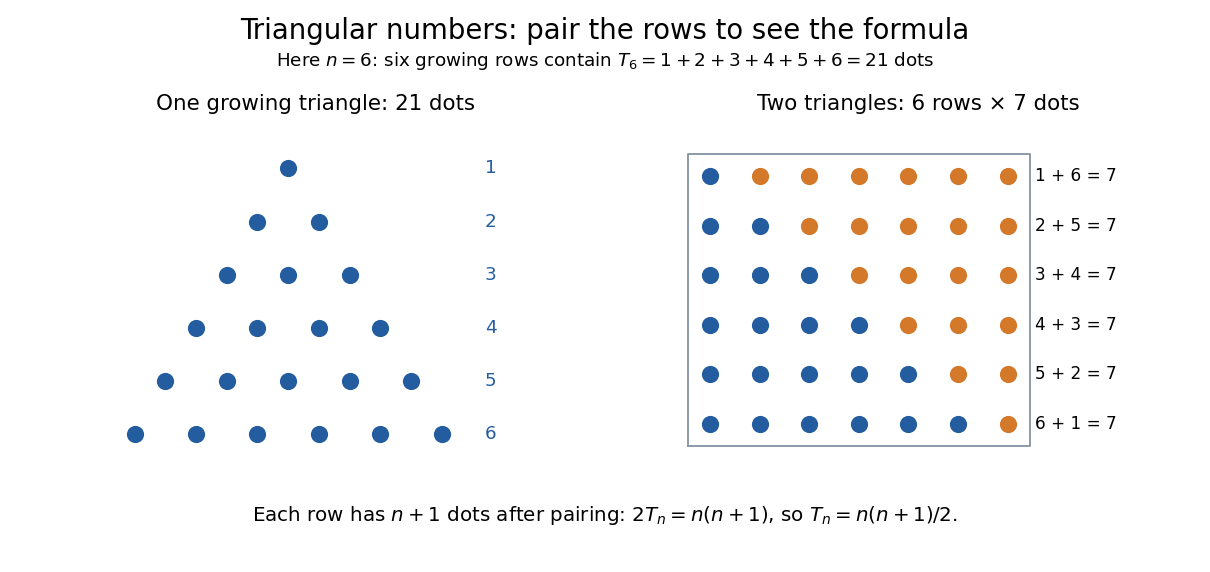
Pair the rows with a reversed copy: . There are such pairs, so two copies contain dots. Dividing by two proves the formula. This rectangle picture explains the factor one-half without requiring a formula for a long summation. For example, one hundred rows contain dots.
The same count appears whenever every pair of different objects must be considered once. Five participants make ten possible handshakes; five sensors have ten different pairwise comparisons; a complete graph on five vertices has ten edges. These are the triangular number pair-counting identity, with one fewer row than objects. The distinction prevents a common error: counts all pairs from six objects, whereas five objects give .
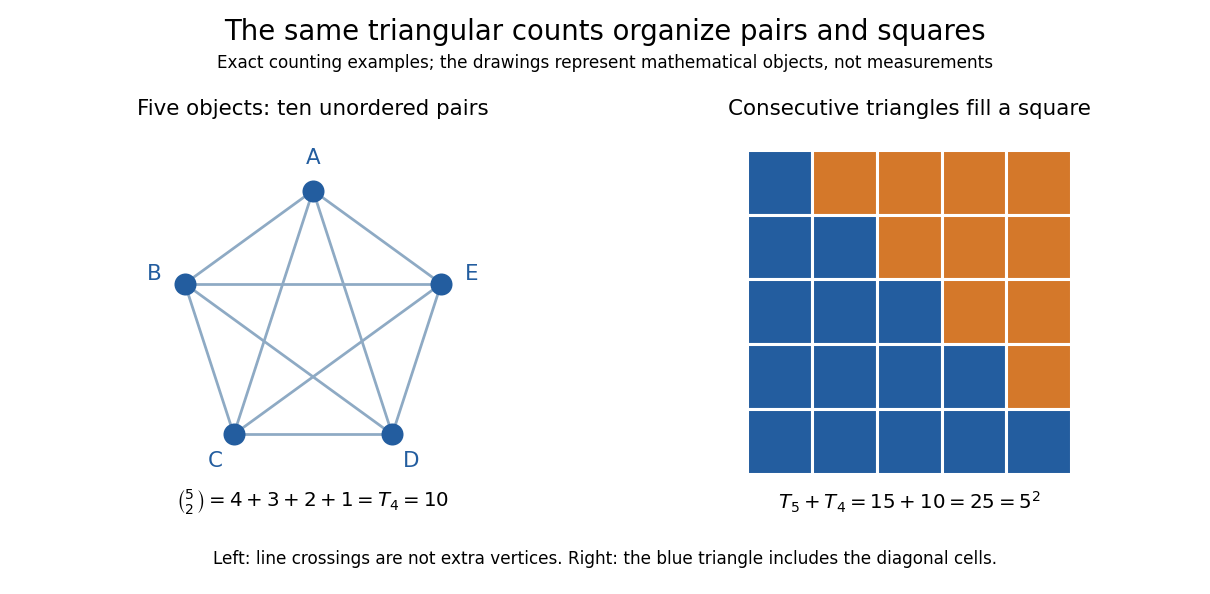
The triangular number square-complement identity says that two neighboring triangular numbers fill a square. Combining that identity with the one-row difference makes the difference of squares equal to . It leads to Nicomachus's theorem: the sum of the first cubes of numbers is the square of a number . A change in the way one groups objects exposes a relation between summation, multiplication and geometry.
This geometric view is already visible in Nicomachus's Introduction to Arithmetic by Nicomachus (Hahn teacher edition): Book II, Chapter 8 describes growing triangular rows, Chapter 12 combines successive triangular counts into squares, and Chapter 20 groups successive odd integers into cubes of numbers.[ref]
Introduction to Arithmetic by Nicomachus (Hahn teacher edition). Book II, Chapters 8, 12 and 20, printed pp. 63–64, 70 and 75
The linked edition uses Martin Luther D'Ooge's translation, revised with modern teaching material by Nathanael Hahn. Our empty-row index is a modern convention; the historical passage starts from unity and calls three the first actual triangle.K-essence is a cosmological scalar-field mechanism in which noncanonical kinetic dynamics supply negative pressure or accelerated expansion. Its action is a particular use of a P(X, phi) scalar field theory; that general action also includes theories without kinetic dark energy.
A field extension is algebraic if every element of is an algebraic element over . Every finite field extension is algebraic, but algebraic extensions can have infinite degree.
A field extension obtained by adjoining finitely many square roots in characteristic different from two. If the classes of are independent in , the extension has degree and Galois group : each square root's sign can be changed independently. The products of distinct square roots form a basis over .
The algebraic conjugates of an algebraic element over a field are the polynomial roots of its algebraic minimal polynomial over in an algebraic closure.
The algebraic conjugates of an algebraic number are the polynomial roots of its algebraic minimal polynomial, equivalently its images under field embeddings of its number field into an algebraic closure.
A field is Hilbertian if each finite family of polynomials irreducible over and separable in its root variable remains irreducible of the same degree at infinitely many , after any finitely many prescribed bad parameter values are excluded. Equivalently, every finite separable extension of has infinitely many unramified -rational places whose residue extension retains its full degree.
For each positive integer , the product of the preceding Fermat numbers is two less than the next:For example, . The identity telescopes by repeated difference of squares: . Its usefulness is that a huge integer product exposes a tiny difference, two, from the next term.
The set of all feasible points of an optimization problem. It depends on the optimization constraints and the decision domain; the objective function ranks its members.
Think of three successive questions. Which decisions can be represented in the model? Which satisfy every optimization constraint? Which of those receive the best objective function value? For decisions in a domain , inequalities and equations define the feasible regionThe domain must be contained in the domain of a function for every function being evaluated; choosing integers rather than real numbers as decisions can also change the feasible set. Constraint satisfaction determines membership of . Minimizing an objective function then compares its members by , with optimal value . Changing the scores while keeping and the optimization constraints fixed leaves unchanged, provided the new objective function is defined throughout . These distinctions separate an allowed decision from a best decision.[ref]
Convex Optimization by Stephen Boyd and Lieven Vandenberghe. §4.1.1, printed pp. 127–128: problem domain, feasible set, optimal value and attainment
Let be nested normal linear models with full-rank design matrices of ranks , where , and observations. Under the reduced model,The difference of the orthogonal projection matrices onto the two model spaces is an orthogonal projection of rank , orthogonal to the full-model residual projection. Independent normal distribution projections therefore give independent chi-squared numerators and denominators after division by . This proves the ratio law. The test evaluates the extra terms conditional on all reduced-model terms, and estimates the unknown common variance from the full model.
A set family on a finite set separates ordered pairs if each ordered pair of distinct points has a member containing the first point and omitting the second. If its members are , assign each point the characteristic vector of its incidences, or equivalently . Separation in both directions says precisely that the form an antichain in the Boolean lattice on coordinates. Thus the Sperner theorem gives . Conversely, any antichain of distinct subsets of supplies such a set family by transposing its incidence table.
If all members of a set family on have odd size and all distinct pairwise intersections have even size, its characteristic vectors over the finite field are linearly independent. Their pairwise dot products are zero, and each vector has dot product one with itself. Taking the dot product of a linear combination with each vector makes every coefficient vanish, so there are at most vectors. The set family of all singleton sets attains this bound.
If every member of a set family on and every distinct pairwise intersection has even size, its characteristic vectors span a self-orthogonal binary subspace. The standard dot product is nondegenerate, so implies . Thus the set family has at most members. All unions of disjoint pairs of points attain this bound.
For the optimized left-to-right exponentiation by squaring algorithm, let be the length of the binary expansion of a positive integer , and let be its Hamming weight, the number of digits equal to one. There are exactly digits after the leading one, and exactly remaining ones. Therefore the count isHere counts squarings and counts further multiplications by the base; every squaring counts as one multiplication in . Assignment, digit reading, and any inversion are outside this count. The formula includes , which requires zero multiplications; define separately.
For a fixed length , the bounds are . A power of two reaches the lower bound because its Hamming weight is one; reaches the upper bound because all digits are one. For , and , giving . Thus the arithmetic operation count is in Big O notation, but inputs of similar magnitude can have different counts.
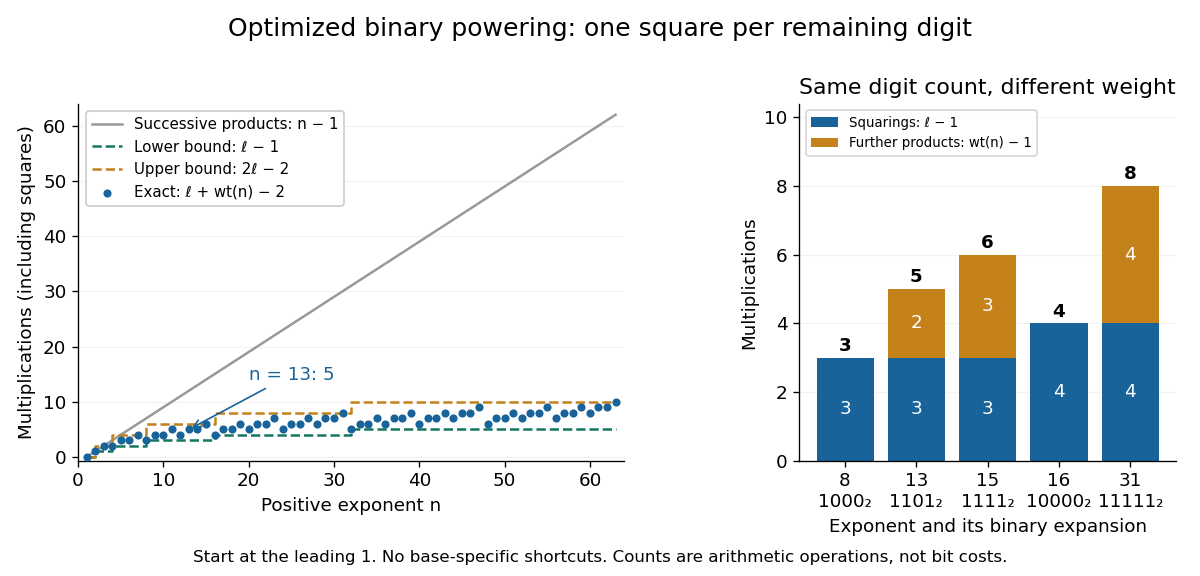
Exact multiplication counts for optimized exponentiation by squaring depend on binary length and Hamming weight
. For positive exponents through , dots show , including each squaring. The dashed curves bound all counts at each binary length. Successive multiplication needs operations. The second panel compares squarings and further multiplications for exponents . These are exact counts, not timing measurements. Details.This is a count for the specified algorithm, not a claim that it always minimizes multiplications among all methods. For instance, at the count is six, but the powers with exponents can be built in five multiplications: square, multiply by , square, square, then multiply by the already stored . Saving operations this way uses a different schedule and stored intermediate powers.
A stretched exponential has the form with and . A boundary cost proportional to the square root of an enclosed area naturally produces exponent .
Methods of detecting exoplanets infer or resolve an exoplanet through its effects on the host star's light or through its own light. The observable determines what can be learned:
- Doppler spectroscopy measures changes in a star's line-of-sight velocity from its spectral lines, constraining a companion's mass, orbital period, and orbital eccentricity, with an orbital inclination ambiguity.
- Exoplanet transit photometry measures a repeating dip in the star's observed radiative flux, constraining the exoplanet's radius relative to the star and its orbital period. It requires a suitably aligned orbit.
- Astrometry measures a star's changing position on the sky from stellar reflex motion; with adequate orbital coverage it can constrain orbital inclination and the companion's true mass.
- Gravitational microlensing detects a companion's perturbation of the temporary brightening of a background star. Such alignments are usually not repeatable, and additional information is needed to turn fitted ratios into absolute masses and separations.
- Exoplanet direct imaging spatially separates an exoplanet's light from its host star's light, enabling studies of an exoplanet atmosphere and, over time, its orbit.
An exoplanet secondary eclipse measures the loss of the exoplanet's light when it passes behind its star, complementing exoplanet transit photometry. A detection method also selects which systems are easiest to find: deeper exoplanet transits favour larger radius ratios, and larger stellar radial-velocity semi-amplitudes favour more massive companions, shorter orbital periods, and larger . These preferences must be accounted for when inferring the underlying exoplanet population.
In an economy with a measure space of consumers, a consumption allocation is a measurable, integrable function assigning each consumer a feasible bundle. Exact aggregate feasibility means .
A demand correspondence assigns a nonempty set of chosen consumption bundles to each price and wealth pair. Every chosen bundle satisfies the budget constraint. A utility function rationalizes the demand correspondence when the chosen bundles are exactly its maximizers over the budget set.
A price quasi-equilibrium with transfers is an exactly feasible consumption allocation and a nonzero price vector for which, almost everywhere, every strictly preferred bundle has cost at least . The transfer-adjusted wealth is ; transfers sum to zero. Equal-cost strict improvements may remain, which distinguishes a quasi-equilibrium from a utility-maximizing equilibrium. Nonnegative prices need extra assumptions if goods may be undesirable.
Aggregate excess demand subtracts total endowment from the sum of consumers' demand correspondences. A market-clearing price satisfies . Under Walras law, one equation is redundant after price normalization.
Pinned article: Introduction to the OurBigBook Project
Welcome to the OurBigBook Project! Our goal is to create the perfect publishing platform for STEM subjects, and get university-level students to write the best free STEM tutorials ever.
Everyone is welcome to create an account and play with the site: ourbigbook.com/go/register. We belive that students themselves can write amazing tutorials, but teachers are welcome too. You can write about anything you want, it doesn't have to be STEM or even educational. Silly test content is very welcome and you won't be penalized in any way. Just keep it legal!
Intro to OurBigBook
. Source. We have two killer features:
- topics: topics group articles by different users with the same title, e.g. here is the topic for the "Fundamental Theorem of Calculus" ourbigbook.com/go/topic/fundamental-theorem-of-calculusArticles of different users are sorted by upvote within each article page. This feature is a bit like:
- a Wikipedia where each user can have their own version of each article
- a Q&A website like Stack Overflow, where multiple people can give their views on a given topic, and the best ones are sorted by upvote. Except you don't need to wait for someone to ask first, and any topic goes, no matter how narrow or broad
This feature makes it possible for readers to find better explanations of any topic created by other writers. And it allows writers to create an explanation in a place that readers might actually find it.
Figure 1. Screenshot of the "Derivative" topic page. View it live at: ourbigbook.com/go/topic/derivativeVideo 2. OurBigBook Web topics demo. Source. - local editing: you can store all your personal knowledge base content locally in a plaintext markup format that can be edited locally and published either:This way you can be sure that even if OurBigBook.com were to go down one day (which we have no plans to do as it is quite cheap to host!), your content will still be perfectly readable as a static site.
- to OurBigBook.com to get awesome multi-user features like topics and likes
- as HTML files to a static website, which you can host yourself for free on many external providers like GitHub Pages, and remain in full control

Figure 2. You can publish local OurBigBook lightweight markup files to either OurBigBook.com or as a static website.
Figure 3. Visual Studio Code extension installation.
Figure 5. . You can also edit articles on the Web editor without installing anything locally. Video 3. Edit locally and publish demo. Source. This shows editing OurBigBook Markup and publishing it using the Visual Studio Code extension. 
- Infinitely deep tables of contents:




All our software is open source and hosted at: github.com/ourbigbook/ourbigbook
Further documentation can be found at: docs.ourbigbook.com
Feel free to reach our to us for any help or suggestions: docs.ourbigbook.com/#contact