Topics (384k) Articles (398k) Users (410) Discussions (242) Comments (383) Files (13k) New article
Evolutionary game theory studies how a population's composition changes when the success of a pure strategy depends on which other pure strategies it encounters. The central feedback is a frequency-dependent payoff: becoming common changes the opponents a strategy meets, which can change whether it does well. In a coordination game, common behaviour can reinforce itself; in the coexistence example below, being rare is an advantage. This makes evolutionary game theory useful for asking which behaviours can persist and which initial compositions lead to different outcomes, without assuming that each participant solves an optimization problem.
In the basic model, a large, well-mixed population has finitely many inherited pure strategies; interactions sample opponents according to their population frequencies. Assume that a strategy's expected payoff determines its per capita net reproductive growth rate, with a common baseline allowed. These are modelling assumptions: reproduction must transmit the strategy, encounters must match the proposed sampling rule, and the conversion from payoff to growth must be justified for an application. The replicator equation below describes the resulting continuous-time frequencies. Taylor and Jonker's [ref]
https://static1.squarespace.com/static/5dc9917c4cdb1467e1e54c4c/t/6526a5647942e33b89ab7af1/1697031525653/1978%2Bevolutionarily%2Bstable%2Bstrategies%2Band%2Bgame%2Bdynamics.pdf. Evolutionarily Stable Strategies and Game Dynamics (1978), section 3, pp. 148–149
explicitly derive this growth model.For learned behaviour, reproduction can instead be replaced by an assumed copying rule: an individual samples another individual uniformly and copies a better-performing pure strategy at a rate proportional to the positive payoff difference. At frequencies , the net flow from to is , because the two directional positive parts subtract to . Summing over gives , the replicator equation. This derivation states a particular mechanism; an arbitrary rule for learning or imitation need not give the same dynamical system.
Three questions must be distinguished. A symmetric Nash equilibrium tests whether an individual can improve its expected payoff against the resident composition. An evolutionarily stable strategy tests whether each distinct rare mutant is outperformed after it is introduced. Dynamical stability tests the response of an actual dynamical system to small changes of composition, and asymptotic stability additionally requires nearby trajectories to converge. For a finite symmetric bimatrix game under the continuous-time replicator equation, every evolutionarily stable strategy is a symmetric Nash equilibrium and a locally asymptotically stable rest point; the converse from asymptotic stability to an evolutionarily stable strategy fails in general. See Ross Cressman and Yi Tao, The replicator equation and other game dynamics (2014), Theorems 1–2 and Example 1. These statements refer to stability on the full probability simplex, including perturbations introducing currently absent pure strategies.
A concrete experiment makes the frequency feedback visible. In 2009, Gore, Youk and van Oudenaarden competed two yeast strains: a producer of the enzyme invertase, which enables sucrose hydrolysis, and a mutant lacking the corresponding SUC2 gene. Released sugars can feed neighbours, so avoiding production can be advantageous. They used shaken 5 mL cultures with 5% sucrose at , diluted daily after 23 hours of growth. Different labelled proteins allowed the two strains to be counted separately by flow cytometry; selective plating periodically checked the counts. The cooperator required externally supplied histidine, so restricting that amino acid imposed an adjustable growth disadvantage. See Snowdrift game dynamics and facultative cheating in yeast, pp. 253 and 255–256, Methods Summary.
Starting with rare producers and, separately, rare nonproducers tested both invasion directions. Under the reported coexistence conditions each rare strain increased; changing histidine or added glucose shifted the eventual composition. Their explanation used nonlinear growth benefits, rather than a fixed pairwise payoff matrix. This motivates testing both rarity regimes before inferring an evolutionarily stable strategy or fitting a replicator equation; it does not identify the illustrative tables below with measured payoffs. See Gore, Youk and van Oudenaarden, Figures 1–3.
An early motivation was understanding why animal contests can involve restraint even when escalation might win an individual encounter. Maynard Smith and Price's [ref]
https://public.ek-cer.hu/~szabo/EGT20/library/maynard_n73.pdf. The Logic of Animal Conflict (1973), Nature 246, 15–18
introduced the evolutionarily stable strategy in this setting. Taylor and Jonker's [ref] then studied explicit continuous and discrete dynamics. Static resistance to invasion and the paths populations follow are related questions, but they require separate definitions.Two people can each have a clear incentive to choose an outcome that leaves both worse off. The prisoner's dilemma isolates this tension between individual best responses and Pareto efficiency. For example, two partners can each save effort by withholding a promised contribution, yet both would prefer a successful joint project to mutual withholding. The model applies when each person's payoffs really have the ordering below; the names “cooperate” and “defect” alone do not establish a prisoner's dilemma.
In the symmetric two-player normal-form game, each player chooses cooperation or defection simultaneously, without observing the other's current choice. The four payoffs are the mutual-cooperation reward , mutual-defection punishment , sole-defector temptation , and sole-cooperator payoff , with . Defection is a strictly dominant strategy: it beats cooperation against either opposing pure strategy. This definition and the resulting one-shot Nash equilibrium are discussed in Steven Kuhn, Prisoner's Dilemma, Stanford Encyclopedia of Philosophy, section 1.
Take the concrete payoffs , , , . Each entry below gives the row player's payoff followed by the column player's payoff:
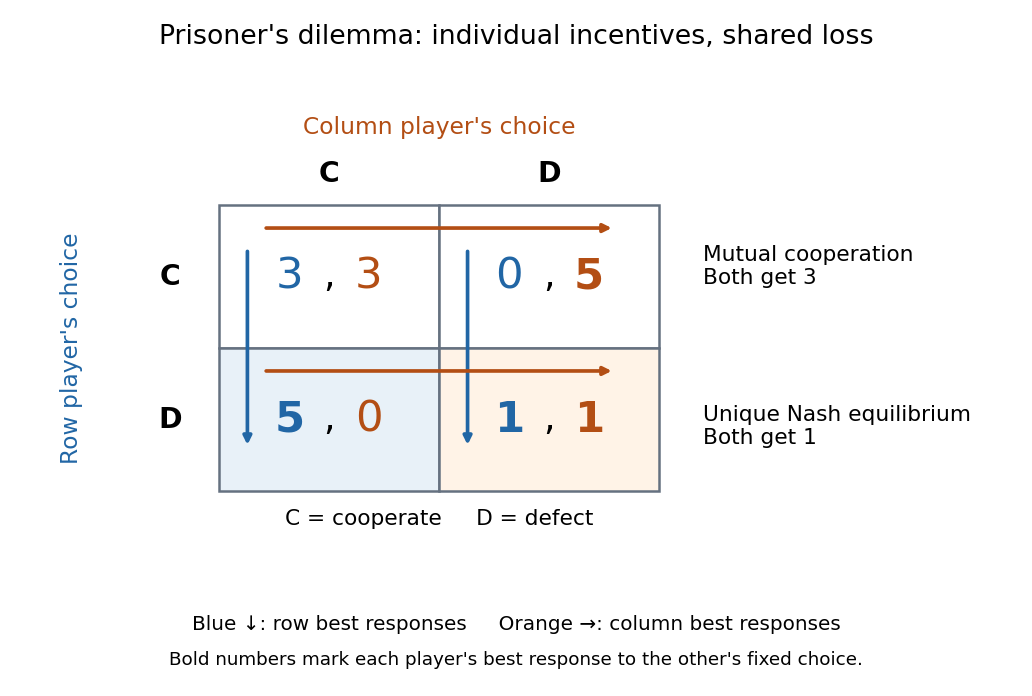
Prisoner's dilemma: best-response arrows lead to mutual defection despite the gains from mutual cooperation
. Details. For the row player, switching from to improves the payoff from to against , and from to against . The column player has the same comparisons, so is a strictly dominant strategy for each. Even against a mixed strategy choosing with probability , the expected payoff advantage is . Thus cooperation cannot appear with positive probability in a best response, and is the unique one-shot Nash equilibrium, including mixed strategies.
At , a unilateral deviation to lowers the deviator's payoff from to . A joint change to instead raises both payoffs from to : mutual cooperation Pareto dominates mutual defection, making the Nash equilibrium fail Pareto efficiency. A Nash equilibrium tests unilateral deviations, so it need not maximize shared gains. This is the useful lesson: improving the available outcome may require changing incentives, rather than telling each participant to choose a better best response.
The additional inequality says that mutual cooperation gives each player at least as much average payoff as equal-time alternation between the two asymmetric outcomes. It is a further assumption, not a consequence of . Here it holds strictly: , and alternating exploitation gives each player average payoff . This comparison concerns equal-time averages, not every discounted sequence. See Kuhn, section 3, on the additional cardinal-payoff condition.
A resolvent is an auxiliary polynomial built from expressions in the roots of a polynomial. The action of its Galois group on those expressions gives information about solvability and intermediate field extensions. A Lagrange resolvent for a cubic uses Fourier combinations of the three roots.
An algebraic extension in characteristic is purely inseparable when every one of its elements is purely inseparable over the base field.
An algebraic extension is separable when every element has a minimal polynomial with distinct roots.
An algebraic extension is normal when every irreducible polynomial over with a root in splits in . For finite extensions, equivalently every -embedding into an algebraic closure has image .
The inverse Galois problem asks which finite groups occur as Galois groups over a given field, with the classical problem taking the base field to be . A regular realization over and Galois-preserving Hilbert specialization solve an instance over a Hilbertian field. Realization over an algebraically closed constant field's rational function field alone does not supply descent to .
A spiral galaxy has a galactic disk with spiral structure, commonly cold interstellar gas and ongoing star formation as well as an older stellar population.
An irregular galaxy lacks a regular spiral or elliptical outline. Many contain substantial gas and recent star formation; irregular appearance alone does not determine a stellar population's age.
A star-forming galaxy is a galaxy with ongoing star formation. Its hot young stars can supply hydrogen-ionizing radiation to the intergalactic medium, with the contribution controlled by the ionizing photon escape fraction.
A stellar halo is the extended, approximately spheroidal stellar population surrounding a galaxy. It differs from the total dark matter halo. If its outer luminosity density is , its projected light follows the projection of a spherical power-law emissivity and scales as away from breaks and outer truncation.
A galactic bulge is a centrally concentrated stellar population in a galaxy, usually thicker than its disk. Its origin, rotation and random stellar motions can differ from those of the disk; bulge light is often described by a Sérsic profile.
Yeasts are fungi whose growth is predominantly unicellular, commonly through budding or division into two cells. The word describes a growth form across different fungal lineages, rather than one species or an exclusive clade; some fungi can switch between unicellular and filamentous growth. Thus Saccharomyces cerevisiae is a yeast, but yeast is not another name for that one species. See Kurtzman, Fell and Boekhout, The Yeasts, chapter 1 (2011): definition and classification.
A yeast cell has eukaryotic organization, including a cell nucleus, mitochondria and a cell wall. Small size and a unicellular lifestyle do not make it a member of bacteria. These compartments let an experimentally accessible biological cell retain much of the organization shared with other eukaryotes. See Clark, Douglas and Choi, Biology 2e, 24.1: fungal cells and yeast growth.
A motivating experiment: can fermentation continue without intact yeast cells? In 1897, Eduard Buchner ground brewers' yeast with quartz sand and diatomite, added water, and pressed out a liquid extract. Adding concentrated cane sugar produced carbon dioxide after 15–60 minutes. A cell-retaining filter still yielded an active filtrate: with sterilized cane sugar in an icebox, fermentation began after about a day. Saturated lactose gave no observed fermentation. These are reported observations, not invented control results. See Buchner, Alcoholic fermentation without yeast cells (1897), translated excerpt hosted by Carmen Giunta.
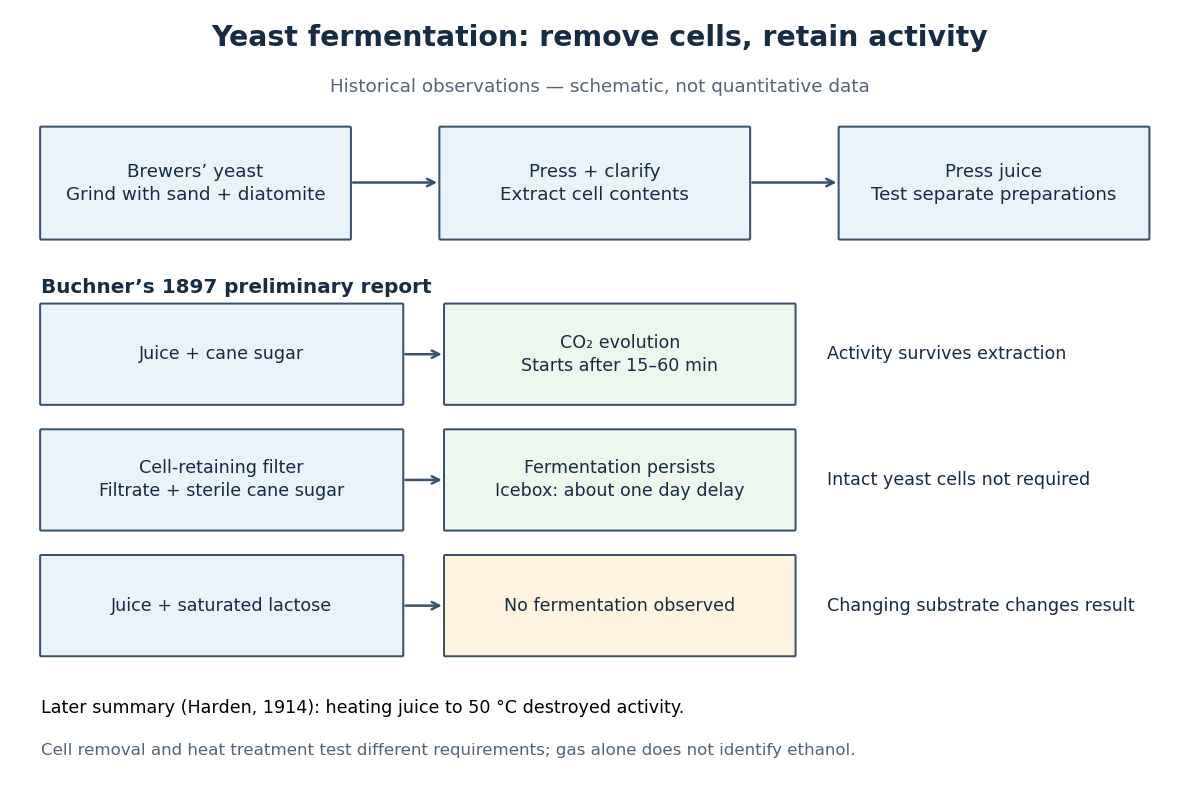
The filtration comparison addresses the objection that surviving intact yeast cells caused the activity. The lactose comparison tests substrate dependence; it is not a no-sugar blank, nor a comparison at matched sugar concentrations. A proposed modern follow-up would also compare the same extract with and without added sugar, accounting for material already in the extract. That is an experimental suggestion, not a result attributed to Buchner. His report specifies brewers' yeast; it does not identify the preparation here as a pure Saccharomyces cerevisiae strain.
Heat treatment asks a different question: does destroying activity in the extract stop fermentation? Buchner's preliminary report described weak or absent activity after heating and filtration, rather than one clean universal threshold. Harden's 1914 account of the subsequent work summarized loss of activity on heating the juice to . Harden also described requirements for both enzymes and coenzymes. Cell-free therefore means neither chemical-free nor a preparation containing one purified enzyme. See Arthur Harden, Alcoholic Fermentation (1914), chapters II and VI: cell-free activity and the fermenting complex.
The inference is that extracted cellular machinery can sustain these chemical reactions without an intact living biological cell. This does not show that the extract reproduces, grows or maintains itself like a yeast. Moreover, gas evolution alone does not identify ethanol: cellular respiration can also release carbon dioxide. Product identification is a separate measurement; Harden's account describes both ethanol and carbon dioxide as products of cell-free alcoholic fermentation. The beautiful separation is between the organism that produces and maintains the machinery and the machinery that catalyzes a particular transformation.
A glucan is a polysaccharide built from glucose units. Different linkages produce different structures; some glucans contribute to a fungal cell wall.
Chitin is a structural polysaccharide built from modified sugar units. It contributes reinforcement to a fungal cell wall.
Brownian proof of the fundamental theorem of algebra by  Codex 0 Created 2026-10-14 Updated 2026-11-05
If a nonconstant complex polynomial had no zeros, its reciprocal would be an entire holomorphic function, bounded and tending to zero at infinity. Its real and imaginary parts are harmonic functions. Thus , for planar Brownian motion started at zero, is a bounded complex martingale with expectation . For fixed , the Gaussian density bounds by . Outside a sufficiently large disk, . Hence . Let and then to obtain , a contradiction. This proves the fundamental theorem of algebra without the maximum modulus principle.
A continuous real function satisfying is either identically zero or for a real constant . If it is nonzero somewhere, and , so it never vanishes. The identity then makes it everywhere positive. Its real logarithm is a continuous additive function, hence linear by additive function continuous at one point is linear. Exponentiating proves the classification, and each listed function satisfies the equation.
A locally convex topological vector space is reflexive when its canonical evaluation map to its continuous bidual is an isomorphism with the specified strong dual topologies. For a Banach space, this reduces to surjectivity of the canonical map and gives a reflexive Banach space.
A nonnegative function-valued operator is sublinear if and almost everywhere. This pointwise domination notion includes maximal one-sided interval averaging operators and differs from requiring an ordinary linear map.
Pinned article: Introduction to the OurBigBook Project
Welcome to the OurBigBook Project! Our goal is to create the perfect publishing platform for STEM subjects, and get university-level students to write the best free STEM tutorials ever.
Everyone is welcome to create an account and play with the site: ourbigbook.com/go/register. We belive that students themselves can write amazing tutorials, but teachers are welcome too. You can write about anything you want, it doesn't have to be STEM or even educational. Silly test content is very welcome and you won't be penalized in any way. Just keep it legal!
Intro to OurBigBook
. Source. We have two killer features:
- topics: topics group articles by different users with the same title, e.g. here is the topic for the "Fundamental Theorem of Calculus" ourbigbook.com/go/topic/fundamental-theorem-of-calculusArticles of different users are sorted by upvote within each article page. This feature is a bit like:
- a Wikipedia where each user can have their own version of each article
- a Q&A website like Stack Overflow, where multiple people can give their views on a given topic, and the best ones are sorted by upvote. Except you don't need to wait for someone to ask first, and any topic goes, no matter how narrow or broad
This feature makes it possible for readers to find better explanations of any topic created by other writers. And it allows writers to create an explanation in a place that readers might actually find it.
Figure 1. Screenshot of the "Derivative" topic page. View it live at: ourbigbook.com/go/topic/derivativeVideo 2. OurBigBook Web topics demo. Source. - local editing: you can store all your personal knowledge base content locally in a plaintext markup format that can be edited locally and published either:This way you can be sure that even if OurBigBook.com were to go down one day (which we have no plans to do as it is quite cheap to host!), your content will still be perfectly readable as a static site.
- to OurBigBook.com to get awesome multi-user features like topics and likes
- as HTML files to a static website, which you can host yourself for free on many external providers like GitHub Pages, and remain in full control

Figure 2. You can publish local OurBigBook lightweight markup files to either OurBigBook.com or as a static website.
Figure 3. Visual Studio Code extension installation.
Figure 5. . You can also edit articles on the Web editor without installing anything locally. Video 3. Edit locally and publish demo. Source. This shows editing OurBigBook Markup and publishing it using the Visual Studio Code extension. 
- Infinitely deep tables of contents:




All our software is open source and hosted at: github.com/ourbigbook/ourbigbook
Further documentation can be found at: docs.ourbigbook.com
Feel free to reach our to us for any help or suggestions: docs.ourbigbook.com/#contact