Topics (384k) Articles (398k) Users (410) Discussions (242) Comments (383) Files (13k) New article
An exchange economy is regular when the derivative of its reduced aggregate excess demand has full rank at every equilibrium. For two goods and normalized prices , this means at every zero of first-good excess demand. Regular equilibria are locally isolated and persist smoothly under small parameter changes.
Write and , with . The prime-power formula for the Euler totient function gives an integer contribution to from each prime: it is when , and when . Multiplying proves the divisibility assertion, including with .
If is odd, its Euler totient function is even and cannot divide . Otherwise write with odd primes and . Comparing powers of two in gives . Thus there is at most one odd prime , with . Since divides , it divides , and is coprime to ; with only the prime factors available it must be a power of two. Hence and . Conversely, for the prime-power totient formula verifies divisibility for , and is immediate.
The map is a bijection of the integers between one and that are coprime to . If their sum is , this bijection gives , so . This works even at , where the single residue is fixed. The same identity follows from the weighted inclusion-exclusion principle by excluding multiples of the prime factors of .
The divisor sum of Euler's totient function is the identity arithmetic function:Equivalently, under Dirichlet convolution, with the constant-one arithmetic function. [ref]
Floor and arithmetic functions by Darij Grinberg. Darij Grinberg, MIT 18.781 lecture notes, Propositions 2.4.4 and 2.4.5
To see why, group the integers by . Each is a positive integer divisor of . Within its group, with and , by the scaling identity for greatest common divisors. Dividing by gives a bijection with the integers counted by . The groups form a partition of a set, soFor , the groups with greatest common divisor are respectively . Their sizes are , totaling . Möbius inversion reverses this divisor sum to recover Euler's totient function from .
For a unit modulo n and a nonnegative integer , division with remainder writes with . Euler's theorem then givesThis replaces a potentially enormous exponent by a small remainder. The exponent itself is reduced modulo Euler's totient function, while the powers are reduced modulo : these are different integer moduli.
For a worked modulo-fifteen calculation, seven is coprime to fifteen and . ThereforeUse exponentiation by squaring on the remaining exponent , reducing after each multiplication:Thus . Modular exponentiation supplies the computation; Euler's theorem supplies the optional shortening of its exponent. Exponentiation by squaring also works for nonunit bases, without using this shortening.
The guaranteed exponent is a common return exponent and an upper bound on the shortest period; it need not be that period. The multiplicative order is the least positive return exponent for the chosen unit. The Carmichael function is the least positive return exponent that works for every unit. Their precise relation isEither smaller return exponent can replace in exponent reduction for units. Modulo fifteen, , so gives immediately. For base four the multiplicative order is only two, smaller even than . A return at exponent eight alone does not prove that the multiplicative order is eight.[ref]
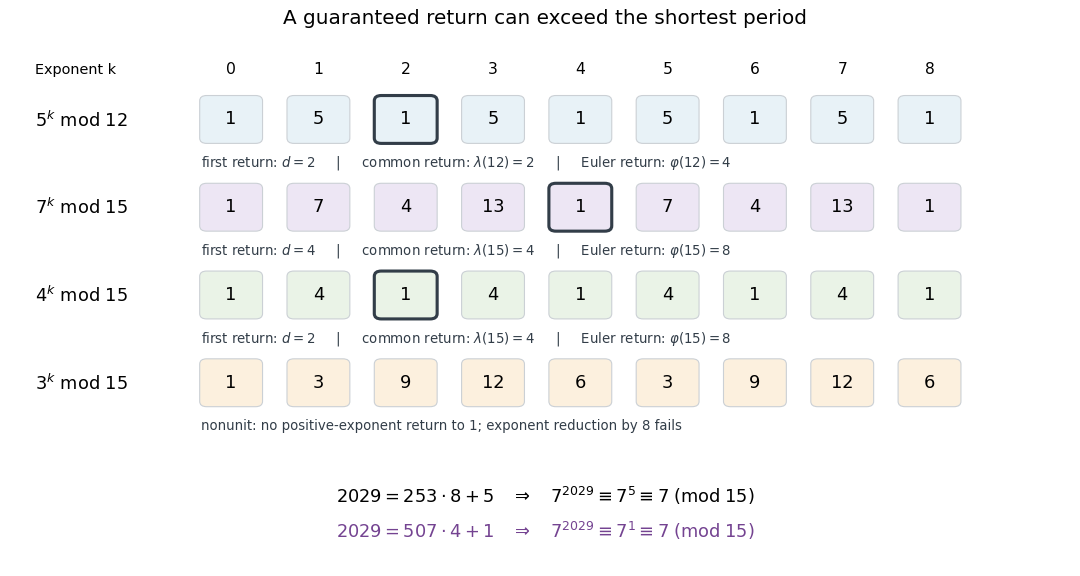
Actual power periods, Carmichael function exponents and Euler return exponents
. Each row lists powers from exponent zero through eight. Highlighted first returns identify multiplicative orders; the accompanying labels distinguish a chosen base's shortest period, the common exponent for all units, and Euler's totient function. Powers of the nonunit three modulo fifteen repeat after an initial term but never return to one at a positive exponent. The final calculation compares reduction of modulo eight and modulo four. Details.Choose a reduced residue system . For a unit modulo n , the bijection on the unit group has inverse . Comparing products before and after this permutation givesThe product is a unit; its modular inverse cancels it, proving Euler's theorem. Merely being nonzero would not justify cancellation.[ref]
Euler’s Theorem by Keith Conrad. pp. 2–3, Section 2: permutation of the units, comparison of products, cancellation
In the modulo-twelve example, . The permuted representatives have the same product, while the unreduced products equal . Equating these products modulo twelve exposes the fourth power without calculating it directly. Using all nonzero congruence classes instead would include nonunits, whose product need not permit cancellation.
The Bernoulli principle relates pressure, kinetic energy per unit volume and Newtonian gravitational potential along a streamline of steady flow with inviscid flow. For constant mass density, the Bernoulli equation gives constant along that streamline. Constancy across different streamlines requires further hypotheses, such as irrotational flow.
Precisely, suppose a fluid of constant positive mass density obeys the Euler equations for an inviscid fluid, its velocity field and pressure are steady, and the body force per unit mass is . ThenEvery term has units of energy per unit mass. For a uniform gravitational field, Newtonian gravitational potential is , up to an additive constant. The pressure term represents work by surrounding fluid, so acceleration can exchange pressure work with kinetic energy. Dotting the steady Euler equations with gives the displayed directional derivative: this is why constancy follows a streamline. [ref]
https://www.damtp.cam.ac.uk/user/mem2/FLUIDS-IB/dyn.pdf. Cambridge, Fluid Dynamics IB, Dynamics, section 2.4
Continue the horizontal water constriction example from incompressible flow. Assume negligible viscous losses, steady flow and approximately uniform flow at both measurement sections, so the streamline speeds there equal the mean speeds and . Equal height cancels the Newtonian gravitational potential terms. The ideal pressure drop isThis is the Venturi effect in its ideal limit: the gain in kinetic energy density is supplied by pressure work. Cambridge's treatment uses this relation to connect a measured pressure difference to volumetric flow rate. [ref]
https://www.damtp.cam.ac.uk/user/mem2/FLUIDS-IB/dyn.pdf. Cambridge, Fluid Dynamics IB, Dynamics, section 2.5
The result is conditional, rather than a prediction of the actual viscous pipe. Mass conservation fixes and the ratio of mean speeds even with viscosity, but nonuniform velocity profiles require an integrated energy balance, and wall friction dissipates mechanical energy. A pump would supply additional work. In particular, constant mean speed in a straight pipe does not imply constant pressure: Poiseuille flow needs a continuing pressure gradient to overcome viscosity. [ref]
https://uclnatsci.github.io/2021/Electromagnetism-Fluids-and-Waves/fluids/bernoulli.html. UCL, Bernoulli's equation, assumptions and boundary limitations
For a fixed-composition inviscid fluid, specific enthalpy satisfies . Combining this identity with the vorticity cross-product identity gives the displayed equation, with and . It exposes entropy gradients as the thermodynamic source of a mismatch between Bernoulli function gradients and the vorticity term. In a steady adiabatic process, its projection along a streamline makes constant there.
Conservative energy flux of a polytropic ideal gas by  Codex 0 Created 2026-10-14 Updated 2026-11-05
For an unmagnetized ideal gas without gravity, the pressure equation gives internal-energy balance , where . The momentum equation gives kinetic-energy balance with source . Their sum is conservative with the displayed total-energy flux. Tangential velocities contribute to kinetic energy even when all derivatives are in the normal direction. Smooth polytropic flow advects its entropy parameter; a physical shock need not preserve that parameter across the discontinuity.
The linearized Euler equations retain only first-order perturbations about a specified inviscid fluid state. Together with the linearized continuity equation and a pressure-density constitutive relation, they describe small-amplitude acoustic waves. About a uniform resting state, , , and an isentropic pressure perturbation has . Gradients and advection of a moving background must be retained when its variation is not negligible.
A rigid motion preserves Euclidean distances and therefore preserves angles, lengths, and curvatures.
An Apollonius circle is the locus of points whose distances from two fixed points have a prescribed positive ratio different from one. Ratio one gives the perpendicular bisector.
A plane crystallographic group is a discrete group of Euclidean plane isometries with compact quotient. Its translation subgroup is a rank-two lattice, and the quotient by translations is its finite point group. This separates the periodic translational geometry from the finite rotational and reflection symmetries.
A point group is a group of spatial symmetry operations fixing at least one common point. Choosing that point as the origin represents its operations by orthogonal matrices, so the point group is a subgroup of the orthogonal group. A pure nonzero translation cannot belong to it.[ref]
A crystallographic point group additionally preserves a full-rank Euclidean lattice and is finite. For a crystallographic space group, the group of orthogonal linear parts is its quotient by the translation subgroup; it preserves the translation Euclidean lattice. In two dimensions the crystallographic restriction theorem allows only rotation orders .
The broader definition is needed for molecular point groups. A regular planar pentagon has a fivefold rotation, so its finite point group is not crystallographic. An ideal centrosymmetric linear molecule has the infinite D infinity h molecular point group, including rotations through arbitrary angles about its axis. Thus neither finiteness nor lattice preservation belongs to the unrestricted definition.
A polygon is a closed finite chain of line segments in a plane, with successive segments meeting at vertices of a polygon. In the usual simple case, nonadjacent sides of a polygon do not intersect and the chain bounds an interior region. A triangle has three sides, a quadrilateral four, and a hexagon six. A simple -sided polygon has interior angle sum : splitting it into triangles explains the formula. A regular polygon has equal side lengths and equal interior angles. Self-intersecting regular star polygons require a separate convention for their interior and signed area.
The centroid of a region with finite positive volume is the average of position with respect to uniform volume:provided the component integrals exist. For a planar region use area in place of volume; for finitely many equally weighted points use their arithmetic mean. The centroid of a uniform triangle is in terms of its vertex position vectors, the intersection of its medians of a triangle. For nonuniform mass density, weighting the same integral by density instead gives the center of mass. The vertex centroid of a general polygon need not equal the centroid of its filled interior.
Pinned article: Introduction to the OurBigBook Project
Welcome to the OurBigBook Project! Our goal is to create the perfect publishing platform for STEM subjects, and get university-level students to write the best free STEM tutorials ever.
Everyone is welcome to create an account and play with the site: ourbigbook.com/go/register. We belive that students themselves can write amazing tutorials, but teachers are welcome too. You can write about anything you want, it doesn't have to be STEM or even educational. Silly test content is very welcome and you won't be penalized in any way. Just keep it legal!
Intro to OurBigBook
. Source. We have two killer features:
- topics: topics group articles by different users with the same title, e.g. here is the topic for the "Fundamental Theorem of Calculus" ourbigbook.com/go/topic/fundamental-theorem-of-calculusArticles of different users are sorted by upvote within each article page. This feature is a bit like:
- a Wikipedia where each user can have their own version of each article
- a Q&A website like Stack Overflow, where multiple people can give their views on a given topic, and the best ones are sorted by upvote. Except you don't need to wait for someone to ask first, and any topic goes, no matter how narrow or broad
This feature makes it possible for readers to find better explanations of any topic created by other writers. And it allows writers to create an explanation in a place that readers might actually find it.
Figure 1. Screenshot of the "Derivative" topic page. View it live at: ourbigbook.com/go/topic/derivativeVideo 2. OurBigBook Web topics demo. Source. - local editing: you can store all your personal knowledge base content locally in a plaintext markup format that can be edited locally and published either:This way you can be sure that even if OurBigBook.com were to go down one day (which we have no plans to do as it is quite cheap to host!), your content will still be perfectly readable as a static site.
- to OurBigBook.com to get awesome multi-user features like topics and likes
- as HTML files to a static website, which you can host yourself for free on many external providers like GitHub Pages, and remain in full control

Figure 2. You can publish local OurBigBook lightweight markup files to either OurBigBook.com or as a static website.
Figure 3. Visual Studio Code extension installation.
Figure 5. . You can also edit articles on the Web editor without installing anything locally. Video 3. Edit locally and publish demo. Source. This shows editing OurBigBook Markup and publishing it using the Visual Studio Code extension. 
- Infinitely deep tables of contents:



All our software is open source and hosted at: github.com/ourbigbook/ourbigbook
Further documentation can be found at: docs.ourbigbook.com
Feel free to reach our to us for any help or suggestions: docs.ourbigbook.com/#contact