Topics (384k) Articles (398k) Users (410) Discussions (242) Comments (383) Files (13k) New article

The lower half-plane is the set of complex numbers with negative imaginary part. It is the reflection of the complex upper half-plane across the real axis.
For a compact set , its polynomial hull is the set displayed, where ranges over all complex multivariate polynomials. It contains . In one complex dimension, bounded complementary components are filled in: the maximum modulus principle bounds every polynomial inside those components by its boundary values. Polynomial approximation and separation distinguish points outside the hull.
A boundary limit taken while approaching within a cone that stays away from tangency. At zero in the complex upper half-plane, every fixed cone is allowed. A nontangential limit need not be a limit along all paths approaching the boundary.
// Destination: analysis.bigb
Homogeneous mixing assumes that contacts sample the whole modelled population without differences between groups or locations. In the SIR model, the chance that a sampled contact belongs to the infectious compartment is . This assumption makes a frequency-dependent transmission rule depend on the overall infectious compartment rather than a graph of individual contacts. Structured contacts require a different mathematical model, such as a discrete SIR epidemic on a graph.
Disease prevalence is the proportion of a population that is infected at a specified time. In a susceptible-infective model with total population , it is .
An SIS model divides a host population into a susceptible compartment and an infectious compartment. Recovery returns hosts directly to susceptibility, without lasting immunity or a separate recovered stage. Let be a constant population size and the infectious fraction, so the infectious count is and the susceptible count is .
For homogeneous frequency-dependent transmission at rate and recovery at rate , the count-level infection rate is . Dividing the net count rate by givesThe disease-free state is . For , the positive endemic equilibrium is . The derivative of the right-hand side at is , proving local stability. If , every positive fraction decreases toward zero; at , gives algebraic decay. The scalar model illustrates a transmission/recovery threshold; heterogeneous contacts or different infectious-duration assumptions require other equations.[ref]
The Mathematics of Infectious Diseases by Herbert W. Hethcote. Section 3, printed p. 621, SIS reductions and the constant-population Bernoulli equation; the no-demography specialization and scalar stability calculation are derived here
The epidemiological abbreviation is distinct from the singular-isothermal-sphere abbreviation in galaxy dynamics.
Any deterministic comparison sort correct for all orders of distinct sort keys needs at least comparisons on some input. Here is a factorial, a logarithm, and the brackets denote the ceiling function. This is a worst-case requirement, not a requirement on every input.[ref]
For three distinct sort keys, the diagram has one leaf for each possible ordering of the original entries . Some paths need two comparisons, others three; two comparisons cannot distinguish all six orders.
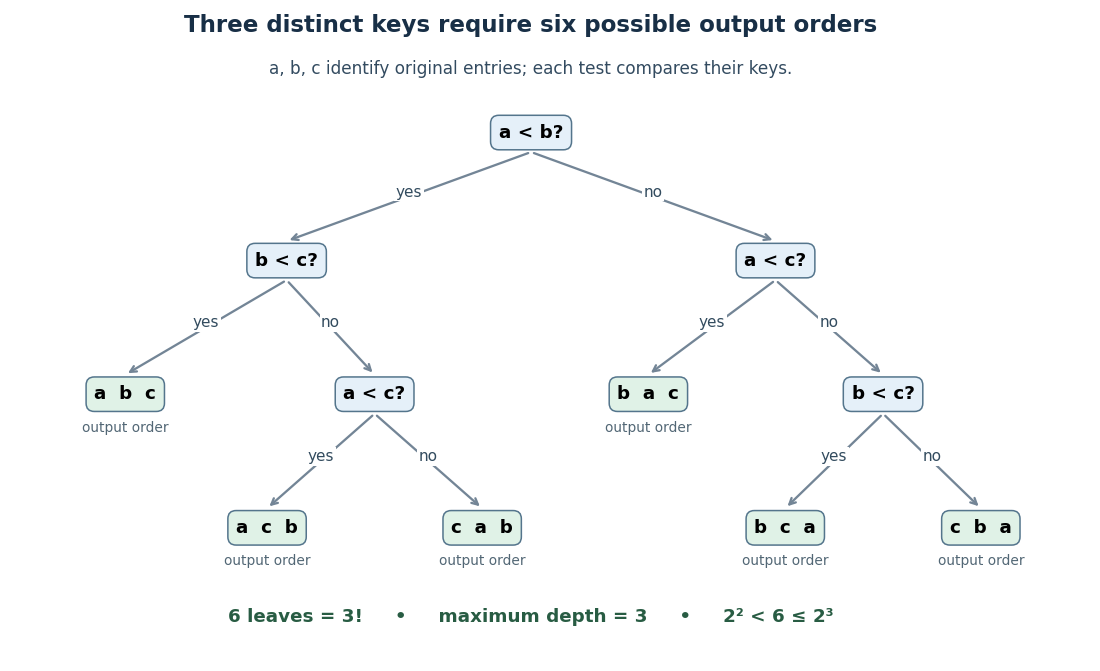
For the proof outline, represent adaptive comparisons by a binary tree: distinct sort keys give only two outcomes per comparison. A leaf fixes an output permutation; one leaf cannot correctly handle two different strict orders. Hence there must be at least leaves. Maximum depth permits at most leaves, so gives the bound. Even a three-way comparator has only two reachable outcomes on this distinct-key family.
The growth follows without a precise approximation to the factorial. At least of its factors are at least , so for ,The brackets denote the floor function. This gives a constant times lower bound for large , matching the worst-case comparison growth of merge sort.
Distinct sort keys are essential to the counting argument. Identical sort keys do not create different strict orders. If all sort keys coincide, stable sorting returns the arrival order. This does not remove the worst-case bound for a comparison sort required to handle arbitrary distinct-key inputs.
If is a commutative -algebra which is a finite free module over , its norm sends to the determinant of multiplication . The determinant is independent of the chosen basis and is multiplicative because . It commutes with scalar extension. On a separable field extension it becomes the product over embeddings, recovering the field norm. An invertible has invertible norm.
A combinatorial structure whose elements carry distinct labels from a prescribed finite set. For example, a rooted tree can have labelled vertices; assigning labels is part of the structure counted by an exponential generating function.
Electron impact can excite an ion into a state above an electron-emission threshold, which then ejects a bound electron by autoionization. This two-stage excitation-autoionization contributes to collisional ionization in addition to direct impact removal.
A codeword is a member of the specified set of words used to encode messages. For a linear code specified by a parity-check matrix , the codewords are precisely the vectors satisfying . The minimum distance between distinct codewords controls error correction.
For codes over an alphabet of size , the greedy packing argument gives , where . A maximal distance- code has radius- Hamming balls covering the entire space; counting their union proves the lower bound. The linear refinement is the Varshamov bound for linear codes.
// Target: algebra.bigb
Code encoding maps messages injectively to codewords. For a dimension- linear code with generator matrix , the standard encoder maps to . The redundancy makes error detection and recovery possible; for a Reed-Solomon code, encoding can instead evaluate a message polynomial at the chosen field elements.
Channel coding represents messages with codewords chosen to withstand transmission errors. An error-correcting code deliberately supplies redundancy, so a receiver can distinguish nearby corrupted outputs and recover the message. Lossless source coding instead removes predictable redundancy; practical communication can use both operations. The Shannon second coding theorem relates achievable rates on a discrete memoryless channel to its channel capacity.
Complex cobordism is the generalized cohomology theory represented by the stable Thom spaces of universal complex vector bundles. Its geometric cycles use maps with chosen stable complex normal data. Its complex Thom classes give Chern classes in complex cobordism, and proper oriented maps have a Gysin map in complex cobordism.
Framed cobordism is the generalized cohomology theory of stable cohomotopy. Its geometric maps have a stable framing of a vector bundle on their normal data. A finite covering has canonically framed zero-dimensional relative tangent data; its Gysin class of is the stable transfer of the cover. A trivial -sheeted cover gives in degree zero.
A compact smooth cobordism is an h-cobordism when both boundary inclusions are homotopy equivalences. The name does not itself impose simple connectivity. A trivial cobordism is an h-cobordism because a product cylinder retracts onto either end.
A cobordism is trivial when it is diffeomorphic to a cylinder with the prescribed incoming boundary identification. Both boundary inclusions are homotopy equivalences and its relative homology with respect to either end vanishes. It can have critical points for a chosen cobordism Morse function; those must form an acyclic relative Morse chain complex.
Pinned article: Introduction to the OurBigBook Project
Welcome to the OurBigBook Project! Our goal is to create the perfect publishing platform for STEM subjects, and get university-level students to write the best free STEM tutorials ever.
Everyone is welcome to create an account and play with the site: ourbigbook.com/go/register. We belive that students themselves can write amazing tutorials, but teachers are welcome too. You can write about anything you want, it doesn't have to be STEM or even educational. Silly test content is very welcome and you won't be penalized in any way. Just keep it legal!
Intro to OurBigBook
. Source. We have two killer features:
- topics: topics group articles by different users with the same title, e.g. here is the topic for the "Fundamental Theorem of Calculus" ourbigbook.com/go/topic/fundamental-theorem-of-calculusArticles of different users are sorted by upvote within each article page. This feature is a bit like:
- a Wikipedia where each user can have their own version of each article
- a Q&A website like Stack Overflow, where multiple people can give their views on a given topic, and the best ones are sorted by upvote. Except you don't need to wait for someone to ask first, and any topic goes, no matter how narrow or broad
This feature makes it possible for readers to find better explanations of any topic created by other writers. And it allows writers to create an explanation in a place that readers might actually find it.
Figure 1. Screenshot of the "Derivative" topic page. View it live at: ourbigbook.com/go/topic/derivativeVideo 2. OurBigBook Web topics demo. Source. - local editing: you can store all your personal knowledge base content locally in a plaintext markup format that can be edited locally and published either:This way you can be sure that even if OurBigBook.com were to go down one day (which we have no plans to do as it is quite cheap to host!), your content will still be perfectly readable as a static site.
- to OurBigBook.com to get awesome multi-user features like topics and likes
- as HTML files to a static website, which you can host yourself for free on many external providers like GitHub Pages, and remain in full control

Figure 2. You can publish local OurBigBook lightweight markup files to either OurBigBook.com or as a static website.
Figure 3. Visual Studio Code extension installation.
Figure 5. . You can also edit articles on the Web editor without installing anything locally. Video 3. Edit locally and publish demo. Source. This shows editing OurBigBook Markup and publishing it using the Visual Studio Code extension. 
- Infinitely deep tables of contents:



All our software is open source and hosted at: github.com/ourbigbook/ourbigbook
Further documentation can be found at: docs.ourbigbook.com
Feel free to reach our to us for any help or suggestions: docs.ourbigbook.com/#contact