Topics (384k) Articles (398k) Users (410) Discussions (242) Comments (383) Files (13k) New article

For a specified photodetector measurement, coronagraph throughput is the fraction of a source's light transmitted into that measurement at angular separation from the blocked source, relative to a stated reference configuration. Total transmitted power and power inside a small image opening can give different fractions; one must specify which is used. Throughput usually depends on wavelength and separation. A lower stellar residual is useful only in relation to the retained companion signal and noise. Guyon's worked designs plot transmitted off-axis light against separation to expose that tradeoff. [ref]
https://subarutelescope.org/staff/guyon/04research.web/10coronagraphy.web/60complexApertures.web/content_nomenu.html. Olivier Guyon, High Performance Lyot and PIAA Coronagraphy for Arbitrarily shaped Apertures, §3.4
.A classical Lyot coronagraph first forms an image of a bright source on the optical axis. A coronagraphic focal plane mask hides its core. Relay optics then form an image of the entrance pupil, where a Lyot stop blocks the outer rim and, when needed, borders around internal obstructions. Finally an optical camera forms the science image. The focal plane sorts incoming directions into image positions; the optical pupil sorts contributions across the aperture. This change of plane makes it possible to reject additional stellar light that survives the first mask. [ref].
Assume exactly two operating-system processes, initially resident private memory pages of bytes each, initially distinct page frames shared by A and B. Neither unmaps, exits, forks again, or encounters page replacement; no other owner exists, allocation succeeds, and a first write copies one whole shared memory page. Once a page frame is exclusively owned it is reused on writes, without another copy; writable mappings remain writable. Count data storage only, excluding page tables and other bookkeeping. With B as the only writer, writing distinct memory pages givesThis depends on distinct written memory pages, not the number of store instructions or reads. For the diagrams, take and an illustrative bytes:
| Access pattern | New page frames | Whole-page copies | Resident data bytes |
|---|---|---|---|
| Both only read | 0 | 0 | 12288 |
B writes memory page 0x12 once | 1 | 1 | 16384 |
B writes memory page 0x12 one hundred times | 1 | 1 | 16384 |
B writes memory pages 0x12 and 0x14 | 2 | 2 | 20480 |
| B writes all three memory pages | 3 | 3 | 24576 |
B then A each write memory page 0x12 | 1 | 1 | 16384 |
For both writers, let be the sets of initial memory page numbers written by A and B. Under these assumptions, new allocations and copies both equal , the cardinality of their set union, while resident data storage is . Each initially shared page frame needs at most one split: after the first writer copies it, the other owns the original exclusively. Both writing the same memory page therefore produces two versions with one copy, even if the final values happen to match. The last row can incur two protection page faults, one for each writer, while making only one copy. A handler that always allocates on a protected write can make a second copy and free the now-unreferenced original: allocation counts and final resident storage are different observables.
These are model counts, not measured Linux costs or a guaranteed bound on total computer memory. More descendants, other owners, demand paging, page replacement, different memory page sizes, and different exclusive-ownership rules change the accounting. The useful claim is conditional: deferred data copying can cost in proportion to the distinct shared memory pages that are written, while creating separate page tables has its own cost.
// Target: computer-science.bigb
The operating-system kernel must distinguish a temporarily protected copy-on-write mapping from one whose writes are forbidden. The teaching procedure in MIT's xv6 lab protects both page tables, copies the shared page frame on a valid write page fault, and installs a writable page table entry. Originally read-only code remains read-only. Its reference counting increments on sharing and decrements on removal; storage is freed only after the last reference disappears. The lab also requires kernel writes into user storage to respect copy-on-write, and specifies failure if no free storage remains. [ref]
Every write must respect the sharing policy, but every write need not copy. Repeated writes to B's already private writable F3 need no further copy-on-write page fault. If A later writes F0, an implementation can reuse F0 when it establishes exclusive, writable ownership; A's remaining read-only page table entry may still need a page fault to enable the write. This exclusive-reuse rule is an assumption of copy-on-write page accounting below, not a promise that every operating system uses that path. A count of one alone is not a universal permission to alter storage belonging to a memory-mapped file or another owner.
Changing mappings or permissions must also make cached address translations consistent. [ref] Concurrent software threads require synchronization around ownership checks, copying, and installation to prevent a race condition; neither diagrams nor counts specify a production operating-system kernel's locking or hardware invalidation protocol.
Projections onto convex sets is an iterative feasibility method that successively applies a Euclidean projection onto a convex set to each closed convex constraint set. With two sets it uses . It seeks a point in the intersection; a single projection onto one set is a different operation, and the method does not generally compute the closest intersection point to the initial iterate.
A subset of a real vector space is radially open when, for each and each vector , the points remain in for all sufficiently small real . No ambient topology is required. If is also convex and contains zero, it is absorbing and its Minkowski functional is finite and sublinear, with . Convexity gives subadditivity; radial openness permits a slight dilation of any point of , giving the strict inequality.
The relative interior of a convex set is its interior in its affine span. A polyhedral cone has nonempty relative interior in its linear span, even when its ordinary interior in the ambient vector space is empty.
// Target: geometry-and-topology.bigb
A convex set in a finite-dimensional space has a nonzero supporting linear functional at each boundary point. If zero lies outside a nonempty convex set , weak separation gives with for all , even when zero belongs to its closure. Strict separation needs stronger hypotheses.
Two nonempty disjoint convex sets in a finite-dimensional real vector space admit a separating nonzero linear functional: for an appropriate and , on the respective sets. Strict separation requires additional assumptions, such as one set being compact and the other closed. For an open convex cone excluding zero, separation from gives for all ; scaling cone elements forces the separating level to be zero. This finite-dimensional result is related to the supporting hyperplane theorem.
A convex set that is also a closed subset in the specified topology. In a Hilbert space with its norm topology, every nonempty closed convex set has a unique nearest point to every ambient vector, by the Hilbert projection theorem.
Checking only midpoints is not enough for an arbitrary subset of a real vector space. The rational numbers contain the midpoint of every pair of rational numbers, but the line segment from to also contains irrational numbers. For instance lies on that line segment and is not rational. This shows why the definition quantifies over every real .
There is a useful additional hypothesis: a closed subset containing the midpoint of every pair of its points is a convex set. Repeated bisection includes all points with dyadic rational . These coefficients approach every real ; being a closed subset then includes each limit. This is a short proof outline, and the rational numbers example identifies precisely why a closed subset was required.
Consider a stipulated continuous-allocation problem. Amounts of two activities use units of a common resource, with budget six. The feasible regionis a triangle with extreme points , and . It is the intersection of three closed half-spaces, hence a closed convex set. The general intersection argument is short: a line segment between two points in every constraint set belongs to every constraint set, so it belongs to their intersection.[ref]
Convex Optimization by Stephen Boyd and Lieven Vandenberghe. §2.2.1, p. 27: half-spaces; §2.3.1, p. 36: intersections preserve convexity
For an original numerical check, take and . Their resource totals are and . Every convex combination is nonnegative and has resource totalIn particular the midpoint is , using units. This verifies the full line segment, rather than just a plotted sample of it.
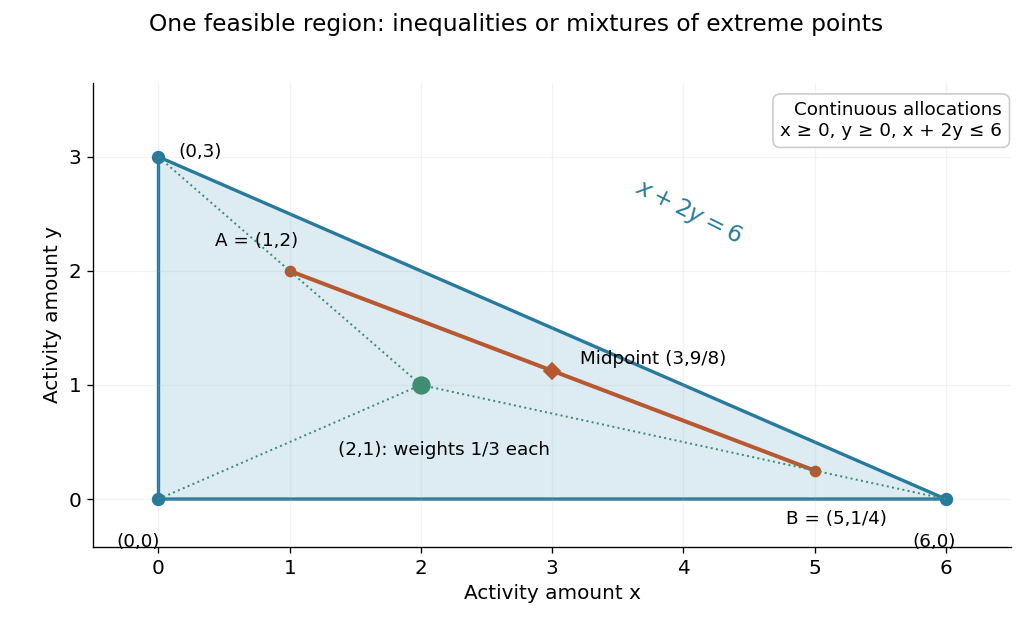
This is useful whenever divisible quantities share linear limits: the feasible choices remain compatible under averaging. A new linear equation also preserves this property, because averaging two identical constraint values gives the same value. The affine subspace and closed half-space viewpoints explain this without requiring a separate argument for every budget.
These methods optimize a smooth loss plus a term with a tractable proximal operator, such as a sparsity regularizer or a convex-set indicator. The basic proximal gradient method combines a gradient step with a proximal step; projected gradient and accelerated variants are related members of the family.
A separation oracle either certifies that a supplied point belongs to a convex feasible set or returns a violated linear inequality whose half-space contains the whole feasible set. Its running time can be small even when the set has exponentially many defining inequalities. Together with rational encoding bounds and an outer bound, this permits polynomial time ellipsoid method feasibility and optimization.
For positive existing stakes and budget , maximizing is equivalent to minimizing . A positive multiplier chosen so that gives the displayed allocation. Each coordinate minimizes on , which proves global optimality by Lagrangian sufficiency theorem. Its active set is ordered by . Zero existing stakes require a separate payoff convention and can cause nonattainment; the positive-stake formula should not be extended through undefined ratios.
A convex body in is a compact convex set with nonempty interior in the ambient Euclidean space. It consequently has positive finite Lebesgue measure. A filled rectangle with positive side lengths and a closed positive-radius Euclidean disk are planar convex bodies. A line segment in has empty ambient interior and is not a convex body under this convention. This is the convention used in the Brunn-Minkowski theorem. [ref]
https://sites.stat.washington.edu/jaw/COURSES/520s/523/HO.523.20/Gardner.BullAMS.02.pdf. Gardner (2002), introduction
Compositional convection is buoyancy-driven motion caused by composition-dependent density variations. In a planetary core, freezing can expel light elements into the surrounding liquid, making that liquid buoyant and supplying mechanical power for a planetary dynamo. It can operate alongside thermally driven convection and release of latent heat.
A stellar convection zone is a region where buoyant fluid motion transports a significant part of the stellar heat flux. Rising and sinking parcels carry enthalpy, so heat transport is not entirely radiative. The Sun's outer convection zone extends from near to the surface and overlies its radiative interior. The tachocline lies near this transition, and the convection helps power the solar dynamo.
An organized region of buoyant rising fluid and compensating descending flow that transports heat or composition. Convection rolls are a simple planar example; solar granules are evolving compressible examples. A cellular pattern does not require every material trajectory to form a closed streamline, especially near a radiating free surface.
An ideal PID controller combines proportional control, integral action, and a term proportional to the derivative of the tracking error. With , it gives proportional-integral control. The integral stores past error, while the derivative responds to its current rate of change. Practical implementations must account for measurement noise, which an ideal differentiator can amplify. [ref]
https://www.fbswiki.org/wiki/index.php/PID_Control. Åström and Murray, PID Control
. Pinned article: Introduction to the OurBigBook Project
Welcome to the OurBigBook Project! Our goal is to create the perfect publishing platform for STEM subjects, and get university-level students to write the best free STEM tutorials ever.
Everyone is welcome to create an account and play with the site: ourbigbook.com/go/register. We belive that students themselves can write amazing tutorials, but teachers are welcome too. You can write about anything you want, it doesn't have to be STEM or even educational. Silly test content is very welcome and you won't be penalized in any way. Just keep it legal!
Intro to OurBigBook
. Source. We have two killer features:
- topics: topics group articles by different users with the same title, e.g. here is the topic for the "Fundamental Theorem of Calculus" ourbigbook.com/go/topic/fundamental-theorem-of-calculusArticles of different users are sorted by upvote within each article page. This feature is a bit like:
- a Wikipedia where each user can have their own version of each article
- a Q&A website like Stack Overflow, where multiple people can give their views on a given topic, and the best ones are sorted by upvote. Except you don't need to wait for someone to ask first, and any topic goes, no matter how narrow or broad
This feature makes it possible for readers to find better explanations of any topic created by other writers. And it allows writers to create an explanation in a place that readers might actually find it.
Figure 1. Screenshot of the "Derivative" topic page. View it live at: ourbigbook.com/go/topic/derivativeVideo 2. OurBigBook Web topics demo. Source. - local editing: you can store all your personal knowledge base content locally in a plaintext markup format that can be edited locally and published either:This way you can be sure that even if OurBigBook.com were to go down one day (which we have no plans to do as it is quite cheap to host!), your content will still be perfectly readable as a static site.
- to OurBigBook.com to get awesome multi-user features like topics and likes
- as HTML files to a static website, which you can host yourself for free on many external providers like GitHub Pages, and remain in full control

Figure 2. You can publish local OurBigBook lightweight markup files to either OurBigBook.com or as a static website.
Figure 3. Visual Studio Code extension installation.
Figure 5. . You can also edit articles on the Web editor without installing anything locally. Video 3. Edit locally and publish demo. Source. This shows editing OurBigBook Markup and publishing it using the Visual Studio Code extension. 
- Infinitely deep tables of contents:



All our software is open source and hosted at: github.com/ourbigbook/ourbigbook
Further documentation can be found at: docs.ourbigbook.com
Feel free to reach our to us for any help or suggestions: docs.ourbigbook.com/#contact