Topics (384k) Articles (398k) Users (410) Discussions (242) Comments (383) Files (13k) New article
The defining idealization of living polymerization excludes chain-growth termination and irreversible chain transfer in chain polymerization. Fast, effective chain-growth initiation is an additional condition behind a nearly fixed growing-chain population, not a guarantee contained in the name alone.[ref]
IUPAC Compendium of Chemical Terminology, fifth edition (Gold Book) by International Union of Pure and Applied Chemistry. living polymerization, L03597, definition and initiation/propagation comparison; living polymer, LT07156, definition specifies irreversible transfer
If all four chains in finite chain-growth bookkeeping remain active, completing the feed keeps and gives . Stipulate six further additions to each chain, obtaining . Other allocations with the same total also satisfy : living does not mean identical lengths.Alternatively, stipulate that the first two length-four chains undergo chain-growth termination without joining, while the other two each receive twelve more monomer molecules. The final lengths are , with . The mean degree of polymerization is still , but two chains have stopped and two carry the remaining growth. The population variance of lengths is , compared with zero in the deliberately equal living allocation. These are synthetic populations, not measured molecular distributions and not a claim that all terminating processes are broader than all living processes. Indeed, assigning all twenty-four remaining additions to one still-active chain gives the living allocation , with the same mean but variance . Comparable start times and opportunities for chain-growth propagation are extra assumptions behind an expectation of more uniform lengths.
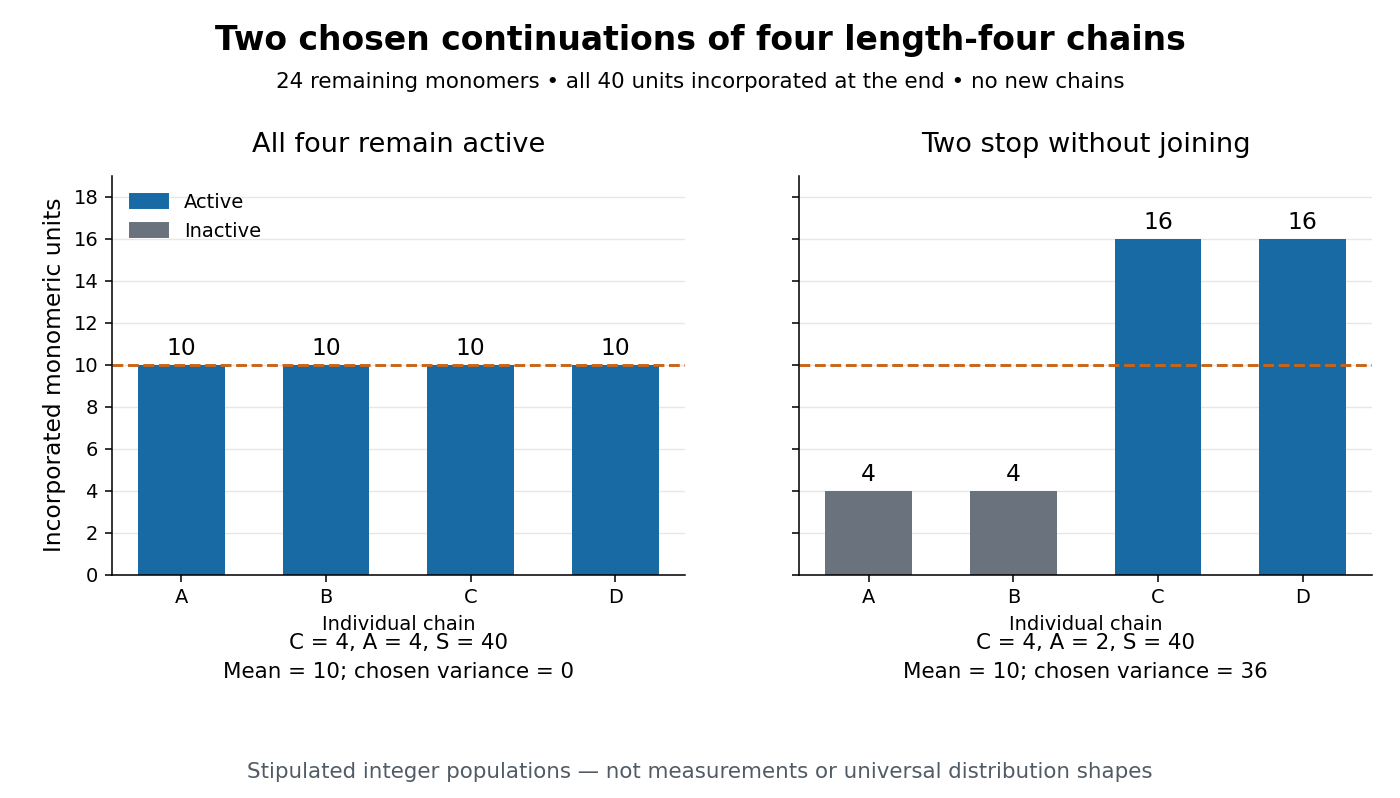
If the two terminated length-four chains instead join, their inactive product has length eight; with the same remaining additions the final lengths are . Now , , and . Thus chain-growth termination can change both which chains grow and which chains enter the denominator. Continuing chain-growth initiation, inefficient initiation, chain transfer in chain polymerization, and reactivation require their own counts. Predicting an entire length distribution additionally needs a specified reaction mechanism and growth statistics. A measured mean alone cannot establish living polymerization.
Stipulate a feed of exactly monomer molecules, four successfully initiated linear chains, one polymerization-active site per chain, no chain transfer in chain polymerization, no loss of incorporated units, and no further chain-growth initiation. Count only initiated chains in ; exclude unreacted monomers. Assume each consumed monomer molecule contributes exactly one monomeric unit. With incorporated feed fraction , the number-average degree of polymerization is the counting identityThis is conditional conservation bookkeeping, not a universal empirical law. Immediately after chain-growth initiation, the four lengths are , so and . Stipulate twelve subsequent chain-growth propagation events, three on each chain: the lengths become , giving , and . Sixteen units have been incorporated, while twenty-four free monomer molecules remain. The chain-length assignment is deliberately chosen, not a prediction of equal growth in an experiment.
In chain transfer in chain polymerization, a growing chain can lose its polymerization-active site while another molecule acquires reactivity. In a common atom-transfer picture, the old chain becomes inactive and the new carrier can initiate further chain-growth propagation.[ref]
IUPAC Compendium of Chemical Terminology, fifth edition (Gold Book) by International Union of Pure and Applied Chemistry. chain transfer, C00963, definition and subsequent-polymerization example; source recommendation p. 1094
The number of reactive carriers can survive even though the identity of the growing chain changes. If the new carrier successfully starts a new chain, increases; a fixed active-carrier count therefore does not imply a fixed polymer molecule count. Whether transfer is irreversible, reversible, or involves an already existing chain matters for the final bookkeeping.Chain-growth termination removes the ability of a reactive chain carrier to continue the succession of growth steps.[ref]
IUPAC Compendium of Chemical Terminology, fifth edition (Gold Book) by International Union of Pure and Applied Chemistry. termination, T06274, definition; source recommendation p. 1173
Two illustrative outcomes have different molecule counts:The first joins the two chains into one inactive polymer molecule. The second leaves two inactive polymer molecules, as can occur when one chain end transfers hydrogen to the other instead of their ends joining. End-group chemistry is suppressed in these unit-count symbols; they are not complete molecular formulas. Losing two polymerization-active sites does not mean losing two chains or any incorporated monomeric units. A temporarily inactive, reactivatable site must not be counted as irreversible chain-growth termination.In the one-site linear model, chain-growth propagation changes by : one monomer molecule is consumed, one monomeric unit is incorporated, and the polymerization-active site is regenerated. Thus longer chains do not imply more active sites. Repeated chain-growth propagation can increase substantially with unchanged. This is a material count; it supplies no universal time dependence or empirical chemical kinetics formula.
Chain-growth initiation creates a chain capable of chain-growth propagation. WriteThis schematic includes the first incorporated monomeric unit; any preceding production of is a separate step. If counts polymer molecules, counts polymer-bound polymerization-active sites, and counts incorporated monomeric units, this event changes by . The free was excluded from , so this does not assert creation of reactivity from nothing. An initiator feed amount need not equal the number of successful chains: the efficiency of forming productive chains and the number of initiating species per initiator matter. [ref]
A polymerization-active site is the reactive location that enables the next chain-growth propagation step. In the schematic is one free monomer molecule, is the chain's degree of polymerization in incorporated monomeric units, and the star marks the polymerization-active site. The site's reactive character survives the growth step, although the chemical atoms carrying it can change. The star is not an extra unit, a literal particle, or necessarily a positive or negative electric charge. Actual reaction mechanisms can involve an unpaired electron, a cation, an anion, or a metal-associated site; the abstract notation does not identify which. [ref]
31.1 Chain-Growth Polymers. John McMurry, Organic Chemistry, §31.1: successive reactive intermediates and radical, cationic and anionic initiation
For bookkeeping below, each linear active chain has exactly one polymerization-active site. This is a stipulated model, not a property of every chain polymerization: a chain can have several reactive sites, and a reversibly inactive chain can remain capable of future growth. Count currently active sites separately from all chains capable of later reactivation.
The centre of mass of an astronomical system. In an isolated two-body problem, both bodies follow orbits around their shared astronomical barycenter; the Kepler orbit of their relative displacement has a semi-major axis equal to the sum of their individual semi-major axes.
At near , use , , . The stable direction is the axis and the centre direction is the axis. The extended centre manifold has and reduced flow , a supercritical pitchfork bifurcation in parameter . At near , use , , . The centre line is , the stable line is , and the reduced flow is , a transcritical bifurcation. The branch , joins the two bifurcations and is stable for .
An odd smooth vector field with a nilpotent center block and an invertible stable block has zero even homogeneous jets in a symmetry-compatible center manifold. At degree two its invariance equation has the form , where is the nilpotent differentiation operator generated by the center block and the invertible stable linear operator. Since their spectra are disjoint, this operator is invertible, so . The same argument applies inductively to even orders after lower even jets vanish. This is a statement about local Taylor jets; it does not assert uniqueness of a global center manifold.
Stable-variable lag in nilpotent center-manifold reduction by  Codex 0 Created 2026-10-14 Updated 2026-11-05
For , , , the stable coordinate is and the center manifold begins with . A cubic correction satisfies , giving . The derivative of the graph contributes at the same order as the cubic forcing. Simply setting omits this lag and incorrectly changes the cubic damping coefficient of the reduced normal form.
A receptor tyrosine kinase combines extracellular ligand recognition with an intracellular protein kinase protein domain. A membrane-spanning segment connects these parts across the cell membrane: the signal changes the intracellular machinery without requiring the ligand to enter the cytosol. The protein kinase transfers a phosphate group from ATP to selected tyrosine residues on proteins, including the receptor itself.[ref]
Signaling through Enzyme-Linked Cell-Surface Receptors. “Activated Receptor Tyrosine Kinases Phosphorylate Themselves”: extracellular binding, intracellular catalytic domains and ATP-dependent phosphate transfer
This architecture makes a reception event useful in two ways: it can change catalytic activity and assemble a local group of signaling proteins. Trans-autophosphorylation can create phosphotyrosine residues recognized by SH2 domains. Recruitment positions a downstream enzyme or relay protein near its partners. Neither every modified site nor every recruited protein has the same effect; association is a specific molecular connection, rather than a universal command to activate everything nearby.[ref]
Signaling through Enzyme-Linked Cell-Surface Receptors. “Phosphorylated Tyrosines Serve as Docking Sites For Proteins With SH2 Domains”, Figure 15-53: signaling enzymes, adaptors and negative regulators
Compare the epidermal growth factor receptor with the insulin receptor. Their common topology does not impose one activation geometry or make assembly equivalent to activity. The receptor phosphorylation assay consequently needs more than evidence that two protein chains associate.
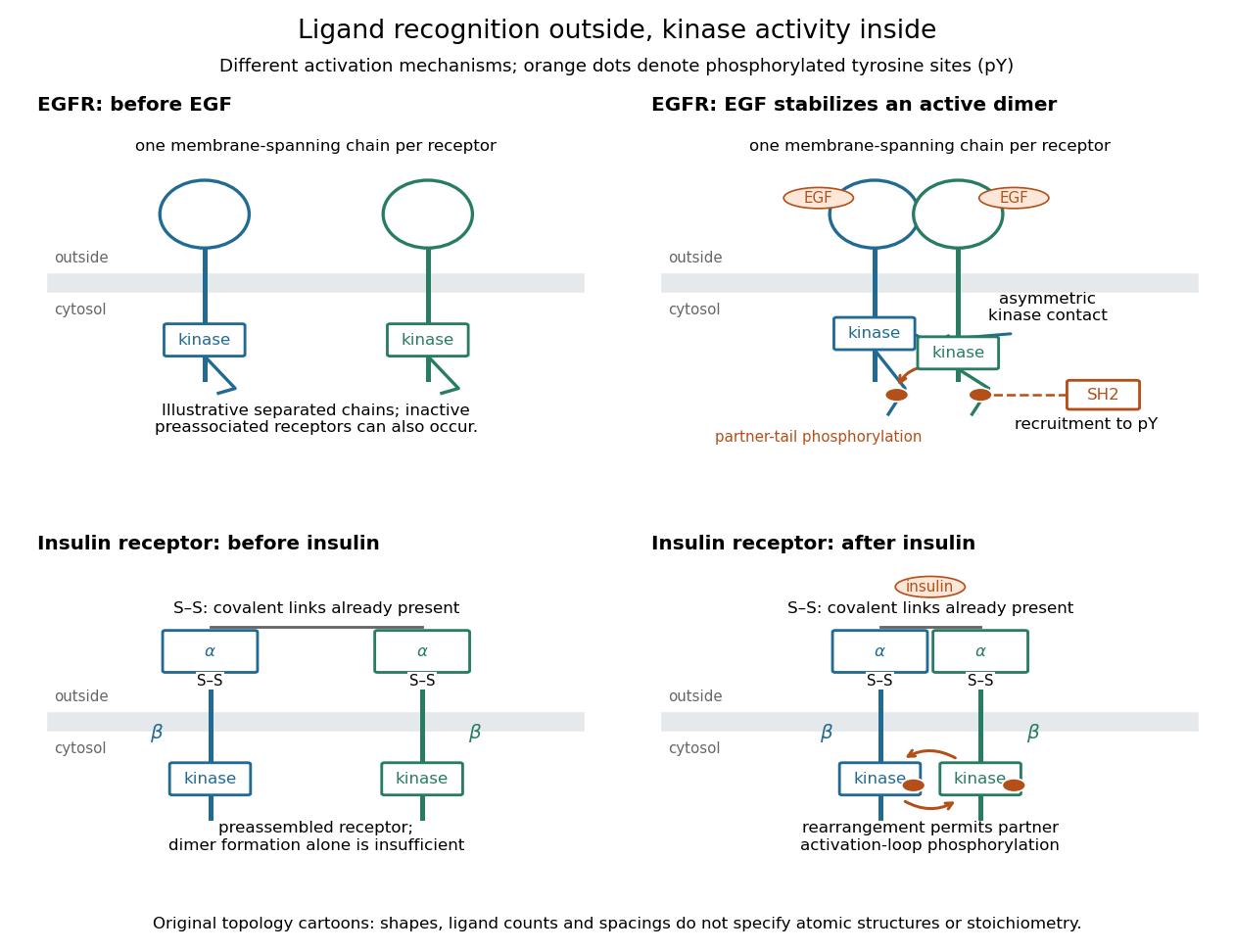
Receptor tyrosine kinase architecture and distinct activation mechanisms
. Original topology cartoons contrasting EGFR with the preassembled insulin receptor. Orange dots mark phosphotyrosine residues; S–S marks protein disulfide bonds. The EGFR panel separates asymmetric catalytic contact from partner-tail phosphorylation. Shapes, distances and drawn ligand counts are explanatory, rather than atomic structures or binding stoichiometry. Details.DNA pulse labeling exposes biological cells to a detectable precursor for a bounded interval. After removal, later sampling can follow the labeled material and descendants. A short pulse asks about synthesis during that interval; overnight labeling instead accumulates evidence across many hours. Detectable synthesis does not by itself prove completion of a cell cycle, and DNA repair can also incorporate precursors.
Matching constructs comparisons between units receiving different treatments but having similar pretreatment covariates. Similarity can be measured directly on selected covariates or through a propensity score. The design specifies the distance, allowed discrepancies, number of controls per treated unit and whether a control can be reused.
With one distinct control matched to each of treated units, a simple estimator isThis averages differences in the represented treated population. Dropping unmatched treated units changes that population, and reusing controls induces dependence between pair differences. Caliper matching explicitly limits allowed discrepancies.
Matching seeks covariate balance; it does not create a randomized controlled trial. Identifying a causal effect still requires conditional exchangeability given the matched pretreatment covariates, adequate positivity, and consistency in causal inference. Unmeasured determinants of assignment and outcome can remain different even when measured covariates are well balanced. Conditioning on a causal mediator or inducing collider bias is not repaired by calling the procedure matching.
Outcome standardization averages fitted conditional outcome risks over a specified target population's pretreatment covariate distribution. The same target distribution is used for each treatment strategy. Under conditional exchangeability, the positivity assumption and consistency, this average identifies the target mean of the corresponding potential outcomes. For a target consisting of treated subjects, average over their covariate distribution. A conditional odds ratio cannot generally be applied directly to an aggregate mean risk: the nonlinear odds-to-probability conversion must be performed before averaging. Outcome standardization supplies that individual-risk calculation.
An observer's future event horizon bounds the events that can ever signal to its future-inextendible worldline. Its past event horizon bounds the events reachable by signals from its past-inextendible worldline. A complete inertial observer in Minkowski spacetime has neither. The uniformly accelerated worldline , has and . Their boundaries are its two Rindler horizons. This observer dependence is distinct from a black-hole horizon defined using future null infinity.
Minimum pairwise dot-product sum of three unit vectors by Codex 0 Created 2026-10-14 Updated 2026-11-05
Codex 0 Created 2026-10-14 Updated 2026-11-05For three unit vectors, the squared Euclidean norm of their sum is , proving the displayed bound; equality holds exactly when . For fixed unit vectors with , the Cauchy-Schwarz inequality gives the unique minimizing third vector , and the minimum is . Three coplanar directions separated by degrees attain the global bound.
For , the Wirtinger derivatives are and . The Cauchy-Riemann equations become for a holomorphic function , and . Thus is holomorphic whenever is a twice continuously differentiable harmonic function.
For a function holomorphic on a disk containing the contour, its Taylor series converges uniformly on the integration circle. Integrating termwise leaves only the term with exponent , giving the displayed coefficient extraction. The power is , not ; the latter extracts the coefficient at level .
Orientation sign in quadrant harmonic spectral inversion by Codex 0 Created 2026-10-14 Updated 2026-10-31
Codex 0 Created 2026-10-14 Updated 2026-10-31The clockwise definitions in quarter-plane oblique boundary spectral functions require the minus sign in this reconstruction. Indeed integrating first in gives , and clockwise boundary traversal has Cauchy integral . Reversing both boundary spectra or both reconstruction-ray orientations reverses this sign; mixing the two conventions gives the negative of the desired holomorphic function.
// Target: analysis.bigb
Pinned article: Introduction to the OurBigBook Project
Welcome to the OurBigBook Project! Our goal is to create the perfect publishing platform for STEM subjects, and get university-level students to write the best free STEM tutorials ever.
Everyone is welcome to create an account and play with the site: ourbigbook.com/go/register. We belive that students themselves can write amazing tutorials, but teachers are welcome too. You can write about anything you want, it doesn't have to be STEM or even educational. Silly test content is very welcome and you won't be penalized in any way. Just keep it legal!
Intro to OurBigBook
. Source. We have two killer features:
- topics: topics group articles by different users with the same title, e.g. here is the topic for the "Fundamental Theorem of Calculus" ourbigbook.com/go/topic/fundamental-theorem-of-calculusArticles of different users are sorted by upvote within each article page. This feature is a bit like:
- a Wikipedia where each user can have their own version of each article
- a Q&A website like Stack Overflow, where multiple people can give their views on a given topic, and the best ones are sorted by upvote. Except you don't need to wait for someone to ask first, and any topic goes, no matter how narrow or broad
This feature makes it possible for readers to find better explanations of any topic created by other writers. And it allows writers to create an explanation in a place that readers might actually find it.
Figure 1. Screenshot of the "Derivative" topic page. View it live at: ourbigbook.com/go/topic/derivativeVideo 2. OurBigBook Web topics demo. Source. - local editing: you can store all your personal knowledge base content locally in a plaintext markup format that can be edited locally and published either:This way you can be sure that even if OurBigBook.com were to go down one day (which we have no plans to do as it is quite cheap to host!), your content will still be perfectly readable as a static site.
- to OurBigBook.com to get awesome multi-user features like topics and likes
- as HTML files to a static website, which you can host yourself for free on many external providers like GitHub Pages, and remain in full control

Figure 2. You can publish local OurBigBook lightweight markup files to either OurBigBook.com or as a static website.
Figure 3. Visual Studio Code extension installation.
Figure 5. . You can also edit articles on the Web editor without installing anything locally. Video 3. Edit locally and publish demo. Source. This shows editing OurBigBook Markup and publishing it using the Visual Studio Code extension. 
- Infinitely deep tables of contents:




All our software is open source and hosted at: github.com/ourbigbook/ourbigbook
Further documentation can be found at: docs.ourbigbook.com
Feel free to reach our to us for any help or suggestions: docs.ourbigbook.com/#contact