Topics (384k) Articles (398k) Users (410) Discussions (242) Comments (383) Files (13k) New article
Crossover interference means that an exchange affects the occurrence of other nearby chromosomal crossovers. The Haldane mapping function assumes this dependence is absent. See Meiosis.
Sister chromatids are the paired chromatids originating from DNA replication of the same chromosome.
A Chern-Simons form is an odd-degree transgression form whose exterior derivative is an invariant polynomial in the curvature form. For the trace polynomial of degree , ; the Chern-Simons 3-form is the degree-three case.
For the vector-bundle curvature matrix of a metric connection on a vector bundle on a real oriented vector bundle, the A-hat form is the even differential form defined by the displayed finite-degree power series, with square root having constant term one. The expression is independent of the choice of orthonormal frame. Equivalently, for formal paired curvature Chern roots , it is . The Bianchi identity makes it closed, and changing the connection changes it by an exact differential form via Chern-Weil connection transgression. Its degree-four part is , where is the first Pontryagin class form.
For a real vector bundle , its Pontryagin classes areThey use the even-index Chern classes of the complexification. An integral qualification matters for direct sums: for the total Pontryagin class,Thus the usual multiplicative formula holds over the rational numbers, over the real numbers, or after discarding elements of order two. It need not hold without qualification in integral cohomology. The missing terms are products of odd Chern classes of complexified real vector bundles, which are annihilated by two.[ref]
For a metric connection on a vector bundle with curvature matrix , a real representative isThe Bianchi identity makes this a closed differential form, and Chern-Weil connection transgression makes its de Rham cohomology class independent of the connection on a vector bundle. This normalization gives the degree-four A-hat form . Curvature representatives record real classes and therefore cannot detect the integral torsion qualification.
For a homogeneous state with linear decay rate , chemical decay , chemical diffusivity and chemotactic coupling , a spatial mode has determinant , where . The trace is negative, so an instability requires . Without a cutoff, the sharp continuous-wavenumber threshold is . With , minimize over that range; its unconstrained minimizer is . Discrete geometries additionally require an actual allowed Laplacian eigenvalue in the open unstable band.
The dilution rate is the fraction of a constant-volume chemostat replaced per unit time: volumetric flow divided by culture volume . For and , . A well-mixed constituent with no source and absent from the feed has concentration , since . Thus is the time for its concentration to fall by a factor , not the time by which all original material has left.
At a positive chemostat steady state, the specific growth rate equals the dilution rate; the biomass concentration stays constant because production balances outflow. For , growth alone would have doubling time , even though the vessel's biomass concentration does not double. Raising the dilution rate beyond causes chemostat washout; comparing it only with misses the nutrient limitation imposed by the feed.
For a dimensionless chemostat with Monod equation kinetics,the total nutrient equivalent satisfies . The positive equilibrium is , , provided and . The Jacobian matrix has eigenvalues and , so the positive equilibrium is locally asymptotically stable.
Chemostat washout means the culture's biomass concentration tends to zero because growth cannot sustain replacement of the cells leaving the vessel. In the ideal Monod equation chemostat with , its equilibrium is . Its Jacobian matrix has eigenvalues and : a small inoculum grows when , whereas chemostat washout is locally asymptotically stable when . For nonnegative initial concentrations, chemostat washout occurs for ; the boundary case also loses biomass asymptotically.
At the positive chemostat steady state meets the chemostat washout equilibrium, and one eigenvalue is zero, so linearization alone does not decide the boundary case. On the invariant nutrient-equivalent balance , small positive obeys : nutrient consumption lowers the specific growth rate below , leading to slow decay rather than a positive biomass concentration. The continued mathematical branches exchange stability in a transcritical bifurcation; the positive-biomass branch becomes physically inadmissible beyond .
A chemostat steady state has constant nutrient concentration and biomass concentration even while nutrient and cells flow through the vessel. It is an equilibrium of the chemostat ordinary differential equations, rather than a culture in which all growth has stopped. Assume and the Monod equation. Setting both derivatives to zero gives the always-existing chemostat washout equilibrium . A positive biomass concentration instead requires growth to balance removal, , whenceThe positive chemostat steady state exists exactly whenThe weaker condition only makes the denominator positive; it does not ensure or . Because the Monod equation is increasing, the feed must permit a specific growth rate greater than . At a positive chemostat steady state, increasing feed nutrient concentration at fixed increases the biomass concentration without changing , within the one-nutrient assumptions.
For a concrete chemostat, let , , and . At ,The nutrient supply minus outflow is , matching nutrient consumption . Biomass production and removal both equal . The chemostat washout threshold is . For example, formally gives and , which cannot describe a physical culture.
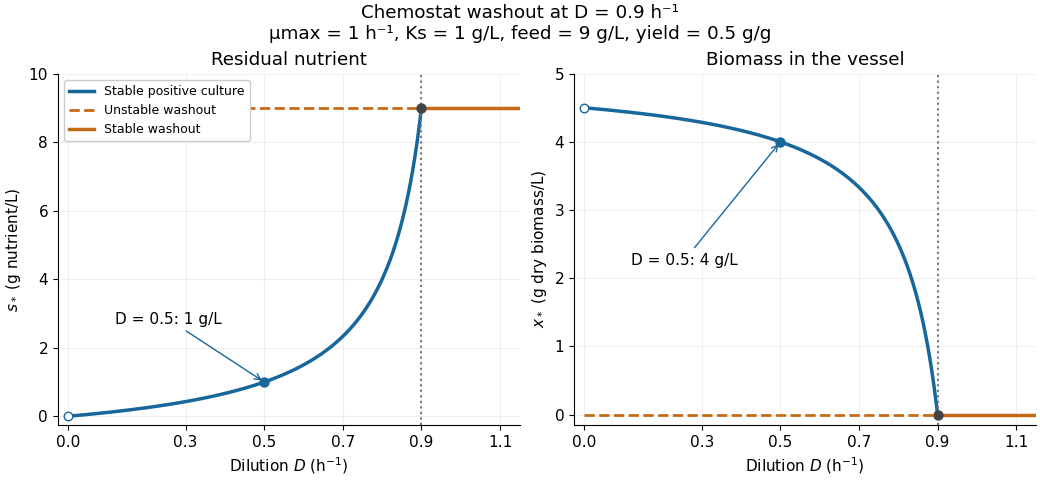
There is a useful exact simplification: the nutrient-equivalent concentration satisfies , so . This combines dissolved nutrient and the nutrient equivalent of biomass; it does not assert that these two variables account for every chemical constituent. In coordinates , the Jacobian matrix at the positive chemostat steady state has eigenvalues and , both negative. Hence the positive chemostat steady state is locally asymptotically stable. In the worked example the eigenvalues are and .
The biomass yield converts nutrient consumption into biomass production: consuming nutrient mass produces dry biomass mass under the assumed constant conversion. For , consumption of of nutrient produces of dry biomass. Its numerical value depends on the measurement conventions; it is not a fraction of all feed mass converted into cells. With no separate maintenance consumption, biomass production requires nutrient consumption in the chemostat balance.
The biomass concentration is the mass of biological material per unit culture volume; here it is measured as dry cell mass in . A biomass concentration differs from a cell count per unit volume because cell sizes can change. In the ideal chemostat, biomass leaves the vessel at rate , giving a removal term in the ordinary differential equation for .
A reaction-rate equation is an ordinary differential equation for continuously varying species concentrations. Under the law of mass action, its reaction rates are monomials in those concentrations.
Equal constant production, individual linear removal, and joint bimolecular removal give . For the unique stable equilibrium is symmetric and solves . For , every point on is an equilibrium: the difference is conserved and trajectories approach the equilibrium on their own constant-difference line.
// Target: mathematical-biology.bigb
Take independent proper normal prior distributions for the two segment means and a proper inverse-gamma distribution for the common variance. A uniform prior distribution over may then retain the empty second segment. The posterior distribution is proper: its likelihood function is bounded above by , whose integral against is finite for . At the second mean has its unchanged proper prior distribution as its full conditional distribution. The configuration's posterior probability now has the meaningful interpretation of no change inside the observed sample.
Poisson count change-point model with gamma priors by  Codex 0 Created 2026-10-14 Updated 2026-11-05
For independent Poisson distributions with rate up to an unknown index and rate after it, independent shape-rate Gamma distribution priors give the displayed posterior distribution when is uniform on and . The model differs from a continuous-time Poisson change-point posterior. The endpoint represents no observed change: the second segment is empty and its rate keeps its prior law.
Living polymerization is chain-growth polymerization without chain termination or irreversible chain transfer. A linear mean degree of polymerization versus feed conversion additionally needs the fixed-chain assumptions in polymerization; reversibility of monomer addition is not required. See Shipp, IUPAC workshop, slide 50.
A simple route to deuterated polystyrene block copolymers by reverse iodine transfer polymerisation by Trevor Gavin Wright and Harald Pasch (2015, Experimental section, pp. 3237–3238) provides a concrete study of consumption and chain products. The authors used a valve-sealed J Young tube, freeze–pump–thaw preparation and argon. NMR monitoring of chain polymerization compared a reference with spectra acquired at every fifteen minutes for twenty-four hours. Their formulation contained an azo initiating reagent, molecular iodine and a vinyl monomer. Companion flask syntheses used stirring and a heated silicone-oil bath.
The authors followed initiating and transfer-agent signals; Figure 3 reports a transfer-agent signal rising during induction and then falling as polymerization proceeds. Their size-exclusion characterization of chain polymers used porous columns, refractive-index detection and polystyrene calibration. These distinct consumption and size readouts concern transfer-mediated chemistry; they do not establish strict living polymerization. [ref]
A simple route to deuterated polystyrene block copolymers by reverse iodine transfer polymerisation by Trevor Gavin Wright and others. Wright and Pasch, pp. 3237–3239: Experimental section, Analyses and Figure 3
Useful proposed controls, rather than reported measurements, are a matched mixture omitting the initiating reagent, an unheated mixture, and a repeat of the complete formulation. Keep monomer amount, solvent, tube preparation and acquisition conditions matched where possible. The unheated comparison needs a readout that does not itself initiate polymerization; placing it in the hot probe would defeat that control. A mixture omitting iodine asks a different question: it changes chain transfer in chain polymerization and induction chemistry, so it is not necessarily a no-polymerization control. Record the pre-reaction baseline and compare crude material with isolated product; isolation can selectively remove shorter chains. These comparisons help separate initiation-dependent monomer consumption from signal drift and unrelated chemical reactions.
The mechanistic inference is deliberately limited. Consumption plus independently characterized larger chain products supports polymerization; evidence of an induction stage helps test a proposed reaction mechanism. Neither readout directly counts stars in , proves the absence of chain-growth termination, nor recovers every chain length. A chain-extension test would probe retained growth capability, but even a successful extension would not by itself establish that all original chains extended. No measured molecular distribution is reconstructed here. IUPAC cautions that reversible deactivation can produce living-like behaviour even when some termination occurs.[ref]
IUPAC Compendium of Chemical Terminology, fifth edition (Gold Book) by International Union of Pure and Applied Chemistry. reversible-deactivation radical polymerization, 08916, notes 2 and 4: living terminology and remaining active/dormant population
Size-exclusion characterization of chain polymers separates dissolved chains using porous columns and records an elution signal. Calibrating that separation against appropriate standards supplies a size-related estimate of molecular masses. Detector response and calibration must accompany any claimed molecular distribution: an elution trace is not automatically a histogram of molecule counts or degree of polymerization. Similar signals can conceal chemically different chain populations, while a shift toward larger apparent size alone does not show that every chain retained a polymerization-active site.
NMR monitoring of chain polymerization uses nuclear magnetic resonance signals to follow monomer and other distinguishable chemical species. In a proton experiment, suitable signal integrals can track changes in their relative amounts. Disappearance of a monomer signal is a consumption readout; it is not a direct count of polymerization-active sites. Overlapping signals, baseline errors and competing chemical reactions can obstruct the inference. A pre-reaction reference and independent product characterization make the consumption interpretation stronger.
Pinned article: Introduction to the OurBigBook Project
Welcome to the OurBigBook Project! Our goal is to create the perfect publishing platform for STEM subjects, and get university-level students to write the best free STEM tutorials ever.
Everyone is welcome to create an account and play with the site: ourbigbook.com/go/register. We belive that students themselves can write amazing tutorials, but teachers are welcome too. You can write about anything you want, it doesn't have to be STEM or even educational. Silly test content is very welcome and you won't be penalized in any way. Just keep it legal!
Intro to OurBigBook
. Source. We have two killer features:
- topics: topics group articles by different users with the same title, e.g. here is the topic for the "Fundamental Theorem of Calculus" ourbigbook.com/go/topic/fundamental-theorem-of-calculusArticles of different users are sorted by upvote within each article page. This feature is a bit like:
- a Wikipedia where each user can have their own version of each article
- a Q&A website like Stack Overflow, where multiple people can give their views on a given topic, and the best ones are sorted by upvote. Except you don't need to wait for someone to ask first, and any topic goes, no matter how narrow or broad
This feature makes it possible for readers to find better explanations of any topic created by other writers. And it allows writers to create an explanation in a place that readers might actually find it.
Figure 1. Screenshot of the "Derivative" topic page. View it live at: ourbigbook.com/go/topic/derivativeVideo 2. OurBigBook Web topics demo. Source. - local editing: you can store all your personal knowledge base content locally in a plaintext markup format that can be edited locally and published either:This way you can be sure that even if OurBigBook.com were to go down one day (which we have no plans to do as it is quite cheap to host!), your content will still be perfectly readable as a static site.
- to OurBigBook.com to get awesome multi-user features like topics and likes
- as HTML files to a static website, which you can host yourself for free on many external providers like GitHub Pages, and remain in full control

Figure 2. You can publish local OurBigBook lightweight markup files to either OurBigBook.com or as a static website.
Figure 3. Visual Studio Code extension installation.
Figure 5. . You can also edit articles on the Web editor without installing anything locally. Video 3. Edit locally and publish demo. Source. This shows editing OurBigBook Markup and publishing it using the Visual Studio Code extension. 
- Infinitely deep tables of contents:



All our software is open source and hosted at: github.com/ourbigbook/ourbigbook
Further documentation can be found at: docs.ourbigbook.com
Feel free to reach our to us for any help or suggestions: docs.ourbigbook.com/#contact