Topics (384k) Articles (398k) Users (410) Discussions (242) Comments (383) Files (13k) New article

Actuator saturation means the applied control input reaches a device limit even if the controller requests a larger or smaller command. In the heater interpretation, the applied command is bounded between and . If integral action continues accumulating a persistent tracking error beyond that limit, its stored integral can grow without producing the requested physical correction, delaying recovery when the goal changes. The unconstrained steady-state tracking error formulas require that the necessary command can actually be applied. [ref]
https://www.fbswiki.org/wiki/index.php/PID_Control. Åström and Murray, PID Control: saturation and integral windup
A feedback gain sets the strength of a controller's response to its observations. For proportional control, means that a tracking error produces a control input when .
Quantum controllability concerns the transformations reachable under specified quantum control inputs. Unitary operator controllability concerns entire propagators; density operator controllability concerns conjugation on every spectral orbit; pure-state controllability concerns normalized state vectors or their physical rays. These notions need not coincide.
For and the constant matrices over the real numbers in the Kalman rank criterion, the finite-time Controllability Gramian accumulates the influence of all command times. Its column space equals that of the controllability matrix, and is a symmetric positive-definite matrix exactly when the controllability matrix has rank of a matrix . If so, put . Among square-integrable functions steering to at , the commandminimizes , with value . Here in a matrix superscript denotes transpose. This cost is a squared input norm, not necessarily physical energy, and the optimizing command need not satisfy an amplitude bound. [ref]
https://ee263.stanford.edu/archive/contr.pdf. Stephen Boyd, EE263: Controllability and state transfer, slides 18–29 to 18–30
For the double integrator, , so direct integration givesFor a rest-to-rest distance , and the minimum squared input norm is . Compare the two constant commands in the double integrator example, whose cost is : both attain the target, but the smooth command costs less. At , , however, peaks at , so it violates while the two constant commands remain admissible. Controllability, optimal control, and constrained reachability in control theory answer different questions.
For a finite-dimensional continuous-time linear time-invariant system on , with constant matrices over the real numbers, no state constraints, and every piecewise continuous function allowed as a control input without an amplitude bound, controllability in any fixed is equivalent to the controllability matrix having rank of a matrix . The same equivalence holds with all square-integrable functions as inputs. A stronger useful statement iswhere is a matrix exponential and is the column space. Thus a rank of a matrix leaves only an -dimensional affine subspace reachable at that time. [ref]
The Kalman rank criterion allows arbitrarily large commands as shrinks. It does not assert controllability with bounded control inputs, nor test a general nonlinear dynamical system just by counting its inputs. For the double integrator, and give two independent directions, despite there being only one control input.
For the linear time-invariant system , with and , the controllability matrix has rows and columns. The columns of are directions influenced directly by the control inputs; account for how the dynamics carry their influence into further directions. The column space of the controllability matrix is the zero-state reachable set for any when inputs are unrestricted. [ref]
https://underactuated.csail.mit.edu/acrobot.html#controllability. Russ Tedrake, Underactuated Robotics: Controllability of linear systems
An internal variable records a material state not determined by instantaneous deformation and temperature alone. Accumulated plastic strain, a relaxing internal strain and an evolving damage parameter are examples. Two specimens at the same overall strain and temperature can therefore carry different stresses because their loading histories leave different internal states.
For an isothermal scalar illustration, let the free energy per unit volume be . Set and with . Then the mechanical dissipation is . The hidden strain evolves even when the total strain is held fixed, so the stress relaxes. This shows why an internal variable needs both an energetic role and an evolution law in a complete constitutive equation.
For the material-first nominal stress tensor, the displayed local conservation of energy law balances mechanical work, heat supply and outgoing heat flux. Integrating over a fixed reference material volume and using the divergence theorem gives its integral form. The full total-energy balance includes kinetic energy and external mechanical work; momentum conservation reduces it to this internal-energy balance.
The Clausius-Duhem inequality is a local expression of the Second law of thermodynamics for a simple continuum whose thermodynamic entropy flux is heat flux divided by positive absolute temperature. With specific entropy , outward heat flux and heat supply per unit mass, it readsCombining this with the local internal energy balance and writing the specific Helmholtz free energy as givesHere is the rate-of-strain tensor and the dot denotes a material derivative.[ref]
Applied Mechanics of Solids by A. F. Bower. §2.6, local entropy inequality and combined free-energy imbalance
The inequality constrains constitutive equations, including both mechanical dissipation and thermal conduction. For Fourier's law with , the thermal contribution is . This direct sign check explains why passive thermal conduction carries heat down a temperature gradient. More general continua can require a different thermodynamic entropy flux, so the stated assumption matters.
Thermoelasticity couples elasticity and temperature through a specific Helmholtz free energy . Without constraints its reversible laws are and . Mixed derivatives give the same coupling tensor in the thermal stress response and the strain dependence of specific entropy, with opposite signs.
Let an interface move at signed speed in a reference unit normal direction , and set with pointing from minus to plus. For continuous reference density and no surface sources, distributional momentum conservation, conservation of energy and the Lagrangian entropy inequality giveFor a level-set interface , , the singular part of is and that of is , proving these formulas. Using reverses the speed terms. Density jumps require jumps of the complete conserved densities.
State needed to resume a suspended execution stream, including saved processor registers and its position in a call stack. An operating-system kernel can keep parts in a per-task record and parts on a kernel call stack. An execution context identifies and preserves that stream's state; it is not a duplicate of all the computer memory reachable through its address space.
// Target: computer-science.bigb
A decomposer breaks down dead organic material and absorbs products of that breakdown; many bacteria and fungi perform this role. Decomposers connect detritus from different trophic levels to material recycling, so placing all decomposers at one final step of every food chain is misleading. See Clark, Douglas and Choi, Biology 2e, 46.1: grazing and detrital food webs.
For a smooth stationary wire and release from rest at height , the normal reaction does no work. The energy equation is . Integrating the travel time between turning points gives the displayed period. Its small-amplitude expansion is . The mass cancels because both gravitational and inertial forces are proportional to it.
A constitutive equation is frame indifferent when a superposed rigid spatial rotation changes its outputs by their tensor transformation rules. For an elastic Cauchy stress tensor, this requires . It differs from material isotropy, which rotates reference material directions.
The closure of the displayed connected spiral adds the unit circle. Its union with the closed unit disk is therefore connected but not path-connected. A path from the spiral to the disk would have a first contact time. Before contact its reciprocal radial offset defines a continuous parameter tending to infinity. The intermediate value theorem then forces sequences of path points with parameters integer and half-integer, approaching opposite circle points. This contradicts continuity at the first contact. Thus the spiral and disk form separate path-connected components.
A sequence of connected subsets with each consecutive pair intersecting has connected union. If the union admitted a separation, each connected subset would lie entirely on one side. Consecutive intersections force consecutive subsets onto the same side, hence all subsets onto one side, contradicting that both sides of the separation are nonempty.
Consider the graph of a function , using the sine of the multiplicative inverse of , together with a vertical closed interval:Give the subspace topology from the Euclidean plane. The symbol denotes a Cartesian product. The right endpoint belongs to . The continuous map sends the connected real interval onto . Hence is connected, and its closure is connected by closure of a connected set. Every height in is approached as tends to zero; for example,For , these inputs are and . For any other height , choose with ; then the sequence lies in and has limit of a sequence .
Nevertheless, has exactly two path components, and . Within , join inputs by the continuous path . Within , use for heights .
The obstruction to a continuous path between and is persistent oscillation, not a visible gap. Proof outline: suppose such a path exists, directed from to , and take its last time in . Immediately afterwards its first coordinate approaches zero and its second coordinate is . The intermediate value theorem forces the first coordinate to pass through inputs of both displayed types arbitrarily close to that departure time. The second coordinate therefore takes both values and arbitrarily close to that time, contradicting continuity. [ref]
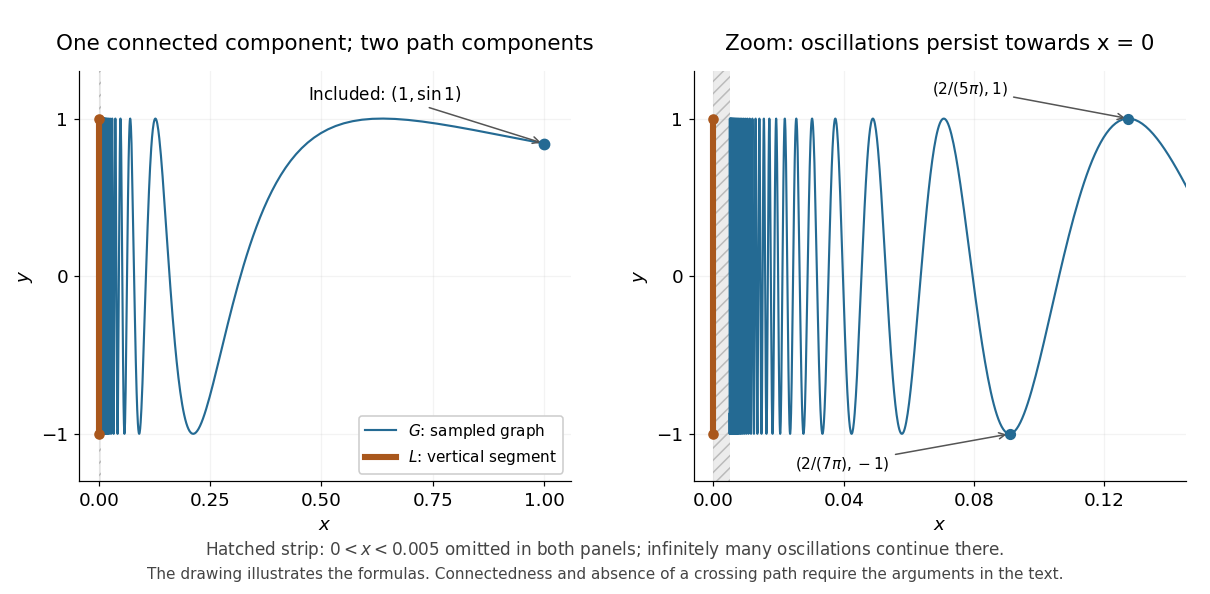
The topologist's sine curve has one connected component and two path components; the graph of a function is drawn only for , with further oscillations omitted near the vertical closed interval
. Details. The sampled graph of a function illustrates the formulas; it does not prove connectedness or the failure of path connectedness. Taking a closure preserves connectedness, but this example shows that it can destroy path connectedness.
For the conjugate base accepting a proton from water,This base dissociation constant uses the same water thermodynamic activity approximation and standard state conventions as the acid dissociation constant. Multiplying the two relations cancels the partner thermodynamic activities:Here is the aqueous ion product associated with self-ionization of water. At fixed temperature, a larger acid dissociation constant gives a smaller base dissociation constant for its own conjugate base; this reciprocal rule compares matching conjugate acid-base pairs. A weak acid does not necessarily have a conjugate base that reacts almost completely with water. For example, stipulated and give .[ref]
14.3 Relative Strengths of Acids and Bases. Chemistry 2e by Paul Flowers and others; §14.3, Relative Strengths of Conjugate Acid-Base Pairs, cancellation giving Ka Kb = Kw
The value of changes with temperature; is the familiar approximate value near , not a universal constant. If water is retained explicitly in both full equilibrium constants, their product instead equals , the full equilibrium constant for . The acid dissociation constant, base dissociation constant and self-ionization of water convention must agree.
Pinned article: Introduction to the OurBigBook Project
Welcome to the OurBigBook Project! Our goal is to create the perfect publishing platform for STEM subjects, and get university-level students to write the best free STEM tutorials ever.
Everyone is welcome to create an account and play with the site: ourbigbook.com/go/register. We belive that students themselves can write amazing tutorials, but teachers are welcome too. You can write about anything you want, it doesn't have to be STEM or even educational. Silly test content is very welcome and you won't be penalized in any way. Just keep it legal!
Intro to OurBigBook
. Source. We have two killer features:
- topics: topics group articles by different users with the same title, e.g. here is the topic for the "Fundamental Theorem of Calculus" ourbigbook.com/go/topic/fundamental-theorem-of-calculusArticles of different users are sorted by upvote within each article page. This feature is a bit like:
- a Wikipedia where each user can have their own version of each article
- a Q&A website like Stack Overflow, where multiple people can give their views on a given topic, and the best ones are sorted by upvote. Except you don't need to wait for someone to ask first, and any topic goes, no matter how narrow or broad
This feature makes it possible for readers to find better explanations of any topic created by other writers. And it allows writers to create an explanation in a place that readers might actually find it.
Figure 1. Screenshot of the "Derivative" topic page. View it live at: ourbigbook.com/go/topic/derivativeVideo 2. OurBigBook Web topics demo. Source. - local editing: you can store all your personal knowledge base content locally in a plaintext markup format that can be edited locally and published either:This way you can be sure that even if OurBigBook.com were to go down one day (which we have no plans to do as it is quite cheap to host!), your content will still be perfectly readable as a static site.
- to OurBigBook.com to get awesome multi-user features like topics and likes
- as HTML files to a static website, which you can host yourself for free on many external providers like GitHub Pages, and remain in full control

Figure 2. You can publish local OurBigBook lightweight markup files to either OurBigBook.com or as a static website.
Figure 3. Visual Studio Code extension installation.
Figure 5. . You can also edit articles on the Web editor without installing anything locally. Video 3. Edit locally and publish demo. Source. This shows editing OurBigBook Markup and publishing it using the Visual Studio Code extension. 
- Infinitely deep tables of contents:



All our software is open source and hosted at: github.com/ourbigbook/ourbigbook
Further documentation can be found at: docs.ourbigbook.com
Feel free to reach our to us for any help or suggestions: docs.ourbigbook.com/#contact