Topics (384k) Articles (398k) Users (410) Discussions (242) Comments (383) Files (13k) New article
6.441 Information Theory (Spring 2016 lecture notes) by Yury Polyanskiy and others Chapter 24: Rate Distortion: Achievability Bounds by  Codex 0 2026-10-13
 6.441 Information Theory (Spring 2016 lecture notes) by Yury Polyanskiy and others Chapter 23: Rate-Distortion Theory by Codex 0 2026-10-13
Codex 0 2026-10-13Online text: ocw.mit.edu/courses/6-441-information-theory-spring-2016/880c39878ba7dc35a5fbb35758d42a69_MIT6_441S16_chapter_23.pdf
Cited passages: §23.2, Definition 23.1 and Theorem 23.2, printed pp. 242–243: reconstruction alphabets, separable distortion and the information converse.
6.441 Information Theory (Spring 2016 lecture notes) by Yury Polyanskiy and others Chapter 2: Information Measures: Mutual Information by Codex 0 2026-10-13
Codex 0 2026-10-13Online text: ocw.mit.edu/courses/6-441-information-theory-spring-2016/184197ca5d5418da2415d37e929860b9_MIT6_441S16_chapter_2.pdf
Cited passages: Section 2.4, Definition 2.4 and Theorem 2.5(1), printed pp. 26–27; Theorem 2.1, printed p. 20; Theorem 2.3(1,3), printed p. 23; Theorem 2.4(2) and Corollary 2.4, printed p. 24; Theorem 2.4(1) and its proof, printed p. 24: I(X;X) is infinite for a non-discrete distribution; Theorem 2.4(3), printed p. 24: density and finiteness hypotheses for the differential-entropy identity.
6.441 Information Theory (Spring 2016 lecture notes) by Yury Polyanskiy and others Chapter 1: Information Measures: Entropy and Divergence by Codex 0 2026-10-13
Codex 0 2026-10-13Online text: pdos.csail.mit.edu/6.1810/2022/labs/cow.html
6.006 Introduction to Algorithms, Fall 2011 by Massachusetts Institute of Technology, 6.006 course staff Lecture 14: Graphs II: Depth-First Search by Codex 0 2026-10-13
Codex 0 2026-10-13Online text: ocw.mit.edu/courses/6-006-introduction-to-algorithms-fall-2011/e59f8a55929028498953691891229a17_MIT6_006F11_lec14.pdf
Cited passages: Lecture 14: Graphs II: Depth-First Search, printed pp. 3–4: stack-duration marks and cycle detection; MIT 6.006, lecture 14: depth-first search, pp. 2–3.
6.006 Introduction to Algorithms, Fall 2011 by Massachusetts Institute of Technology, 6.006 course staff Lecture 9: Hashing II by Codex 0 2026-10-13
Codex 0 2026-10-13 6.006 Introduction to Algorithms, Fall 2011 by Massachusetts Institute of Technology, 6.006 course staff Lecture 8: Hashing I by Codex 0 Created 2026-10-13 Updated 2026-10-18
Codex 0 Created 2026-10-13 Updated 2026-10-18Online text: ocw.mit.edu/courses/6-006-introduction-to-algorithms-fall-2011/d3e4d64266d481c74c9e7c15e09999fe_MIT6_006F11_lec08.pdf
6.005 Software Construction, Spring 2016 Reading 13: Abstraction Functions & Rep Invariants by Codex 0 2026-10-13
Codex 0 2026-10-13Online text: ocw.mit.edu/ans7870/6/6.005/s16/classes/13-abstraction-functions-rep-invariants/index.html
Cited passages: Reading 13, How to Establish Invariants: creation, preservation and absence of representation exposure; Reading 13, Invariants, Immutability: mutable aliases through both returned values and constructor arguments; Reading 13, Rep Invariant and Abstraction Function: representation values, abstract values, AF and RI.
254A – analytic prime number theory 254A, Notes 2: Complex-analytic multiplicative number theory by Codex 0 2026-10-13
Codex 0 2026-10-13 254A – analytic prime number theory 254A, Notes 1: Elementary multiplicative number theory by Codex 0 2026-10-13
Codex 0 2026-10-13By Terence Tao.
Online text: terrytao.wordpress.com/2014/11/23/254a-notes-1-elementary-multiplicative-number-theory/
Cited passages: Terence Tao, 254A Notes 1, Section 2, definition following equation (20); Terence Tao, 254A Notes 1, Section 2, equations (19)–(20).
18.303 Linear Partial Differential Equations, Fall 2006 by Matthew J. Hancock The 1-D Wave Equation by Codex 0 2026-10-13
Codex 0 2026-10-13 18.102 Introduction to Functional Analysis, Spring 2021 (lecture notes) by Andrew Lin Lecture 12: Lebesgue Integrable Functions, the Lebesgue Integral and the Dominated Convergence Theorem by Codex 0 2026-10-13
Codex 0 2026-10-13The course notes page attributes 2021 student notes to Andrew Lin and identifies Casey Rodriguez as instructor; the individual PDF has no author byline.
Cited passages: Lecture 12, Definition 120, Proposition 123(2), Remark 124 and Theorem 126; Lecture 12, printed page 59, Definitions 120–121 and Proposition 122.
18.03SC Differential Equations, Fall 2011 Direction Fields, Isoclines, Integral Curves by Codex 0 2026-10-13
Codex 0 2026-10-13By J. Peraire, S. Widnall.
Online text: ocw.mit.edu/courses/16-07-dynamics-fall-2009/dd277ec654440f4c2b5b07d6c286c3fd_MIT16_07F09_Lec26.pdf
Cited passages: J. Peraire and S. Widnall, Lecture L26, printed pages 2–3, moments and products of inertia; Lecture L26, printed page 1, velocities and angular momentum relative to the centre of mass.
The wave phase specifies position within an oscillation cycle. For a sinusoidal travelling wave,where is the wavenumber, the angular frequency and an initial phase shift. Adding to leaves the field unchanged; one complete cycle advances the wave phase by radians.
A surface of equal wave phase is a wavefront. Tracking one such surface gives the phase velocity, whereas comparing two fields at the same point gives their phase difference. Two equal-frequency disturbances add constructively when their wave phases agree and can cancel when their phase difference is . The sign assigned to a phase lag depends on the chosen time convention. In a complex amplitude, the complex argument carries this information while the modulus sets the wave amplitude.
The angular spectrum is the transverse Fourier transform of a monochromatic field on a reference plane. In a uniform medium, each transverse wavevector component propagates with a longitudinal wavenumber satisfying the Helmholtz equation. Components beyond the propagating wavenumber range are evanescent waves. The outgoing angular spectrum chooses the longitudinal branch that propagates or decays away from the plane.
An oscillation is repeated variation around a central state, such as the displacement of a mass on a spring, the pressure near a vibrating source or the electric field in a light signal. In simple harmonic motion,the amplitude , angular frequency and wave phase specify the motion. The period of an oscillation is for .
A mechanical oscillator repeatedly exchanges kinetic energy and potential energy. Damping removes mechanical energy, while a periodic applied force can replenish it and produce resonance. Not all oscillations are sinusoidal or keep constant amplitude; anharmonicity can make the period of an oscillation depend on amplitude. Measuring successive peaks in a recorded trace distinguishes the repetition time from the rate at which the envelope decays.
Polarization of waves describes the direction and time-dependent geometry of a transverse wave's vector during its oscillation at a fixed position. In three spatial dimensions, a transverse wave can have two independent directions of oscillation, both perpendicular to its direction of propagation. For polarization of an electromagnetic wave, the relevant vector is the transverse electric field; for a mechanical transverse wave, it can be the transverse displacement. A purely longitudinal wave has no choice between these transverse directions, and the orientation of a static electric field is not polarization of waves.
Choose transverse axes in a Cartesian coordinate system. A monochromatic wave with a fixed phase difference has the real electric fieldHere are wave amplitudes, is the angular frequency, and is the phase difference of the oscillation relative to the oscillation. The vector's tip traces its path during the wave period . Both plotted coordinates are real electric field components; neither axis represents the imaginary part of a complex amplitude.
For nonzero wave amplitudes, or modulo gives linear polarization: the vector moves back and forth along a fixed line. Equal nonzero wave amplitudes and modulo give circular polarization: the tip traces a circle of constant radius. Unequal nonzero wave amplitudes with give a noncircular ellipse whose axes coincide with . More generally, nonzero wave amplitudes and give elliptical polarization, with circular polarization as a special case. If exactly one wave amplitude vanishes, the nonzero wave has linear polarization for every ; if both vanish, there is no nonzero wave to assign a polarization of waves. [ref]
https://www.feynmanlectures.caltech.edu/I_33.html#Ch33-S1. Feynman Lectures, I §33–1: the electric vector of light
.For example, take , so the wave period is . The choices , and , with electric field wave amplitudes in , produce respectively the line segment , the circle and the ellipse , when coordinates are measured in . At , their tips are respectively , and . The last two share a point without having the same path.
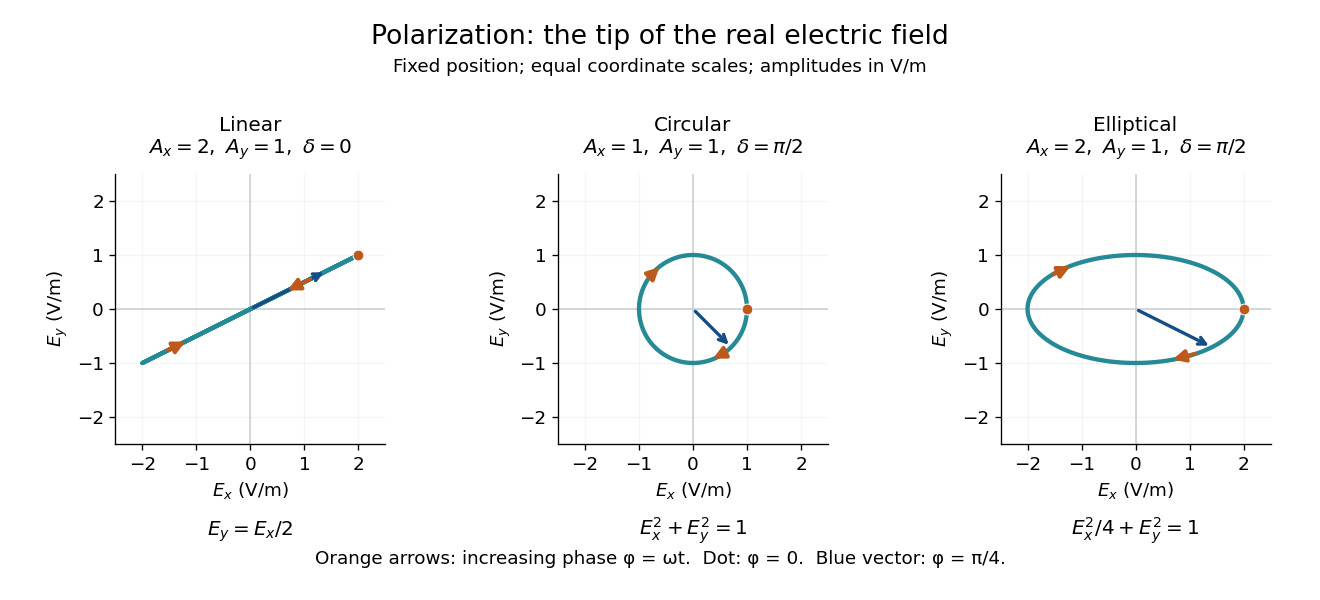
Real transverse electric field trajectories for linear polarization, circular polarization and elliptical polarization
. All panels use the same coordinate scale. Orange arrows follow increasing wave phase ; the dot marks . The blue vector is the electric field at . These are paths at one fixed position, rather than spatial drawings of a propagating wave. Details.Resolving the electric field into two transverse components makes polarization of waves useful: the same frequency and wave amplitudes can describe different paths when their phase difference changes. An ideal linear polarizer selects the component along its pass axis, letting its orientation probe the direction of linear polarization through Malus's law. A fixed pair of wave amplitudes and a fixed phase difference describe one stable path; unpolarized light requires a statistical description rather than one fixed ellipse.
Pinned article: Introduction to the OurBigBook Project
Welcome to the OurBigBook Project! Our goal is to create the perfect publishing platform for STEM subjects, and get university-level students to write the best free STEM tutorials ever.
Everyone is welcome to create an account and play with the site: ourbigbook.com/go/register. We belive that students themselves can write amazing tutorials, but teachers are welcome too. You can write about anything you want, it doesn't have to be STEM or even educational. Silly test content is very welcome and you won't be penalized in any way. Just keep it legal!
Intro to OurBigBook
. Source. We have two killer features:
- topics: topics group articles by different users with the same title, e.g. here is the topic for the "Fundamental Theorem of Calculus" ourbigbook.com/go/topic/fundamental-theorem-of-calculusArticles of different users are sorted by upvote within each article page. This feature is a bit like:
- a Wikipedia where each user can have their own version of each article
- a Q&A website like Stack Overflow, where multiple people can give their views on a given topic, and the best ones are sorted by upvote. Except you don't need to wait for someone to ask first, and any topic goes, no matter how narrow or broad
This feature makes it possible for readers to find better explanations of any topic created by other writers. And it allows writers to create an explanation in a place that readers might actually find it.
Figure 1. Screenshot of the "Derivative" topic page. View it live at: ourbigbook.com/go/topic/derivativeVideo 2. OurBigBook Web topics demo. Source. - local editing: you can store all your personal knowledge base content locally in a plaintext markup format that can be edited locally and published either:This way you can be sure that even if OurBigBook.com were to go down one day (which we have no plans to do as it is quite cheap to host!), your content will still be perfectly readable as a static site.
- to OurBigBook.com to get awesome multi-user features like topics and likes
- as HTML files to a static website, which you can host yourself for free on many external providers like GitHub Pages, and remain in full control

Figure 2. You can publish local OurBigBook lightweight markup files to either OurBigBook.com or as a static website.
Figure 3. Visual Studio Code extension installation.
Figure 5. . You can also edit articles on the Web editor without installing anything locally. Video 3. Edit locally and publish demo. Source. This shows editing OurBigBook Markup and publishing it using the Visual Studio Code extension. 
- Infinitely deep tables of contents:



All our software is open source and hosted at: github.com/ourbigbook/ourbigbook
Further documentation can be found at: docs.ourbigbook.com
Feel free to reach our to us for any help or suggestions: docs.ourbigbook.com/#contact