Topics (384k) Articles (398k) Users (410) Discussions (242) Comments (383) Files (13k) New article

Wave intensity is the time-averaged power carried through unit area perpendicular to the transport direction. It has SI units . For a uniform beam carrying power through a perpendicular area , ; a nonuniform beam instead requires integration of its local energy flux.
For a progressive plane acoustic wave in a lossless fluid,where is the peak pressure amplitude, its root mean square, the mean mass density and the speed of sound. Doubling the wave amplitude therefore quadruples the wave intensity in the same medium. A standing wave can have large local pressure amplitude with zero net averaged sound intensity, so the progressive-wave formula must not be applied to an arbitrary field.
A monochromatic wave has one angular frequency , so its physical field can be writtenThe spatial complex amplitude contains the local wave amplitude and wave phase. It can describe a travelling wave, a standing wave, or a more complicated pattern: a single temporal frequency does not require a single propagation direction.
Exact monochromaticity is an infinite-duration idealization. A finite pulse has a nonzero bandwidth, while a sufficiently long, stable tone can be treated as approximately monochromatic over a measurement interval. This idealization is powerful because linear, time-independent equations can be solved separately at each frequency and the results recombined by a Fourier transform. A monochromatic wave is therefore a building block for broadband signals as well as a useful approximation to narrowband illumination.
A longitudinal wave has oscillating displacement parallel to its propagation direction. Push and pull one end of a long spring along its axis: compressed and expanded regions travel along the spring while individual turns move back and forth. In a small-amplitude acoustic wave in a uniform fluid, the corresponding pressure and mass density variations drive neighbouring fluid elements through pressure gradients.
For a plane acoustic wave, can describe the particle velocity along . The separation between a particle's small excursion and the distance travelled by the disturbance is essential: the speed of sound is the propagation rate, not the particle velocity. Compressional waves in an solid with elasticity provide another example; their speed depends on both the bulk modulus and resistance to shear strain. A longitudinal polarization leaves no independent choice of transverse direction of the kind available to a transverse wave.
A transverse wave has an oscillating vector perpendicular to its direction of propagation. For a mechanical string running along , a small displacement is transverse. A succession of transverse forces from the tension accelerates neighbouring string elements, carrying the disturbance along the string. Their motion is across the string while the pattern travels along it.
A plane electromagnetic wave in vacuum also has transverse electric field and magnetic field. Two independent transverse directions permit different wave polarizations, including linear polarization and circular polarization. A fluid's ordinary bulk acoustic wave is instead a longitudinal wave. A water-surface gravity wave generally combines vertical and horizontal particle motion, so its visible vertical motion alone does not make the full motion purely transverse. Marking one position on a string and filming a passing pulse makes the distinction between particle motion and pattern motion directly visible.
On , use reduced representations of rational numbers with positive denominator. This reverses the nonzero values of the Thomae function, while leaving its values at irrational numbers zero. Every interval of positive length contains rational numbers of arbitrarily large reduced denominator: there are only finitely many fractions in with denominator at most a fixed , whereas any open interval contains infinitely many rational numbers. Thus this function taking finite real number values is unbounded on every nondegenerate subinterval.
An enthalpy of solution is an enthalpy difference for dissolution into a specified solvent at stated temperature and final concentration. Keep a measured finite-dilution value distinct from an infinite-dilution reference value.
An enthalpy of atomization is the enthalpy change for making one mole of separated gaseous chemical atoms from a specified starting chemical substance. For sodium, the relevant step is sublimation to monatomic gas; for diatomic chlorine, it is half the compatible molar bond-dissociation energy expressed as an enthalpy.
The standard enthalpy of formation is the enthalpy change for forming one mole of a specified chemical substance from its chemical elements in their reference states at the stated temperature. For sodium chloride at , those reactant states are solid sodium and diatomic gaseous chlorine. Standard state specifies conditions; it does not by itself select a temperature.
Hess's law states that compatible chemical reaction enthalpies add when their equations add. Reversing a chemical reaction reverses its enthalpy change; multiplying the entire chemical reaction equation by a factor multiplies that change by the same factor. The reason is that enthalpy is a state function: intermediate states cancel from the differences. A cycle supplies one independent balance relation; it cannot determine two unknown inputs without further information.
The law is named after Germain Henri Hess.
For specified initial and final thermodynamic states, the change is . Because enthalpy is an extensive variable, a quoted reaction belongs to the amount of substance specified for each species in its chemical equation. Reversing the equation changes the sign; scaling every coefficient scales ; adding compatible equations adds their values. A per-mole value must say which chemical equation and normalization it uses. Match temperature, pressure, thermodynamic phases, chemical solution compositions and reference states before cancellation; the same formula in a gas and a liquid represents different states.[ref]
The value of Hess's law is that an inaccessible reaction enthalpy can be obtained from measurable transformations. The algebra does not require those transformations to be steps of the actual reaction mechanism. Neither an activation energy nor a reaction rate follows from the endpoint difference: a catalyst may change the reaction rate while preserving the compatible initial and final enthalpies.
A species is a named unit of biological classification. The useful criteria vary among groups: reproductive compatibility can inform classification in many animals, while microbial comparisons also use genomes and other characters. Escherichia coli is a species; K-12 MG1655 identifies a particular strain within it. See OpenStax Biology 2e, 18.2: species concepts.
A biological domain is a high-level rank used to classify organisms in the three-domain system. Distinguish a taxonomic rank from a primary branch in an inferred phylogenetic tree: retaining familiar names does not settle the branching relationships.
The International System of Units defines a common system for expressing physical quantities. Its base units include the kelvin for thermodynamic temperature; derived units combine them to describe quantities such as force and energy.[ref]
Invariance of an action, equation or configuration under a translation. For a continuous spatial translation symmetry, Noether's theorem supplies the conserved momentum; spacetime translation gives the canonical stress-energy tensor.
In a Fischer projection, each cross represents a carbon position: horizontal chemical bonds point toward the viewer and vertical chemical bonds point away. For the open-chain aldehyde sugars illustrated here, place at the top and at the bottom. This is a convention for stereochemistry, not a measured molecular shape. See Moss, IUPAC Recommendations 1996: Fischer projection.
In these Fischer projections, D specifies that the hydroxy group at the lowest stereocenter lies on the right: C4 for ribose and deoxyribose, C5 for glucose. D does not specify every other stereocenter, and it does not specify the direction of rotation of polarized light. See McMurry: the meaning of D and L.
At a stereocenter, exchanging two attached groups produces a different spatial configuration. The open-chain ribose and glucose examples have carbon stereocenters bearing four different groups; C2 of deoxyribose has two identical hydrogen substituents and is not a stereocenter. See Moss, Basic Terminology of Stereochemistry, IUPAC Recommendations 1996: stereogenic units.
Chirality means that a molecule cannot be superposed on its mirror image. A carbon attached to four different groups is a common source of chirality; the definition concerns the whole molecule, rather than requiring this particular structural feature.
The test is spatial: apply a translation and a rotation to the entire molecule until corresponding chemical atoms coincide, keeping their identities and chemical bonds. A mirror operation is a reflection; physically turning a model is a rotation. They are different operations. If no such superposition exists, the two forms are enantiomers; if one succeeds, the molecule is achiral. A different-looking flat drawing alone establishes neither conclusion.
For a simple molecule with exactly one tetrahedral stereocenter and four constitutionally different substituents, the mirror forms cannot superpose. Compare entire attached groups, including paths around a ring, rather than just the first chemical atom. Several tetrahedral stereocenters require a whole-molecule check: a meso compound can be achiral. Conversely, axial chirality needs no tetrahedral stereocenter.[ref]
5.2 The Reason for Handedness in Molecules: Chirality. McMurry, Organic Chemistry, §5.2: whole-molecule chirality, four different groups and equivalent ring paths
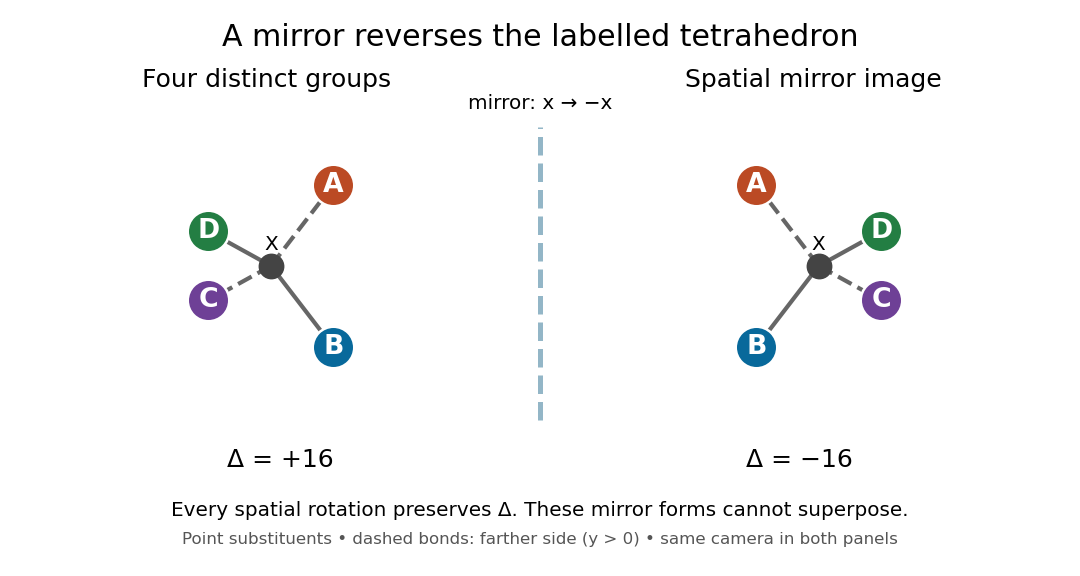
Why care about this distinction? Two enantiomers can fit differently into an already chiral molecule, just as two opposite hands fit differently into one glove. Thus a protein's spatial arrangement can distinguish a mirror pair even when an achiral measurement cannot. Polarimetry provides a different kind of test: it measures a sample's net optical rotation, which depends on the populations of its enantiomers.
An addressed entry of a spreadsheet, such as
A1. Here it stores either a literal numerical input or a spreadsheet formula; its current value is distinct from the stored formula. A cached cell value records a previously computed value, not an instruction to compute it again.In a spreadsheet tabular model,
D2 can store =C2*(1+$F$1) while displaying 9. The spreadsheet cell reference D2 identifies the location, the spreadsheet formula describes the calculation, and 9 is the value obtained from the present inputs. Keeping those three ideas distinct makes copying and checking a model much easier.Evaluate numeric formula dependencies using depth-first search and memoization, or a topological ordering. Marking active evaluations detects cycles; repeated numerical sweeps need not terminate or determine a unique result.
A spreadsheet dependency graph turns a page of spreadsheet formulas into a plan: compute each prerequisite before the spreadsheet cell that consumes it. This section uses a deliberately small model with explicit cell references, fixed spreadsheet formulas, and deterministic computation from numerical inputs. There are no external data changes or formulas that change their references while running. Within these assumptions, a topological order gives a reproducible answer without repeatedly sweeping the visible grid.
Take two input spreadsheet cells and five spreadsheet formulas:
| Spreadsheet cell | Stored input or spreadsheet formula | Initial value | Value after changing A1 to 5 |
|---|---|---|---|
A1 | 3, later 5 | ||
A2 | 4 | ||
B1 | =A1+A2 | ||
B2 | =2*A1 | ||
C1 | =B1+B2 | ||
D1 | =C1/2 | ||
E1 | =A2^2 |
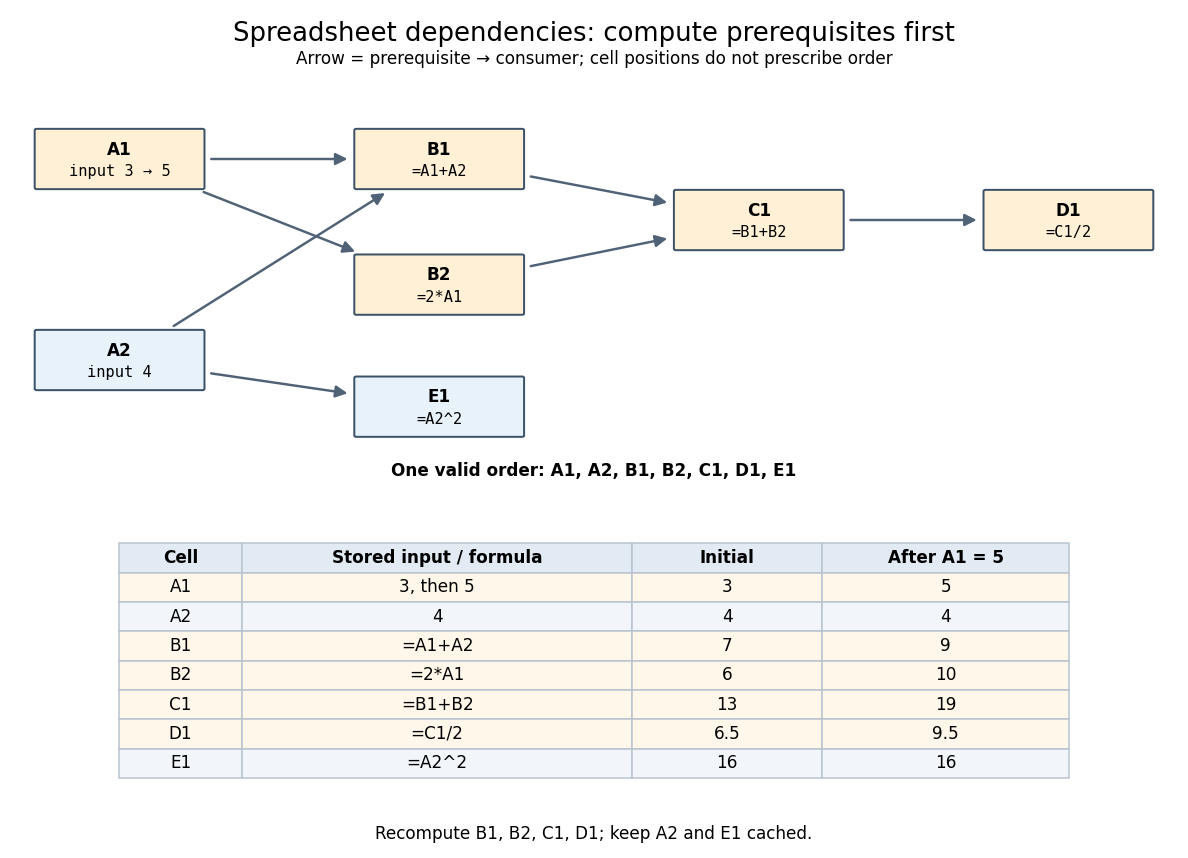
An original spreadsheet dependency graph and a topological order with values before and after one edit
. Details. Our directed edge convention is prerequisite to consumer:
A1 B1 means that B1 reads A1, not the reverse. The seven directed edges are A1 B1, A2 B1, A1 B2, B1 C1, B2 C1, C1 D1, and A2 E1. This spreadsheet dependency graph is a directed acyclic graph. One topological order is A1,A2,B1,B2,C1,D1,E1; E1 could instead be computed immediately after A2. A topological order constrains prerequisites, not the physical positions of spreadsheet cells.In that order, the initial arithmetic operations give , , , , and . The spreadsheet formulas define one value per spreadsheet cell: an outline by induction along any topological order shows that every prerequisite already has its uniquely determined value when its consumer is computed. Different permitted orders therefore agree in this model. The useful idea is that information flows through the directed acyclic graph even when the visible grid does not display that flow.
A concrete implementation history illustrates this separation. Microsoft's documentation distinguishes the per-worksheet calculation chains used in Excel 2002 and earlier from calculation using multiple software threads introduced in Excel 2007 for independent chain sections. This is a documented implementation example, not a definition of spreadsheet dependency evaluation.[ref]
Excel Recalculation by Microsoft. Dependence, Dirty Cells, and Recalculated Cells: paragraphs beginning “In Excel 2002 and earlier versions” and “In Excel 2007”
An application programming interface defines the operations available to client code and their promised behavior, including inputs, outputs and failure cases. For a FIFO queue, operation names alone do not specify what happens on an empty or full queue. An API should state those cases before clients depend on them.
An incoherent feedforward loop carries influences from a shared input to a shared output along routes with opposite net signs. In the signaling adaptation toy, drives fast and slow , which contribute with opposite signs to . Despite the conventional word "loop", those routes do not return the output to an earlier stage: this arrangement is distinct from negative feedback. Opposing routes alone do not guarantee complete signaling adaptation. [ref]
https://cqb.pku.edu.cn/tanglab/pdf/78.pdf. Ma et al., Cell 138 (2009), p. 764: definition of an incoherent feedforward loop
Pinned article: Introduction to the OurBigBook Project
Welcome to the OurBigBook Project! Our goal is to create the perfect publishing platform for STEM subjects, and get university-level students to write the best free STEM tutorials ever.
Everyone is welcome to create an account and play with the site: ourbigbook.com/go/register. We belive that students themselves can write amazing tutorials, but teachers are welcome too. You can write about anything you want, it doesn't have to be STEM or even educational. Silly test content is very welcome and you won't be penalized in any way. Just keep it legal!
Intro to OurBigBook
. Source. We have two killer features:
- topics: topics group articles by different users with the same title, e.g. here is the topic for the "Fundamental Theorem of Calculus" ourbigbook.com/go/topic/fundamental-theorem-of-calculusArticles of different users are sorted by upvote within each article page. This feature is a bit like:
- a Wikipedia where each user can have their own version of each article
- a Q&A website like Stack Overflow, where multiple people can give their views on a given topic, and the best ones are sorted by upvote. Except you don't need to wait for someone to ask first, and any topic goes, no matter how narrow or broad
This feature makes it possible for readers to find better explanations of any topic created by other writers. And it allows writers to create an explanation in a place that readers might actually find it.
Figure 1. Screenshot of the "Derivative" topic page. View it live at: ourbigbook.com/go/topic/derivativeVideo 2. OurBigBook Web topics demo. Source. - local editing: you can store all your personal knowledge base content locally in a plaintext markup format that can be edited locally and published either:This way you can be sure that even if OurBigBook.com were to go down one day (which we have no plans to do as it is quite cheap to host!), your content will still be perfectly readable as a static site.
- to OurBigBook.com to get awesome multi-user features like topics and likes
- as HTML files to a static website, which you can host yourself for free on many external providers like GitHub Pages, and remain in full control

Figure 2. You can publish local OurBigBook lightweight markup files to either OurBigBook.com or as a static website.
Figure 3. Visual Studio Code extension installation.
Figure 5. . You can also edit articles on the Web editor without installing anything locally. Video 3. Edit locally and publish demo. Source. This shows editing OurBigBook Markup and publishing it using the Visual Studio Code extension. 
- Infinitely deep tables of contents:




All our software is open source and hosted at: github.com/ourbigbook/ourbigbook
Further documentation can be found at: docs.ourbigbook.com
Feel free to reach our to us for any help or suggestions: docs.ourbigbook.com/#contact