Topics (384k) Articles (398k) Users (410) Discussions (242) Comments (383) Files (13k) New article

Rudolf Clausius established a relation between average kinetic energy and the forces acting on a bounded mechanical system. The virial theorem follows by differentiating the sum of position-momentum products and averaging when the boundary term remains bounded. For inverse-square gravity it gives under the appropriate equilibrium assumptions. The result connects microscopic motion with binding energy and supplies a bridge between mechanics, gases and gravitating systems.[ref]
On a Mechanical Theorem applicable to Heat by R. Clausius. 1870 paper, mechanical time-average relation; gravitational specialization in modern notation

Portrait of Rudolf Clausius
. Unknown author. Public domain in countries with copyright term life plus 100 years or fewer (Commons PD-old-100). Source usage terms, via Wikimedia Commons. Source.Donald Lynden-Bell investigated the unusual thermodynamics of self-gravitating systems. A bound system can become hotter while losing total energy: contraction makes its gravitational energy more negative while increasing typical particle speeds. This negative heat capacity is compatible with a suitable isolated-system description, even though equilibrium heat capacity in a canonical ensemble is nonnegative. His account connects this ensemble distinction with gravitational thermal runaway and the stability of star clusters.[ref]
Negative Specific Heat in Astronomy, Physics and Chemistry by D. Lynden-Bell. 1998 review, abstract: gravitational thermodynamics, ensemble distinction and thermal runaway

Portrait of Donald Lynden-Bell
. Amanda Smith / Institute of Astronomy, University of Cambridge. CC BY-SA 4.0, via Wikimedia Commons. Source.A technical author whose electrostatics manual turns electrostatic induction into a sequence of measurable tests. Inserting a charged object into an isolated conducting enclosure, withdrawing it, and then allowing contact distinguish redistribution of charge from actual charge transfer. The procedure makes the interpretation depend on controlled operations rather than a single meter reading.[ref]
Basic Electrostatics System (ES-9080B), Instruction Manual 012-07227G by Cecilia Hernandez. Credits, p. 35; Procedure 1A, pp. 14–15: insertion, withdrawal, contact and retesting
A metrology researcher who measured the vapor pressure of water using a controlled boiler and precision manometer. Comparing pressure with independently calibrated temperature readings supplies a quantitative relation between the two. The work also reports uncertainties, making the results useful for testing vapor-pressure formulas and temperature standards.[ref]
Some Precise Measurements of the Vapor Pressure of Water in the Range From 25 to 100 °C by H. F. Stimson. Abstract and pp. 493–496: boiler, manometer, temperatures and uncertainty estimates
A researcher and instrument developer whose technical account explains time-correlated single-photon counting. Repeated weak excitation pulses are followed by timed detections of individual photons; a histogram of delays reconstructs the emission’s time dependence. Measuring the instrument’s own response and accounting for it in the fit allows a fluorescence lifetime to be distinguished from timing blur. The method uses many excitation cycles instead of requiring a detector to resolve an entire weak decay in one shot.[ref]
A biophysics researcher whose joint study connected rapid switching in atomic force microscopy recognition images with mechanically induced changes in an antibody. The work tests how the measurement apparatus itself can alter molecular recognition.[ref]
Antibody-Unfolding and Metastable-State Binding in Force Spectroscopy and Recognition Imaging by Parminder Kaur and others. Abstract and recognition-imaging results: reversible structural changes and switching
A researcher whose team compared force measurements with surface plasmon resonance. Differences in apparent binding kinetics showed why antibody recognition measured under mechanical stress need not reproduce equilibrium behavior, even when the interaction remains specific.[ref]
Antibody-Unfolding and Metastable-State Binding in Force Spectroscopy and Recognition Imaging by Parminder Kaur and others. Abstract and Table 1: force measurements and equilibrium-binding comparison
A researcher whose joint work examined how pulling speed affects antibody recognition. At high loading rates, additional extension peaks signaled partial unfolding, showing that the probe’s mechanical history can change the interaction being measured.[ref]
Antibody-Unfolding and Metastable-State Binding in Force Spectroscopy and Recognition Imaging by Parminder Kaur and others. Force-spectroscopy results: extension peaks and probe history
Coauthored an antibody study using atomic force microscopy to investigate pulling-induced partial unfolding. Reversible probe-history effects supported a metastable antibody state affecting recognition imaging and comparisons with surface plasmon resonance. [ref]
Antibody-Unfolding and Metastable-State Binding in Force Spectroscopy and Recognition Imaging by Parminder Kaur and others. Page 243: printed Qiang-Fu byline and abstract; page 249: Conclusions.
A biophysics researcher whose team found that rapid pulling can partly unfold an antibody. This changes the measured binding behavior, so single-molecule force spectroscopy can probe a mechanically altered molecule rather than its undisturbed state.[ref]
Antibody-Unfolding and Metastable-State Binding in Force Spectroscopy and Recognition Imaging by Parminder Kaur and others. Abstract and force-spectroscopy results: loading-rate-dependent unfolding
A researcher in magnetic measurement whose account of demagnetizing factors distinguishes the field applied to a specimen from the field produced by the specimen’s own magnetization. For a cylinder, that internal field is generally nonuniform, so an instrument sampling the central region and one averaging the entire specimen need not require the same correction. This explains why specimen shape and measurement geometry matter when inferring a material’s magnetic susceptibility.[ref]
Demagnetizing Factors. Printed p. 104, §2: fluxmetric and magnetometric definitions, cylindrical nonuniformity and susceptibility dependence
An astronomical researcher whose work with Beverley J. Wills tested whether a double quasar represented two sources or two lensed images. The similar absorption-line redshifts and line widths supplied evidence for a shared distant source. The analysis also examined differences in brightness and reddening rather than assuming that lensed images must look identical.[ref]
Spectrophotometry of the Double QSO, 0957 + 561 by Beverley J. Wills and D. Wills. Abstract: absorption-line similarities, differential reddening and flux ratios
An astronomer whose joint spectrophotometry of the Twin Quasar compared the spectra along its two apparent light paths. Closely matching absorption-line properties supported gravitational lensing: two visible images can correspond to one distant quasar viewed along paths bent by intervening matter.[ref]
Spectrophotometry of the Double QSO, 0957 + 561 by Beverley J. Wills and D. Wills. Abstract and pp. 1–3: matching absorption spectra and lens interpretation
An astrophysicist whose work develops gravitational lensing as a probe of matter in the Universe. His review derives lensing relations from geodesic deviation and applies them to objects from stars to large-scale structure. Because gravity deflects light regardless of whether the lens emits light, the method can constrain otherwise unseen mass. The point-mass gravitational lens provides a concrete starting example, producing multiple images and a critical alignment that becomes an Einstein ring.[ref]
Gravitational Lensing by Matthias Bartelmann. Abstract and §2.2, Eqs. (100)–(110): point lens, image positions, critical circle and magnification
An astrophysicist whose work connects models of gravity with astronomical observations. His lectures with Matthias Bartelmann develop gravitational lensing from the deflection of individual light rays to images made by galaxies and galaxy clusters. A useful example is the thin gravitational lens equation: an observed image position combines the deflection angle with the geometry between observer, lens and source. This turns a distorted image into information about the intervening mass distribution.[ref]
Lectures on Gravitational Lensing by Ramesh Narayan and Matthias Bartelmann. §2.1.3, Eqs. (13)–(15): lens equation and angular-diameter distances
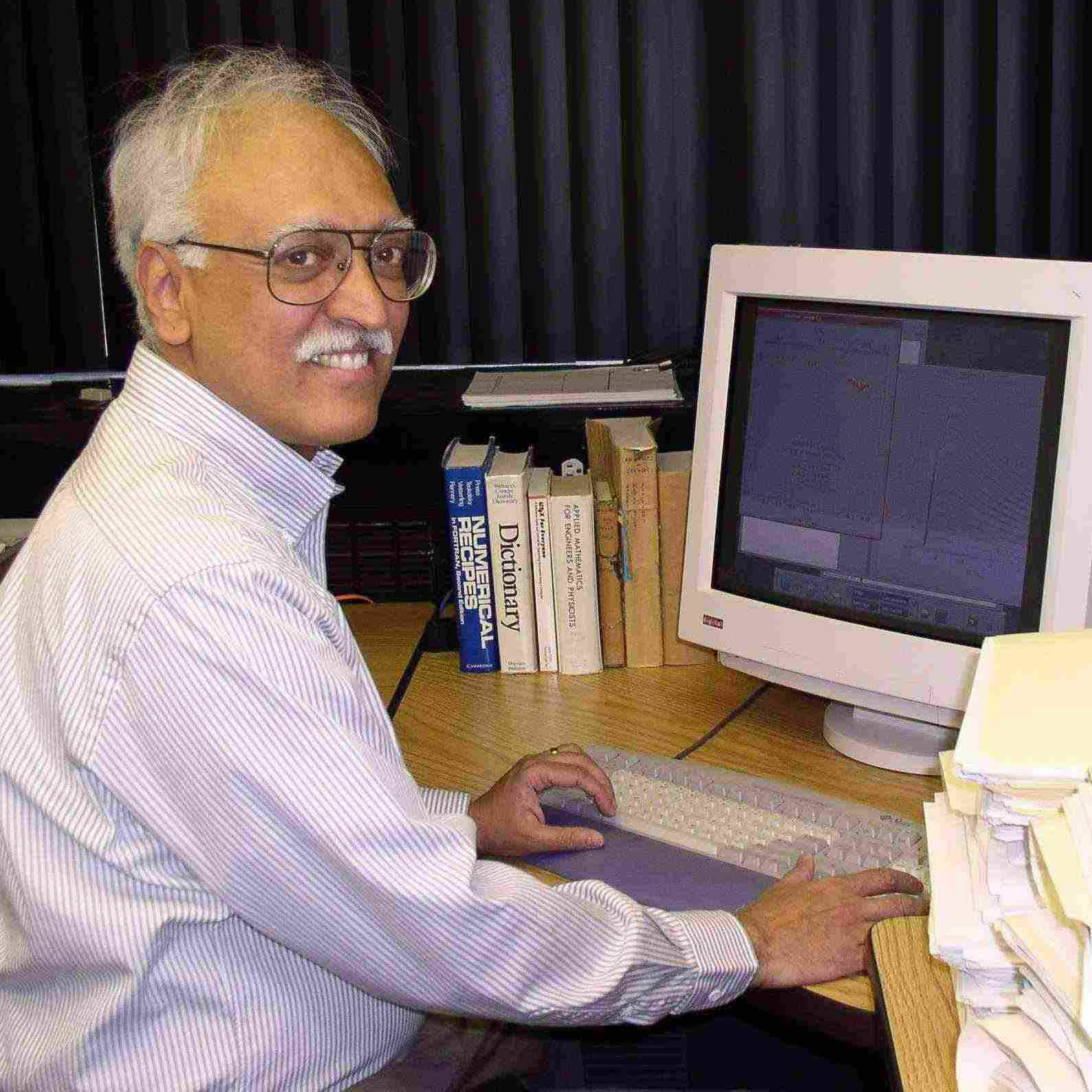
Portrait of Ramesh Narayan
. Source. Pinned article: Introduction to the OurBigBook Project
Welcome to the OurBigBook Project! Our goal is to create the perfect publishing platform for STEM subjects, and get university-level students to write the best free STEM tutorials ever.
Everyone is welcome to create an account and play with the site: ourbigbook.com/go/register. We belive that students themselves can write amazing tutorials, but teachers are welcome too. You can write about anything you want, it doesn't have to be STEM or even educational. Silly test content is very welcome and you won't be penalized in any way. Just keep it legal!
Intro to OurBigBook
. Source. We have two killer features:
- topics: topics group articles by different users with the same title, e.g. here is the topic for the "Fundamental Theorem of Calculus" ourbigbook.com/go/topic/fundamental-theorem-of-calculusArticles of different users are sorted by upvote within each article page. This feature is a bit like:
- a Wikipedia where each user can have their own version of each article
- a Q&A website like Stack Overflow, where multiple people can give their views on a given topic, and the best ones are sorted by upvote. Except you don't need to wait for someone to ask first, and any topic goes, no matter how narrow or broad
This feature makes it possible for readers to find better explanations of any topic created by other writers. And it allows writers to create an explanation in a place that readers might actually find it.
Figure 1. Screenshot of the "Derivative" topic page. View it live at: ourbigbook.com/go/topic/derivativeVideo 2. OurBigBook Web topics demo. Source. - local editing: you can store all your personal knowledge base content locally in a plaintext markup format that can be edited locally and published either:This way you can be sure that even if OurBigBook.com were to go down one day (which we have no plans to do as it is quite cheap to host!), your content will still be perfectly readable as a static site.
- to OurBigBook.com to get awesome multi-user features like topics and likes
- as HTML files to a static website, which you can host yourself for free on many external providers like GitHub Pages, and remain in full control

Figure 2. You can publish local OurBigBook lightweight markup files to either OurBigBook.com or as a static website.
Figure 3. Visual Studio Code extension installation.
Figure 5. . You can also edit articles on the Web editor without installing anything locally. Video 3. Edit locally and publish demo. Source. This shows editing OurBigBook Markup and publishing it using the Visual Studio Code extension. 
- Infinitely deep tables of contents:




All our software is open source and hosted at: github.com/ourbigbook/ourbigbook
Further documentation can be found at: docs.ourbigbook.com
Feel free to reach our to us for any help or suggestions: docs.ourbigbook.com/#contact