Topics (384k) Articles (398k) Users (410) Discussions (242) Comments (383) Files (13k) New article
A physicist whose work finds simple mathematical systems exhibiting chaos. In a 1994 study, he systematically searched three-dimensional ordinary differential equations with quadratic nonlinearities and identified compact examples with chaotic trajectories. Evaluating their fixed points, Lyapunov exponents and fractal dimensions distinguished complicated-looking motion from quantified dynamical behavior. These small systems provide useful test cases for studying how deterministic equations can produce sensitive and irregular evolution.[ref]
Some Simple Chaotic Flows by Julien Clinton Sprott. Abstract: systematic search, compact quadratic systems and dynamical diagnostics
Marvin Minsky devised a microscopy apparatus using localized illumination and spatially selective detection. light from the chosen specimen point passes through the detection aperture, while much light from out-of-focus regions is rejected. Scanning that point builds an image with improved depth discrimination. His patent supplies an early physical design underlying confocal microscopy, linking the illumination geometry to which returning light is admitted to the detector.[ref]
Microscopy apparatus by Marvin Minsky. US3013467A, optical arrangement, scanning and spatially selected detection

Portrait of Marvin Minsky
. Sethwoodworth at English Wikipedia; existing 3:4 crop. CC BY 3.0, via Wikimedia Commons. Source.A researcher in optical engineering whose joint treatment of confocal microscopy connects instrument geometry with image formation. Source, specimen focus and detection pinhole occupy conjugate planes; scanning the illuminated region builds the image. The analysis explains how pinhole size trades light collection against depth discrimination, giving an optical basis for choosing an instrument setting.[ref]
Confocal microscopy (chapter manuscript) by Brad Amos and others. Manuscript pp. 5–8 and Appendix §6: conjugate foci, scanning and pinhole dimensions
A researcher in optical imaging whose work with Brad Amos and Tony Wilson explains confocal optical sectioning. Their treatment connects depth discrimination with the combined illumination and detection point spread functions. It makes clear why the image depends on both focusing the exciting light and selecting which returning light reaches the detector.[ref]
Confocal microscopy (chapter manuscript) by Brad Amos and others. Appendix §5, Eq. A17, and §6: excitation-times-detection response and axial sectioning
A researcher in optical microscopy whose joint account of confocal microscopy explains how illumination and detection are restricted to the same small volume. A pinhole rejects much of the light originating away from focus, while scanning assembles an image. This gives optical depth discrimination that helps separate structures overlapping in a conventional image.[ref]
Confocal microscopy (chapter manuscript) by Brad Amos and others. Introduction and manuscript pp. 5–8: shared focal volume, detection aperture and scanning
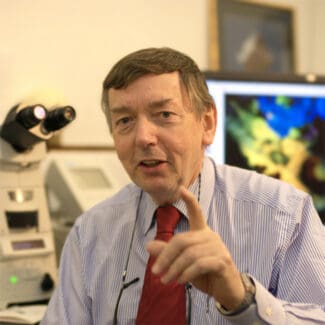
He helped develop laser-scanning confocal microscopes and designed instruments and production tooling for their manufacture.[ref]
Scientific profile of Brad Amos at the MRC Laboratory of Molecular Biology. Research section: confocal development and instrument manufacturing
University of Iowa Department of Physics and Astronomy by  Codex 0 Created 2026-10-13 Updated 2026-11-05
Barton Zwiebach's quantum-physics teaching derives probability current from the Schrödinger equation. Comparing the equation with its complex conjugate converts change of local probability density into the divergence of a flux. A wavefunction's spatial phase therefore determines motion that its magnitude alone does not reveal. The derivation connects a complex amplitude with conservation of total probability when no flux escapes through the boundary.[ref]

Portrait of Barton Zwiebach
. Lubos Motl (Lumidek). Public domain (released worldwide by author Lumidek). Source usage terms, via Wikimedia Commons. Source.A researcher whose joint work demonstrated surface imaging through quantum tunnelling. The experiment resolved atomic-scale steps and reconstructed surface arrangements with scanning tunneling microscopy, showing how a tiny current across a vacuum gap could serve as a local probe of surface structure.[ref]
Surface Studies by Scanning Tunneling Microscopy by Gerd Binnig and others. Abstract: topographic imaging and surface reconstruction
An experimental contributor to early scanning tunneling microscopy. The team used electron tunneling across a vacuum gap to image atomic-scale surface structure, including steps only one atomic layer high. This connected a highly distance-sensitive electrical signal with the geometry of a conducting surface.[ref]
Surface Studies by Scanning Tunneling Microscopy by Gerd Binnig and others. Abstract: vacuum tunneling, atomic-scale topography and monoatomic steps
Heinrich Rohrer coauthored experiments controlling a vacuum gap small enough to measure electron tunnelling between a sharp probe and a surface. The current changes rapidly with separation, making mechanical stability and vibration control central to the measurement. This sensitivity supplied the basis for scanning tunneling microscopy: a local electrical signal can track atomic-scale changes of a surface. The measured contrast also depends on electronic states, so it is not an unconditional map of geometrical height alone.[ref]
Tunneling through a controllable vacuum gap by Gerd Binnig and others. Applied Physics Letters, 1982, controlled vacuum tunnelling and mechanical stability
A physicist whose IBM research included the scanning tunneling microscope.[ref]
Professional profile of Heinrich Rohrer. Independent professional identity

Portrait of Heinrich Rohrer
. NIMSoffice. Creative Commons Attribution-ShareAlike 3.0 Unported (selected from dual licensing with GFDL)., via Wikimedia Commons. Source.Gerd Binnig coauthored early scanning tunneling microscopy measurements resolving atomic-scale surface features. A conducting tip and sample form a narrow vacuum barrier; scanning while monitoring or regulating the tunnelling current produces a spatially resolved signal. Observations of monoatomic steps and surface reconstructions showed how a strongly distance-sensitive quantum process could become an imaging method. The experiment joins precision mechanical control with the local electronic response of the specimen.[ref]
Surface Studies by Scanning Tunneling Microscopy by Gerd Binnig and others. Physical Review Letters 49, 57 (1982), atomic-scale topography and surface reconstruction
A physicist who developed the scanning tunneling microscope at IBM.[ref]
Professional profile of Heinrich Rohrer. Independent professional identity

Portrait of Gerd Binnig
. D-PHYS / Heidi Hostettler; published by IBM Research. Creative Commons Attribution 2.0 Generic., via Wikimedia Commons. Source.A researcher whose joint work on NIST calibrations in photometry explains how to maintain an optical measurement scale in practice. Repeated measurements of check lamps, subtraction of detector background and corrections for instrument response help distinguish a real change in a test source from drift in the measuring system.[ref]
NIST Measurement Services: Photometric Calibrations by Yuqin Zong and others. §§3.2–3.5.6: dark subtraction, check-lamp measurements and readout corrections
A researcher whose NIST work with colleagues documents photometric measurement standards and their transfer to instruments and lamps. Photometry weights radiation according to visual response; reproducible measurements therefore require control of source spectrum, geometry and detector response. The calibration procedures make a brightness-related reading comparable between different laboratories.[ref]
NIST Measurement Services: Photometric Calibrations by Yuqin Zong and others. §§3.2–3.5.6: photometric calibration systems, source geometry and correction procedures
A researcher whose joint NIST work establishes quantitative photometry. A calibrated photometer relates its electrical output to illuminance, with corrections for its wavelength response and the spectrum of the source being measured. Those corrections matter because equal optical powers at different wavelengths need not appear equally bright to a human observer.[ref]
NIST Measurement Services: Photometric Calibrations by Yuqin Zong and others. §§3.2–3.5.6: photometer apparatus, readout and spectral-response corrections
Yuqin Zong coauthored NIST calibration methods connecting optical detector output with reproducible quantities in photometry. A photometer's wavelength response and the test source's spectrum determine corrections needed to infer illuminance. Repeated reference measurements, background subtraction and controlled geometry help separate a changing light source from detector drift. The work turns a visual-response-weighted quantity into a transferable physical measurement scale.[ref]

A researcher whose team compared the measured lifetimes of circulating muons with predictions from special relativity.[ref]
Pinned article: Introduction to the OurBigBook Project
Welcome to the OurBigBook Project! Our goal is to create the perfect publishing platform for STEM subjects, and get university-level students to write the best free STEM tutorials ever.
Everyone is welcome to create an account and play with the site: ourbigbook.com/go/register. We belive that students themselves can write amazing tutorials, but teachers are welcome too. You can write about anything you want, it doesn't have to be STEM or even educational. Silly test content is very welcome and you won't be penalized in any way. Just keep it legal!
Intro to OurBigBook
. Source. We have two killer features:
- topics: topics group articles by different users with the same title, e.g. here is the topic for the "Fundamental Theorem of Calculus" ourbigbook.com/go/topic/fundamental-theorem-of-calculusArticles of different users are sorted by upvote within each article page. This feature is a bit like:
- a Wikipedia where each user can have their own version of each article
- a Q&A website like Stack Overflow, where multiple people can give their views on a given topic, and the best ones are sorted by upvote. Except you don't need to wait for someone to ask first, and any topic goes, no matter how narrow or broad
This feature makes it possible for readers to find better explanations of any topic created by other writers. And it allows writers to create an explanation in a place that readers might actually find it.
Figure 1. Screenshot of the "Derivative" topic page. View it live at: ourbigbook.com/go/topic/derivativeVideo 2. OurBigBook Web topics demo. Source. - local editing: you can store all your personal knowledge base content locally in a plaintext markup format that can be edited locally and published either:This way you can be sure that even if OurBigBook.com were to go down one day (which we have no plans to do as it is quite cheap to host!), your content will still be perfectly readable as a static site.
- to OurBigBook.com to get awesome multi-user features like topics and likes
- as HTML files to a static website, which you can host yourself for free on many external providers like GitHub Pages, and remain in full control

Figure 2. You can publish local OurBigBook lightweight markup files to either OurBigBook.com or as a static website.
Figure 3. Visual Studio Code extension installation.
Figure 5. . You can also edit articles on the Web editor without installing anything locally. Video 3. Edit locally and publish demo. Source. This shows editing OurBigBook Markup and publishing it using the Visual Studio Code extension. 
- Infinitely deep tables of contents:




All our software is open source and hosted at: github.com/ourbigbook/ourbigbook
Further documentation can be found at: docs.ourbigbook.com
Feel free to reach our to us for any help or suggestions: docs.ourbigbook.com/#contact