Topics (384k) Articles (398k) Users (410) Discussions (242) Comments (383) Files (13k) New article

A researcher whose joint study of collapsing soap films in the form of a catenoid compared experiments with sequences of idealized shapes. The analysis predicts a cone angle before final pinching, showing how a tractable geometric construction can explain an observable feature of a more complicated fluid motion.[ref]
Geometry of catenoidal soap film collapse induced by boundary deformation by Raymond E. Goldstein and others. Abstract and geometrical-model analysis: shape sequence toward the Goldschmidt configuration and cone angle
An experimental researcher whose team investigated how soap films collapse when their supporting boundaries are moved. Their measurements compared films of different viscosities and found a common cone angle near pinching. The result identifies a reproducible geometric feature within a rapidly changing fluid structure.[ref]
Geometry of catenoidal soap film collapse induced by boundary deformation by Raymond E. Goldstein and others. Abstract and §II: film preparation, contour observations and viscosity-independent cone geometry
A researcher whose joint work on soap film collapse connects linear stability analysis with visible changes of shape. The team analyzed the loss of stability of a catenoid and the evolving modes that follow boundary deformation. This provides a link between an equilibrium minimal surface and its subsequent collapse dynamics.[ref]
Geometry of catenoidal soap film collapse induced by boundary deformation by Raymond E. Goldstein and others. Abstract: linear and weakly nonlinear analysis near the saddle-node instability
A researcher in physical and mathematical modeling whose team studied the collapse of soap films in the form of a catenoid. Moving the supporting boundaries destabilizes the film; the resulting shape develops conical regions before pinching. Comparing experiments with geometric and fluid-dynamical models reveals which features are controlled by geometry rather than liquid viscosity.[ref]
Geometry of catenoidal soap film collapse induced by boundary deformation by Raymond E. Goldstein and others. Abstract and §II: boundary deformation, transient cones, viscosity comparison and physical models
An optical scientist whose work included interferometry, optical testing and ophthalmic instrumentation.[ref]
Professional profile of John E. Greivenkamp at the University of Arizona. Research Interests: interferometry, optical testing and ophthalmic instrumentation
His teaching in radiometry carefully distinguishes radiance from total transmitted power. Across a refracting interface, the invariant quantity in an ideal system is radiance divided by the square of refractive index; accounting for this prevents brightness calculations from confusing a change in the angular spread of rays with a gain of optical power.[ref]Radiative Transfer lecture notes by John E. Greivenkamp. Slides 22-18–22-20: camera equation and invariant basic radiance

Portrait of John E. Greivenkamp
. Source. An optical scientist whose teaching connects etendue with the practical limits of illumination design. Etendue combines the area occupied by a beam with its spread in propagation directions, weighted by refractive index. Its conservation in an ideal optical system constrains how much light a lens or reflector can concentrate. This provides a useful feasibility check before attempting a detailed optical design.[ref]
Étendue (Photon Snacks) by R. John Koshel. pp. 1–3, Eq. (1.1) and Fig. 1: definition, lossless-system restrictions and phase-space interpretation
A physicist whose photonics teaching relates the propagation of electromagnetic waves to the response of an optical material. His treatment of birefringence derives the direction-dependent refractive index of an extraordinary wave and distinguishes the direction of its wavefront propagation from that of its energy flow. This explains optical walk-off: in an anisotropic crystal, a beam’s energy can travel obliquely to its wave vector. Such distinctions matter when aligning and designing crystal-based optical devices.[ref]
Immanuel Bloch coauthored the observation of repeated collapse and revival in a Bose-Einstein condensate. Cold collisions and the quantization of atom number change the phases contributing to a macroscopic matter wave. Measuring the evolving interference pattern showed coherence disappear and return. The experiment connects collective wave behavior with interactions between discrete atoms, providing a direct test of many-body quantum dynamics.[ref]
Collapse and revival of the matter wave field of a Bose-Einstein condensate by Markus Greiner and others. 2002 report, abstract and collapse/revival measurements

Portrait of Immanuel Bloch
. T. Naeser. External portrait hosted by Max Planck Institute of Quantum Optics / Quantum Optics Group. Source.Theodor W. Hänsch developed high-resolution laser spectroscopy, including Doppler-free two-photon measurements of hydrogen. Absorbing one photon from each of two counterpropagating beams can cancel the first-order Doppler shift.
The resulting narrow resonance exposes atomic structure that is hidden inside an ordinary thermally broadened line. Comparing precise transition frequencies with theory tests atomic energy levels and their small corrections. His Nobel lecture also explains how optical frequency combs connect these optical measurements to an accurately countable frequency reference.[ref]
Doppler-Free Two-Photon Spectroscopy of Hydrogen by Theodor W. Hänsch and others. 1975 two-photon experiment
[ref]Passion for Precision by Theodor W. Hänsch. Nobel lecture: precision spectroscopy and frequency-comb measurement
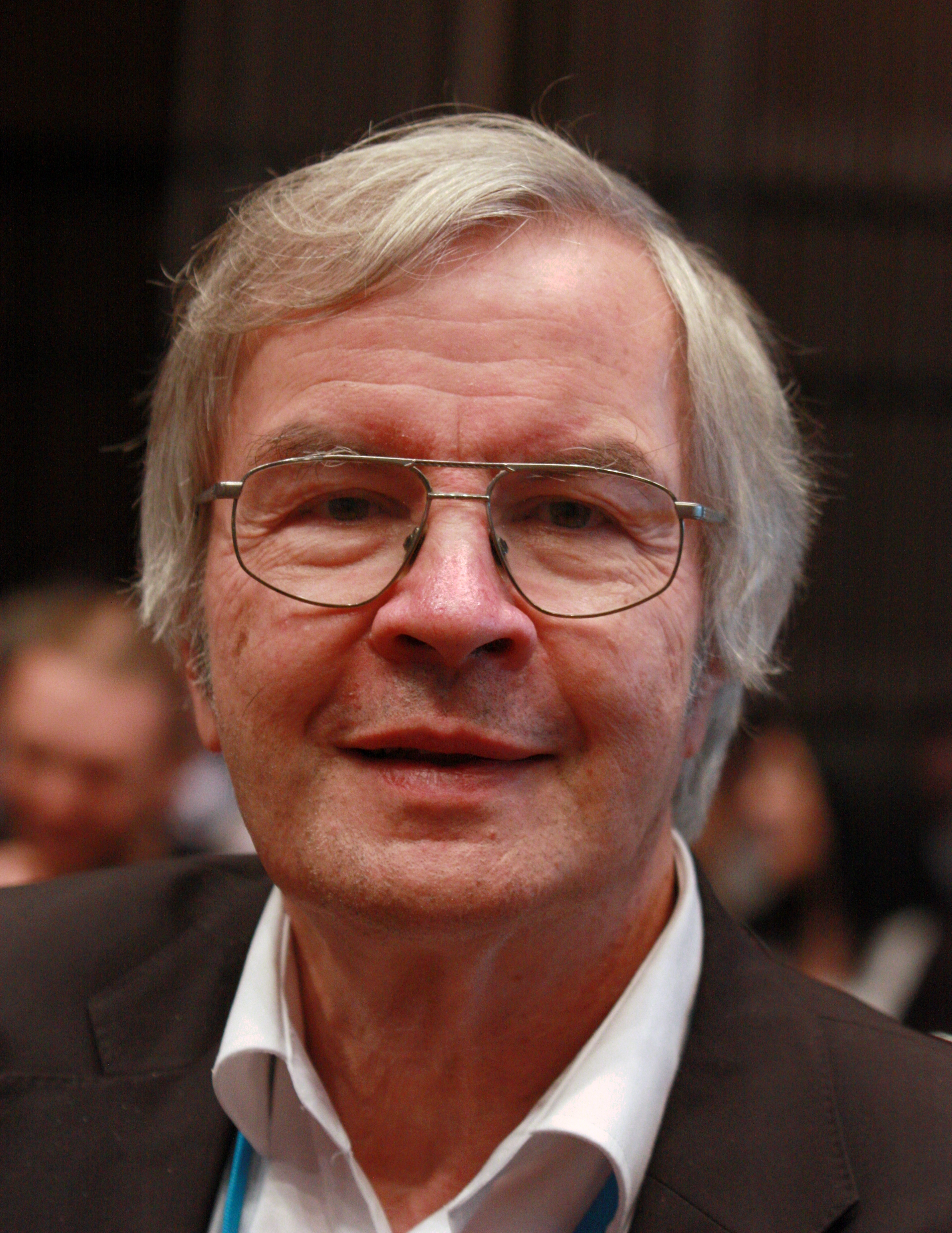
Portrait of Theodor W. Hänsch
. Source. An experimental researcher whose team observed the collapse and revival of a Bose-Einstein condensate matter-wave field. Atoms were confined in an optical lattice; interactions caused different occupation-number components to accumulate different phases. Their interference signal weakened and later returned as these phases realigned. The 2002 experiment made the discrete particle content of a coherent matter wave visible through its time-dependent interference, rather than treating the condensate only as a classical wave.[ref]
Collapse and revival of the matter wave field of a Bose-Einstein condensate by Markus Greiner and others. Abstract; manuscript pp. 2–4 and Fig. 2: number-dependent evolution, lattice preparation and interference readout
Markus Greiner coauthored an experiment observing collapse and revival of the coherent matter-wave field of a Bose-Einstein condensate. Atomic interactions make different particle-number components accumulate different phases, reducing the interference contrast before those components rephase. A changing matter-wave interference pattern therefore revealed the discrete atomic population beneath a seemingly classical macroscopic wave. The revival distinguishes coherent dephasing from irreversible loss of all phase information.[ref]

Portrait of Markus Greiner
. Via Wikimedia Commons; the linked file page provides image credits and usage information. Source.Peter Hänggi coauthored a formulation of fluctuating work in a driven quantum system. Initial and final energy measurements define a distribution of energy differences, rather than one fixed work operator applicable to the whole process. The resulting characteristic function connects quantum dynamics with the Jarzynski equality. This makes the measurement protocol part of a precise statement about quantum work fluctuations.[ref]
Fluctuation theorems: Work is not an observable by Peter Talkner and others. Physical Review E 75, 050102(R) (2007), characteristic function and two-energy-measurement formulation

Portrait of Peter Hänggi
. External portrait hosted by University of Augsburg. Source.A researcher in statistical mechanics and coauthor with Peter Talkner and Peter Hänggi of a 2007 analysis of work in quantum mechanics. Their result expresses the statistics of work through the system's driven dynamics and two energy measurements, giving a quantum formulation of the Jarzynski equality. It explains why subtracting two Hamiltonian operators as if they were classical numbers generally misses the measurement statistics.[ref]
Fluctuation theorems: Work is not an observable by Peter Talkner and others. Abstract and Eqs. (3)–(5): characteristic function and exponential work average
A researcher in statistical mechanics who, with Eric Lutz and Peter Hänggi, clarified how to define fluctuating work for a driven quantum system. Their 2007 treatment uses initial and final energy measurements; work is their difference, with a probability distribution determined by the intervening dynamics. This distinction matters when applying the Jarzynski equality to quantum mechanics.[ref]
Fluctuation theorems: Work is not an observable by Peter Talkner and others. Eqs. (1)–(5): two energy measurements, work distribution and characteristic function
A researcher in statistical mechanics whose work connects reversible microscopic dynamics with irreversible thermodynamic behavior through fluctuation theorems. He coauthored the 2002 dragged-bead fluctuation theorem experiment, which measured the relative occurrence of entropy-producing and entropy-consuming trajectories of an optically trapped bead. Such measurements expose the role of thermal fluctuations when a system is small and observation times are short.[ref]
Experimental Demonstration of Violations of the Second Law of Thermodynamics for Small Systems and Short Time Scales by G. M. Wang and others. Introduction: reversibility and fluctuation theorem; Figs. 1–4: experimental trajectory statistics
A researcher in statistical mechanics who coauthored the 2002 dragged-bead fluctuation theorem experiment. The team tracked a colloidal bead held by optical tweezers while moving the surrounding water relative to the trap. Individual short trajectories sometimes showed negative entropy production; their frequencies tested a quantitative fluctuation theorem, rather than contradicting the macroscopic Second law of thermodynamics.[ref]
Experimental Demonstration of Violations of the Second Law of Thermodynamics for Small Systems and Short Time Scales by G. M. Wang and others. Author list; abstract; pp. 050601-2–4: apparatus and measured trajectory statistics
A researcher whose joint work tested the fluctuation theorem using a colloidal particle held by optical tweezers. Moving the trap relative to the surrounding liquid drives the particle away from equilibrium, while its measured trajectory reveals fluctuations in dissipation. Brief trajectories with negative entropy production occurred with measurable probability; their statistics clarify how microscopic fluctuations coexist with the macroscopic Second law of thermodynamics.[ref]
Experimental Demonstration of Violations of the Second Law of Thermodynamics for Small Systems and Short Time Scales by G. M. Wang and others. pp. 050601-1–050601-4: optical-trap protocol, dissipation function and trajectory statistics
A researcher whose joint study connected stochastic thermodynamics with a single-particle experiment. Measuring the motion of a trapped bead relative to a liquid made a microscopic dissipation distribution observable. The fluctuation theorem predicted the imbalance between trajectories that dissipate energy and their less probable entropy-reducing counterparts.[ref]
Experimental Demonstration of Violations of the Second Law of Thermodynamics for Small Systems and Short Time Scales by G. M. Wang and others. Abstract and experimental results: transient fluctuation relation and optical-trap trajectories
An experimental researcher whose team measured microscopic departures from the most probable direction of dissipation. A bead driven through liquid by optical tweezers produces trajectories with fluctuating entropy production. Their relative probabilities test the fluctuation theorem, explaining why brief entropy-reducing trajectories do not invalidate the macroscopic Second law of thermodynamics.[ref]
Experimental Demonstration of Violations of the Second Law of Thermodynamics for Small Systems and Short Time Scales by G. M. Wang and others. pp. 050601-1–050601-4: driven optical trap and dissipation statistics
Pinned article: Introduction to the OurBigBook Project
Welcome to the OurBigBook Project! Our goal is to create the perfect publishing platform for STEM subjects, and get university-level students to write the best free STEM tutorials ever.
Everyone is welcome to create an account and play with the site: ourbigbook.com/go/register. We belive that students themselves can write amazing tutorials, but teachers are welcome too. You can write about anything you want, it doesn't have to be STEM or even educational. Silly test content is very welcome and you won't be penalized in any way. Just keep it legal!
Intro to OurBigBook
. Source. We have two killer features:
- topics: topics group articles by different users with the same title, e.g. here is the topic for the "Fundamental Theorem of Calculus" ourbigbook.com/go/topic/fundamental-theorem-of-calculusArticles of different users are sorted by upvote within each article page. This feature is a bit like:
- a Wikipedia where each user can have their own version of each article
- a Q&A website like Stack Overflow, where multiple people can give their views on a given topic, and the best ones are sorted by upvote. Except you don't need to wait for someone to ask first, and any topic goes, no matter how narrow or broad
This feature makes it possible for readers to find better explanations of any topic created by other writers. And it allows writers to create an explanation in a place that readers might actually find it.
Figure 1. Screenshot of the "Derivative" topic page. View it live at: ourbigbook.com/go/topic/derivativeVideo 2. OurBigBook Web topics demo. Source. - local editing: you can store all your personal knowledge base content locally in a plaintext markup format that can be edited locally and published either:This way you can be sure that even if OurBigBook.com were to go down one day (which we have no plans to do as it is quite cheap to host!), your content will still be perfectly readable as a static site.
- to OurBigBook.com to get awesome multi-user features like topics and likes
- as HTML files to a static website, which you can host yourself for free on many external providers like GitHub Pages, and remain in full control

Figure 2. You can publish local OurBigBook lightweight markup files to either OurBigBook.com or as a static website.
Figure 3. Visual Studio Code extension installation.
Figure 5. . You can also edit articles on the Web editor without installing anything locally. Video 3. Edit locally and publish demo. Source. This shows editing OurBigBook Markup and publishing it using the Visual Studio Code extension. 
- Infinitely deep tables of contents:




All our software is open source and hosted at: github.com/ourbigbook/ourbigbook
Further documentation can be found at: docs.ourbigbook.com
Feel free to reach our to us for any help or suggestions: docs.ourbigbook.com/#contact