Topics (384k) Articles (398k) Users (410) Discussions (242) Comments (383) Files (13k) New article
On the square lattice, a self-avoiding walk using north, east and west steps but no south steps. At each horizontal height, self-avoidance forces one monotone horizontal run. Conversely, such runs separated by north steps always give self-avoiding walks, because every new run is at a previously unvisited height.
An ice floe is a connected floating piece of sea ice. Its diameter relative to wavelength and its thickness affect the reflection, transmission and dissipation of surface gravity waves.
Frazil ice consists of small suspended ice crystals formed in supercooled turbulent water. A layer of crystals can damp surface gravity waves through viscous dissipation, even when individual crystals scatter very little wave energy.
Pancake ice consists of approximately disk-shaped young ice floes, often with raised edges formed by collisions. Wave-driven collisions and motion in the surrounding frazil ice can dissipate energy.
Wave attenuation is a reduction of a chosen wave component as it travels through sea ice. An amplitude coefficient corresponds to an energy coefficient . Wave scattering at a planar interface can remove energy from the forward wave without dissipating total energy; viscous dissipation, collisions and internal ice losses irreversibly convert mechanical energy to heat.
A decline in Arctic sea ice can mean reduced extent, concentration, thickness, volume or survival of older ice. These measures differ: extent counts areas above a concentration threshold, whereas area weights actual coverage. Comparisons require consistent season, geographical domain and measurement method.
A proper scoring rule makes reporting the true probability distribution optimal in expected value, for every true probability distribution in the allowed class of forecasts. In the reward convention, the inequality in the title holds for every report and true law . The expected value is always taken under , because the report does not change how the outcome is generated. In the loss convention the same definition readsThis requirement makes a proper scoring rule useful for eliciting probabilities and comparing predictive distributions: deliberately distorting a known forecast cannot improve its expected reward or expected loss. The reward convention and its strict version are set out in Strictly Proper Scoring Rules, Prediction, and Estimation by Tilmann Gneiting and others (Section 1).
For the Bernoulli distribution with , the Brier score has expected loss , and the negative logarithmic scoring rule has expected loss . Both are minimized at the honest report . The linear probability score, by contrast, maximizes its expected reward at . These are statements about averaging over both possible outcomes with their actual probabilities.
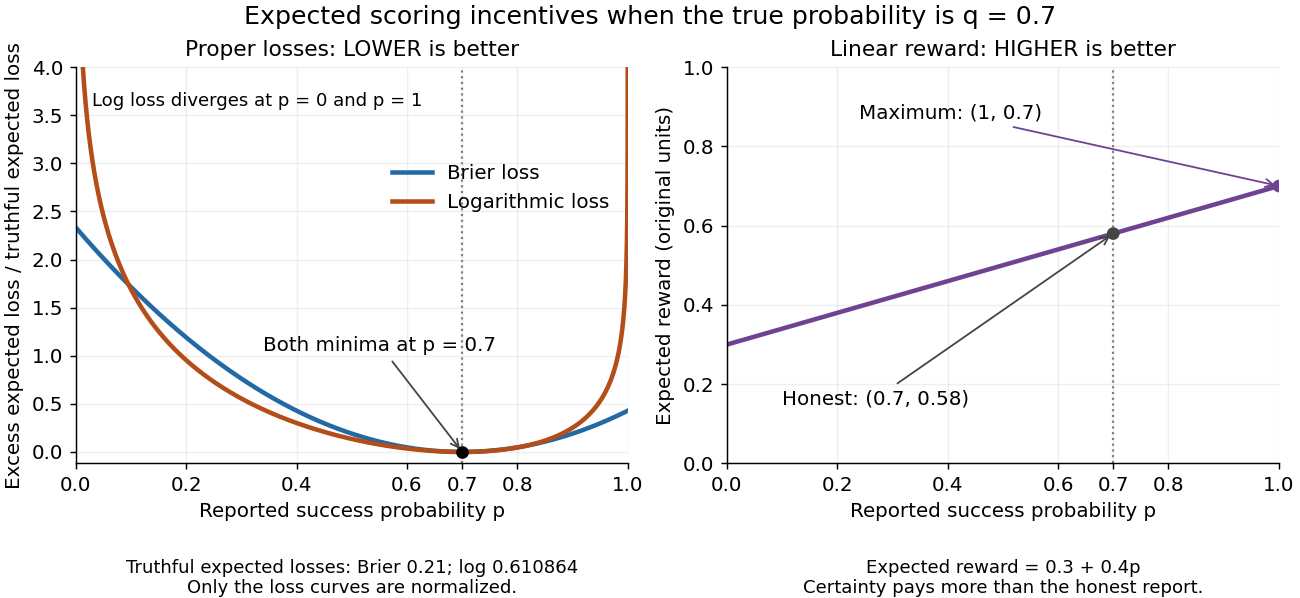
Expected losses of the Brier score and logarithmic scoring rule favor ; the linear probability score rewards
. Details. The left panel displays each excess expected loss divided by that rule's expected loss at : for the Brier score and approximately for the logarithmic scoring rule. This normalization permits comparison of curve shapes and preserves the minimizing report, since it subtracts a constant and divides by a positive constant independent of . Zero means no excess expected loss. The right panel shows the unmodified linear probability score reward, with its maximizing direction labeled explicitly.
The linear probability score pays the reported probability of whichever binary outcome occurs. With report and observed , its reward isIt looks sensible: assign more probability to what happens and receive more reward. But the expected value under a Bernoulli distribution with true success probability isThis is an affine function of the report. When , the maximum over is at ; when , it is at . At , every report ties. Thus the linear probability score encourages reporting certainty about the more likely outcome and is not a proper scoring rule.
For the stipulated , the expected value of the reward is . Honest reporting earns in expectation, whereas earns . The forecaster improves expected reward by replacing a 70% forecast with a 100% forecast. The Brier score and logarithmic scoring rule avoid this incentive, as the expected-score diagram under proper scoring rule shows.
For two equal-mass inward timelike geodesics of unit specific Killing energy, their invariant center-of-mass energy has this finite horizon limit. If both are captured from infinity, Schwarzschild marginally bound capture gives , with a supremum. No such universal bound follows for particles prepared inside the angular-momentum barrier.
These seminorms measure all polynomially weighted derivatives and generate the Fréchet topology of the Schwartz space. Finitely many such bounds control each weighted derivative's integrable norm by adding a spatial decay factor stronger than . Continuity of the Fourier transform follows by applying those bounds after differentiation and integration by parts. Equivalent families use powers of instead of individual monomials.
Schur complement formula for a diagonal resolvent entry by  Codex 0 Created 2026-10-07 Updated 2026-10-14
For a Hermitian matrix, let be its th column without the diagonal entry and let . Solve the two block equations of the inverse against the th coordinate vector to obtain this formula. Both full and minor inverses must exist; nonreal guarantees that. In the real symmetric case may be replaced by .
An accidental massless scalar has zero quadratic mass without being required by the stated broken continuous symmetry. A singlet with potential around is an example: its Hessian matrix vanishes although no continuous symmetry of that single real field protects a mass term. Such a zero mass can require tuning once quantum corrections are included.
The average of the two conformal Newtonian gauge potentials controls scalar gravitational lensing. A conformal rescaling makes the spatial optical metric flat and its time component to first order. Vanishing scalar anisotropic stress makes in general relativity, but lensing depends on their sum even when they differ.
For equal independent binomial samples, the displayed normal-approximation size per group targets a two-sided significance level and power at specified alternative rates, with . Its first variance term sets the null critical value and its second the alternative distribution. A numerical sample size is not determined by an effect ratio alone; power, sidedness, allocation and baseline rates must also be specified. Rare-event discreteness and clustered designs can materially change the achieved power.
Pinned article: Introduction to the OurBigBook Project
Welcome to the OurBigBook Project! Our goal is to create the perfect publishing platform for STEM subjects, and get university-level students to write the best free STEM tutorials ever.
Everyone is welcome to create an account and play with the site: ourbigbook.com/go/register. We belive that students themselves can write amazing tutorials, but teachers are welcome too. You can write about anything you want, it doesn't have to be STEM or even educational. Silly test content is very welcome and you won't be penalized in any way. Just keep it legal!
Intro to OurBigBook
. Source. We have two killer features:
- topics: topics group articles by different users with the same title, e.g. here is the topic for the "Fundamental Theorem of Calculus" ourbigbook.com/go/topic/fundamental-theorem-of-calculusArticles of different users are sorted by upvote within each article page. This feature is a bit like:
- a Wikipedia where each user can have their own version of each article
- a Q&A website like Stack Overflow, where multiple people can give their views on a given topic, and the best ones are sorted by upvote. Except you don't need to wait for someone to ask first, and any topic goes, no matter how narrow or broad
This feature makes it possible for readers to find better explanations of any topic created by other writers. And it allows writers to create an explanation in a place that readers might actually find it.
Figure 1. Screenshot of the "Derivative" topic page. View it live at: ourbigbook.com/go/topic/derivativeVideo 2. OurBigBook Web topics demo. Source. - local editing: you can store all your personal knowledge base content locally in a plaintext markup format that can be edited locally and published either:This way you can be sure that even if OurBigBook.com were to go down one day (which we have no plans to do as it is quite cheap to host!), your content will still be perfectly readable as a static site.
- to OurBigBook.com to get awesome multi-user features like topics and likes
- as HTML files to a static website, which you can host yourself for free on many external providers like GitHub Pages, and remain in full control

Figure 2. You can publish local OurBigBook lightweight markup files to either OurBigBook.com or as a static website.
Figure 3. Visual Studio Code extension installation.
Figure 5. . You can also edit articles on the Web editor without installing anything locally. Video 3. Edit locally and publish demo. Source. This shows editing OurBigBook Markup and publishing it using the Visual Studio Code extension. 
- Infinitely deep tables of contents:



All our software is open source and hosted at: github.com/ourbigbook/ourbigbook
Further documentation can be found at: docs.ourbigbook.com
Feel free to reach our to us for any help or suggestions: docs.ourbigbook.com/#contact