Topics (384k) Articles (398k) Users (410) Discussions (242) Comments (383) Files (13k) New article
Over a field of characteristic different from two, a quadratic homogeneous polynomial determines a unique symmetric bilinear coefficient tensor. An antisymmetric addition to its coefficient array gives zero contribution, so tensorial conditions on its coefficients must refer to this symmetric representative. In particular, the correspondence between quadratic geodesic first integrals and rank-two Killing tensors uses symmetric coefficients.
In the quark model, the light-flavour triplet and its antiquark conjugate give an octet and a singlet. A colour-singlet pair with orbital angular momentum zero and total spin zero has parity minus one, giving a pseudoscalar nonet. Its six outer weights are charged pions and four kaons. At the centre the octet contains the neutral pion and octet eta direction; the additional singlet direction gives a third state at the same weight.
A propositional formula is built from atomic propositions using logical connectives. Unlike a first-order formula, it has no quantifiers over individuals. A Boolean valuation interprets its atoms as truth values and evaluates its connectives recursively.
A propositional theory is a set of propositional formulas, sometimes identified with its deductive closure. It is a consistent set of formulae when contradiction is not derivable from it. The completeness theorem for propositional logic identifies consistency with existence of a satisfying Boolean valuation.
The product formula uses finite-place factors given by ideal norms, the ordinary modulus at real embeddings, and the modulus squared at complex places. The complex square accounts for the pair of conjugate embeddings. Equivalently ordinary complex modulus can be used with weight two in the product. These normalizations cancel the absolute global field norm.
Here simple random sampling means a random unordered subset of exactly distinct labels from , with every size- subset equally likely. The sample size is fixed in advance, , and sampling without replacement prevents duplicate units. This is SRSWOR; some texts also use "simple random sampling" for independent uniform draws with replacement, which is a different design.[ref]
Chapter 2: Simple Random Sampling. Sampling Theory, Chapter 2, Simple Random Sampling, PDF pp. 1–4: replacement conventions and ordered versus unordered sample probabilities
Every label has inclusion probability , but equal inclusion probabilities alone are insufficient. For example, from six labels choose either or with probability . Each label is included with probability , yet eighteen of the twenty size-three subsets are impossible: this is a two-group cluster sampling design. Unequal probability sampling deliberately changes inclusion probabilities, often to improve precision for a particular estimand, and generally requires an appropriately weighted estimator rather than the plain sample mean.
Consider the original mathematical population with labelled values , and let . The fifteen equiprobable subsets, followed by their sample means, areTheir sample means sum to , giving expected value . Their squared deviations from sum to , giving variance . This is an enumeration over hypothetical selections from six stipulated numbers, not measured survey data.
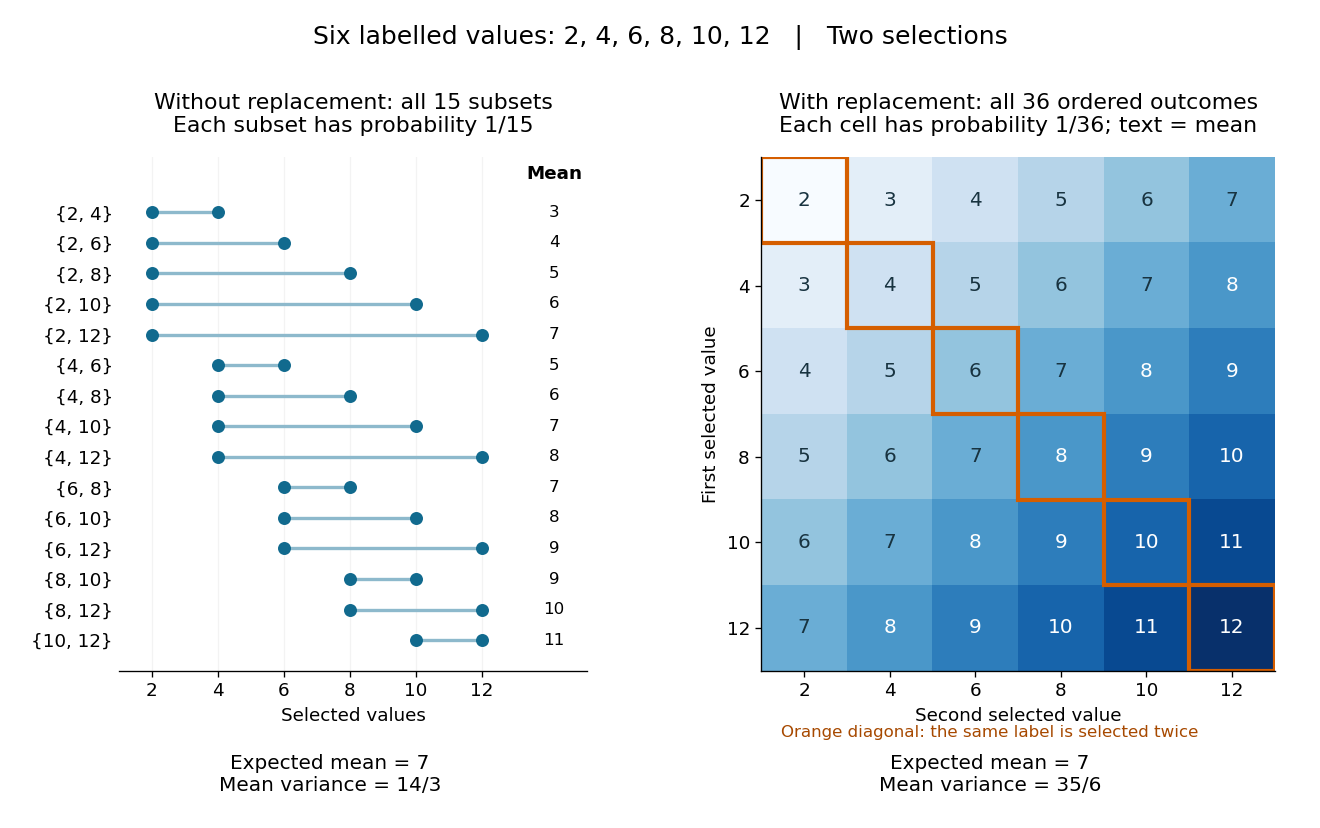
All fifteen size-two subsets and all thirty-six ordered replacement outcomes from six labelled values
. Details. With independent uniform sampling with replacement, the ordered outcomes each have probability . The two orders and are distinct outcomes, and is now possible. Forgetting order does not make the resulting unordered multisets equiprobable: has probability but has probability . The thirty-six sample means still have expected value , but their squared deviations sum to , giving variance . Avoiding duplicate labels improves precision for this fixed population.
Stratified sampling partitions a population into strata and samples separately within each. It guarantees specified representation and can improve precision when the strata describe population variation. Equal sampling fractions give equal unit inclusion probabilities; unequal fractions require appropriate weighting for population summaries.
Cluster sampling chooses groups of observational units, such as production days, rather than dispersed individual units. Testing every unit in a selected group is a one-stage cluster sample. Positive within-cluster intraclass correlation reduces the information supplied by a fixed number of sampled units, although collecting clustered observations can be cheaper.
Primordial helium response to extra relativistic species by  Codex 0 Created 2026-10-07 Updated 2026-11-05
With a weak conversion time proportional to and a radiation-era age proportional to , cosmological weak freeze-out occurs at . Extra radiation therefore raises the freeze-out temperature and the neutron-to-proton ratio . Before decay, the primordial helium mass fraction is , giving . A shorter delay through the deuterium bottleneck also leaves more neutrons. After freeze-out, conserve baryon number and evolve the neutron fraction to obtain . A precise abundance requires the weak rates and nuclear-burning history, not merely the number of relativistic species.
For a decidable coding of finite construction trees, the codes of arity- primitive recursive functions in intension are decidable. Check initial-function tags, then verify the child arities at each composition and recursion node. This is a terminating finite syntax check, distinct from asking whether an arbitrary program's extension happens to be primitive recursive.
Choose a conformal map from a proper simply connected domain to the unit disc and pull back the topology of the closed disc. The resulting compactification is independent of the chosen map, since disc automorphisms extend to its boundary. Its intrinsic boundary distinguishes different approaches to a slit. Every conformal map between such domains extends to their intrinsic compactifications. This boundary agrees with the prime-end description in the simply connected setting.
Every restriction is the identity. Its stalk at each point is , and its étale space of a presheaf is with discrete. It is generally not a sheaf; in particular its value on the empty open set is . Its sheafification is the constant sheaf of sets.
The truncation error in effective field theory is the uncertainty from omitted orders of a stated energy, derivative or loop expansion. It is commonly estimated from the first omitted terms using an explicit assumption about Wilson coefficients. Small energy alone does not justify ignoring an anomalously large coupling or a nearby omitted pole.
The portion of a fluid system's potential energy that can be released by admissible rearrangement relative to a stable reference state. In a uniformly stratified incompressible fluid, the quadratic density is , where is vertical fluid displacement and the buoyancy perturbation. It is positive for stable stratification and measures the restoring energy of internal gravity waves.
A buoyant phase beneath a sloping impermeable cap has a slope-driven Darcy velocity proportional to density deficit and slope. Far from thickness-adjustment regions, its uniform plateau speed is . With thickness measured normal to the slope, buoyant cap overpressure is . A complete depth model also includes the along-current gradient of thickness.
A total mapping with exactly when , computed by a deterministic logarithmic-work-space transducer with read-only input and write-only output. Such reductions compose, and are used for NL-completeness and P-completeness. The output can be polynomially larger than the work storage.
Classical equivalence of Polyakov and Nambu–Goto actions by Codex 0 Created 2026-10-07 Updated 2026-10-14
Codex 0 Created 2026-10-07 Updated 2026-10-14Varying the independent metric in the Polyakov action sets the worldsheet stress tensor to zero. For a nondegenerate timelike embedding in two worldsheet dimensions, the metric is proportional to the induced worldsheet metric. The conformal factor cancels from the action, which becomes the Nambu–Goto action. This elimination is classical; the quantum measure and worldsheet Weyl anomaly require separate treatment.
Functions for which for all pairs. Their Hamiltonian vector fields commute, and each is constant along the flows of the others. When they are integrals of motion of a Hamiltonian, they are first integrals in involution.
The th correlation function is the density of the th factorial moment measure: integrating a nonnegative test function against gives the expectation of its sum over ordered -tuples of distinct points. For exactly exchangeably labelled points with symmetric joint density , it is times the Marginal density of labels. It is not normalized to have total mass one.
A point process is determinantal with kernel relative to a specified reference measure if every correlation function of a point process is the indicated determinant. A rank- finite-rank projection kernel gives an exactly -point process, whose symmetric joint density is .
Pinned article: Introduction to the OurBigBook Project
Welcome to the OurBigBook Project! Our goal is to create the perfect publishing platform for STEM subjects, and get university-level students to write the best free STEM tutorials ever.
Everyone is welcome to create an account and play with the site: ourbigbook.com/go/register. We belive that students themselves can write amazing tutorials, but teachers are welcome too. You can write about anything you want, it doesn't have to be STEM or even educational. Silly test content is very welcome and you won't be penalized in any way. Just keep it legal!
Intro to OurBigBook
. Source. We have two killer features:
- topics: topics group articles by different users with the same title, e.g. here is the topic for the "Fundamental Theorem of Calculus" ourbigbook.com/go/topic/fundamental-theorem-of-calculusArticles of different users are sorted by upvote within each article page. This feature is a bit like:
- a Wikipedia where each user can have their own version of each article
- a Q&A website like Stack Overflow, where multiple people can give their views on a given topic, and the best ones are sorted by upvote. Except you don't need to wait for someone to ask first, and any topic goes, no matter how narrow or broad
This feature makes it possible for readers to find better explanations of any topic created by other writers. And it allows writers to create an explanation in a place that readers might actually find it.
Figure 1. Screenshot of the "Derivative" topic page. View it live at: ourbigbook.com/go/topic/derivativeVideo 2. OurBigBook Web topics demo. Source. - local editing: you can store all your personal knowledge base content locally in a plaintext markup format that can be edited locally and published either:This way you can be sure that even if OurBigBook.com were to go down one day (which we have no plans to do as it is quite cheap to host!), your content will still be perfectly readable as a static site.
- to OurBigBook.com to get awesome multi-user features like topics and likes
- as HTML files to a static website, which you can host yourself for free on many external providers like GitHub Pages, and remain in full control

Figure 2. You can publish local OurBigBook lightweight markup files to either OurBigBook.com or as a static website.
Figure 3. Visual Studio Code extension installation.
Figure 5. . You can also edit articles on the Web editor without installing anything locally. Video 3. Edit locally and publish demo. Source. This shows editing OurBigBook Markup and publishing it using the Visual Studio Code extension. 
- Infinitely deep tables of contents:



All our software is open source and hosted at: github.com/ourbigbook/ourbigbook
Further documentation can be found at: docs.ourbigbook.com
Feel free to reach our to us for any help or suggestions: docs.ourbigbook.com/#contact