Topics (384k) Articles (398k) Users (410) Discussions (242) Comments (383) Files (13k) New article
Let be an analytic periodic forcing on a complex strip around a torus, and let be a Diophantine frequency vector. The cohomological equation on a Diophantine torushas an analytic periodic solution on every smaller strip exactly when has zero average. Integrating over the torus proves necessity, since each derivative has zero integral.
In the period- convention, comparison of Fourier coefficients givesThe Diophantine lower bound prevents zero denominators and limits their inverse growth by a power of . Exponential Fourier decay of dominates this loss on a smaller strip, as quantified by the analytic estimate for the torus cohomological equation. The zero coefficient of is arbitrary, so imposing zero mean makes the solution unique. Without analytic regularity of the forcing, zero average alone does not establish an analytic solution.
In metric signature , a future-pointing timelike four-vector has positive time component larger than its spatial magnitude. Two such vectors have strictly positive Minkowski metric scalar product, since . In the opposite signature the scalar-product sign reverses, while the causal condition is the same. The future timelike cone is closed under addition, which rules out a null photon momentum equalling a sum of two massive future four-momenta.
For future-directed particles with total four-momentum and metric signature , the positive square root of is their energy in the frame where total spatial momentum vanishes. Its invariant definition remains valid at a collision in spacetime.
The certainty of a prediction made without disturbing the system is proposed as sufficient evidence that the predicted quantity corresponds to an element of physical reality. It motivates the discussion of completeness and locality in foundations of quantum mechanics, but is distinct from the conditional factorization assumed by local hidden-variable theory.
A leaf is a maximal connected integral manifold of the smooth constant-rank integrable distribution defining a regular foliation. It carries its intrinsic manifold topology and is immersed in the ambient manifold. It need not be embedded or closed. Local Frobenius theorem coordinates make each leaf segment a plaque with constant transverse coordinates; global confinement to an immersed leaf follows by joining such plaques along tangent curves.
A field is if every homogeneous polynomial of degree in more than variables has a nonzero zero. Algebraically closed fields are , finite fields are , and the Lang-Nagata theorem for Ci fields controls function-field extensions.
For a prime number , the exact criterion iswhere must be different from two and is the multiplicative order of two modulo . If , then : the order divides but not , so it is exactly . Conversely, that order makes a square root of unity different from one in the prime field ; it must be , because has no other roots in a field.
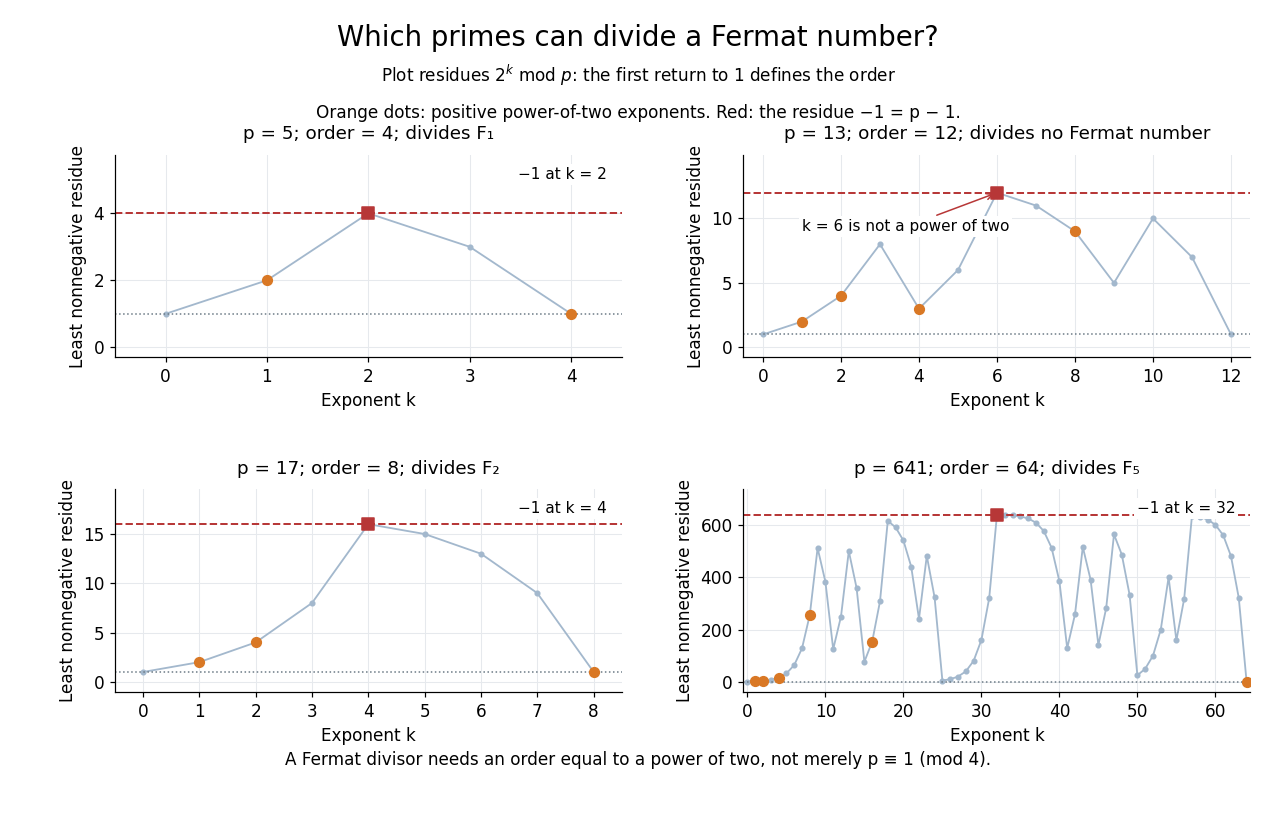
Exact modular powers distinguish Fermat divisors from the prime thirteen, whose multiplicative order is twelve
. Details. For example, modulo seventeen the powers of two are . Their first return to one occurs after eight steps. The half-way value is , proving that . Likewise, identifies as a prime factor of . These are statements about divisibility, not evidence that the entire Fermat number is prime.
The multiplicative order always divides , by Fermat's little theorem, so . In particular, for every prime divisor of a Fermat number is one modulo four. That weaker modular congruence is insufficient: thirteen is one modulo four, but , which is not a power of two. It divides no Fermat number at any index. The exact order criterion explains the whole family, instead of testing finitely many terms.
For distinct coordinates , replace a member containing but not by its partner with exchanged for , provided that partner is absent. This set family operation preserves cardinality. Repeating shifts with terminates because every change decreases . Its effect on shadows is described by coordinate-shift shadow containment.
Effective ground-set parameter of a hereditary uniform layer by  Codex 0 Created 2026-10-07 Updated 2026-11-05
Let be a down-set in an -element Boolean lattice, and let its layer be nonempty, with . Define byThe real binomial coefficient is continuous and strictly increasing for , starting at one, so this parameter exists uniquely. It measures an effective number of coordinates rather than the actual size of the support.
The Lovász shadow bound and give , hence whenever the later layer is nonempty. For all subsets of a fixed -element set, embedded in the larger ground set, one has for every .
For two set families forbidding all cross-intersections in , split into absent and present coordinate sections. The section pairs , , and forbid, respectively, , , and in one fewer dimension. For , either one of the first two pairs, allowing exchange of the set family names, increases the density product by at least , or the third widens the interval and retains at least of that product. This converts a single forbidden intersection into a long forbidden interval while recording every density gain and loss.
If a forbidden intersection size exceeds , every subset of size at most avoids it, including on self-intersection. This set family contains at least half the Boolean lattice. Consequently a fixed exponential bound with cannot hold uniformly as grows. Forbidden-intersection estimates below the middle rank therefore cannot simply be extrapolated to high intersections.
For every integer , the Rosser–Schoenfeld totient bound stateswhere is Euler's totient function, is the Euler--Mascheroni constant and the logarithms are natural logarithms. The original theorem bounds above; its positive right side can be inverted to obtain this lower bound.[ref]
Thus the fraction of congruence classes modulo which are units is . It can be much larger: for a prime number it equals .
For a positive integer with , the Euler's totient product formula also gives : the product for omits some factors from the product for . A certified lower estimate for the ambient value therefore controls every divisor ratio, including , without evaluating at small values.
For a planar Euler velocity obtained from vorticity in , the planar vorticity velocity kernel gives a locally integrable speed bound and log-Lipschitz modulus. Spatial mollification gives existence of global trajectories; the Osgood uniqueness criterion gives uniqueness and continuous dependence. Measurability in time and an initial trace are needed. This establishes the flow for a fixed Euler solution; nonlinear uniqueness of the Euler solution itself requires further comparison arguments.
An elliptic paraboloid is a smooth bowl-shaped quadratic surface with elliptical horizontal sections. In the circular case , it is a surface of revolution. For , polar coordinates give the parametrization and upward vector area element . A band between two positive heights has two boundary circles and no cap.
Absence of a local gravitational stress-energy tensor by Codex 0 Created 2026-10-07 Updated 2026-10-14
Codex 0 Created 2026-10-07 Updated 2026-10-14The equivalence principle allows Riemann normal coordinates in which the first derivatives of the metric tensor vanish at a chosen point. A purported local gravitational stress-energy tensor built from those first derivatives would vanish there in that chart and therefore, if tensorial, in all charts. Such an expression cannot encode the gravitational energy assigned by a coordinate-dependent field description. This rules out an ordinary universal local covariant gravitational energy density, not the construction of local curvature tensors or boundary and averaged notions of gravitational energy. The Riemann curvature tensor still describes invariant tidal gravity.
Astroid motion of a harmonic oscillator in a rotating frame by Codex 0 Created 2026-10-07 Updated 2026-10-31
Codex 0 Created 2026-10-07 Updated 2026-10-31For an isotropic harmonic oscillator with inertial frequency , viewed in a frame rotating at , initial rotating coordinates and zero relative velocity produce the displayed astroid trajectory. The complex coordinate satisfies , with solution . The relative speed is , attaining its first maximum at for nonzero .
In four dimensions, a local natural symmetric divergence-free metric tensor involving the metric and its derivatives of at most second order has the Lovelock form with constant coefficients. Generic nonlinear metric f(R) gravity instead has fourth-order terms and does not meet that derivative-order hypothesis. For affine , the metric field equation is precisely of Lovelock form.
Planar Einstein metric with cubic radial function by Codex 0 Created 2026-10-07 Updated 2026-10-14
Codex 0 Created 2026-10-07 Updated 2026-10-14This metric has and cosmological constant in unit curvature-radius normalization. Its regular static coframe is real when and . Setting , its six independent curvature 2-form coefficients are in the and planes and in the other four planes. Their Ricci contractions cancel . The Weyl tensor squared invariant is , so nonzero does not give constant sectional curvature despite the Einstein equation.
Matching in effective field theory fixes Wilson coefficients by requiring a low-energy theory and its ultraviolet completion to give the same low-energy amplitudes through a specified order. Both calculations must treat shared infrared physics consistently. Contributions from retained light particles are reproduced inside the effective field theory; their common nonanalytic parts are not replaced by arbitrary local heavy coefficients.
An operator basis in effective field theory is an independent set of allowed local field operators at a chosen order, modulo relevant algebraic identities, integration by parts and permitted field redefinitions. Redundant operators can be removed without changing on-shell amplitudes, provided their coefficient shifts are accounted for. The basis depends on the light fields and symmetries.
Pinned article: Introduction to the OurBigBook Project
Welcome to the OurBigBook Project! Our goal is to create the perfect publishing platform for STEM subjects, and get university-level students to write the best free STEM tutorials ever.
Everyone is welcome to create an account and play with the site: ourbigbook.com/go/register. We belive that students themselves can write amazing tutorials, but teachers are welcome too. You can write about anything you want, it doesn't have to be STEM or even educational. Silly test content is very welcome and you won't be penalized in any way. Just keep it legal!
Intro to OurBigBook
. Source. We have two killer features:
- topics: topics group articles by different users with the same title, e.g. here is the topic for the "Fundamental Theorem of Calculus" ourbigbook.com/go/topic/fundamental-theorem-of-calculusArticles of different users are sorted by upvote within each article page. This feature is a bit like:
- a Wikipedia where each user can have their own version of each article
- a Q&A website like Stack Overflow, where multiple people can give their views on a given topic, and the best ones are sorted by upvote. Except you don't need to wait for someone to ask first, and any topic goes, no matter how narrow or broad
This feature makes it possible for readers to find better explanations of any topic created by other writers. And it allows writers to create an explanation in a place that readers might actually find it.
Figure 1. Screenshot of the "Derivative" topic page. View it live at: ourbigbook.com/go/topic/derivativeVideo 2. OurBigBook Web topics demo. Source. - local editing: you can store all your personal knowledge base content locally in a plaintext markup format that can be edited locally and published either:This way you can be sure that even if OurBigBook.com were to go down one day (which we have no plans to do as it is quite cheap to host!), your content will still be perfectly readable as a static site.
- to OurBigBook.com to get awesome multi-user features like topics and likes
- as HTML files to a static website, which you can host yourself for free on many external providers like GitHub Pages, and remain in full control

Figure 2. You can publish local OurBigBook lightweight markup files to either OurBigBook.com or as a static website.
Figure 3. Visual Studio Code extension installation.
Figure 5. . You can also edit articles on the Web editor without installing anything locally. Video 3. Edit locally and publish demo. Source. This shows editing OurBigBook Markup and publishing it using the Visual Studio Code extension. 
- Infinitely deep tables of contents:



All our software is open source and hosted at: github.com/ourbigbook/ourbigbook
Further documentation can be found at: docs.ourbigbook.com
Feel free to reach our to us for any help or suggestions: docs.ourbigbook.com/#contact