Topics (384k) Articles (398k) Users (410) Discussions (242) Comments (383) Files (13k) New article

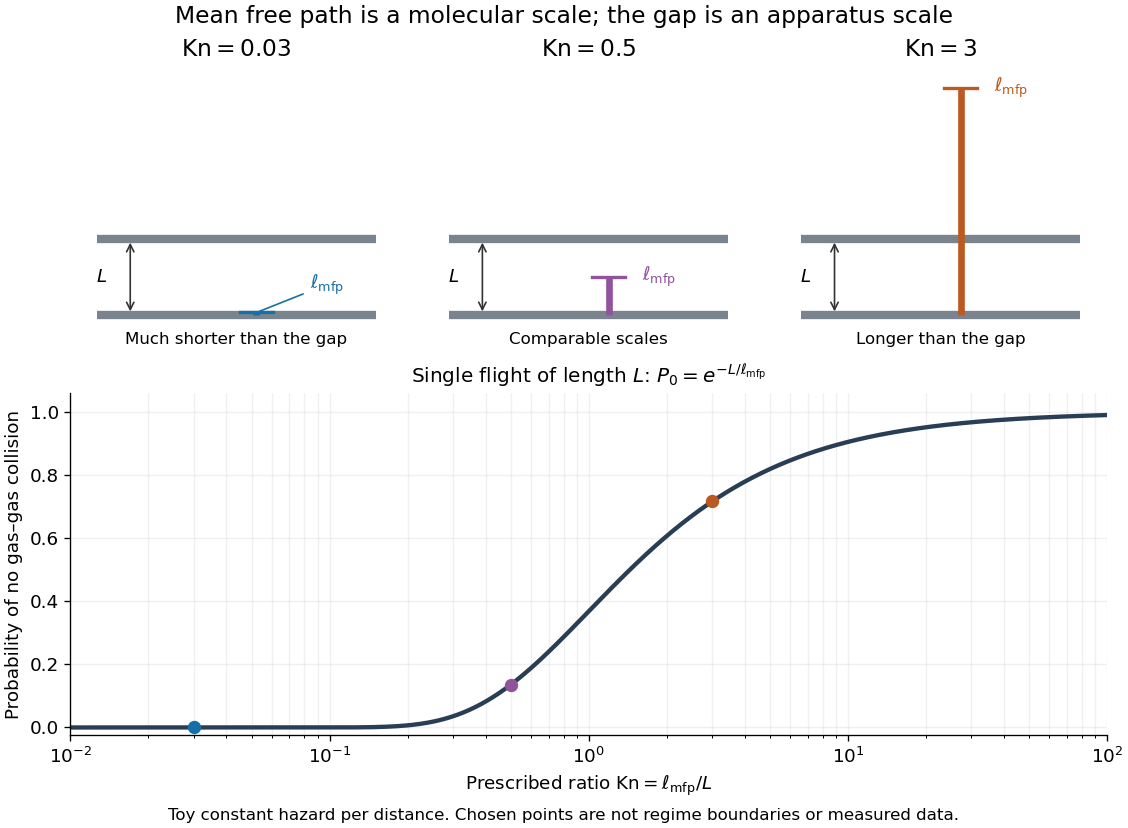
The Knudsen number is the dimensionless ratio of an intermolecular mean free path to a specified characteristic length of the apparatus or flow. The mean free path measures the distance travelled between gas–gas collisions; measures the distance over which boundaries or macroscopic conditions matter. Wall encounters must not be counted as gas–gas collisions in this comparison: doing so would hide the very wall-dominated behavior we want to detect. The same gas can therefore have a small Knudsen number in a large vessel and a large Knudsen number in a tiny opening.
For a dilute hard-sphere gas of identical molecular diameter in thermal equilibrium, use the conventionHere is the number density, the pressure, the absolute temperature, and the Boltzmann constant; the second equality uses the ideal gas law. The collision cross-section is , and the accounts for both partners moving with independent equilibrium velocities. Mixtures and velocity-dependent collision cross-sections require a stated molecular model and mean free path convention; the displayed expression is not an exact formula for every real gas. [ref]
https://farside.ph.utexas.edu/teaching/355/Surveyhtml/node219.html. Fitzpatrick, Mean Free Path, equations 5.209–5.219
[ref]https://arxiv.org/abs/1309.1197. Steve T. Paik, Is the mean free path the mean of a distribution?, dilute hard-sphere equilibrium convention
As a numerical toy example, choose and , without claiming that this is a measured molecular diameter for a particular gas. The formula gives at . It yields for a vessel but for a gap. At the same toy gas has , comparable to the centimetre vessel. Reducing either pressure or apparatus size can thus expose molecular transport.
Choose for the question being asked: a tube diameter compares the mean free path with wall separation, while tube length describes a different geometric scale. For a positive macroscopic field , a local gradient scale can instead be , where its gradient is nonzero. A large vessel can contain a thin region with a large local Knudsen number. Small geometric Knudsen number alone does not guarantee a slowly varying near-equilibrium flow. The time, velocity and space scalings must also be stated when the Knudsen number appears as a coefficient in a Boltzmann equation. [ref]
https://ntrs.nasa.gov/citations/20230013741. NASA, Comparison Between DSMC and CFD for Hypersonic Planetary Entry Simulations (2023), local gradient-length breakdown analysis
For hard particles in a fixed macroscopic volume, shrink their diameter while keeping of order one. The occupied volume fraction tends to zero, but the mean free path stays macroscopic. Deriving the Boltzmann equation in this dilute limit requires control of recollisions and propagation of an incoming independence hypothesis related to molecular chaos for the Boltzmann equation. Its validity is not an automatic all-time consequence of small particle size.
Map each real into by a fixed bijection, choose its canonical binary expansion, and alternate the two bit sequences as ternary digits and . If two such outputs first differ at position , the leading difference has size and the remaining tail has size at most , so they are unequal. This gives an explicit injection pairing two reals. Iteration encodes every fixed finite real tuple without invoking ambiguous decimal expansions.
A bounded subset of is a Kakeya set if it contains a unit line segment in every direction. Segment positions may vary with direction. Such a set need not have positive Lebesgue measure; the dimension problem concerns its Minkowski dimension or other notions of dimension.
For distinct real affine lines in , , a joint of a line collection is a point lying on lines with linearly independent direction vectors. In three dimensions the directions must not all lie in one plane. Extra incident lines are allowed; existence of one spanning choice is enough. This counts joint of a line collection points, rather than tuples of lines or incidence multiplicities.
Gaussian blur applies convolution with to an image signal. It averages over a spatial scale , suppressing rapid variation while also blurring image edges. The heat-kernel convolution realizes this filter at time .
A median filter replaces an image signal value by the median of nearby values. Unlike a linear average, it can reject isolated extreme observations without averaging both sides of an image edge. The small-radius response depends on neighbourhood geometry and measure; a uniform disk-area median and a circle-boundary median have different time scales.
A six-sided polygon in the hyperbolic plane whose sides are geodesic segments. The especially useful right-angled case is a right-angled hyperbolic hexagon.
This stable hydrogen isotope has one proton and one neutron. In the Proton–proton chain it is produced by the slow weak proton-pair reaction and is rapidly consumed by proton capture to make helium-3. Its short nuclear lifetime inside a stellar core allows a deuterium quasi-equilibrium in proton-proton burning approximation.
A perturbation preserving both values and slopes has at the endpoints. Apply the Poincaré inequality to and then to . The resulting inequality makes a quadratic second variation proportional to nonpositive. If a functional is quadratic, its exact expansion about a stationary function then proves a global maximum.
This stable helium isotope contains two protons and one neutron. In solar proton-proton burning it is an intermediate: two such nuclei can form helium-4 and return two protons, or one can capture helium-4 to enter the second chain branch. The balance between production and destruction determines the helium-3 equilibrium abundance and its helium-3 relaxation time.
The uncentered maximal function takes the supremum over all open Euclidean balls containing , not only balls centred at . It is an extended nonnegative lower semicontinuous function: each strict superlevel set is the union of the balls whose average density exceeds that level. For finite positive measures it satisfies the uncentered maximal weak-type inequality.
In a first-order light-deflection calculation, evaluate the Weyl lensing potential and its gradients on the unperturbed null geodesic. The position correction is first order, so inserting it into an already first-order potential produces a second-order correction. This approximation omits repeated deflection and lens-lens coupling.
When gravitational lensing gives small angular distortions without generic multiple imaging, its deflection field changes source positions, magnification and shear. Angular derivatives of the lensing potential determine these distortions. Ensemble galaxy-shape distortions and cosmic microwave background remapping probe the foreground gravitational field.
An orientation of a graph keeps the same vertex set and the same individual edges. For every edge with distinct endpoints, choose exactly one directed edge, either or . Replacing it by both arrows is a different construction: it doubles the edges and permits travel both ways along that connection. In an orientation of a graph, the return journey must use another route.[ref]
The Basics (author-hosted chapter preview). §1.10, printed p. 28: an orientation retains the vertex and edge sets and assigns initial and terminal endpoints
All examples below use finite simple graphs: no self-loops and no multiple edges. For a multigraph, each individual nonloop edge receives its own direction, so two multiple edges can point in opposite directions. A self-loop becomes , which is already a directed cycle of length one and therefore prevents an acyclic orientation. A finite simple graph with edges has orientations of a graph, since the two choices for each edge are independent.
Think of vertices as junctions and edges as streets. An orientation of a graph makes each street one-way; reachability asks whether a legal journey exists from one specified junction to another. Two useful aims pull in different directions: an acyclic orientation rules out circular dependencies, while a strong orientation permits journeys between every ordered pair of junctions.
A graph property is a class of finite graphs closed under isomorphism. Its labelled order- slice consists of members on vertex set . Closure under taking arbitrary subgraphs and closure under taking only induced subgraphs lead respectively to subgraph-closed graph properties and hereditary graph properties.
A nonsmooth gradient flow driven by the subdifferential of a convex function. Explicit discretization gives the forward subgradient step; implicit discretization gives the proximal operator. Monotonicity of a convex subdifferential underlies uniqueness and contraction properties.
The completed-square form gives global minima at and , both with value , and a saddle point at with value zero. Negative levels split into two closed components; the zero contour joins their lobes at the saddle. The gradient flow decreases by the gradient-flow dissipation identity. A negative initial level traps each trajectory on its original side of , because .
The Burger number compares the square of a relevant deformation radius with the square of the horizontal flow scale: . In a two-layer geostrophic model . Its inverse measures the scale ratio of baroclinic available potential energy to kinetic energy. Keeping it of order unity retains both interface and relative-vorticity contributions in QG scaling.
A horizontal scale comparing gravitational or buoyancy restoring forces with rotation. For a shallow-water gravity mode with propagation speed , the deformation radius is . The barotropic deformation radius uses ; internal layered modes use a speed set by reduced gravity and layer depths.
Pinned article: Introduction to the OurBigBook Project
Welcome to the OurBigBook Project! Our goal is to create the perfect publishing platform for STEM subjects, and get university-level students to write the best free STEM tutorials ever.
Everyone is welcome to create an account and play with the site: ourbigbook.com/go/register. We belive that students themselves can write amazing tutorials, but teachers are welcome too. You can write about anything you want, it doesn't have to be STEM or even educational. Silly test content is very welcome and you won't be penalized in any way. Just keep it legal!
Intro to OurBigBook
. Source. We have two killer features:
- topics: topics group articles by different users with the same title, e.g. here is the topic for the "Fundamental Theorem of Calculus" ourbigbook.com/go/topic/fundamental-theorem-of-calculusArticles of different users are sorted by upvote within each article page. This feature is a bit like:
- a Wikipedia where each user can have their own version of each article
- a Q&A website like Stack Overflow, where multiple people can give their views on a given topic, and the best ones are sorted by upvote. Except you don't need to wait for someone to ask first, and any topic goes, no matter how narrow or broad
This feature makes it possible for readers to find better explanations of any topic created by other writers. And it allows writers to create an explanation in a place that readers might actually find it.
Figure 1. Screenshot of the "Derivative" topic page. View it live at: ourbigbook.com/go/topic/derivativeVideo 2. OurBigBook Web topics demo. Source. - local editing: you can store all your personal knowledge base content locally in a plaintext markup format that can be edited locally and published either:This way you can be sure that even if OurBigBook.com were to go down one day (which we have no plans to do as it is quite cheap to host!), your content will still be perfectly readable as a static site.
- to OurBigBook.com to get awesome multi-user features like topics and likes
- as HTML files to a static website, which you can host yourself for free on many external providers like GitHub Pages, and remain in full control

Figure 2. You can publish local OurBigBook lightweight markup files to either OurBigBook.com or as a static website.
Figure 3. Visual Studio Code extension installation.
Figure 5. . You can also edit articles on the Web editor without installing anything locally. Video 3. Edit locally and publish demo. Source. This shows editing OurBigBook Markup and publishing it using the Visual Studio Code extension. 
- Infinitely deep tables of contents:



All our software is open source and hosted at: github.com/ourbigbook/ourbigbook
Further documentation can be found at: docs.ourbigbook.com
Feel free to reach our to us for any help or suggestions: docs.ourbigbook.com/#contact