Topics (384k) Articles (398k) Users (410) Discussions (242) Comments (383) Files (13k) New article

An electron hole is an unoccupied electron quantum state in an otherwise nearly full energy band, often the valence band. “Filled” refers to occupation of the allowed quantum states, not to filling all space with a continuous fluid of electrons. Each state, including its spin label, can hold at most one electron by the Pauli exclusion principle. The almost full energy band and its few missing occupants are therefore simpler to describe as a background plus a few electron holes. The electron hole is a quasiparticle, not a Positron inserted into the crystal.
Removing an electron of electric charge changes the background's electric charge by . Thus an electron hole carries positive electric charge relative to that background. Promoting an electron into the conduction band creates an electron hole without changing the whole crystal's electric charge: . An unbound pair still consists of two separate charge carriers; only a bound state of their relative motion is an exciton.
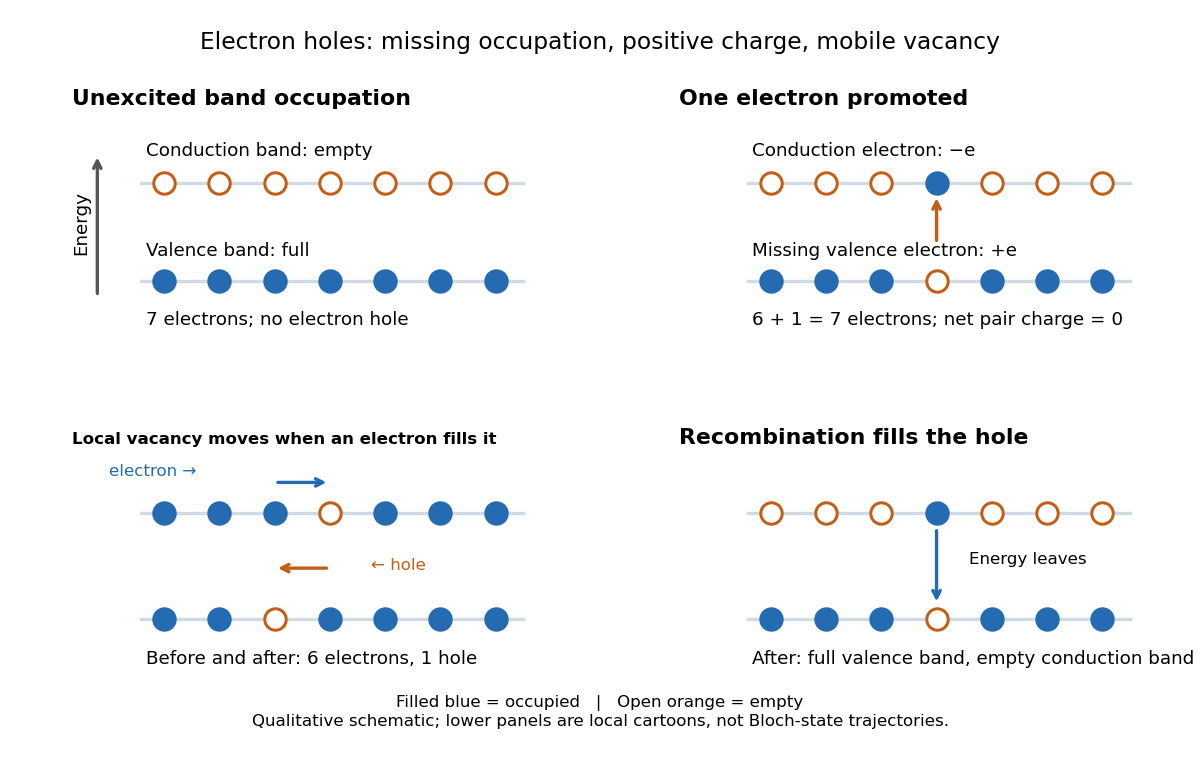
The local cartoon explains why a vacancy can move: when a neighboring electron fills it, another vacancy appears where that electron was. The vacancy has moved opposite to that particular transfer of an electron. In an extended Bloch state, use crystal momentum instead of imagining a permanently empty atomic site. For a completely filled energy band the summed electric current vanishes. Omitting one electron with group velocity removes its contribution , leaving a contribution . This fixes both the positive electric charge and the velocity convention of the electron hole.
More precisely, near a parabolic valence band maximum, set its energy as reference and define the electron hole wave vector by . ThenThe occupied electron branch has negative curvature there, while the electron hole branch has positive effective mass . The velocity equality compares the electron hole with the missing Bloch state's group velocity; it does not contradict the opposite vacancy motion in a local transfer cartoon. The sign conventions are listed in Phys 460 Lecture 17.
An exciton is a bound state of an electron and an electron hole. Their opposite electric charges attract through the Coulomb potential, producing a neutral quasiparticle with internal relative motion and motion of its center of mass. In a semiconductor, promoting an electron from the valence band into the conduction band leaves an electron hole; the pair can occupy either an exciton bound state or an unbound scattering state. Merely creating the two charge carriers does not establish binding. A neutral exciton can transport excitation energy without transporting net electric charge. Coupling this material excitation strongly to a photon can form a polariton.
The striking optical consequence is that an exciton optical transition can absorb a photon with less energy than the threshold for creating unbound electrons and electron holes. The difference is the exciton binding energy, not an extra one-electron energy band inside the band gap. The Wannier-Mott exciton supplies a useful large-radius model; the Frenkel exciton describes the opposite, tightly localized limit.[ref]
Excitons in Semiconductor Quantum Dots by Matjaž Humar. §3, printed pp. 4–6: bound pairs, effective masses and localized contrast
The S-matrix maps incoming asymptotic states to outgoing asymptotic states. Its connected transition matrix elements contain an overall energy-momentum Dirac delta function and an invariant scattering amplitude. In quantum field theory, the LSZ reduction formula obtains these elements from amputated field correlators.
Postselection conditions a quantum measurement on a specified outcome. If its branch acts by a linear operator on a normalized input , its probability is , and its normalized output is . This conditional state is defined only when the probability is nonzero. Physically unsuccessful trials are discarded; postselection is not a deterministic implementation of the nonlinear normalization map.
A finite family of quantum states is antidistinguishable if a quantum measurement has labelled outcomes such that each outcome has zero probability for its corresponding state, while the outcomes form a complete quantum measurement. It can exclude a state without identifying which state was prepared. The PBR exclusion measurement for zero and plus supplies a four-state projective measurement example.
Remote state preparation uses a shared entangled state, local quantum measurements and classical communication to prepare a state known to the sender at the receiver. The sender can tailor the measurement to the desired state, so restricted state families can require less communication than quantum teleportation. A real great-circle family of qubit states admits one-bit remote preparation of real qubit states.
The Fermi level is the chemical potential controlling electron occupations. For an ideal Fermi gas at zero temperature it equals the Fermi energy; at nonzero temperature the chemical potential need not equal that zero-temperature energy.
This Hilbert space has norm . Completeness follows from completeness of H1 space and closedness of the multiplication operator . Smooth cutoffs followed by convolution with a mollifier show that smooth compactly supported functions are dense. The space is the natural energy domain of the dimensionless quantum harmonic oscillator, whereas the operator domain additionally requires and to lie in L2 space.
For a quantum harmonic oscillator with , a complex mode satisfying the Wronskian normalization can be written with . Its vacuum energy is . This is at least , with equality exactly when and . The same argument fixes the subhorizon positive-frequency normalization in the Bunch-Davies vacuum of a canonical cosmological mode.
A free Klein-Gordon field is a scalar obeying in the mostly-plus metric signature. Global hyperbolicity provides a well-defined initial-value problem. Quantization additionally needs a state or positive-norm mode splitting; the equation alone does not select particles.
The Hadamard condition requires the two-point function of a physical free-field state to have the universal local short-distance singularity prescribed by the spacetime geometry and field equation. It permits state-dependent smooth contributions and enables local renormalization of the stress-energy tensor. It does not select a unique Fock vacuum.
QMA is the class of promise problems with a polynomial-size quantum witness checked by a uniform polynomial-size quantum circuit. YES instances have an accepting witness with probability at least ; NO instances have acceptance at most for every witness, including mixed states. The verifier's acceptance is linear in the witness density operator. Inverse-polynomial or exponentially small error can be obtained through QMA error reduction.
StoqMA is a restricted quantum-verifier class using stoquastic circuits and polynomial-size quantum witnesses. A YES instance has a quantum witness accepted with probability at least ; on a NO instance every quantum witness has acceptance at most , with an inverse-polynomial gap . An optimal quantum witness can be chosen with nonnegative amplitudes, since the witness acceptance operator is entrywise nonnegative. The quantum witness is generally a superposition, rather than a computational basis vector. The stoquastic acceptance floor explains the lower limit for a nontrivial soundness promise.
A quantum witness is a polynomial-size quantum state supplied to a verifier as evidence for a YES instance. The verifier fixes its own ancilla qubits independently. Pure quantum witnesses suffice when maximizing a linear acceptance functional on density operators. Quantum witnesses are not generally restricted to basis vectors or product states.
BQP is the class of promise problems decided by uniform polynomial-size quantum circuits with bounded error. Completeness and soundness are conventional; BQP error reduction shows that other fixed separated thresholds give the same class.
A quantum register is a named tensor product factor of a quantum circuit's Hilbert space, usually a collection of qubits. Registers separate data, control, output and workspace roles; uncomputation returns workspace to a fixed quantum state without destroying coherence in the data.
Measurement-based quantum computation prepares an entangled resource quantum state, then applies single-qubit quantum measurements, potentially adapting later bases to earlier outcomes. Pauli frame tracking and classical outcome processing convert random physical branches into a specified logical computation. Graph states and one-bit teleportation provide a concrete construction.
A unitary operation on a fixed number of qubits used as a component of a quantum circuit. Examples include the Hadamard gate and Controlled-Z gate. Measurements are described separately by quantum measurement; a gate is a reversible operation on its full input state.
A computational history state coherently records a circuit's intermediate states with orthogonal clock labels: . A propagation term penalizes a mismatch between adjacent time labels and the corresponding gate. With correct propagation, uniform coefficients form a zero-energy ground state within the history subspace.
Pinned article: Introduction to the OurBigBook Project
Welcome to the OurBigBook Project! Our goal is to create the perfect publishing platform for STEM subjects, and get university-level students to write the best free STEM tutorials ever.
Everyone is welcome to create an account and play with the site: ourbigbook.com/go/register. We belive that students themselves can write amazing tutorials, but teachers are welcome too. You can write about anything you want, it doesn't have to be STEM or even educational. Silly test content is very welcome and you won't be penalized in any way. Just keep it legal!
Intro to OurBigBook
. Source. We have two killer features:
- topics: topics group articles by different users with the same title, e.g. here is the topic for the "Fundamental Theorem of Calculus" ourbigbook.com/go/topic/fundamental-theorem-of-calculusArticles of different users are sorted by upvote within each article page. This feature is a bit like:
- a Wikipedia where each user can have their own version of each article
- a Q&A website like Stack Overflow, where multiple people can give their views on a given topic, and the best ones are sorted by upvote. Except you don't need to wait for someone to ask first, and any topic goes, no matter how narrow or broad
This feature makes it possible for readers to find better explanations of any topic created by other writers. And it allows writers to create an explanation in a place that readers might actually find it.
Figure 1. Screenshot of the "Derivative" topic page. View it live at: ourbigbook.com/go/topic/derivativeVideo 2. OurBigBook Web topics demo. Source. - local editing: you can store all your personal knowledge base content locally in a plaintext markup format that can be edited locally and published either:This way you can be sure that even if OurBigBook.com were to go down one day (which we have no plans to do as it is quite cheap to host!), your content will still be perfectly readable as a static site.
- to OurBigBook.com to get awesome multi-user features like topics and likes
- as HTML files to a static website, which you can host yourself for free on many external providers like GitHub Pages, and remain in full control

Figure 2. You can publish local OurBigBook lightweight markup files to either OurBigBook.com or as a static website.
Figure 3. Visual Studio Code extension installation.
Figure 5. . You can also edit articles on the Web editor without installing anything locally. Video 3. Edit locally and publish demo. Source. This shows editing OurBigBook Markup and publishing it using the Visual Studio Code extension. 
- Infinitely deep tables of contents:



All our software is open source and hosted at: github.com/ourbigbook/ourbigbook
Further documentation can be found at: docs.ourbigbook.com
Feel free to reach our to us for any help or suggestions: docs.ourbigbook.com/#contact