Topics (384k) Articles (398k) Users (410) Discussions (242) Comments (383) Files (13k) New article
An innovation measures the part of the current observation not predicted from past observations. The linear innovation process uses orthogonal projection onto the past linear span. A conditional expectation predictor can use nonlinear information; the two predictors agree for a Gaussian process.
The difference can remove a unit-root stochastic trend. A seasonal difference operator instead subtracts an observation a full seasonal period earlier. Neither operation automatically removes a changing variance.
In a second-order sense a weakly stationary process has short memory when its autocovariance is absolutely summable. Then its spectral density of a stationary process is continuous and its sample-mean variance has the usual finite long-run variance of a stationary process. A central limit theorem still needs additional conditions.
A weakly stationary process can have very slowly decaying autocovariance, for example with and . Its sample mean can require a normalization different from . Long memory is dependence over long lags, rather than a changing marginal distribution.
Seasonality is systematic repetition at a calendar period. It can appear in a deterministic mean, in a periodic variance, or in dependence across seasons. A seasonal difference operator removes a fixed periodic mean but seasonal differencing does not remove periodic variance. A periodic-looking path alone does not prove a nonstationary process.
An ARCH model writes with standardized independent driving noise and a conditional variance . Typically and ensure a positive conditional variance. It allows a changing conditional scale even when is a stationary process.
A linear process is an L2-convergent white-noise filter , with square-summable coefficients. It is weakly stationary, and its autocovariance is . A causal representation restricts the coefficients to ; it is then an infinite moving-average representation.
A state-space model separates a latent transition equation from an observation equation . A complete specification includes the initial-state law and its relation to the noise sequences, not just the two equations. Linear second-order models specify covariance structure; Gaussian versions additionally prescribe joint Gaussian laws.
Diffusion is net transport associated with random microscopic motion. A localized patch of a dilute solute can spread through a stationary solvent: individual molecules move in both directions, but more cross from the crowded side of an imaginary surface than from the less crowded side. This imbalance gives a net diffusive flux down the concentration gradient; the molecules do not need to sense which direction has lower concentration. At uniform concentration, microscopic exchanges continue even though the net diffusive flux vanishes. [ref]
The distinction from advection is easiest to see in a dye patch. Uniform bulk motion carries its centre downstream; diffusion broadens it relative to that centre. Both can happen together. A moving or spreading patch by itself does not identify the mechanism: a nonuniform velocity field can also stretch a patch. [ref]
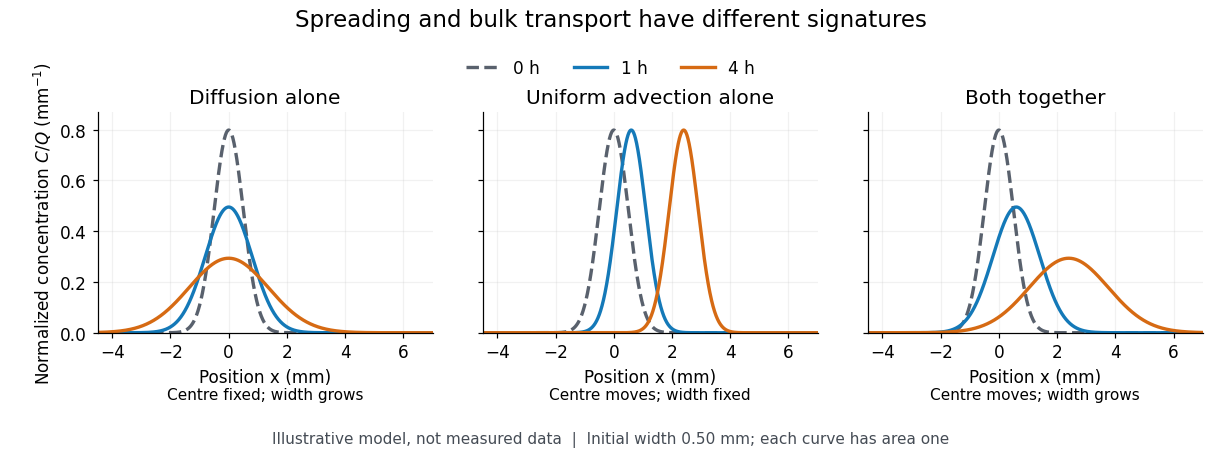
For a dilute nonreacting solute in a uniform medium at fixed temperature, Fick's first law models the relative diffusive flux as , with scalar diffusion coefficient of units . Here is the amount of substance per unit volume, so has units . With carrier velocity field , the total flux is . The continuity equation, with no sources or chemical reactions, givesFor constant and incompressible flow, this reduces to , where is the Laplacian. In a stationary carrier it is the diffusion equation. These assumptions matter: variable must remain inside the divergence, and changing sources require extra terms. [ref]
https://ocw.mit.edu/courses/1-061-transport-processes-in-the-environment-fall-2008/5536a0bf7f3bd0b21fde2169b93a4b5a_lec_02.pdf. Nepf, MIT: conservation with advective and diffusive fluxes
The useful surprise is the common mathematics: thermal conduction smooths temperature through the analogous heat equation, while molecular diffusion smooths composition. This analogy already motivated the original formulation of Fick's laws. [ref]
https://doi.org/10.1080/14786445508641925. Fick (1855), On liquid diffusion: the analogy with heat conduction
However, the thermal diffusivity and the solutal diffusivity need not be equal. A diffusive time scale means that crossing ten times the distance requires roughly one hundred times the time. This is why molecular diffusion is especially effective across thin layers, and why chaotic advection can assist mixing by making those layers thinner. Physical diffusion is a transport mechanism, distinct from the broader probabilistic class of Markov diffusion.At the upper multiplier- threshold of , set . The second iterate is . Since its cubic damping coefficient is positive for , this endpoint is locally asymptotically stable despite the inconclusive linear multiplier.
A Cox–Snell residual is the fitted cumulative hazard function evaluated at an observed event or censoring time: . Its reference probability distribution comes from the probability integral transform. If the true event time has a proper continuous survival function , then satisfiesFor example, an exponential distribution with rate has , so rescaling its event time by produces a unit-rate exponential distribution.
With right censoring, and the transformed observation is together with its original event indicator . Under independent censoring, a Kaplan–Meier estimator applied to these transformed observations should approximately follow ; its logarithm should approximately follow a straight line of slope minus one. Censored residuals must remain censored in this comparison.
The exact exponential identity uses the true model, whereas is estimated from data: fitted residuals are approximate diagnostics and need not be independent exact exponentials. Atoms in a discrete event-time probability distribution, or a cure fraction with positive probability of no finite event, invalidate the unmodified proper-continuous reference law. Such models require diagnostics respecting their jumps or surviving mass.
A survival time is the elapsed time to an event of interest, which may be death, failure, recovery or completion of a task. Its survival function and hazard function describe the event-time law. Right censoring records only that the event time exceeds the observed follow-up time.
Localization of a zero-dimensional polynomial model by  Codex 0 Created 2026-10-06 Updated 2026-11-05
With a nonconstant polynomial, positive area measure and Berezin integration oriented positively, a holomorphic polynomial insertion in equals , where and is the multiplicity of a root. Rescaling by leaves the insertion fixed and localizes it as .
At a vacuum obeying F-flatness and D-flatness, charged scalar field expectation values can break an internal gauge symmetry while preserving supersymmetry. For each broken generator, a massless vector multiplet combines with a chiral superfield into a massive N=1 vector multiplet. The vector absorbs one real Goldstone boson; a real scalar remains, and the gaugino mixes with a higgsino. All four bosonic and four fermionic on-shell states have a common mass.
In four spacetime dimensions, power-counting renormalizability restricts an ungauged chiral action to a canonical quadratic Kähler potential, up to transformations, and a superpotential of degree at most three. Terms of larger degree belong to an effective field theory.
The gravitino is the spin- gauge field of local supersymmetry and the partner of the graviton. A massless four-dimensional gravitino has two physical helicities, ; a massive one has four, adding . The super-Higgs mechanism supplies these extra states from the goldstino.
When local supersymmetry is spontaneously broken, the gravitino absorbs the goldstino and becomes massive. The two goldstino states provide its longitudinal spin- polarizations. With only global supersymmetry breaking, the goldstino remains a physical massless particle. An ordinary supersymmetric Higgs mechanism instead makes an internal spin-one gauge boson massive and can leave supersymmetry unbroken.
Pinned article: Introduction to the OurBigBook Project
Welcome to the OurBigBook Project! Our goal is to create the perfect publishing platform for STEM subjects, and get university-level students to write the best free STEM tutorials ever.
Everyone is welcome to create an account and play with the site: ourbigbook.com/go/register. We belive that students themselves can write amazing tutorials, but teachers are welcome too. You can write about anything you want, it doesn't have to be STEM or even educational. Silly test content is very welcome and you won't be penalized in any way. Just keep it legal!
Intro to OurBigBook
. Source. We have two killer features:
- topics: topics group articles by different users with the same title, e.g. here is the topic for the "Fundamental Theorem of Calculus" ourbigbook.com/go/topic/fundamental-theorem-of-calculusArticles of different users are sorted by upvote within each article page. This feature is a bit like:
- a Wikipedia where each user can have their own version of each article
- a Q&A website like Stack Overflow, where multiple people can give their views on a given topic, and the best ones are sorted by upvote. Except you don't need to wait for someone to ask first, and any topic goes, no matter how narrow or broad
This feature makes it possible for readers to find better explanations of any topic created by other writers. And it allows writers to create an explanation in a place that readers might actually find it.
Figure 1. Screenshot of the "Derivative" topic page. View it live at: ourbigbook.com/go/topic/derivativeVideo 2. OurBigBook Web topics demo. Source. - local editing: you can store all your personal knowledge base content locally in a plaintext markup format that can be edited locally and published either:This way you can be sure that even if OurBigBook.com were to go down one day (which we have no plans to do as it is quite cheap to host!), your content will still be perfectly readable as a static site.
- to OurBigBook.com to get awesome multi-user features like topics and likes
- as HTML files to a static website, which you can host yourself for free on many external providers like GitHub Pages, and remain in full control

Figure 2. You can publish local OurBigBook lightweight markup files to either OurBigBook.com or as a static website.
Figure 3. Visual Studio Code extension installation.
Figure 5. . You can also edit articles on the Web editor without installing anything locally. Video 3. Edit locally and publish demo. Source. This shows editing OurBigBook Markup and publishing it using the Visual Studio Code extension. 
- Infinitely deep tables of contents:



All our software is open source and hosted at: github.com/ourbigbook/ourbigbook
Further documentation can be found at: docs.ourbigbook.com
Feel free to reach our to us for any help or suggestions: docs.ourbigbook.com/#contact