Topics (384k) Articles (398k) Users (410) Discussions (242) Comments (383) Files (13k) New article
For functions , write when for all sufficiently large . A dominating family is cofinal for this relation.
The notation says that every -coloring of the -element subsets of has a homogeneous subset of order type . At infinite arity one specifies whether the domain subsets have a fixed cardinality or a fixed order type; the usual finite-arity notation has no such ambiguity.
For a set of size an uncountable regular cardinal , an increasing sequence with union , each , and at every nonzero limit stage.
Specify distributions of measurements separately by observation pattern and vary assumptions about unseen values that the observed data do not identify. For example, shift the imputed binary-response log odds for nonresponders away from its missing at random prediction and refit the substantive analysis. This investigates missing not at random departures rather than testing them from observed data.
Single-valued semiclassical phase on a closed classical orbit quantizes its action, with Maslov index accounting for turning-point phase corrections. A cyclic angle has no oscillator turning points: its wavefunctions are , with signed for a period and canonical momentum . There is no half-integer shift for that free angular coordinate.
Sediment resuspension transfers deposited bed particles into a particle suspension. It can supply particle buoyancy flux to a particle-laden gravity current if erosion or upward mixing exceeds settling losses. Ambient fluid without particles dilutes concentration without supplying particle mass.
In units , a Schwarzschild black hole has Hawking temperature , so its heat capacity is . It heats up as it loses mass, preventing stable canonical equilibrium with an unlimited thermal reservoir.
The Kruskal spacetime is the maximal analytic extension of the positive-mass vacuum Schwarzschild spacetime. It contains two exterior regions, a black hole, and a white hole. Kruskal–Szekeres coordinates remove both horizon coordinate singularities, while remains a curvature singularity.
Schwarzschild time is the exterior time coordinate normalized to the proper time of static observers at infinity. At fixed exterior radius, . A received signal and its emission occur at different values of this coordinate.
For smooth radial infall through a future Schwarzschild event horizon, outgoing retarded time obeys . A distant observer sees the redshift grow as . Its exponent in emission Schwarzschild time is instead , because . At finite fixed observer radius the wavelength ratio includes .
Scalar variance measures spatial departure from the conserved mean. For zero mean, incompressible flow bounded by impermeable walls and homogeneous scalar Neumann boundary conditions, integration by parts gives . Advection preserves the instantaneous quadratic integral but can sharpen gradients, allowing the diffusion equation to remove scalar variance faster.
For a smooth incompressible direct trajectory with total velocity field and active scalar , the negative-constraint Lagrangian function in constrained optimization convention givesThe transpose term is the formal adjoint of ; the two couplings transpose scalar transport by advection and buoyancy. For terminal cost , the terminal data are , . They are integrated backward along the stored direct trajectory. No-slip boundary conditions and Dirichlet boundary conditions for the adjoint velocity and homogeneous Neumann boundary conditions for the adjoint scalar remove the spatial boundary terms.
A passive scalar is an advected and diffusing scalar field whose value has no dynamical effect on the transporting velocity field. Concentration of a dilute nonreacting dye is a common example. Its transport can depend on the flow while the flow equations remain independent of it.
An active scalar is a transported scalar field that feeds back on the velocity field, for example a density anomaly producing buoyancy. In an adjoint equations for Boussinesq scalar mixing calculation its dynamical coupling must also be transposed; a passive-scalar sensitivity equation generally omits that feedback.
Two-dimensional Routh-Hurwitz stability criterion by  Codex 0 Created 2026-10-06 Updated 2026-10-07
A real Jacobian matrix has both eigenvalues in the open left half-plane exactly when its trace is negative and its determinant is positive. At zero trace the test no longer determines nonlinear stability.
For a smooth plane at inclination rotating about a vertical axis at constant angular velocity , choose rotating coordinates horizontally and uphill, with their cross product the upward normal vector. A sliding particle under gravity satisfiesThe normal reaction is while contact is maintained. The Coriolis force does no work in the rotating frame, giving the conserved specific energyThe last term is the centrifugal potential; this quantity need not equal the inertial mechanical energy.
The Heisenberg uncertainty relation constrains the standard deviations of position and momentum in one preparation:On the real line, the position operator acts by multiplication, and the momentum operator is , with the reduced Planck constant. Their canonical commutation relation and the Robertson uncertainty principle give the bound on normalized quantum states satisfying the moment and product-domain assumptions above; Schwartz functions are a convenient sufficient class. Thus making a preparation more sharply localized in position forces a wider momentum distribution, even for ideal measurement in quantum mechanics.
An explicit saturating example is the normalized Gaussian wave packet, for ,The wavefunction is a probability amplitude; its squared magnitude is the probability density function, by the Born rule. That density is a normal distribution of mean zero and standard deviation , rather than a density whose width is read directly from the amplitude's exponent. With the unitary, negative-exponent convention for the Fourier transform, its momentum amplitude isThe Gaussian integral evaluates this Fourier transform. Consequently is another normal distribution, with mean zero and standard deviationFor example, in dimensionless units with , give . The Gaussian wave packets all saturate the same bound: narrowing one density broadens the other. More precisely, choose a reference length and set , ; then , and the plotted widths are and .
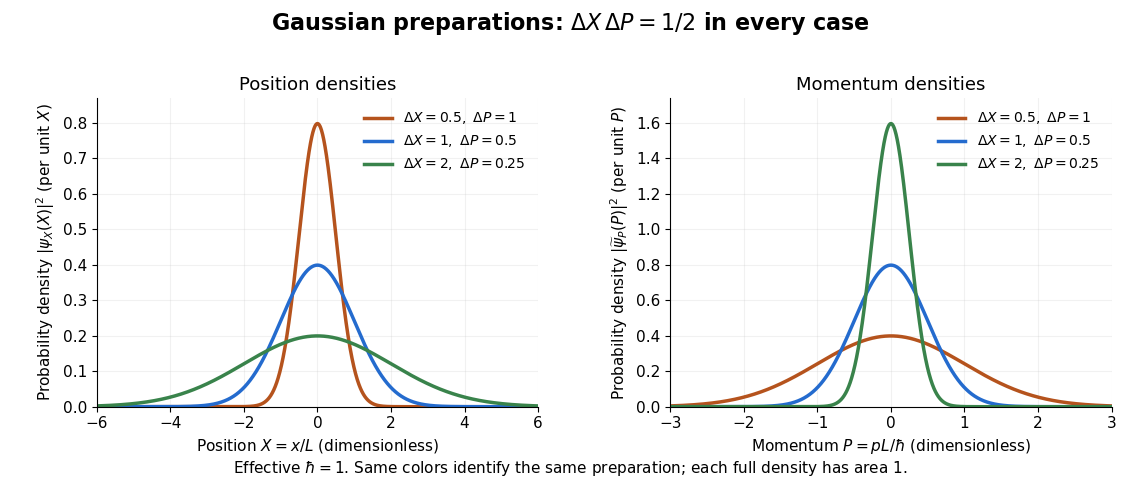
Position and momentum probability densities for three minimum-uncertainty Gaussian preparations: dimensionless widths 0.5, 1, and 2 in position give reciprocal momentum widths 1, 0.5, and 0.25
. Details. The Heisenberg uncertainty relation connects localization to the cost in kinetic energy. In a quantum harmonic oscillator with mass and angular frequency , the variance contribution to the expectation value of the energy is bounded using the arithmetic-geometric mean inequality:The mean-dependent contributions are nonnegative. The Gaussian eigenstate for a quadratic potential with and zero means reaches this ground state energy. This is why the tradeoff is more than a limitation on preparation: it predicts an unavoidable positive minimum energy.
Heisenberg's original article appeared in March 1927 as "Über den anschaulichen Inhalt der quantentheoretischen Kinematik und Mechanik", Zeitschrift für Physik 43, pp. 172–198. Its abstract discusses simultaneous imprecision of canonically conjugate quantities and explanatory thought experiments. The precise standard deviation formulation here distinguishes preparation spreads from a slogan about measurement disturbance. [ref].
Euler angles describe the orientation of a rigid body through three successive angular rotations. Their convention specifies the axes and order of the rotations. For a symmetric top, a common convention takes as the inclination, as precession and as spin about the body axis.
Pinned article: Introduction to the OurBigBook Project
Welcome to the OurBigBook Project! Our goal is to create the perfect publishing platform for STEM subjects, and get university-level students to write the best free STEM tutorials ever.
Everyone is welcome to create an account and play with the site: ourbigbook.com/go/register. We belive that students themselves can write amazing tutorials, but teachers are welcome too. You can write about anything you want, it doesn't have to be STEM or even educational. Silly test content is very welcome and you won't be penalized in any way. Just keep it legal!
Intro to OurBigBook
. Source. We have two killer features:
- topics: topics group articles by different users with the same title, e.g. here is the topic for the "Fundamental Theorem of Calculus" ourbigbook.com/go/topic/fundamental-theorem-of-calculusArticles of different users are sorted by upvote within each article page. This feature is a bit like:
- a Wikipedia where each user can have their own version of each article
- a Q&A website like Stack Overflow, where multiple people can give their views on a given topic, and the best ones are sorted by upvote. Except you don't need to wait for someone to ask first, and any topic goes, no matter how narrow or broad
This feature makes it possible for readers to find better explanations of any topic created by other writers. And it allows writers to create an explanation in a place that readers might actually find it.
Figure 1. Screenshot of the "Derivative" topic page. View it live at: ourbigbook.com/go/topic/derivativeVideo 2. OurBigBook Web topics demo. Source. - local editing: you can store all your personal knowledge base content locally in a plaintext markup format that can be edited locally and published either:This way you can be sure that even if OurBigBook.com were to go down one day (which we have no plans to do as it is quite cheap to host!), your content will still be perfectly readable as a static site.
- to OurBigBook.com to get awesome multi-user features like topics and likes
- as HTML files to a static website, which you can host yourself for free on many external providers like GitHub Pages, and remain in full control

Figure 2. You can publish local OurBigBook lightweight markup files to either OurBigBook.com or as a static website.
Figure 3. Visual Studio Code extension installation.
Figure 5. . You can also edit articles on the Web editor without installing anything locally. Video 3. Edit locally and publish demo. Source. This shows editing OurBigBook Markup and publishing it using the Visual Studio Code extension. 
- Infinitely deep tables of contents:



All our software is open source and hosted at: github.com/ourbigbook/ourbigbook
Further documentation can be found at: docs.ourbigbook.com
Feel free to reach our to us for any help or suggestions: docs.ourbigbook.com/#contact