Topics (384k) Articles (398k) Users (410) Discussions (242) Comments (383) Files (13k) New article
A triatomic form of oxygen, produced photochemically from molecular oxygen. The ozone layer absorbs ultraviolet radiation; ozone can trace atmospheric oxygen without being directly emitted by metabolism.
An organic sulfur gas emitted through biological processing, including marine production associated with sulfur-containing metabolites. It is a secondary metabolic byproduct example and a possible atmospheric biosignature gas whose detectability depends on production and photochemical destruction.
An organochlorine gas with biological as well as possible nonbiological sources. Its specialized biological production is a secondary metabolic byproduct example.
The bound atomic nucleus containing one proton and one neutron. Its ground-state spin is one and its isospin is zero. The appropriately quantized toroidal two-Skyrmion models these quantum numbers.
The helium-four atomic nucleus, containing two protons and two neutrons. Its ground-state spin and isospin are zero. A quantized cubic four-Skyrmion supplies a corresponding nuclear state in the soliton description.
Growth of an astronomical object's mass by capture of surrounding matter. During planetary scattering, a collision can lead to accretion if material is retained by the planet; not every collision retains all material. An accretion disk is one particular geometry supplying material.
The celestial sphere is the sphere of viewing directions around an observer; distances to objects are suppressed. Great circles define coordinate reference planes.
A horizontal coordinate system describes a viewing direction using altitude above the observer's astronomical horizon and azimuth around it. Here azimuth starts at true north and increases through east: north is , east , south , and west , with . True north is the northward intersection of the celestial meridian with the astronomical horizon, rather than an uncorrected magnetic-compass reading. Other origins and directions are legitimate, but their formulae must be converted consistently. [ref]
https://www.astro.uvic.ca/~tatum/celmechs/celm6.pdf. Jeremy Tatum: Celestial mechanics, section 6.2, altazimuth coordinates and azimuth conventions
.Construct a local orthonormal basis of east , north , and upward , with . The upward unit vector points to the zenith; the horizontal plane is perpendicular to it. For a ground instrument, a freely hanging weight establishes the local vertical through gravity. In an elementary spherical-Earth model, this vertical is radial; precision work distinguishes it from the normal to a reference surface. With the observer as origin, write a direction's unit vector asIts local components obey . Conversely, and modulo one turn, except where . The quadrant-aware arctangent takes east as its first argument and north as its second. A synthetic direction with and has . Thus its horizontal component has norm ; its altitude is not the angle of the projected arrow in the horizontal plane.
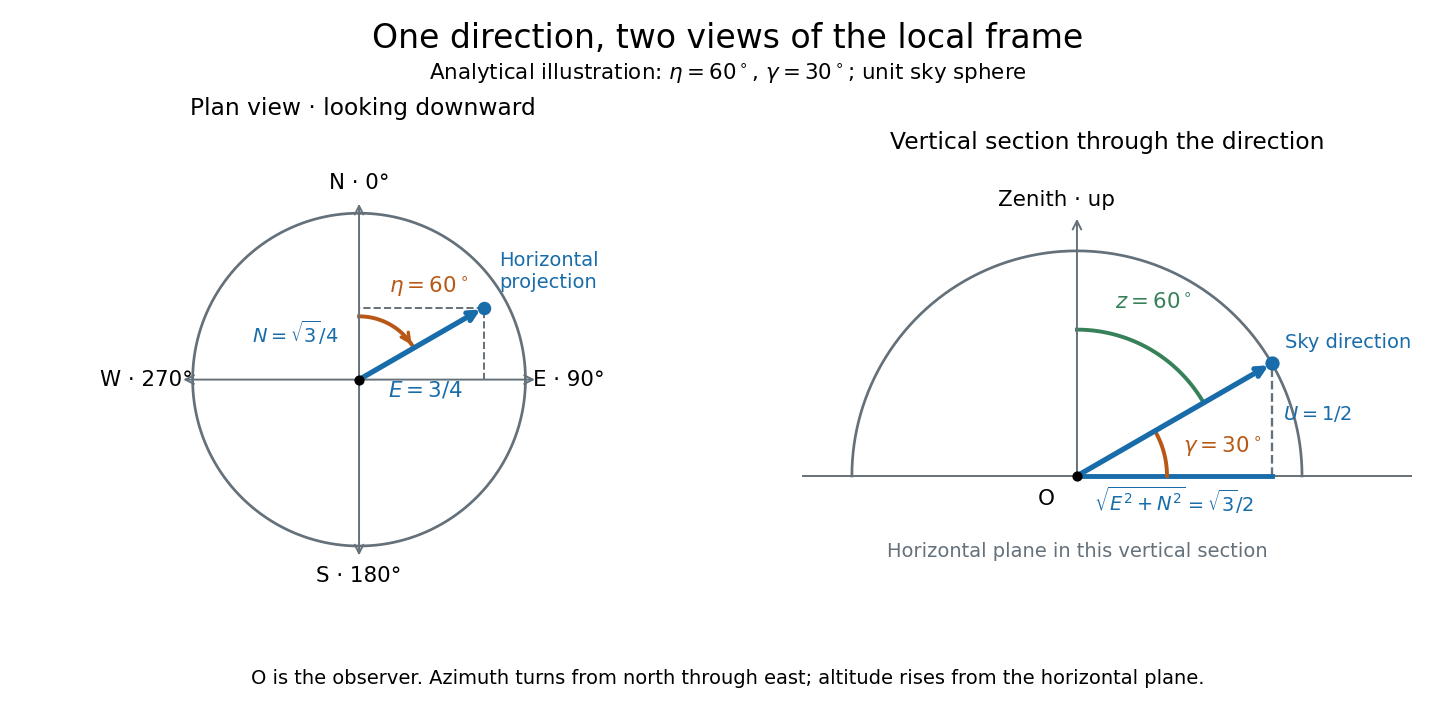
Analytical illustration of north-through-east azimuth and altitude in a local orthogonal frame; synthetic direction
. Details. A horizontal coordinate system depends on the observer's site and the observation time. The Earth's rotation changes the local axes relative to a fixed distant direction, while changing the site changes the zenith and the astronomical horizon. This makes the horizontal coordinate system directly useful for pointing an optical telescope and checking whether terrain blocks a target. A pair of angles without a site, time, azimuth convention, and geometric or refracted interpretation is an incomplete pointing instruction.
For a check against an equatorial coordinate system, let be the observer's geographical latitude, the direction's declination, and its west-positive hour angle, obtained from local sidereal time minus right ascension. In the spherical-Earth, unrefracted fixed-direction model, projection onto the local orthonormal basis givesTaking the dot product with the upward unit vector gives the last formula; the other two follow by the same projection. Recover altitude and azimuth from as above, using radians inside software trigonometric functions. The minus sign in is essential: a negative hour angle puts this synthetic direction east of the celestial meridian. [ref]
https://aa.usno.navy.mil/faq/alt_az. US Naval Observatory: Computing altitude and azimuth, local hour angle and quadrant-aware conversion
.For illustrative geographical latitude and invented declination , hour angle gives and . At , the same altitude accompanies : the direction is now westward. At , it is due south with altitude , agreeing with at upper meridian transit. These are analytical checks, not present positions of any star. For nearby objects, the direction must also be referred to the observer; simply rotating a geocentric direction omits the change of viewing position. Catalogue-to-observation refinements are described under equatorial coordinate system.
Local sidereal time is the right ascension on the upper celestial meridian. A sidereal day is approximately minutes; its angular rate is . Mean and apparent sidereal time must be paired with corresponding equatorial coordinate systems.
The Solar system consists of the Sun and bodies moving in its gravitational environment, including planets, their satellites, asteroids, comets and small particles. The Sun dominates the mass, making a Kepler orbit a useful first approximation for many trajectories, while mutual interactions produce secular perturbations and orbital resonances.
It is also a physical environment rather than a collection of isolated ellipses. The solar wind, radiation pressure and Poynting–Robertson drag affect small particles differently from massive planets. Comparing these nearby, directly observed processes with exoplanets tests how much of a planetary system can be inferred from unresolved light.
Gravitational collapse is contraction driven by a system's own gravitational attraction or an enclosing potential. Pressure, angular momentum and other stresses can oppose it. A free-fall timescale measures the dynamical contraction rate when pressure support is removed; gas cooling determines whether thermal support can be removed fast enough.
Radiation heats gas sufficiently to drive an escaping thermal outflow. It can remove material from protoplanetary disks, planetary atmospheres and irradiated clouds. In a heated Keplerian disk, the photoevaporative gravitational radius compares the sound speed with the orbital speed. The mass-loss rate depends on the heating, density and wind geometry rather than radiation pressure alone.
Potential theory studies harmonic functions, subharmonic functions, and the Laplace operator, including harmonic measure, regular boundary points, and the Dirichlet problem. The Brownian representation of the Dirichlet problem connects these analytic objects with exit probability distributions.
For an additive semigroup with identity zero, the semigroup algebra has a -basis of formal symbols , , and multiplication . For it is the integral domain . Its positive-exponent ideal is a nonzero idempotent ideal, and the strictly ascending chain shows that the algebra is not a Noetherian ring.
A normed algebra is an algebra over a field with a norm satisfying . Its completion is a Banach algebra, since multiplication extends continuously. Completeness is additional structure, rather than part of the definition of a normed algebra.
Outgoing modes of an open rigid acoustic waveguide by  Codex 0 Created 2026-10-06 Updated 2026-10-13
For an even field between rigid plates at , the transverse modes are , with longitudinal wave numbers . With time dependence , outgoing modes into use : choose positive real for cut-on modes and negative imaginary for cut-off modes. A lower-half-plane Fourier inversion extracts these modes by residues. Their decaying components are evanescent waves, not backward-propagating waves. At an exact cutoff one takes the radiation continuation before its limit.
For , the outgoing Green function for the three-dimensional Helmholtz equation yields the far-field patternThe sign corresponds to the Green function satisfying . This Hilbert-Schmidt operator samples the source Fourier transform on the sphere ; for a ball of radius , its squared Hilbert-Schmidt norm is .
A source is nonradiating at frequency if its outgoing field has zero far-field pattern. For every , the source has outgoing field and is invisible outside . Integration by parts shows that its Fourier transform vanishes on , so it belongs to the kernel of a linear map defined by the source-to-far-field operator at fixed frequency. This family proves nonuniqueness independently of the instability of the inverse.
Pinned article: Introduction to the OurBigBook Project
Welcome to the OurBigBook Project! Our goal is to create the perfect publishing platform for STEM subjects, and get university-level students to write the best free STEM tutorials ever.
Everyone is welcome to create an account and play with the site: ourbigbook.com/go/register. We belive that students themselves can write amazing tutorials, but teachers are welcome too. You can write about anything you want, it doesn't have to be STEM or even educational. Silly test content is very welcome and you won't be penalized in any way. Just keep it legal!
Intro to OurBigBook
. Source. We have two killer features:
- topics: topics group articles by different users with the same title, e.g. here is the topic for the "Fundamental Theorem of Calculus" ourbigbook.com/go/topic/fundamental-theorem-of-calculusArticles of different users are sorted by upvote within each article page. This feature is a bit like:
- a Wikipedia where each user can have their own version of each article
- a Q&A website like Stack Overflow, where multiple people can give their views on a given topic, and the best ones are sorted by upvote. Except you don't need to wait for someone to ask first, and any topic goes, no matter how narrow or broad
This feature makes it possible for readers to find better explanations of any topic created by other writers. And it allows writers to create an explanation in a place that readers might actually find it.
Figure 1. Screenshot of the "Derivative" topic page. View it live at: ourbigbook.com/go/topic/derivativeVideo 2. OurBigBook Web topics demo. Source. - local editing: you can store all your personal knowledge base content locally in a plaintext markup format that can be edited locally and published either:This way you can be sure that even if OurBigBook.com were to go down one day (which we have no plans to do as it is quite cheap to host!), your content will still be perfectly readable as a static site.
- to OurBigBook.com to get awesome multi-user features like topics and likes
- as HTML files to a static website, which you can host yourself for free on many external providers like GitHub Pages, and remain in full control

Figure 2. You can publish local OurBigBook lightweight markup files to either OurBigBook.com or as a static website.
Figure 3. Visual Studio Code extension installation.
Figure 5. . You can also edit articles on the Web editor without installing anything locally. Video 3. Edit locally and publish demo. Source. This shows editing OurBigBook Markup and publishing it using the Visual Studio Code extension. 
- Infinitely deep tables of contents:



All our software is open source and hosted at: github.com/ourbigbook/ourbigbook
Further documentation can be found at: docs.ourbigbook.com
Feel free to reach our to us for any help or suggestions: docs.ourbigbook.com/#contact