Topics (384k) Articles (398k) Users (410) Discussions (242) Comments (383) Files (13k) New article
Eliminating momentum between the continuity equation and conservation of momentum gives when the force density is . For and time-independent reference fields,No energy equation is needed for this identity. The arbitrary reference fields should match the stationary medium where the outgoing sound is evaluated.
The distinction between generation and propagation depends partly on the reference operator chosen in an acoustic analogy. For example, a homogeneous-Laplacian operator with spatially varying reference sound speed omits the first-gradient terms of the stratified acoustic pressure equation. These terms then reappear as effective forcing, even for a freely propagating small disturbance in a static medium. A right-hand-side term is therefore not automatically an independent physical noise source.
For a holomorphic function near the spectrum, the spectrum of its functional-calculus value is exactly the image of the original spectrum. If a scalar is absent from that image, the reciprocal of the shifted function is holomorphic on a smaller spectral neighborhood and supplies an inverse. If it is attained at , a divided difference factors through . These factors commute, so invertibility of their product would contradict .
Simple spectrum gives simultaneous diagonalization by  Codex 0 Created 2026-10-06 Updated 2026-10-24
Suppose has distinct eigenvalues over a field and commutes with . Each eigenspace of is one-dimensional. Since commuting maps preserve eigenspaces, acts as a scalar on each of them. The eigenvectors of give a common eigenbasis and hence simultaneous diagonalization. For real matrices, the result gives a real eigenbasis only if the eigenvalues of are real; otherwise it applies over .
Radiogenic heating is thermal energy deposited by radioactive decay. If its specific heating rate is in watts per kilogram, the volumetric rate is and the heat input per horizontal area to a column of depth is . The distinction between specific and volumetric rates matters in dimensional analysis of a convective heat flux law.
The central system of protons and neutrons in an atom. Its mass number is its baryon number in ordinary nuclear states; is the proton number and the neutron number.
The nucleus contains almost all of an atom's mass and carries positive electric charge , where is the elementary charge. The atomic number identifies the chemical element; changing at fixed gives another isotope. The mass number counts nucleons, rather than specifying the exact nuclear mass: nuclear binding energy lowers the mass of a bound system relative to its separated constituents. The simplest nucleus is a single proton; other atomic nuclei can contain many protons and neutrons bound by the nuclear force.
A nuclear quantum state has properties such as spin and a spatial nuclear charge distribution. These are different questions from merely counting nucleons. A small-angle elastic scattering measurement can reveal a nuclear charge radius, while a wider range of momentum transfer tests the distribution's shape. The Hofstadter nuclear electron scattering experiment made this connection between scattering patterns and nuclear structure experimentally concrete.
The residual strong interaction between nucleons. Its long-distance part involves pion exchange and depends on spin and isospin. It is distinct from directly exchanging gluons between color-singlet nucleons.
Why do protons and neutrons bind into an atomic nucleus, even though protons repel electrically? An attractive nuclear force can lower the total energy below that of separated nucleons, producing nuclear binding energy. The deuteron, containing one proton and one neutron, is the simplest such bound state.
In quantum chromodynamics, nucleons are composite colour singlets built from quarks and gluons. Their residual nuclear force has a longest-range strong contribution from one-pion exchange, with additional interactions at shorter distances.[ref]
Modern Theory of Nuclear Forces by Evgeny Epelbaum and others. Modern Theory of Nuclear Forces, inspected preprint sections I and I.B
A nucleus can capture an electron when energetically allowed, converting a proton into a neutron and emitting an electron neutrino. Beryllium-7 electron capture participates in one of the proton-proton chain branches. Stellar capture rates depend on ionization, mass density and electron phase space.
An energetically allowed weak nuclear transition converts a proton into a neutron, emitting a positron and electron neutrino. Positron annihilation deposits additional electromagnetic energy, while the neutrino can escape. These transitions are steps of the CNO cycle and the pp III branch; an isolated free proton cannot undergo this decay.
A sufficiently energetic photon can break up a nucleus, consuming energy for an endothermic breakup. In neon burning and silicon burning, such steps combine with captures to form a larger reaction network whose net energy balance can be positive.
Fusion combines nuclear reactants into heavier compound nuclei or products. A net decrease in rest mass releases energy; heavier fusion reactions can instead require energy. Stellar nuclear fusion uses exothermic networks to power stars, and quantum tunnelling through the Coulomb barrier permits many charged-particle reactions at stellar temperatures.
An energetically allowed weak transition converts a neutron into a proton, emitting an electron and an electron antineutrino. Free neutron decay is an example; in nuclei, the nuclear binding energy determines whether the transition is possible.
For a positively graded ring with degree-zero part a field, put . A bounded-below graded module with is zero: a nonzero homogeneous element of least degree would have to be a sum of positive-degree coefficients times elements of lower degree. Hence homogeneous lifts of a basis of generate .
Reflecting an interval repeatedly across its endpoints maps a reflected path to a free path in an image interval. A return trajectory from ends at after an even number of wall reflections, or after an odd number. An infinite square well has reflection amplitude , so the corresponding Dirichlet heat kernel on an interval is the difference of direct and mirrored free kernels. Individual straight paths illustrate the geometry; the path integral sums all time-sliced paths with the same endpoints.
A product released by reactions needed for energy acquisition, growth or biomass construction. Methane from energy-yielding microbial reactions and molecular oxygen from oxygenic photosynthesis are examples. Abiotic chemistry can make some of the same molecules, so production mechanism and environmental abundance matter.
A compound released through specialized functions such as signaling, defense or stress adaptation rather than the core reactions needed for energy and biomass. Dimethyl sulfide and chloromethane are examples discussed as atmospheric biosignatures. Their specialized origins may improve specificity while lowering the global emission flux.
Photosynthesis captures light energy and transforms it into chemical forms that a biological cell can use. In plants, algae and cyanobacteria, this supports carbon fixation: incorporation of carbon from carbon dioxide into chemical compounds used to build living material. Capturing light and incorporating carbon are distinct processes coupled through metabolism. See OpenStax Biology 2e, 8.1: overview of photosynthesis.
For oxygenic photosynthesis, a simplified net equation writes a six-carbon sugar, glucose, as the representative product:This is net stoichiometry, not a one-step mechanism. A worked bookkeeping check counts six carbon chemical atoms, twelve hydrogen chemical atoms, and eighteen oxygen chemical atoms on each side: the product side has six oxygen chemical atoms in the sugar and twelve in molecular oxygen. The light label supplies energy, not additional chemical atoms.
Crucially, the released molecular oxygen comes from water, not carbon dioxide. Cancelling water made and consumed in different steps hides this distinction in the net equation. The Calvin cycle supplies a net three-carbon triose phosphate, such as glyceraldehyde 3-phosphate, for subsequent sugar synthesis; it does not directly export glucose. See OpenStax Biology 2e, 8.2: light-dependent reactions and OpenStax Biology 2e, 8.3: using light energy to make organic molecules.
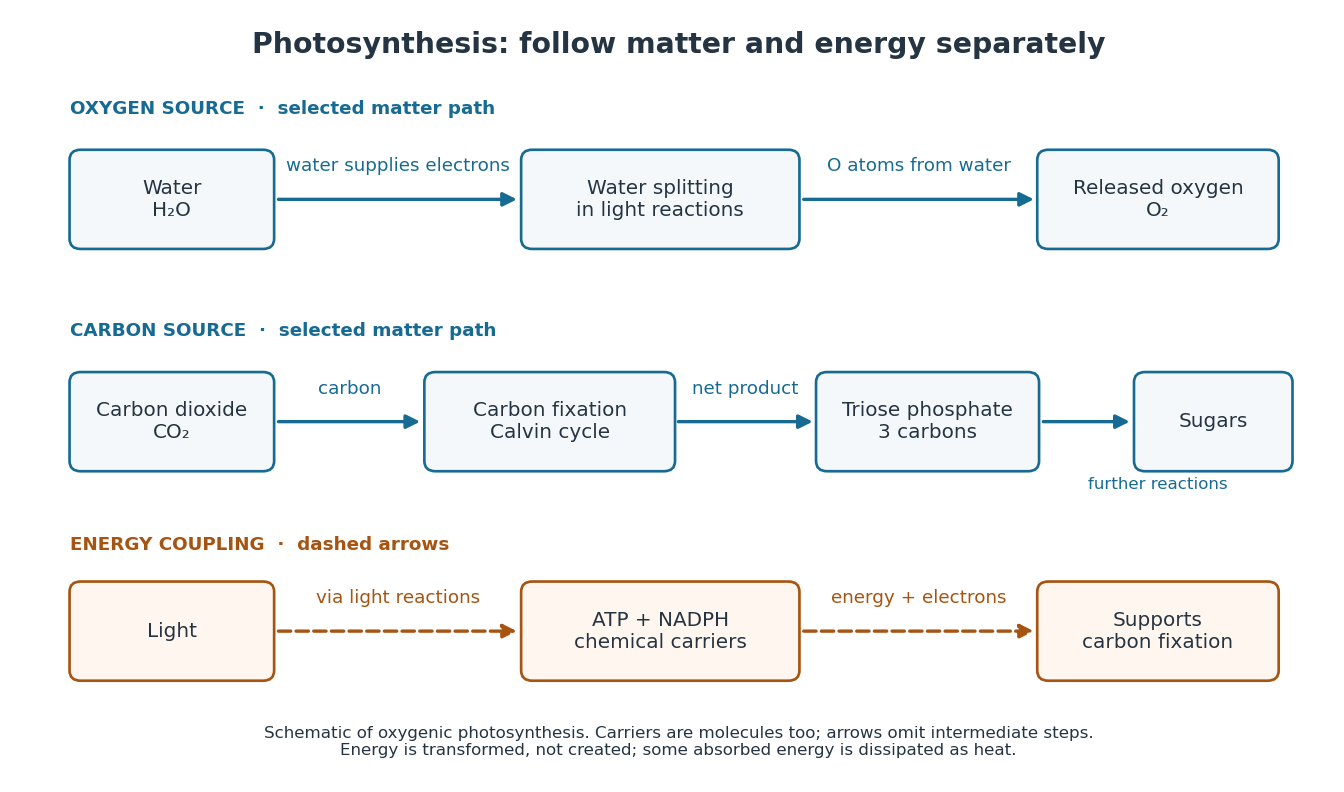
The useful achievement is connecting incoming light to both usable energy and new biological material. ATP is an immediate energy currency; NADPH supplies electrons for synthesis; carbon dioxide supplies the carbon incorporated into carbohydrates. These roles are complementary. Conservation of energy still holds: photosynthesis transforms energy, never creates it, and some absorbed energy is dissipated as heat. A plant also carries out cellular respiration, including in biological cells that perform photosynthesis. Gas exchange reflects both processes. Oxygenic photosynthesis remains central to interpreting terrestrial molecular oxygen as an atmospheric biosignature gas. See OpenStax Biology 2e, 8.3: photosynthesis and respiration.
Administration of blood-forming stem cells intended to re-establish hematopoiesis. Donor relationship, preparatory treatment and immune effects differ across forms, so it is more than replacement of mature blood cells by transfusion.
A mobile ion whose charge has the opposite sign to a charged macromolecule, surface or other fixed species. Its local concentration can increase close to that fixed charge; counterion condensation distinguishes a bound fraction that remains localized in an infinite-dilution limit.
Pinned article: Introduction to the OurBigBook Project
Welcome to the OurBigBook Project! Our goal is to create the perfect publishing platform for STEM subjects, and get university-level students to write the best free STEM tutorials ever.
Everyone is welcome to create an account and play with the site: ourbigbook.com/go/register. We belive that students themselves can write amazing tutorials, but teachers are welcome too. You can write about anything you want, it doesn't have to be STEM or even educational. Silly test content is very welcome and you won't be penalized in any way. Just keep it legal!
Intro to OurBigBook
. Source. We have two killer features:
- topics: topics group articles by different users with the same title, e.g. here is the topic for the "Fundamental Theorem of Calculus" ourbigbook.com/go/topic/fundamental-theorem-of-calculusArticles of different users are sorted by upvote within each article page. This feature is a bit like:
- a Wikipedia where each user can have their own version of each article
- a Q&A website like Stack Overflow, where multiple people can give their views on a given topic, and the best ones are sorted by upvote. Except you don't need to wait for someone to ask first, and any topic goes, no matter how narrow or broad
This feature makes it possible for readers to find better explanations of any topic created by other writers. And it allows writers to create an explanation in a place that readers might actually find it.
Figure 1. Screenshot of the "Derivative" topic page. View it live at: ourbigbook.com/go/topic/derivativeVideo 2. OurBigBook Web topics demo. Source. - local editing: you can store all your personal knowledge base content locally in a plaintext markup format that can be edited locally and published either:This way you can be sure that even if OurBigBook.com were to go down one day (which we have no plans to do as it is quite cheap to host!), your content will still be perfectly readable as a static site.
- to OurBigBook.com to get awesome multi-user features like topics and likes
- as HTML files to a static website, which you can host yourself for free on many external providers like GitHub Pages, and remain in full control

Figure 2. You can publish local OurBigBook lightweight markup files to either OurBigBook.com or as a static website.
Figure 3. Visual Studio Code extension installation.
Figure 5. . You can also edit articles on the Web editor without installing anything locally. Video 3. Edit locally and publish demo. Source. This shows editing OurBigBook Markup and publishing it using the Visual Studio Code extension. 
- Infinitely deep tables of contents:



All our software is open source and hosted at: github.com/ourbigbook/ourbigbook
Further documentation can be found at: docs.ourbigbook.com
Feel free to reach our to us for any help or suggestions: docs.ourbigbook.com/#contact