Topics (384k) Articles (398k) Users (410) Discussions (242) Comments (383) Files (13k) New article

For a smooth autonomous differential equation and a hyperbolic equilibrium point , the unstable manifold consists of points whose backward trajectories approach :where the backward solution must exist for all negative time. The local unstable manifold additionally requires that the backward trajectory remain in a chosen small neighborhood. The global unstable manifold is obtained by following this local set forward as far as the flow map exists.
Its tangent space at is the real sum of the generalized eigenspaces of the Jacobian matrix with eigenvalues of positive real part. Generalized eigenspaces are needed when the matrix is not diagonalizable. Nonreal eigenvalues occur in conjugate pairs, together contributing a real invariant plane. The stable manifold uses negative real parts and convergence in forward time.
A nonlinear example shows why the tangent space alone is insufficient. For , , the curve is invariant because its time derivative is . On this curve and approach zero backward, so it is the unstable manifold. It is tangent to the -axis at the origin, but it is not that axis. In fact obeys , so every point off the curve fails to approach zero backward.
A clonal disorder of blood-forming cells associated with ineffective production and abnormal maturation. Low circulating cell counts can coexist with an active marrow, distinguishing production failure from simple absence of precursor cells.
The physical dimension of a quantity records its powers of chosen base dimensions, independently of units. For example, velocity has dimension and force has dimension . Dimensional analysis compares these expressions in physical equations.
Image smoothing suppresses rapid fluctuations attributed to noise. Linear heat equation image smoothing attenuates Fourier frequencies by but also blurs image edges. Nonlinear filtering uses image signal geometry to distinguish fluctuations from meaningful transitions.
A diffusion tensor for image filtering selects directional transport in an image signal throughHere are estimated normal and tangent directions to an image edge. Taking promotes image smoothing along the image edge while reducing mixing across it. A structure tensor provides orientation estimates.
For a prescribed sufficiently regular , positive eigenvalues give a forward parabolic partial differential equation; fixed finite upper and strictly positive lower bounds on the eigenvalues give uniform ellipticity. This statement concerns the principal coefficient of the equation actually being solved.
If depends directly on the evolving gradient, its positivity alone is insufficient. In one dimension, gives flux , butis negative when . Linearizing then gives backward diffusion in that range. Distinguishing a prescribed tensor from a gradient-dependent nonlinear flux prevents a false general parabolicity claim.
Nonlinear cosmological perturbations allow finite fluctuations of the spatial scale, density and other fields. Expanding in spatial gradients can remain useful even when a linear expansion in their amplitudes is invalid. The long-wavelength approximation in cosmology is one such organization of the equations.
Relative physical laws and large-scale statistical properties do not depend on the chosen spatial origin. For a continuous deterministic galaxy velocity field, using the same relative-velocity rule from each origin forces additivity and hence a position-independent linear velocity gradient.
Decoupling of a particle abundance from chemical equilibrium when interactions become too slow compared with cosmic expansion. Pair annihilation can continue after equilibrium production is negligible, leaving a nonzero relic abundance.
A promise problem consists of disjoint sets of YES and NO instances. An algorithm or verifier must obey its correctness guarantees only on their union. Energy problems with separated thresholds are naturally promise problems because intermediate-energy instances require no prescribed answer.
Dimensional reduction retains fields independent of chosen internal coordinates. In a flat-torus zero-mode reduction, a metric supplies a metric, internal-component vectors and internal metric scalars; a massless p-form gauge field supplies lower-rank fields with internal indices. Fluxes, twists or projections can alter the spectrum and preserved supercharges.
A Kaluza-Klein mode is a coefficient in a field expansion in eigenfunctions on compact extra dimensions. On a circle of circumference , momentum is , and a higher-dimensional massless field has lower-dimensional squared mass . Nonzero modes give exponentially suppressed static-potential corrections at distances much larger than .
For an unwarped product metric with fixed compact volume , integrating the higher-dimensional Einstein-Hilbert action gives when the action coefficient is . The reduced Planck mass convention must be distinguished from the unreduced one, and stabilizing the internal metric is a separate dynamical issue.
A cyclic digit run is a consecutive segment of a digit string whose successive digits all increase by one or all decrease by one modulo the base. For example, is an increasing decimal run. This refers to cyclic digit values, not to joining the final position of the string back to its first position. Overlapping run constraints can be counted with the inclusion-exclusion principle.
The cycle lemma turns a constraint at every prefix into a choice of where to start reading a circular sequence. Think of a lattice path whose vertical increments record votes for two candidates: for one candidate and for the other. Its partial sums are the running lead. Rotating the increments preserves the final lead, but changes whether that lead stays strictly positive throughout. This makes rotation useful for counting lattice paths subject to prefix constraints; the sum-one cycle lemma also supplies the cyclic prefix condition in the cyclic Turán covering construction.
The sum-one form. Let be any nonempty sequence of integers with . A starting position means reading the rotated sequenceCall good when every nonempty partial sum of is strictly positive, including the full sum:The cycle lemma says there is exactly one good starting position. Negative entries, zero entries and positive entries larger than one are all allowed in this sum-one form. The empty partial sum is zero and is excluded from the positivity requirement. Douglas West's exercise 1.3.46(a) states a stronger result for arbitrary integer entries: take its case with all partial sums positive. [ref]
https://api.pageplace.de/preview/DT0400.9781108889520_A49236431/preview-9781108889520_A49236431.pdf#page=72. West, Combinatorial Mathematics, exercise 1.3.46(a), p. 50
A worked sum-one example. For , the partial sums starting at zero are . Starts fail: they have, respectively, a zero second partial sum, a negative first partial sum, and a zero first partial sum. Start reads and has nonempty partial sums , all positive. This example both allows an increment larger than one and shows why touching zero fails.
Why the last minimum works. Put and . Choose the last index attaining the minimum of the proper partial sums : include and exclude . After that index, later proper partial sums are strictly larger than ; also , since . Before wrapping, the new partial sums are therefore positive differences . After wrapping, they are . In the worked example the last minimum is at ; choosing the first minimum at would fail. Uniqueness takes one further observation: two good starts would split the circle into two nonempty arcs, each having a positive integer sum, yet their sum would be one.
An equation of motion determines how a physical state evolves. A variational action gives Euler-Lagrange equations; a phase-space action instead gives canonical Hamiltonian mechanics equations together with any imposed constraints.
Newtonian mechanics describes the motion of bodies using mass, momentum and applied forces in an inertial frame, with a common absolute time. Newton's first law identifies freely moving bodies with constant velocity; Newton's second law relates the rate of change of momentum to net force. For a particle of constant mass,An initial position and velocity, together with a force law, determine an initial value problem. Newton's third law gives equal and opposite mutual forces for the usual instantaneous interaction model, yielding momentum conservation in an isolated particle system. The three laws are set out in Isaac Newton's 1687 Principia.[ref]
Axiomata sive leges motus. Lex I, Lex II and Lex III, printed pp. 12–13
For a falling particle in a uniform gravitational field, choose upward and neglect air resistance. Then gives . The mass cancels between inertia and the specified gravitational force; adding linear drag changes the differential equation and the trajectory. Experiments test such predictions by measuring a trajectory under controlled conditions, rather than by inferring a force law from a single position reading.
The model is a classical approximation. Special relativity modifies its momentum/velocity relation at speeds comparable to the speed of light, while strong relativistic gravity requires a different spacetime description. For constant proper acceleration and , relativistic hyperbolic motion reduces to , illustrating a concrete low-speed limit.
A mechanical Lagrangian quadratic in velocities can be represented by geodesics of a Lorentzian metric with an extra null coordinate. For , use . The null Killing vector field gives the conserved momentum . Fixing projects the geodesic equation to the mechanical Euler-Lagrange equations. This is useful for relating mechanical forces to spacetime geometry.
A point mass constrained to a fixed-length massless arm under uniform gravitational acceleration is a simple pendulum. With no drag its angular equation is . The small-angle approximation yields simple harmonic motion, whereas the full restoring force is nonlinear. Adding drag gives a damped pendulum.
For an ideal point mass swinging in a vertical plane, the torque about the pivot is . Dividing by its moment of inertia gives the displayed equation. Both the inertia and the gravitational torque scale with , explaining why the point mass cancels. This derivation and the small-amplitude period are given in Ling, Sanny and Moebs, University Physics, pendulums.
Released from rest at a small angular amplitude , the linearized solution is , with oscillation period . For , lengths one and four metres give and . This same scaling follows from dimensional analysis; the dynamical calculation supplies the coefficient .
Finite angular amplitude changes the exact ideal period. Conservation of energy gives for release from rest. Integrating a quarter oscillation and substituting givesHere is the complete elliptic integral of the first kind. The small-angle approximation gives a ratio tending to one; at , the ratios are approximately . Thus almost constant period at small amplitude has a quantitative limit. As , the period diverges, connecting to the pendulum separatrix approach takes infinite time.
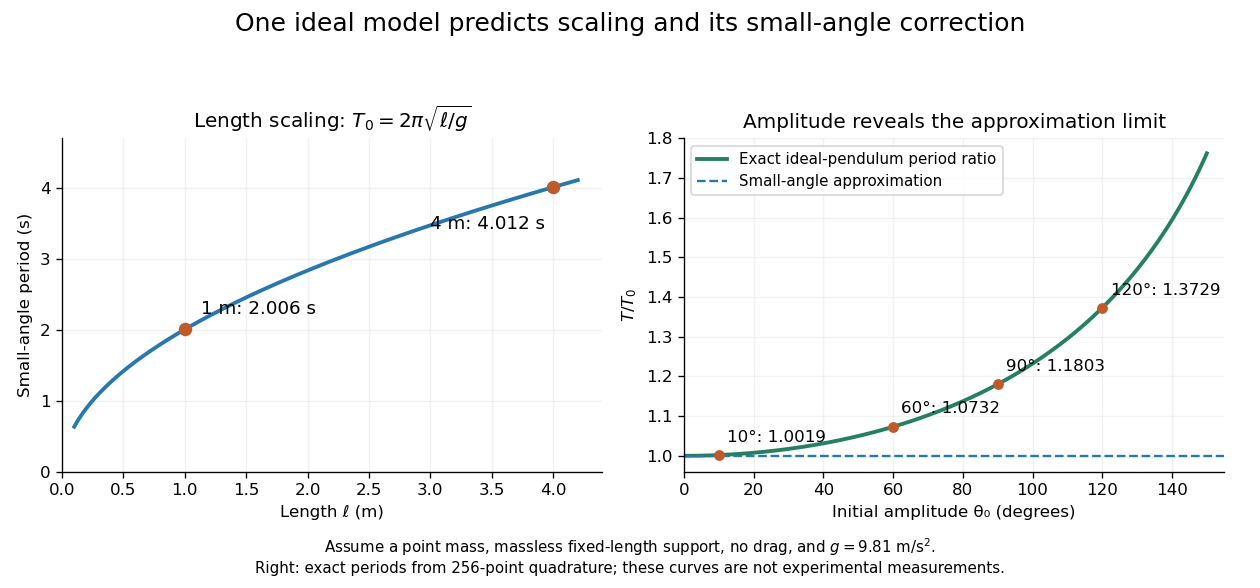
These predictions assume the specified ideal system. Drag changes the mechanical energy; a massive support changes the moment of inertia. The distinction is useful in experiments: a change in period can test an approximation rather than merely indicate an arithmetic mistake.
Phosphine is . Its abundance in giant-planet observable atmospheres can depend on transport from deeper layers faster than local chemical destruction.
Pinned article: Introduction to the OurBigBook Project
Welcome to the OurBigBook Project! Our goal is to create the perfect publishing platform for STEM subjects, and get university-level students to write the best free STEM tutorials ever.
Everyone is welcome to create an account and play with the site: ourbigbook.com/go/register. We belive that students themselves can write amazing tutorials, but teachers are welcome too. You can write about anything you want, it doesn't have to be STEM or even educational. Silly test content is very welcome and you won't be penalized in any way. Just keep it legal!
Intro to OurBigBook
. Source. We have two killer features:
- topics: topics group articles by different users with the same title, e.g. here is the topic for the "Fundamental Theorem of Calculus" ourbigbook.com/go/topic/fundamental-theorem-of-calculusArticles of different users are sorted by upvote within each article page. This feature is a bit like:
- a Wikipedia where each user can have their own version of each article
- a Q&A website like Stack Overflow, where multiple people can give their views on a given topic, and the best ones are sorted by upvote. Except you don't need to wait for someone to ask first, and any topic goes, no matter how narrow or broad
This feature makes it possible for readers to find better explanations of any topic created by other writers. And it allows writers to create an explanation in a place that readers might actually find it.
Figure 1. Screenshot of the "Derivative" topic page. View it live at: ourbigbook.com/go/topic/derivativeVideo 2. OurBigBook Web topics demo. Source. - local editing: you can store all your personal knowledge base content locally in a plaintext markup format that can be edited locally and published either:This way you can be sure that even if OurBigBook.com were to go down one day (which we have no plans to do as it is quite cheap to host!), your content will still be perfectly readable as a static site.
- to OurBigBook.com to get awesome multi-user features like topics and likes
- as HTML files to a static website, which you can host yourself for free on many external providers like GitHub Pages, and remain in full control

Figure 2. You can publish local OurBigBook lightweight markup files to either OurBigBook.com or as a static website.
Figure 3. Visual Studio Code extension installation.
Figure 5. . You can also edit articles on the Web editor without installing anything locally. Video 3. Edit locally and publish demo. Source. This shows editing OurBigBook Markup and publishing it using the Visual Studio Code extension. 
- Infinitely deep tables of contents:



All our software is open source and hosted at: github.com/ourbigbook/ourbigbook
Further documentation can be found at: docs.ourbigbook.com
Feel free to reach our to us for any help or suggestions: docs.ourbigbook.com/#contact