Topics (384k) Articles (398k) Users (410) Discussions (242) Comments (383) Files (13k) New article

The free Schrodinger equation describes linear dispersive evolution without a potential term. In this normalization a spectral mode is . On a half-line, boundary data enter through the global relation for the half-line free Schrodinger equation.
Derandomization converts a randomized construction or algorithm into a deterministic one while preserving its desired guarantee. The method of conditional probabilities does this by maintaining a computable conditional expectation until all choices are fixed.
A quantum fluctuation is a nonzero variance of an observable in a quantum state, even when its mean vanishes. A vacuum field mode has such zero-point variance. In an inflationary background, the expanding geometry transfers short-wavelength vacuum field fluctuations into primordial perturbations as their wavelengths cross the Hubble radius.
A quasiparticle is a collective excitation that can be described approximately by particle-like quantum numbers and dynamics, even though it is not an isolated elementary particle. Excitons and polaritons are examples.
The operator formalism describes a quantum system using states in a Hilbert space and observables represented by self-adjoint operators with suitable domains on that Hilbert space. Evolution and correlation functions are computed from Hamiltonian operators and their time-ordered products. For free quantized fields, the oscillator construction gives a Fock space. The operator-path-integral equivalence relates these matrix elements to integrals over field histories.
Semiclassical quantization uses classical trajectories and actions to approximate quantum states in a regime where relevant actions are large compared with . Phase consistency on a periodic orbit leads to Bohr-Sommerfeld quantization. Soliton collective coordinates can be quantized this way, while fluctuations supply additional corrections to the leading classical mass.
A local quantum field operator is supported at a spacetime point, with operator-valued distributions understood by smearing. Products at the same point generally require renormalization; these give composite operators. This is distinct from the topos-theoretic meaning of local operator.
A quantum field theory with enough mutually compatible conserved quantities to constrain its dynamics exactly. In massive relativistic theories in one spatial dimension, suitable higher-spin conserved charges imply elastic factorized scattering: the set of incoming rapidities is preserved and multiparticle amplitudes are assembled from two-particle S-matrices.
Actuarial statistics uses probability theory and statistical inference to quantify insurance claims, premiums, and the uncertainty of future losses. Aggregate claims model describes portfolios, reinsurance redistributes losses, and the Bühlmann model combines experience with population information.
In nondimensional time the quadratic damping removes energy from the pendulum at rate . Downward resting positions are nonhyperbolic asymptotically stable spirals, even though the linearized equation has a centre. Upward resting positions remain saddle equilibria. Each fixed-sign branch of has a linear equation for as a function of angle.
A phylogenetic tree represents a hypothesis of ancestral relationships among sampled lineages. Branch points indicate inferred common ancestry; a rooted tree specifies direction from ancestors toward descendants. Branch length may encode elapsed time or evolutionary change, but a cladogram need encode neither.
A gene tree follows sampled gene copies, whereas a species tree summarizes lineage relationships at the species level. Distinguishing these objects matters when incomplete lineage sorting or introgression produces different histories for different genomic regions. Computationally, inference over unknown ancestral states can use belief propagation on the tree.
Scattering of light redirects radiation through interaction with particles or spatial variations in a medium. It can remove light from a beam without true absorption, or add light from other directions. Wavelength and particle-size dependence make Rayleigh scattering and aerosol scattering useful probes of planetary atmospheres.
A coronagraph is an optical instrument that suppresses a bright source's light before detection while transmitting some light from nearby directions. Its purpose is to reveal faint structure buried in the bright source's point spread function, as in exoplanet direct imaging. A Lyot coronagraph combines a coronagraphic focal plane mask with a Lyot stop in a reimaged optical pupil; blocking the central image alone does not remove its diffraction rings. [ref].
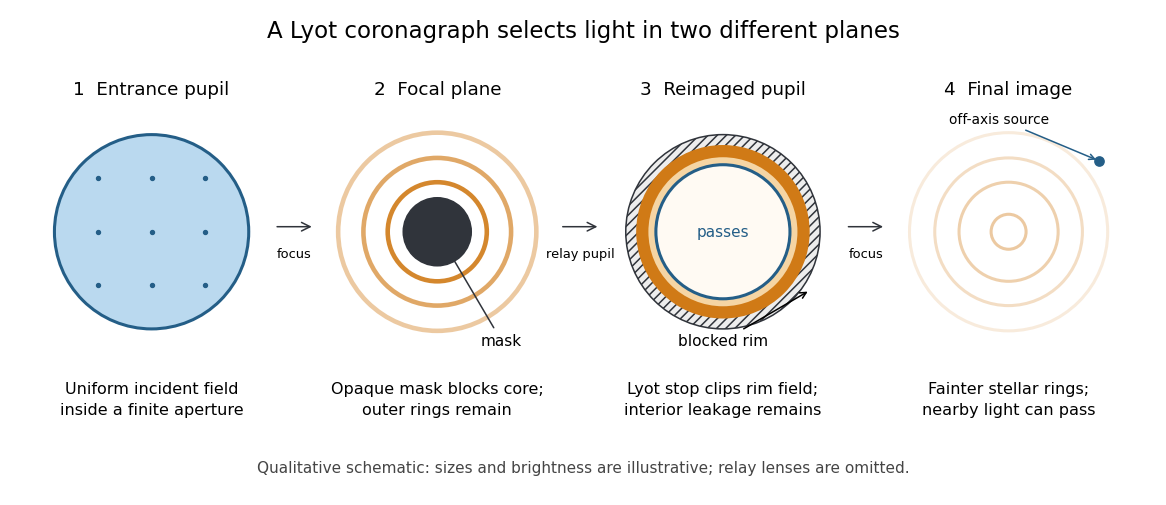
The four principal planes of a Lyot coronagraph: a focal plane mask and a reimaged optical pupil stop select different parts of the wave amplitude distribution. Qualitative schematic, with illustrative sizes and brightness.
Details. The original motivation was the solar corona: hiding the bright photosphere would allow longer, repeated observations of faint surrounding light. In his 1930 paper, Lyot explained that short total eclipses restricted observing time and prevented some long exposures for spectral lines. The attraction is an instrument that makes the faint neighborhood accessible on demand. [ref]
https://www.persee.fr/doc/bastr_0245-9760_1930_num_6_1_14031. Bernard Lyot, La couronne solaire étudiée en dehors des éclipses, 1930, p. 305
. The Sun is an extended source; the point-source calculation below illustrates imaging of an unresolved star and is not a quantitative model of the solar corona.The redshift compares emitted and received local frequencies or wavelengths: . Motion, gravitation, and cosmological expansion can all contribute.
Optical tweezers hold and move a small particle using the force exerted by a tightly focused beam of light, usually from a laser. They can position transparent beads in a liquid and manipulate suitable biological cells. Attaching a molecule to a trapped bead turns the bead into a handle: a measured bead displacement, together with a calibrated spring constant, reveals the force exerted on the attachment. This makes microscopic manipulation and measurement possible without a mechanical tool touching the bead. Living biological cells were manipulated with infrared beams by Ashkin, Dziedzic and Yamane in 1987; Svoboda and Block used trapped beads to measure forces from individual molecules in 1994. [ref]
https://doi.org/10.1038/330769a0. Ashkin, Dziedzic and Yamane, Optical trapping and manipulation of single cells using infrared laser beams, 1987
[ref]https://www.andrew.cmu.edu/course/42-620/handouts/svoboda_cell_94.pdf. Svoboda and Block, Force and Velocity Measured for Single Kinesin Molecules, 1994
.Why can light pull a bead towards a focus? Light carries momentum. A transparent bead with a higher refractive index than the surrounding liquid bends transmitted light rays by refraction, changing their momentum; conservation of momentum requires an opposite transfer to the bead. In the geometrical optics picture, unequal illumination of a displaced bead produces a net restoring force towards the brighter region. For a particle much smaller than the wavelength, a physical optics description replaces that ray picture. The detailed force depends on particle size, refractive index, beam shape and wavelength; the qualitative attraction does not supply a universal formula for every particle.
The optical gradient force draws a suitable transparent bead towards high illumination, while the optical scattering force generally pushes along beam propagation. A stable three-dimensional optical trap needs a balance with a restoring force in each direction: transverse confinement alone does not ensure axial confinement. Strong focusing can make the backward axial gradient contribution large enough to balance the forward scattering contribution, with the equilibrium displaced from the focus. Higher refractive index alone is insufficient; absorbing particles, different index contrasts and different beam geometries can behave differently. [ref]
Observation of a single-beam gradient force optical trap for dielectric particles by Arthur Ashkin and others. Ashkin, Dziedzic, Bjorkholm and Chu, Observation of a single-beam gradient force optical trap for dielectric particles, 1986, pp. 288–289
.Historically, Ashkin's 1970 experiments accelerated and trapped particles using radiation pressure. The 1986 paper by Ashkin, Dziedzic, Bjorkholm and Chu demonstrated the single-beam gradient optical trap for transparent particles. These are distinct steps: the earlier work established optical manipulation, and the later work supplied the tightly focused single-beam arrangement. [ref]
Acceleration and Trapping of Particles by Radiation Pressure by Arthur Ashkin. Ashkin, Acceleration and Trapping of Particles by Radiation Pressure, 1970
[ref]Observation of a single-beam gradient force optical trap for dielectric particles by Arthur Ashkin and others. Ashkin, Dziedzic, Bjorkholm and Chu, 1986
.Near a stable equilibrium, a harmonic optical trap behaves like a spring; thermal calibration of an optical trap uses its Brownian motion to determine the effective spring constant. The later passage through a translating optical trap sections instead consider a moving localized potential energy, which need not remain harmonic throughout a passage.
Repulsion between positively charged nuclei creates this electrostatic energy barrier outside the short-range nuclear interaction. Quantum tunnelling allows reaction at thermal energies below its classical height and contributes the penetration factor in the Gamow peak.
Optimization of a quadratic form or quadratic-plus-linear objective over specified constraints. Convexity depends on the matrix and feasible domain; discrete restrictions lead to binary quadratic optimization.
Randomized rounding converts a solution of a continuous relaxation of a integer programming problem into a random discrete candidate. For fractional binary variables , independent Bernoulli random variables with preserve a linear objective in expectation: . They do not automatically preserve every constraint.
For example, satisfies , but independent rounding chooses both items with probability . A feasibility argument, rejection, repair, or a dependent rounding construction is therefore needed before this becomes an approximation algorithm. The objective bound and the feasibility guarantee are separate parts of its proof.
Gaussian hyperplane rounding uses a shared random hyperplane to produce a feasible sign vector for a semidefinite relaxation of binary quadratic optimization. Rademacher rounding for a semidefinite relaxation instead uses random signs in its construction. In both cases the distribution is chosen so that an expected objective bound can be related to the relaxation value.
Given finitely many locations and pairwise travel costs, find a cyclic visiting order minimizing the sum of its costs. For Euclidean distance this becomes the Euclidean travelling salesman tour problem.
Pinned article: Introduction to the OurBigBook Project
Welcome to the OurBigBook Project! Our goal is to create the perfect publishing platform for STEM subjects, and get university-level students to write the best free STEM tutorials ever.
Everyone is welcome to create an account and play with the site: ourbigbook.com/go/register. We belive that students themselves can write amazing tutorials, but teachers are welcome too. You can write about anything you want, it doesn't have to be STEM or even educational. Silly test content is very welcome and you won't be penalized in any way. Just keep it legal!
Intro to OurBigBook
. Source. We have two killer features:
- topics: topics group articles by different users with the same title, e.g. here is the topic for the "Fundamental Theorem of Calculus" ourbigbook.com/go/topic/fundamental-theorem-of-calculusArticles of different users are sorted by upvote within each article page. This feature is a bit like:
- a Wikipedia where each user can have their own version of each article
- a Q&A website like Stack Overflow, where multiple people can give their views on a given topic, and the best ones are sorted by upvote. Except you don't need to wait for someone to ask first, and any topic goes, no matter how narrow or broad
This feature makes it possible for readers to find better explanations of any topic created by other writers. And it allows writers to create an explanation in a place that readers might actually find it.
Figure 1. Screenshot of the "Derivative" topic page. View it live at: ourbigbook.com/go/topic/derivativeVideo 2. OurBigBook Web topics demo. Source. - local editing: you can store all your personal knowledge base content locally in a plaintext markup format that can be edited locally and published either:This way you can be sure that even if OurBigBook.com were to go down one day (which we have no plans to do as it is quite cheap to host!), your content will still be perfectly readable as a static site.
- to OurBigBook.com to get awesome multi-user features like topics and likes
- as HTML files to a static website, which you can host yourself for free on many external providers like GitHub Pages, and remain in full control

Figure 2. You can publish local OurBigBook lightweight markup files to either OurBigBook.com or as a static website.
Figure 3. Visual Studio Code extension installation.
Figure 5. . You can also edit articles on the Web editor without installing anything locally. Video 3. Edit locally and publish demo. Source. This shows editing OurBigBook Markup and publishing it using the Visual Studio Code extension. 
- Infinitely deep tables of contents:



All our software is open source and hosted at: github.com/ourbigbook/ourbigbook
Further documentation can be found at: docs.ourbigbook.com
Feel free to reach our to us for any help or suggestions: docs.ourbigbook.com/#contact