Topics (384k) Articles (398k) Users (410) Discussions (242) Comments (383) Files (13k) New article
The th cumulant is the coefficient of in the cumulant-generating function. The first two cumulants are the expected value and variance; the third is the third central moment.
Real cross-ratio criterion for a generalized circle by  Codex 0 Created 2026-10-05 Updated 2026-10-06
Normalize three distinct points of the Riemann sphere by a Möbius transformation sending them to . A fourth point lies on their generalized circle exactly when takes a real value there: the image of that generalized circle is the extended real line. Other standard cross-ratio ordering conventions differ by real fractional-linear transformations and preserve this reality criterion.
For cross-intersecting families with member sizes at most respectively, there is a finite set with such that for every . Take a bounded-size transversal kernel preserving hitting sets of size at most and set . For each , the set is a hitting set for , hence for all of . This proves the assertion even for infinite set families; if either family is empty, take .
An echellogram is the two-dimensional detector pattern of separated diffraction orders from a cross-dispersed echelle spectrograph.
A cross-disperser is a second dispersing element, often an optical prism or diffraction grating, oriented to separate optical spectra perpendicular to their principal dispersion direction.
For an infinite subset , repeatedly selecting the least element not yet used gives a bijection . The well-order ensures each minimum exists, infinitude ensures the remaining set is nonempty, and strict increase gives injectivity. If were omitted forever, all selected values would be at most , impossible inside the finite set .
If has finite colimits and a monad preserves reflexive coequalizers, its Eilenberg-Moore category has finite colimits. The forgetful functor creates reflexive coequalizers preserved by . The coproduct presentation for monad algebras yields binary coproducts, and is initial. Any pair can then be replaced by the reflexive pair , with identical coequalizers. Finite coproducts and coequalizers give all finite colimits.
For a population with randomized vertical phases, orbital inclination , and , the effective volume probability near the planetary plane is proportional to . The collision time then scales as , at fixed stellar mass and planetary mass density. An individual inclined Kepler orbit whose orbital nodes do not intersect the planet's orbit need not collide at all.
For an irreducible Markov chain on a finite or countable state space, a positive recurrent state implies a unique stationary distribution . If the chain is also an aperiodic Markov chain, its transition probabilities satisfy the displayed limit for every pair of states. The same limit holds from any initial probability distribution by bounded convergence. Positive recurrence cannot be omitted in the countably infinite case, and aperiodicity is required for ordinary, rather than averaged, convergence. This is the standard discrete-time convergence theorem; the finite-state statement alone does not cover unbounded renewal countdowns.
Occupation time of a continuous-time Markov chain by Codex 0 Created 2026-10-05 Updated 2026-11-05
Codex 0 Created 2026-10-05 Updated 2026-11-05The occupation time records the duration spent in a state of a continuous-time Markov chain. Conditional on , its expected value is , where is the transition probability.
The entry count counts jumps of a continuous-time Markov chain into state by time , excluding initial occupation. It is a counting process. For a finite-state chain with homogeneous transition intensities, its mean has derivative conditional on initial state , so its expected value is the sum of incoming rates times the expected occupation times of a continuous-time Markov chain. This density is an expected count rate, not necessarily a normalized probability density function.
A partition-valued Markov chain in which every unordered pair of current blocks merges at rate one. On initial singleton blocks, the holding time with blocks is exponential with rate . Restrictions to subsets of labels have the same law.
For an equilibrium chain with strictly positive stationary probabilities, reversed jump rates are . Under detailed balance they equal the original rates, making the stationary path law reversible. Holding times and jump directions reverse together; this is more than symmetry of one-time distributions.
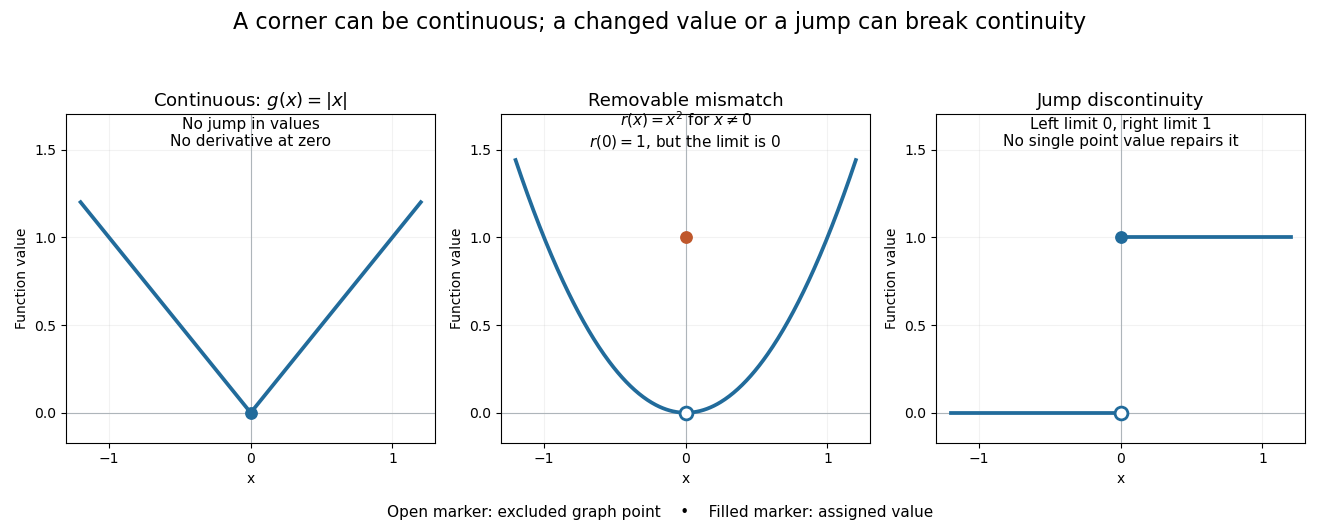
A function is discontinuous at a point in its domain of a function when it fails the epsilon-delta definition of continuity there. Two basic failures are an incorrect assigned value and unequal one-sided limits. They demand different repairs.
For a removable discontinuity, considerThe limit at zero is , but . Replacing that one value by gives the continuous square function. The sequence makes the mismatch visible: . A removable discontinuity can also describe an expression with a missing value, in which case the question is whether a continuous extension to the missing input exists.
For a jump discontinuity, take for and for . The left and right one-sided limits at zero are and . No assignment to can equal both, so changing only the point value cannot make the function continuous there. Contrast both examples with the corner of : that function is continuous at zero even though its derivative is absent.
Inside the constructible universe, every hereditarily countable set appears in a countable level of the constructible hierarchy. Take a countable elementary substructure of a sufficiently large containing its transitive closure pointwise. The condensation lemma for the constructible universe identifies the collapse with for countable , and the collapse fixes the original set. Conversely, a countable-indexed level is countable inside the constructible universe.
This statement says that the first uncountable ordinal of an inner model is a countable ordinal in the ambient universe. It can hold together with the Generalized continuum hypothesis: start with constructibility and use a finite-function collapse to countable size on . The GCH preservation by a finite-function collapse calculation gives the relative consistency result already from the consistency of ZFC.
For radius and tangential velocity with symmetric traceless , the surface divergence is . At small surface Péclet number , neglecting advection of the concentration perturbation givesThe result follows because this quadratic is a degree-two spherical harmonic with surface Laplacian times itself and zero spherical mean.
An affine connection on a smooth manifold is a connection on a vector bundle for its tangent bundle. It satisfies and . Its curvature isThe Leibniz rule makes curvature tensorial in all three slots. An affine connection is also called a linear connection on the manifold; a Levi-Civita connection is the distinguished torsion-free metric-compatible example.
For a metric vector bundle connection over a Riemannian manifold, the rough Laplacian is the formally nonnegative connection operatorwhere is a local orthonormal frame. The correction term makes the expression independent of the orthonormal frame. On a closed manifold, integration by parts gives .
Cohomology ring of a connected sum of odd-dimensional sphere products by Codex 0 Created 2026-10-05 Updated 2026-10-06
Codex 0 Created 2026-10-05 Updated 2026-10-06For odd and , the integral cohomology has one copy of in degrees zero and , in degree , and zero elsewhere. Choose the top orientation class and degree- classes from the two factors of summand . Their nonzero positive-degree basis products areAll and vanish, and annihilates positive-degree classes. The Künneth theorem computes each sphere product; the Mayer–Vietoris sequence computes the connected sum groups, and its degree-one pinch maps determine the products. Thus its middle-degree Poincare duality pairing is a symplectic vector space after changing coefficients to a field of characteristic different from two. The case is the usual cohomology ring of a closed oriented surface.
Pinned article: Introduction to the OurBigBook Project
Welcome to the OurBigBook Project! Our goal is to create the perfect publishing platform for STEM subjects, and get university-level students to write the best free STEM tutorials ever.
Everyone is welcome to create an account and play with the site: ourbigbook.com/go/register. We belive that students themselves can write amazing tutorials, but teachers are welcome too. You can write about anything you want, it doesn't have to be STEM or even educational. Silly test content is very welcome and you won't be penalized in any way. Just keep it legal!
Intro to OurBigBook
. Source. We have two killer features:
- topics: topics group articles by different users with the same title, e.g. here is the topic for the "Fundamental Theorem of Calculus" ourbigbook.com/go/topic/fundamental-theorem-of-calculusArticles of different users are sorted by upvote within each article page. This feature is a bit like:
- a Wikipedia where each user can have their own version of each article
- a Q&A website like Stack Overflow, where multiple people can give their views on a given topic, and the best ones are sorted by upvote. Except you don't need to wait for someone to ask first, and any topic goes, no matter how narrow or broad
This feature makes it possible for readers to find better explanations of any topic created by other writers. And it allows writers to create an explanation in a place that readers might actually find it.
Figure 1. Screenshot of the "Derivative" topic page. View it live at: ourbigbook.com/go/topic/derivativeVideo 2. OurBigBook Web topics demo. Source. - local editing: you can store all your personal knowledge base content locally in a plaintext markup format that can be edited locally and published either:This way you can be sure that even if OurBigBook.com were to go down one day (which we have no plans to do as it is quite cheap to host!), your content will still be perfectly readable as a static site.
- to OurBigBook.com to get awesome multi-user features like topics and likes
- as HTML files to a static website, which you can host yourself for free on many external providers like GitHub Pages, and remain in full control

Figure 2. You can publish local OurBigBook lightweight markup files to either OurBigBook.com or as a static website.
Figure 3. Visual Studio Code extension installation.
Figure 5. . You can also edit articles on the Web editor without installing anything locally. Video 3. Edit locally and publish demo. Source. This shows editing OurBigBook Markup and publishing it using the Visual Studio Code extension. 
- Infinitely deep tables of contents:



All our software is open source and hosted at: github.com/ourbigbook/ourbigbook
Further documentation can be found at: docs.ourbigbook.com
Feel free to reach our to us for any help or suggestions: docs.ourbigbook.com/#contact