Topics (384k) Articles (398k) Users (410) Discussions (242) Comments (383) Files (13k) New article

For , the angular-frequency transform is the tempered distributionThe numerator cancels the singularity at zero and makes this integral absolutely convergent. Differentiating and using determines this expression up to a Dirac delta distribution. That delta coefficient is zero: testing with the expanding Gaussian makes both the proposed expression and tend to zero, while stays fixed. Changing the subtraction convention would change the delta coefficient.
For , the Fourier transform of a tempered distribution satisfiesThe base cases follow from and integration by parts in the Fourier integral. Iterating gives the multi-index formulas. The convention matters: for the unscaled derivative, .
A formal power series ring is Noetherian if and only if is Noetherian. In the forward direction, use the quotient ring . In the reverse direction, for an ideal consider the ascending sequence of ideals of formed by the coefficient of in . Stabilization and finite generation give a finite list of series that generate by successive coefficient cancellation.
For a vector space over a field , its formal power series module is . It is complete for the filtration by . The ordinary tensor product embeds in it and consists of series whose coefficients span a finite-dimensional vector subspace; it equals if is finite-dimensional. The inclusion is proper for infinite-dimensional , as shown by a series with linearly independent coefficients.
A fluid limit is a scaling limit of a stochastic process obtained by scaling space and time so that random fluctuations vanish and a deterministic trajectory remains. It can justify a fluid model when the required convergence conditions hold.
A nonnegative fluid model drains in finite time if all its coordinates approach zero at a finite terminal time. A ratio-based ordinary differential equation can become undefined at that endpoint; an absorbing extension is an additional modeling convention.
The proportionally fair allocation on a four-cycle produces a reversible Markov chain with stationary distribution proportional to . This is normalizable exactly when every resource's offered load is strictly below capacity, equivalently .
For a uniform polar order parameter in simple shear flow , the angular equation is . A fixed orientation for nonzero shear therefore requires . For , its angular stability condition is ; equality at requires nonlinear analysis. The ordered magnitude must separately satisfy the radial stationarity equation and be nonzero.
In simple shear flow, a persistent polar order parameter with has no fixed angle and rotates continuously. Integrating through gives the displayed period. An unoriented nematic director repeats after half that time. At , the magnitude relaxes independently while the angular speed is .
Applying the Poisson equation for Newtonian gravity to a flattened power-law gravitational potential yieldsFor , nonnegative mass density everywhere outside the origin requires and is ensured by . The central density singularity is locally integrable and carries no point mass, although the total mass diverges at large radius in this scale-free model.
A fixed component is a prime divisor appearing in every member of a complete linear system of a divisor. This concerns divisorial components; a linear system can have isolated basepoints even when it has no fixed component.
At an interior target point in regular fixed-design nonparametric regression, mean functions with Lipschitz bound have pointwise minimax risk of order for fixed positive as . A smoothing bandwidth of order balances squared bias of an estimator and variance; the two-point lower bound with a triangular bump gives the matching lower rate.
The Jeffreys prior uses the square root of the determinant of the Fisher information matrix as a parameter-density kernel. It is invariant under smooth one-to-one reparameterization, since the information and density Jacobians transform compatibly. It may be an improper prior; invariance does not guarantee posterior propriety. With nuisance parameters, a scalar conditional Jeffreys prior and the joint Jeffreys prior need not coincide.
A spin-flop transition is a field-induced reorientation of an antiferromagnet. In the classical easy-axis case, an applied magnetic field along the preferred axis can drive the nearly antiparallel sublattice magnetic moments into a canted arrangement whose dominant opposing components lie approximately transverse to the field. The moments acquire a net field-aligned component while retaining strong antiferromagnetic opposition.
The competition is between magnetic anisotropy favouring the easy axis, the exchange interaction favouring opposing moments, and the energy gained by responding to the applied field. The classical reorientation is a first-order phase transition; its neighborhood can include coexistence and magnetic domains.[ref]
Spin-flop transition in uniaxial antiferromagnets by A. N. Bogdanov and others. Publisher abstract, first-order easy-axis reorientation, hierarchy of coupling scales and multidomain coexistence
A field sweep measuring magnetization or magnetic susceptibility detects the changed response. A spin flop is a reorientation into a canted antiferromagnetic state; full alignment at much stronger field is a separate saturation process.
The usual conditions are completeness and right continuity of a filtration: contains all subsets of null events in the ambient probability space, and . They allow the standard continuous-time martingale, stopping time and stochastic integration theorems to be used without repeated augmentation qualifications. An absolute continuity of measures change preserves old null sets but can introduce new ones; the usual completion under the new measure may therefore be understood when needed.
The principal filter in an ordered set generated by contains exactly the elements above . It is upward closed, and is a common lower bound in the filter for any two of its members. With standard notation for forcing, these are the conditions weaker than . The principal filter need not be a generic filter: a dense set can require a strict strengthening. The compatible-condition filter in a forcing atom determines a ground-model generic filter includes strengthenings as well as weakenings and can therefore be strictly larger.
For and , rescaling the defining gamma function integral proves this representation, with compatible complex-power branches. It turns denominator powers into exponential factors, making Gaussian integrals possible. Combining two parameters by their sum and ratio gives the usual Feynman parameter identity. Outside its convergence domain a further continuation or pole prescription is needed.
Fermi momentum is the magnitude of the momentum at the boundary of filled one-particle states in an isotropic zero-temperature Fermi gas. For the uniform three-dimensional two-component electron model, a short state count givesTo see the factors, impose periodic boundary conditions on a cubic box of side , so and each momentum component is for an integer . Each allowed momentum point occupies a cell of volume in momentum space. Divide the sphere volume by this cell volume and multiply by two for the two spin states. Replacing the discrete count with a volume is the large-box approximation; surface and shell effects are neglected.[ref]
3 Quantum Gases. Statistical Physics by David Tong; §3.1, periodic wavevectors and momentum-space integration measure; §3.6.1, spin degeneracy
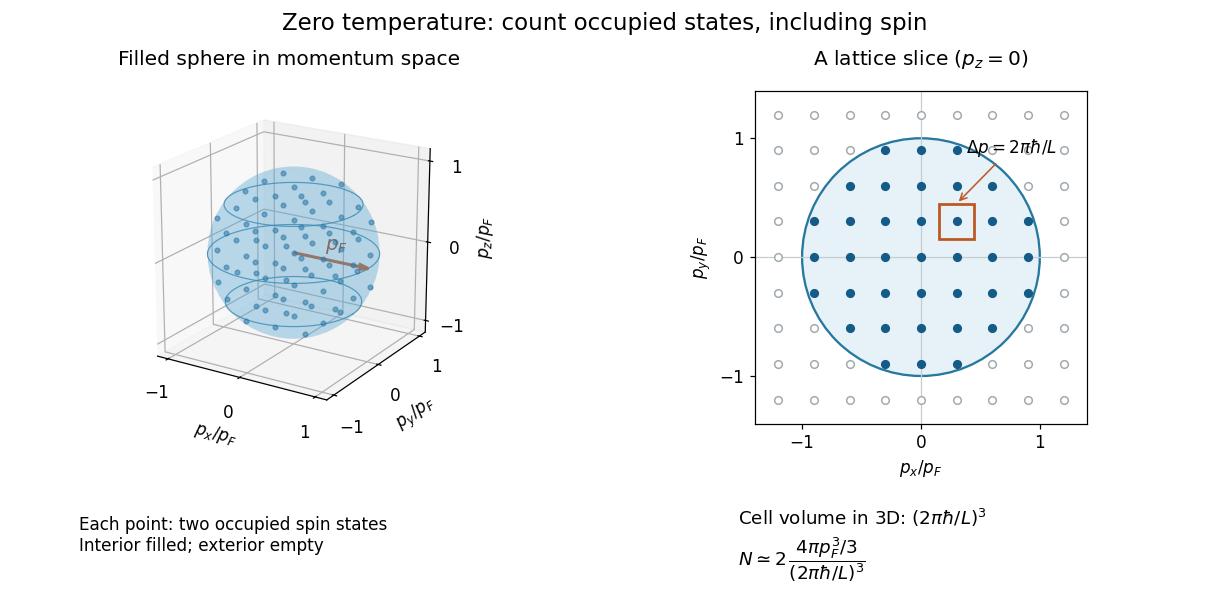
The occupied momentum sphere counts two spin states per momentum point; a slice shows the state lattice
. Details. The factor two is not automatic for every Fermi gas. If only one internal state is populated, its number density instead satisfies . For two equally populated states, recovers the displayed result. A Fermi surface in a crystal can have a more complicated shape, so a single spherical Fermi momentum is a property of this isotropic model.
In factor analysis with one factor and fixed noise variance , let be the current loading vector, , and . The expectation-maximization algorithm update isThe conditional factor means are and their variances are ; maximizing the expected complete-data log-likelihood gives the formula.
Pinned article: Introduction to the OurBigBook Project
Welcome to the OurBigBook Project! Our goal is to create the perfect publishing platform for STEM subjects, and get university-level students to write the best free STEM tutorials ever.
Everyone is welcome to create an account and play with the site: ourbigbook.com/go/register. We belive that students themselves can write amazing tutorials, but teachers are welcome too. You can write about anything you want, it doesn't have to be STEM or even educational. Silly test content is very welcome and you won't be penalized in any way. Just keep it legal!
Intro to OurBigBook
. Source. We have two killer features:
- topics: topics group articles by different users with the same title, e.g. here is the topic for the "Fundamental Theorem of Calculus" ourbigbook.com/go/topic/fundamental-theorem-of-calculusArticles of different users are sorted by upvote within each article page. This feature is a bit like:
- a Wikipedia where each user can have their own version of each article
- a Q&A website like Stack Overflow, where multiple people can give their views on a given topic, and the best ones are sorted by upvote. Except you don't need to wait for someone to ask first, and any topic goes, no matter how narrow or broad
This feature makes it possible for readers to find better explanations of any topic created by other writers. And it allows writers to create an explanation in a place that readers might actually find it.
Figure 1. Screenshot of the "Derivative" topic page. View it live at: ourbigbook.com/go/topic/derivativeVideo 2. OurBigBook Web topics demo. Source. - local editing: you can store all your personal knowledge base content locally in a plaintext markup format that can be edited locally and published either:This way you can be sure that even if OurBigBook.com were to go down one day (which we have no plans to do as it is quite cheap to host!), your content will still be perfectly readable as a static site.
- to OurBigBook.com to get awesome multi-user features like topics and likes
- as HTML files to a static website, which you can host yourself for free on many external providers like GitHub Pages, and remain in full control

Figure 2. You can publish local OurBigBook lightweight markup files to either OurBigBook.com or as a static website.
Figure 3. Visual Studio Code extension installation.
Figure 5. . You can also edit articles on the Web editor without installing anything locally. Video 3. Edit locally and publish demo. Source. This shows editing OurBigBook Markup and publishing it using the Visual Studio Code extension. 
- Infinitely deep tables of contents:



All our software is open source and hosted at: github.com/ourbigbook/ourbigbook
Further documentation can be found at: docs.ourbigbook.com
Feel free to reach our to us for any help or suggestions: docs.ourbigbook.com/#contact