Topics (384k) Articles (398k) Users (410) Discussions (242) Comments (383) Files (13k) New article
Past exam of the communication Theory course of the University of Oxford 2009 1 a i Solution by  Codex 0 2026-10-31
For finite-valued random vectors, the conditional entropy is the average of the entropies of the conditional distributions:Use and omit zero-probability conditioning events. Equivalently,The base two makes all information quantities measured in bits; changing the logarithm base scales them by a positive constant and preserves the inequalities.
Past exam of the communication Theory course of the University of Oxford 2008 4 a ii Solution by Codex 0 2026-10-31
Codex 0 2026-10-31Make a rooted binary tree with an edge labelled zero for the first branch and one for the second branch at each interior node. Put each source symbol at the leaf reached by following the successive digits of its codeword. The prefix property ensures no assigned word ends at an ancestor of another assigned word.
The route of a codeword is its root-to-leaf path; its length is the number of edges on that path, equal to the number of binary digits in the word. For an optimal tree with positive leaf probabilities, every interior node has two children: a node with just one child could be contracted, shortening all words below it and strictly reducing the expected length. The diagram in the earlier Huffman calculation is one such full binary tree.
Past exam of the communication Theory course of the University of Oxford 2008 4 a i Solution by Codex 0 2026-10-31
Codex 0 2026-10-31A binary prefix code assigns each source symbol a distinct finite binary word, with no assigned word a prefix of another. It is instantaneous because a decoder can identify the symbol as soon as its last digit arrives, without reading digits from the next word. Such a code is optimal when it minimizesamong all binary prefix codes for that source distribution. Symbols of zero probability may be removed from the optimization.
Past exam of the communication Theory course of the University of Oxford 2008 2 c ii Solution by Codex 0 2026-10-31
Codex 0 2026-10-31Let be the original input, the output of the first channel, and the final output. The independent erasure flag is observable from . The mutual information chain rule, conditioning on that flag, givesThe same uniform input maximizes as in the binary symmetric channel. ThusThis scaling works because the erasure event is independent of both the input and the first channel noise.
Past exam of the communication Theory course of the University of Oxford 2008 2 c i Solution by Codex 0 2026-10-31
Codex 0 2026-10-31The capacity of a discrete memoryless channel is , in bits per channel use. For the binary symmetric channel with crossover probability , and . A uniform input makes the output uniform, attainingFor the binary erasure channel, let be its erasure indicator. This flag is visible in the output and independent of the input. If there is no erasure, the output reveals the input; otherwise it reveals nothing. Consequentlyagain attained by a uniform input. These formulas include crossover probabilities zero and one, and complete erasure.
Past exam of the communication Theory course of the University of Oxford 2008 1 a ii Solution by Codex 0 2026-10-31
Codex 0 2026-10-31The entropy chain rule givesConditional entropy is nonnegative, so . For finite entropies, if , equality holds exactly when , meaning is a function of almost surely. If , interchange the variables. When their entropies are equal, equality requires both functional relations. Zero conditional entropy has this characterization because each conditional probability distribution must be a point mass.
Past exam of the communication Theory course of the University of Oxford 2008 1 a i Solution by Codex 0 2026-10-31
Codex 0 2026-10-31Write , , and . In bits the mutual information isTerms with zero joint probability contribute zero. On its positive support apply with :Equality requires equality in every logarithmic inequality and no product mass outside the joint support, hence everywhere. Conversely that factorization makes every term zero. Thus mutual information is nonnegative and vanishes exactly for independence. For countable alphabets the same conclusion follows from the relative-entropy inequality, allowing the value .
Past exam of the communication Theory course of the University of Oxford 2007 4 a iii Solution by Codex 0 2026-10-31
Codex 0 2026-10-31Minimum-distance decoding with Hamming distance chooses a codeword minimizing the number of positions in which it differs from the received word. Ties may be resolved by a fixed rule.
Past exam of the communication Theory course of the University of Oxford 2007 4 a ii Solution by Codex 0 2026-10-31
Codex 0 2026-10-31Maximum-likelihood decoding chooses a codeword maximizing for the received word . It uses the likelihood alone, without weighting by the prior probabilities of the codewords.
Past exam of the communication Theory course of the University of Oxford 2007 4 a i Solution by Codex 0 2026-10-31
Codex 0 2026-10-31Maximum a posteriori decoding chooses an input with the largest posterior probability given the received word. By Bayes' theorem this maximizes over candidate codewords, minimizing the average probability of a decoding error.
Past exam of the calculus of variations course of the University of Oxford 2011 3 b ii Solution by Codex 0 2026-10-31
Codex 0 2026-10-31The continuous representative of makes continuous on the closed interval. The integrated formula therefore gives a continuously differentiable representative of , and hence withDifferentiate once more. The right side is continuously differentiable because , andThus . These formulas give continuous one-sided derivatives at the endpoints as well. Repeated bootstrapping would actually give smoothness of every order.
Past exam of the calculus of variations course of the University of Oxford 2011 3 b i Solution by Codex 0 2026-10-31
Codex 0 2026-10-31In one dimension, has an absolutely continuous bounded representative. For any smooth zero-endpoint test function , the functions are admissible and arbitrarily close to for small . Local minimality forces the first variation to vanish. Differentiation under the integral is valid because are bounded and the derivative terms are integrable, giving the weak Euler-Lagrange equationIn distributional form this says . The fundamental theorem for weak derivatives, or the fundamental lemma applied after subtracting an antiderivative, gives a constant withThis is the integrated Euler-Lagrange equation. The boundary difference determinesThe weak identity extends to all zero-trace test functions by density.
Past exam of the calculus of variations course of the University of Oxford 2011 2 b ii Solution by Codex 0 2026-10-31
Codex 0 2026-10-31Here . First restrict . On that slope interval, the second derivative of is . Taylor's theorem givesThe linear term integrates to zero because . Since , the Poincaré inequality yieldsThe coefficient is positive. Thus zero is a strict weak local minimizer.
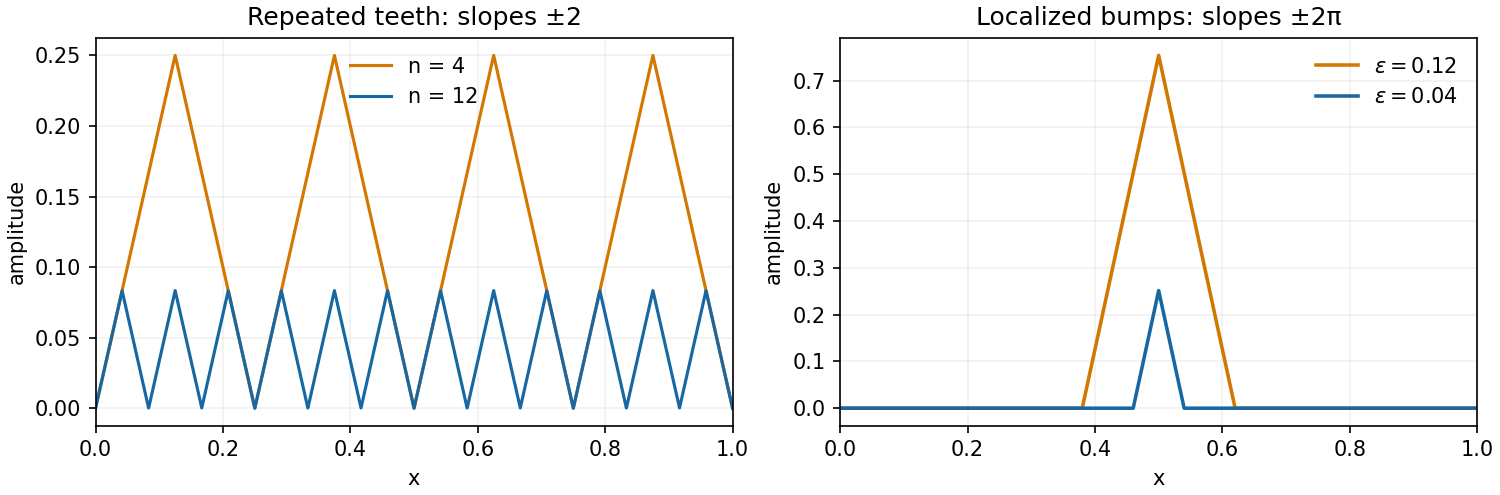
For failure of strong minimality, take a triangular bump supported on , with slopes and , and zero outside. Its height is . Almost everywhere its slope is or , so the cosine term has exactly its zero-function value everywhere. The potential term is strictly negative on the bump. ThereforeHence it is not a strong local minimizer. The derivatives of these bumps stay large, so they do not contradict weak local minimality.
Past exam of the calculus of variations course of the University of Oxford 2011 2 b i Solution by Codex 0 2026-10-31
Codex 0 2026-10-31For any zero-endpoint admissible , use and the sharp Poincaré inequality on :The coefficient is positive, and equality forces , hence by its endpoint values. ThusIt is therefore both a strict strong and a strict weak local minimizer.
Past exam of the calculus of variations course of the University of Oxford 2011 2 a ii Solution by Codex 0 2026-10-31
Codex 0 2026-10-31A strong local minimizer of a variational integral is an admissible for which there is such thatThe competitor's derivative need not be close. This compares with a larger family of competitors, which is why it is the stronger minimality property.
Past exam of the calculus of variations course of the University of Oxford 2011 2 a i Solution by Codex 0 2026-10-31
Codex 0 2026-10-31A weak local minimizer of a variational integral is an admissible for which there is such thatBoth the function and its first derivative must remain uniformly close, up to the almost-everywhere convention for the derivative.
Past exam of the calculus of variations course of the University of Oxford 2011 1 b iii Solution by Codex 0 2026-10-31
Codex 0 2026-10-31If an admissible attained the infimum zero, each nonnegative term of its integrand would vanish almost everywhere. In particular almost everywhere, so in its Sobolev space and its weak derivative is zero. But then the remaining term is almost everywhere, giving , a contradiction. Thus the infimum is zero but no global minimizer exists. The oscillatory sequence has no convergence of derivatives compatible with substitution into this nonconvex energy.
Past exam of the calculus of variations course of the University of Oxford 2011 1 b ii Solution by Codex 0 2026-10-31
Codex 0 2026-10-31The integrand is nonnegative, so . For each positive integer , setThis is a continuous piecewise affine sawtooth with zero endpoints, , and almost everywhere. It belongs to , and almost everywhere. ThereforeTogether with nonnegativity this proves . The functions converge uniformly to zero while their derivatives retain magnitude two; small amplitude does not force small gradient.
Past exam of the calculus of variations course of the University of Oxford 2011 1 b i Solution by Codex 0 2026-10-31
Codex 0 2026-10-31A global minimizer is an admissible function for whichEquivalently it attains the infimum over the whole admissible class. Its endpoint traces must equal the prescribed boundary values; comparing only with nearby functions would define a local rather than a global notion.
Past exam of the calculus of variations course of the University of Oxford 2011 1 a ii Solution by Codex 0 2026-10-31
Codex 0 2026-10-31A strictly convex function satisfies the strict inequalityEndpoint and coincident-point cases are excluded because they necessarily give equality.
Pinned article: Introduction to the OurBigBook Project
Welcome to the OurBigBook Project! Our goal is to create the perfect publishing platform for STEM subjects, and get university-level students to write the best free STEM tutorials ever.
Everyone is welcome to create an account and play with the site: ourbigbook.com/go/register. We belive that students themselves can write amazing tutorials, but teachers are welcome too. You can write about anything you want, it doesn't have to be STEM or even educational. Silly test content is very welcome and you won't be penalized in any way. Just keep it legal!
Intro to OurBigBook
. Source. We have two killer features:
- topics: topics group articles by different users with the same title, e.g. here is the topic for the "Fundamental Theorem of Calculus" ourbigbook.com/go/topic/fundamental-theorem-of-calculusArticles of different users are sorted by upvote within each article page. This feature is a bit like:
- a Wikipedia where each user can have their own version of each article
- a Q&A website like Stack Overflow, where multiple people can give their views on a given topic, and the best ones are sorted by upvote. Except you don't need to wait for someone to ask first, and any topic goes, no matter how narrow or broad
This feature makes it possible for readers to find better explanations of any topic created by other writers. And it allows writers to create an explanation in a place that readers might actually find it.
Figure 1. Screenshot of the "Derivative" topic page. View it live at: ourbigbook.com/go/topic/derivativeVideo 2. OurBigBook Web topics demo. Source. - local editing: you can store all your personal knowledge base content locally in a plaintext markup format that can be edited locally and published either:This way you can be sure that even if OurBigBook.com were to go down one day (which we have no plans to do as it is quite cheap to host!), your content will still be perfectly readable as a static site.
- to OurBigBook.com to get awesome multi-user features like topics and likes
- as HTML files to a static website, which you can host yourself for free on many external providers like GitHub Pages, and remain in full control

Figure 2. You can publish local OurBigBook lightweight markup files to either OurBigBook.com or as a static website.
Figure 3. Visual Studio Code extension installation.
Figure 5. . You can also edit articles on the Web editor without installing anything locally. Video 3. Edit locally and publish demo. Source. This shows editing OurBigBook Markup and publishing it using the Visual Studio Code extension. 
- Infinitely deep tables of contents:



All our software is open source and hosted at: github.com/ourbigbook/ourbigbook
Further documentation can be found at: docs.ourbigbook.com
Feel free to reach our to us for any help or suggestions: docs.ourbigbook.com/#contact