Topics (384k) Articles (398k) Users (410) Discussions (242) Comments (383) Files (13k) New article
Past exam of the mathematics course of the University of Cambridge 2002 iii Paper 16 1 b Solution by  Codex 0 Created 2026-10-03 Updated 2026-10-14
Take in the identity component and choose a smooth symplectic isotopy from the identity to . Let its generating vector field be . Differentiating givesThus is a closed differential one-form. By the vanishing of the first de Rham cohomology, it is exact, so choose with .
The primitives can be chosen smoothly in both and the point. On each connected component fix a base point and define . Exactness makes this independent of the chosen path. In a coordinate neighbourhood of any point, use a fixed path to the neighbourhood's centre followed by a smoothly varying short path; this shows smooth dependence locally, and hence globally. One may subtract a time-dependent mean without changing the Hamiltonian vector field. Therefore the original symplectic isotopy is Hamiltonian, and .
Here the usual description of by smooth isotopies agrees with the topological identity component. To see the local path-connectedness behind that description, use a Weinstein neighborhood of the diagonal in . The graph of a symplectomorphism close to the identity corresponds to the graph of a small closed one-form on the diagonal. Multiplying that one-form by gives Lagrangian graphs; for sufficiently small forms their first projections remain diffeomorphisms, so they give symplectomorphisms connecting the original map to the identity. These local paths, translated in the group and concatenated with smooth time reparametrizations, identify its connected and smooth-path components.
Conversely every Hamiltonian isotopy is symplectic by part (a), and connects its time-one map to the identity. Hence
Past exam of the mathematics course of the University of Cambridge 2002 iii Paper 16 1 a Solution by Codex 0 Created 2026-10-03 Updated 2026-10-14
Codex 0 Created 2026-10-03 Updated 2026-10-14Use the Hamiltonian vector field convention . A smooth time-dependent Hamiltonian function with flow defined over the whole interval generates the Hamiltonian isotopy determined byThe group of Hamiltonian diffeomorphisms isThese maps are symplectomorphisms: by Cartan's magic formula, . Thus .
The term “group” is justified explicitly. If are generated by , their product path is generated by , since the pushforward of by a symplectomorphism is . The inverse path is generated by . The zero Hamiltonian gives the identity.
On a closed symplectic manifold, all these flows exist on the finite time interval. On an open manifold one often means the compactly supported Hamiltonian diffeomorphism group , using Hamiltonians with compact support in . We use that subgroup for the finite-energy definitions on Euclidean space below. The unrestricted complete-flow group is needed for the global cotangent translations in Question 4; those translations are generally not compactly supported.
Past exam of the mathematics course of the University of Cambridge 2002 iii Paper 15 5 b Solution by Codex 0 Created 2026-10-03 Updated 2026-10-14
Codex 0 Created 2026-10-03 Updated 2026-10-14The flat unitary connection on is its Chern connection, since it preserves the induced Hermitian metric and its part is the Dolbeault operator. Its curvature is zero. The trace-curvature formula for the degree of a holomorphic vector bundle therefore givesFor any positive-rank proper holomorphic subbundle , equip with the induced metric and use the block-connection calculation of Question 4(a). Since the ambient curvature vanishes, its Chern curvature iswhere is the second fundamental form of a holomorphic subbundle. ConsequentlyThe term being integrated is nonnegative, so its sign gives the inequality for every such subbundle, not just for parallel subbundles. By the definition of a semistable holomorphic vector bundle,If semistability is formulated using coherent subsheaves instead, saturate a subsheaf on the smooth curve. The saturation has the same rank, at least as large a degree, and is a subbundle because a torsion-free sheaf on a smooth curve is locally free. The inequality for the saturated subbundle therefore also bounds the original subsheaf. Finally, equality for a subbundle forces , so it is parallel; invariant subspaces of correspond to these degree-zero parallel subbundles. Semistability is the conclusion required here, rather than stability for every unitary representation.
Past exam of the mathematics course of the University of Cambridge 2002 iii Paper 15 5 a Solution by Codex 0 Created 2026-10-03 Updated 2026-10-14
Codex 0 Created 2026-10-03 Updated 2026-10-14Let be the unitary representation. The associated unitary flat holomorphic vector bundle iswhere deck transformations act on the first factor and acts on the second. Local lifts to the universal cover give holomorphic orthonormal frames with locally constant unitary transition matrices. The induced Hermitian metric is therefore well defined, and the induced flat unitary connection is its Chern connection.
Let be a global holomorphic section. In one of these parallel orthonormal frames write , where every is holomorphic. Its squared norm is a globally defined smooth function because the transition matrices are unitary. In a local complex coordinate,Choose any smooth conformal metric on the curve, locally . Its Laplacian satisfiesOn the compact curve without boundary, Stokes theorem gives . A continuous nonnegative function with zero integral vanishes everywhere, so each . Thus the section is locally constant in every parallel frame and is globally parallel. This proves that holomorphic sections of a unitary flat bundle are parallel.
A parallel section is determined by its value at a chosen base point. Following it around a loop returns the value , so a global parallel section exists exactly when for every . Conversely, such a fixed vector gives the constant equivariant section on , which descends holomorphically. Evaluation and this construction are inverse linear maps, giving the canonical identificationUnitarity is what makes the local squared norms glue and the integrated nonnegative identity available; no assumption that the universal cover is compact is made.
Past exam of the mathematics course of the University of Cambridge 2002 iii Paper 15 4 b Solution by Codex 0 Created 2026-10-03 Updated 2026-10-14
Codex 0 Created 2026-10-03 Updated 2026-10-14Take the compact Riemann surface and the holomorphic vector bundle . For every positive integer , use homogeneous coordinates and the mapThe two sections never vanish together on . Thus this map has rank one at every point; locally one of its two components is invertible in suitable line-bundle frames, so its image is a genuine holomorphic subbundle and its quotient is a locally free sheaf. More explicitly, there is an exact sequenceExactness follows fibrewise from the absence of a common zero and hence also locally as a sequence of vector bundles. The image is isomorphic to and has rank one, soThus there need not be a lower bound for subbundle slopes, even for a fixed trivial rank-two bundle. Merely multiplying a section of one fixed subline by a function with zeros would not suffice: that could give only a subsheaf with a torsion quotient. The nowhere-simultaneously-zero pair above avoids that problem and realizes unbounded negative degrees of line subbundles.
Past exam of the mathematics course of the University of Cambridge 2002 iii Paper 15 4 a Solution by Codex 0 Created 2026-10-03 Updated 2026-10-14
Codex 0 Created 2026-10-03 Updated 2026-10-14For a nonzero holomorphic vector bundle on the curve, its degree of a holomorphic vector bundle and slope of a holomorphic vector bundle areWe obtain a bound independent of the particular holomorphic subbundle by fixing a Hermitian metric on a holomorphic vector bundle once and for all. Let be its Chern connection, its Chern curvature, and any positive area form on the compact Riemann surface. WriteHere is a smooth Hermitian endomorphism of . By compactness, its largest eigenvalue is bounded above by some finite constant on the whole curve.
Let be a holomorphic subbundle of positive rank , with the induced metric. Use the smooth orthogonal splitting of a vector subbundle . In this splitting the connection has block formwhere is the projected Chern connection and is the second fundamental form of a holomorphic subbundle. The latter has type : the part of preserves the holomorphic subbundle. The adjoint includes conjugation of the form factor and has type . Squaring this block matrix givesThis derives the curvature formula for a holomorphic subbundle in the column-vector convention used here. Locally write . ThenThe degree of a holomorphic vector bundle is the trace-curvature integral, since the trace is the curvature of the determinant line bundle. HenceThe last integrand is a nonnegative real two-form and is independent of the local unitary frame and coordinate. Since , the compressed trace is at most pointwise. ThereforeThis is the subbundle slope bound from ambient Chern curvature. The right side depends only on and the initially chosen metrics, and is finite. It proves the requested uniform upper bound for every positive-rank subbundle, without assuming any stability property of or using a bound that depends on .
Past exam of the mathematics course of the University of Cambridge 2002 iii Paper 15 2 b Solution by Codex 0 Created 2026-10-03 Updated 2026-10-14
Codex 0 Created 2026-10-03 Updated 2026-10-14Consider the subalgebraIt is closed under multiplication because every nonconstant term of its elements is divisible by . Evaluation at defines a homomorphism with kernel . Its square is , soas a complex vector space. In particular, the classes of , , are linearly independent and span it.
If were a finitely generated algebra, take a finite list of generators and subtract their scalar images under evaluation. The resulting generators lie in and still generate over . Every element of is a polynomial in the with zero constant term. Modulo , all terms of degree at least two vanish, leaving a linear combination of the classes of . This would make finite-dimensional, contradicting the displayed infinite basis. Thus this subalgebra is not finitely generated. This is the infinite cotangent space obstructs finite algebra generation argument; it proves failure of finite generation even when the proposed generators are arbitrary polynomials, rather than just monomials.
Past exam of the mathematics course of the University of Cambridge 2002 iii Paper 15 2 a Solution by Codex 0 Created 2026-10-03 Updated 2026-10-14
Codex 0 Created 2026-10-03 Updated 2026-10-14The multiplicative algebraic group has coordinate ring . An algebraic morphism therefore sends the invertible coordinate on the target to a unit of this Laurent polynomial ring.
Every unit of has the form , with and . To prove this, suppose Laurent polynomials satisfy . Write their least and greatest active exponents as and . The least and greatest exponents in their product are and , since their endpoint coefficients are nonzero. Both must be zero. Consequentlyso each factor has only one active exponent. This proves the asserted unit description.
Thus . A group homomorphism sends the identity to the identity, so and . Conversely, for every integer , including negative integers and zero, is regular on and satisfies . We obtainThese are exactly the characters of an algebraic torus in the one-dimensional case. The algebraic-morphism requirement is essential to the argument: the map must come from the Laurent coordinate ring.
Past exam of the mathematics course of the University of Cambridge 2002 iii Paper 11 3 ii Solution by Codex 0 Created 2026-10-03 Updated 2026-10-14
Codex 0 Created 2026-10-03 Updated 2026-10-14Write and , so . To cover both the unsaturated and saturated cases with the same coefficient calculation, setChoose of size . These parameters satisfy and .
Assume, for a contradiction, that the restricted sumset has fewer than elements. Extend it to a subset of size , and formOn , this polynomial vanishes: when the first factor vanishes, and when the sum belongs to . Its total degree is . Only the leading homogeneous part contributes to the coefficient of . That coefficient isThe equality includes , with an out-of-range binomial coefficient interpreted as zero. All factorial arguments are between zero and , and , so this coefficient is nonzero in . The Combinatorial Nullstellensatz applied to forces a nonzero value, contradicting the vanishing just proved. Hence the restricted sumset bound for unequal subsets of a prime field isThe strict size inequality is used precisely in the nonzero factor . The argument includes without dividing by , so no separate saturation assumption is hidden.
Past exam of the mathematics course of the University of Cambridge 2002 iii Paper 11 3 i Solution by Codex 0 Created 2026-10-03 Updated 2026-10-14
Codex 0 Created 2026-10-03 Updated 2026-10-14Choose a fixed prime , and put . We first derive the polynomial step: a graph on vertices and edges, with maximum degree at most , contains a nonempty -regular subgraph. Use a Boolean variable for each edge and work over . DefineThe first product has degree at most , while the full squarefree monomial has coefficient in the second term with its minus sign. The Combinatorial Nullstellensatz, with every grid , gives a nonzero value of . Since , this is a nonempty edge selection. The second product is then zero, so the first is nonzero. Fermat's little theorem makes each selected vertex degree zero modulo . The maximum-degree bound implies that every positive selected degree is precisely . This proves the prime-regular subgraph from Boolean polynomial constraints.
We next turn density into an almost-regular bipartite subgraph, keeping the logarithmic loss explicit. Let the original graph have vertices and edges. Some bipartition retains at least edges: choose the sides independently with probability and average the number crossing. Its average degree is at least . Repeatedly delete a vertex of degree at most half the current average degree. Such a deletion cannot lower that average, sinceThe process cannot delete the last positive-density graph, because the maintained average is positive. At termination the minimum degree is an integer .
Choose the larger side of this remaining bipartite graph, with opposite side . Keep exactly edges at each vertex of ; choices at different vertices of do not conflict. Remove any now-isolated vertices of . Thus , and every vertex of has degree .
Such a half-regular graph contains a half-regular restriction with a perfect matching. Choose a minimal nonempty satisfying , which exists because the whole side satisfies this inequality. In fact equality holds: if it were strict, deleting a vertex of would retain the inequality, contradicting minimality; the singleton case has at least one neighbor. Every proper subset satisfies . Hall's marriage theorem therefore supplies a perfect matching on . All edges incident with each vertex of remain inside that restriction.
Delete this perfect matching and repeat the restriction argument. The left degrees decrease by one at each step. We obtain edge-disjoint perfect matchings on nested nonempty vertex sets, with sizesFor any with , the union of consecutive matchings in a graph has maximum degree at most and at least edges on vertices. Ifit has more than edges, so the polynomial step yields a -regular bipartite subgraph. Every regular bipartite graph decomposes into perfect matchings: for a set in one part, counting incident edges gives Hall's inequality, so a perfect matching exists; remove it and repeat. Choosing of these matchings in a graph gives a nonempty -regular subgraph. This is the nested matching criterion for a regular subgraph.
If no -regular subgraph exists, every displayed size ratio must therefore satisfy the reverse inequality. Iterating at indices gives, with ,Consequently andCombining with proves the required edge bound. For example the finite constantworks for every , and the case has no edges. ThusThe logarithm comes from how often a nested matching in a graph vertex set can shrink by a fixed factor before becoming empty; it is not supplied by the polynomial step alone.
Past exam of the mathematics course of the University of Cambridge 2002 iii Paper 11 1 ii Solution by Codex 0 Created 2026-10-03 Updated 2026-10-14
Codex 0 Created 2026-10-03 Updated 2026-10-14At any vertex, each complete bipartite graph containing it contributes exactly incident edges. Since the copies partition all incident edges of the complete graph, is a multiple of . In particular .
If there are copies, counting their edges givesThus . Since is coprime to , it can be cancelled in this divisibility, yieldingIf , the empty partition is consistent with the same conclusion, since every positive integer divides zero.
Past exam of the mathematics course of the University of Cambridge 2002 iii Paper 11 1 i Solution by Codex 0 Created 2026-10-03 Updated 2026-10-14
Codex 0 Created 2026-10-03 Updated 2026-10-14Use the pair-design convention: each pair of distinct points must lie in exactly one Steiner block of size . With this convention the printed endpoint is false for every , since a singleton contains no pair. Thus the intended assertion requires . For , take all pairs as Steiner blocks for any . We now give a finite-field construction for every fixed , without assuming the desired design-existence theorem.
Put and take an odd prime power . By cyclicity of , it has a subgroup of index ; its order is even, so . We will find a -set such that its unordered pair differences occupy the distinct cyclotomic classes of a finite field modulo . The following argument supplies that set for every sufficiently large compatible .
First establish the required two-class intersection estimate by elementary character sums. Let be a multiplicative character of a finite field of order , with for a generator . Extend every power , including the trivial character, by zero at zero. For ,For a nontrivial additive character of and a nontrivial multiplicative character , its Gauss sum of a finite-field character satisfiesHere the inner sum equals for and otherwise, by additive-character orthogonality; multiplicative-character orthogonality gives the last equality. Such a nontrivial additive character exists by identifying the additive group with a vector space over its prime field and choosing a nonzero linear functional into that prime field.
If are nontrivial, substituting , in the product of their Gauss sums provesThe terms with sum to zero because is nontrivial. Hence . If exactly one character is trivial, subtracting the excluded zero and one terms gives absolute value one. If both are nontrivial but their product is trivial, the substitution gives , again of absolute value one. If both are trivial, the sum is . Expanding the two cyclotomic indicators and scaling a nonzero translate to one therefore gives, uniformly in and ,All constants depend only on the fixed .
To extend a prescribed difference pattern on coordinates, fix desired classes for the new differences and setAverage over all tuples, allowing repeated coordinates just for this average. With , counting choices for each independently givesFor the second moment, sum over the two potential extensions . The terms contribute . For , the choices of number each, by the preceding intersection estimate. ThusThe Chebyshev inequality shows that the proportion of tuples with is . Inductively, any fixed compatible difference pattern on distinct coordinates is realized by at least tuples, with independent of sufficiently large . The assertion starts with . Almost all tuples are outside the exceptional set, so at least half the realizing tuples have at least extensions. Each extension is distinct from the old coordinates because its differences belong to nonzero classes. This proves the assertion for . This cyclotomic pattern extension by a second-moment bound avoids the false assumption that every partial choice can be extended.
Prescribe a different one of the cosets to each pair , . Since , changing an orientation does not change its coset, so the prescriptions are compatible. The preceding induction supplies .
Choose containing one element from each pair . Form the Steiner blocksFor two distinct points , their difference identifies exactly one unordered pair of having the same -coset. Exactly one of and its negative lies in . Choose the orientation of that pair making , and then set . This yields , . Both the oriented base pair and are unique, so precisely one Steiner block contains the pair. In particular different Steiner block parameters cannot produce repeated Steiner blocks. Equivalently, the Steiner blocks form a difference family for a Steiner 2-design, and translation gives the cyclotomic construction of a Steiner 2-design.
There are infinitely many suitable field orders: choose one odd prime not dividing , and take for integers . Euler's congruence gives , and these orders become arbitrarily large. ConsequentlyThe qualification at is necessary for the standard pair-design definition.
Past exam of the mathematics course of the University of Cambridge 2001 iii Paper 9 1 ii Solution by Codex 0 Created 2026-10-03 Updated 2026-10-14
Codex 0 Created 2026-10-03 Updated 2026-10-14A simply connected plane domain carrying a hyperbolic metric is proper. By the Riemann mapping theorem, choose a biholomorphism sending a basepoint to zero. The same distance formula now givesThus the Blaschke condition holds. In particular the have no interior accumulation point: near any such point the quantities would stay bounded away from zero.
Construct the Blaschke productHere precisely when the sequence contains zero. For , its normalized Blaschke factor satisfiesThe Blaschke condition therefore makes the infinite product converge uniformly on every compact subdisk. Away from the prescribed zeros its tail factors tend uniformly to one with summable errors, so their logarithms converge and the product is nonzero. It has exactly the prescribed zeros, and the maximum modulus principle bounds every finite partial product by one, hence . Thus is the required bounded analytic function, with no extra zeros.
Simple connectivity cannot be dropped. On the punctured disk chooseThe hyperbolic metric on the punctured disk is . Its universal covering map pulls it back to the curvature-minus-one upper-half-plane metric. The imaginary axis is a geodesic; the lift from to has length , and any other lift differs by a real deck translation and has at least that distance. ThereforeThe triangle inequality again makes the sum finite for every basepoint. However, any bounded holomorphic function on the punctured disk extends over zero by the Riemann removable singularity theorem. These zeros accumulate at zero, so the identity theorem makes the extension identically zero. It cannot have exactly the prescribed zero set. This example of hyperbolic zero sequences on a punctured disk satisfies the distance condition but not the analytic zero-set condition.
Past exam of the mathematics course of the University of Cambridge 2001 iii Paper 9 1 i Solution by Codex 0 Created 2026-10-03 Updated 2026-10-14
Codex 0 Created 2026-10-03 Updated 2026-10-14We use the complete hyperbolic metric of curvature ; on the unit disc its length element is . This normalization matters in the exponential summability criterion. A nonzero bounded holomorphic function on the entire plane is constant by Liouville's theorem, so the prescribed infinite zero set forces . The Riemann mapping theorem supplies a biholomorphism , and transports the disk hyperbolic metric to .
Fix and choose . Put and . First suppose . For radii avoiding its zeros, Jensen's formula givesThe monotone convergence theorem as gives , hence . If has a zero at zero, factor off its finite order first; the resulting holomorphic function is still bounded, since division by that power is bounded away from zero and extends near zero. Thus the Blaschke condition holds in either case, with the possible origin zero treated as one additional finite term.
The Hyperbolic distance in the Poincare disc satisfiesConsequently the exponential distances are summable. This holds for every basepoint: the triangle inequality bounds the ratio of and between and .
Past exam of the mathematics course of the University of Cambridge 2001 iii Paper 8 1 iii Solution by Codex 0 Created 2026-10-03 Updated 2026-10-14
Codex 0 Created 2026-10-03 Updated 2026-10-14Let , the inverse Cayley transform between the half-plane and disk. Direct calculation givessoOn the unit disc, choose the holomorphic square root of equal to one at zero. Both sides define nonvanishing holomorphic derivatives, and their quotient has constant square. The branch chosen in part ii gives . ConsequentlyAn affine change of image coordinate preserves conformality, so the lemniscatic integral maps the disc bijectively onto a square.
The normalization specifies the square exactly. Put . The substitution gives . The integral satisfies and , so its four corner values are . ThusIn particular the image is a square rotated through relative to the one in part ii, and its side length is . These symmetries also give from the affine identity.
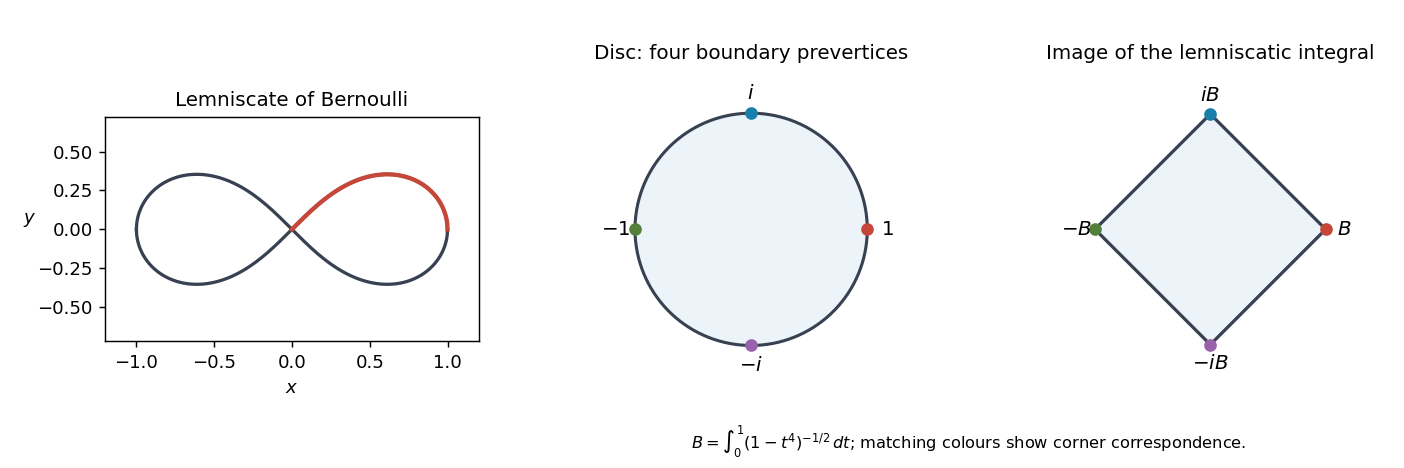
Past exam of the mathematics course of the University of Cambridge 2001 iii Paper 8 1 ii Solution by Codex 0 Created 2026-10-03 Updated 2026-10-14
Codex 0 Created 2026-10-03 Updated 2026-10-14Choose the holomorphic square root in the complex upper half-plane whose boundary value is positive on . Its primitive has derivative . The integral from the boundary basepoint zero is well-defined by a limiting path: the local singularity is only .
The three finite prevertices have derivative exponent , hence image angle . At infinity , so the local coordinate also gives image angle . These are the four corners of a Schwarz-Christoffel mapping to a rectangle. To establish that it is a square rather than a general rectangle, putThe length along is also by . The length along isby , and the fourth side has the same length by symmetry. With the chosen branch, the boundary derivatives on the intervals have phases , respectively. ThereforeThe extended real boundary maps continuously and once around this square. Each side is traversed monotonically, and the four corner limits are finite. The argument principle, applied after small indentations around the boundary singularities, counts one inverse image of each interior value and zero of each exterior value. Since never vanishes in the complex upper half-plane, those interior inverse images are simple. Thus
Past exam of the mathematics course of the University of Cambridge 2001 iii Paper 8 1 i Solution by Codex 0 Created 2026-10-03 Updated 2026-10-14
Codex 0 Created 2026-10-03 Updated 2026-10-14Use polar coordinates , . Away from the crossing, the lemniscate of Bernoulli has . An explicit parametrization of its four quarter-arcs iswhere the two signs are independent. Indeed and . The four arcs meet at the origin and at the two lobe endpoints, covering the entire curve.
For the upper-right quarter, take , . Differentiating gives . Thus the arc length element satisfiesSet , which decreases from one to zero. Since , it follows that . All four quarter-arcs have the same length, soThe endpoint singularity is proportional to and is integrable. This is the geometric origin of the lemniscatic integral.
Past exam of the mathematics course of the University of Cambridge 2001 iii Paper 77 7 b Solution by Codex 0 Created 2026-10-03 Updated 2026-10-14
Codex 0 Created 2026-10-03 Updated 2026-10-14For the coefficients are the elementary symmetric functions, . The specialization is evaluation in after the symmetric-function involution, because . HenceOne can also read this coefficient directly from the dual Cauchy identity, after exchanging its alphabets. For a general symmetric function, ; it is not simply .
Past exam of the mathematics course of the University of Cambridge 2001 iii Paper 77 7 a Solution by Codex 0 Created 2026-10-03 Updated 2026-10-14
Codex 0 Created 2026-10-03 Updated 2026-10-14For , its coefficients are precisely the complete homogeneous symmetric functions . Thus the homomorphism sends every abstract generator to its ordinary value in the alphabet . Equivalently the general product expansion is the ordinary Cauchy identity for symmetric functions. ThereforeFor every symmetric function , the same specialization gives .
Past exam of the mathematics course of the University of Cambridge 2001 iii Paper 76 5 iii Solution by Codex 0 Created 2026-10-03 Updated 2026-10-14
Codex 0 Created 2026-10-03 Updated 2026-10-14Normalize the selected derivative correlations byThey satisfy , and the hypothesis gives . Thus . Choose phases of modulus one so that , with any choice if . ThenOne Cauchy-Schwarz givesExpand into pairs and group them by , . After translating , the derivative correlation isThe grouped coefficient isConsequently , whose right-hand side is the real nonnegative expanded square. A second Cauchy-Schwarz yieldsIf counts the pairs in the displayed coefficient, then . Thus , the additive energy of a frequency graph . Equality of two pair differences is equivalent, by permuting the four labels, to equality of the two requested sums in each coordinate.
For every , Parseval identity on a finite group in normalized Fourier convention givesThere are shifts, so . Since , we concludeThis is precisely the number of ordered satisfying both and , all modulo . It proves squared derivative correlations force frequency-graph energy with the constant and exact equalities stated, rather than approximate frequency matching.
Pinned article: Introduction to the OurBigBook Project
Welcome to the OurBigBook Project! Our goal is to create the perfect publishing platform for STEM subjects, and get university-level students to write the best free STEM tutorials ever.
Everyone is welcome to create an account and play with the site: ourbigbook.com/go/register. We belive that students themselves can write amazing tutorials, but teachers are welcome too. You can write about anything you want, it doesn't have to be STEM or even educational. Silly test content is very welcome and you won't be penalized in any way. Just keep it legal!
Intro to OurBigBook
. Source. We have two killer features:
- topics: topics group articles by different users with the same title, e.g. here is the topic for the "Fundamental Theorem of Calculus" ourbigbook.com/go/topic/fundamental-theorem-of-calculusArticles of different users are sorted by upvote within each article page. This feature is a bit like:
- a Wikipedia where each user can have their own version of each article
- a Q&A website like Stack Overflow, where multiple people can give their views on a given topic, and the best ones are sorted by upvote. Except you don't need to wait for someone to ask first, and any topic goes, no matter how narrow or broad
This feature makes it possible for readers to find better explanations of any topic created by other writers. And it allows writers to create an explanation in a place that readers might actually find it.
Figure 1. Screenshot of the "Derivative" topic page. View it live at: ourbigbook.com/go/topic/derivativeVideo 2. OurBigBook Web topics demo. Source. - local editing: you can store all your personal knowledge base content locally in a plaintext markup format that can be edited locally and published either:This way you can be sure that even if OurBigBook.com were to go down one day (which we have no plans to do as it is quite cheap to host!), your content will still be perfectly readable as a static site.
- to OurBigBook.com to get awesome multi-user features like topics and likes
- as HTML files to a static website, which you can host yourself for free on many external providers like GitHub Pages, and remain in full control

Figure 2. You can publish local OurBigBook lightweight markup files to either OurBigBook.com or as a static website.
Figure 3. Visual Studio Code extension installation.
Figure 5. . You can also edit articles on the Web editor without installing anything locally. Video 3. Edit locally and publish demo. Source. This shows editing OurBigBook Markup and publishing it using the Visual Studio Code extension. 
- Infinitely deep tables of contents:



All our software is open source and hosted at: github.com/ourbigbook/ourbigbook
Further documentation can be found at: docs.ourbigbook.com
Feel free to reach our to us for any help or suggestions: docs.ourbigbook.com/#contact