Topics (384k) Articles (398k) Users (410) Discussions (242) Comments (383) Files (13k) New article
Past exam of the mathematics course of the University of Cambridge 2012 iii Paper 17 4 Solution by  Codex 0 Created 2026-10-03 Updated 2026-10-07
A connection on a vector bundle is an -linear mapsatisfying . Equivalently its directional version is real-bilinear and satisfiesFor a complex bundle it is complex-linear in the section variable and has the same Leibniz property.
Every smooth vector bundle over an ordinary Hausdorff, second-countable smooth manifold has such a connection. Choose trivializing open sets , local frames and a subordinate locally finite partition of unity . In each frame define the flat local connectionThen set , extending each weighted term by zero outside . The supports lie inside the corresponding trivializing sets, making the extensions smooth, and local finiteness makes the sum smooth. Since , its Leibniz rule isThis is the construction of a vector bundle connection by a partition of unity.
The difference of two connections is -linear in both its vector-field argument and its section argument. The derivative terms cancel, so depends only on at each point. Smooth local coefficients therefore identify it withConversely, any such added to a connection preserves its axioms. Thus connections form an affine space modeled on . Choosing a base connection gives the noncanonical bijection ; there is no distinguished zero connection and hence no canonical vector-space identification. This is the affine space of vector-bundle connections.
For a connection on , the torsion tensor is the alternating operation . The connection and bracket Leibniz rules giveAlternation then gives as well. Hence it is tensorial, of type one contravariant and two covariant indices:It is equivalently a -valued two-form, a torsion form.
For the local frame with dual coframe , defineThe connection is -linear in , so these are smooth differential one-forms. Expansion in the frame gives , and uniqueness follows by applying each . Here the first index is the input frame vector and the second the output coefficient; this fixes the connection one-form convention.
Expand and apply the connection Leibniz rule:Subtract the corresponding expression with exchanged, and then subtract . By the exterior derivative of a one-form evaluated on vector fields,Since all pairs of tangent vectors can be tested, equality of the two-forms follows:This is the Cartan first structure equation with input-first indices. Its plus sign is correct with the stated index order and wedge order; the common output-first convention writes the same identity with a minus sign and reversed wedge factors.
Past exam of the mathematics course of the University of Cambridge 2012 iii Paper 17 3 Solution by Codex 0 Created 2026-10-03 Updated 2026-10-07
Codex 0 Created 2026-10-03 Updated 2026-10-07The Lie algebra of a Lie group is the vector space equipped with the bracket transferred from left-invariant vector fields. For , write . A field is left-invariant when for all . Given , defineThis is smooth and left-invariant, because and the chain rule applies. Conversely a left-invariant field is determined by its value at , through this formula. Thusis a vector-space isomorphism, whose inverse is evaluation at the identity.
The Lie bracket of vector fields is preserved by diffeomorphisms: on functions this follows by transporting the commutator of derivations. Therefore the bracket of two left-invariant fields is again left-invariant. Define . Bilinearity, antisymmetry and the Jacobi identity follow from the same properties of commutators of derivations. This supplies the asserted Lie algebra structure.
For the general linear group , invertible matrices form an open subset of , so . The left-invariant field determined by is . Its ambient derivative is . Therefore differentiating left-invariant matrix fields givesHenceThis is the general linear Lie algebra, with the ordinary matrix commutator; right invariance with the same identification would give the opposite sign.
Now let be a smooth Lie group homomorphism. It sends the identity to the identity and induces the linear mapSince , differentiation givesThese fields are -related; no injectivity or surjectivity of is needed. For every smooth function on ,Apply this first with and then with , and subtract the reversed order. The result isAt , smooth functions detect tangent vectors, soThis proves that the differential of a Lie group homomorphism preserves Lie brackets, and hence that is a Lie algebra homomorphism.
For the exponential identity, let be the integral curve of through . Left invariance and uniqueness show for small times: translating the curve through gives the curve through . Repeating this identity extends the curve to all real times. This proves completeness of left-invariant vector fields without assuming that an arbitrary smooth field is complete. Rescaling the parameter also gives . By the definition of the Exponential map of a Lie group, .
The field-related identity shows that is an integral curve of starting at . By uniqueness it equals for all times. At time one,This is the naturality of the Lie group exponential.
Apply this to the determinant homomorphism . The derivative of the determinant at issince the permutation formula gives . The left-invariant field on with initial tangent is ; its curve through one solves , hence is . The matrix exponential determinant identity therefore follows from naturality:This argument uses only the flow definition of the exponential and the scalar exponential, not an unproved matrix formula.
To identify it explicitly with the usual matrix exponential, the series converges in operator norm, uniformly with its differentiated series on bounded intervals. Termwise differentiation gives and . The series commutes with , and differentiating gives zero, so . Thus stays in and, by uniqueness, is the integral curve of through . The matrix series is exactly the flow-defined exponential, justifying either notation in the determinant identity.
Past exam of the mathematics course of the University of Cambridge 2012 iii Paper 16 8 Solution by Codex 0 Created 2026-10-03 Updated 2026-10-07
Codex 0 Created 2026-10-03 Updated 2026-10-07There are two common normalizations. I will define both explicitly, because the numerical conclusion in the question uses the unreduced one.
Set . The reduced Kauffman bracket of a nonempty link diagram iswhere runs over all bracket smoothings, count - and -smoothings, and is the number of resulting circles. Locally,Fix the usual Kauffman bracket convention in which the -smoothing at a positive braid crossing is its oriented smoothing; reflecting a crossing exchanges and . The unknot has reduced bracket , and adjoining another circle multiplies the bracket by . The unreduced Kauffman bracket uses instead and assigns the empty diagram . Thus for a nonempty diagram
For completeness, the bracket calculations for all three Reidemeister moves can be carried out in the Temperley-Lieb diagram algebra. Let be the identity two-strand tangle, and let be the cap-cup tangle. Composition gives . The two crossings correspond toConsequentlywhich proves invariance under the second Reidemeister move. On three strands, the cap-cup diagrams satisfy , , and . Expand the two sides of the third move. Their difference isThus the third Reidemeister move also preserves either bracket normalization. Reflected forms of these moves follow by replacing with .
A positive curl contributes , and a negative curl contributes . The writhe of a link diagram changes by or in exactly these cases. Therefore the corrected bracketis invariant under the first Reidemeister move as well; the second and third moves leave the writhe of a link diagram unchanged. Substituting defines a Jones polynomial. For multiple components half-integer powers of may occur. The reduced version has , and the Unreduced Jones polynomial is
At , switching a crossing does not change the bracket: both smoothing coefficients are . It changes the writhe of a link diagram by , so the correction factor is unchanged. Hence either Jones polynomial at is unchanged by a crossing change. By switching crossings, any -component link can be made an unlink. Its crossing-free diagram has circles and zero writhe of a link diagram, givingThus the printed conclusion holds for the unreduced normalization. For the reduced Jones polynomial, the correct conclusion is ; the unknot alone already rules out in that convention.
Past exam of the mathematics course of the University of Cambridge 2012 iii Paper 16 7 Solution by Codex 0 Created 2026-10-03 Updated 2026-10-07
Codex 0 Created 2026-10-03 Updated 2026-10-07Orient as the boundary of . Push the interior of an oriented Seifert surface slightly into , and let be the double branched covering of over this pushed-in surface. Its boundary is the two-fold branched cover of a knot. Define the knot signature byThe signature of a possibly degenerate intersection form means the number of positive eigenvalues minus the number of negative eigenvalues; its radical contributes zero.
Here is why the definition is independent of . Given two choices , glue their branched covers along the common boundary to obtainThis is the double branched covering of over the closed oriented surface obtained by gluing the pushed-in to . Every closed oriented surface in admits a Seifert hypersurface: its complement has an integral meridional class, represent it by a map to the circle, and take a regular value. Near the surface choose the angular map in its trivial normal disk bundle. The closure of a suitable regular fiber is a compact oriented three-manifold bounding the surface. Its trivial normal framing can be chosen to match this construction.
Push the interior of this Seifert hypersurface into . The double branched covering of over the resulting properly embedded three-manifold has boundary . The existence of the cover follows from the meridian homomorphism to ; smoothness near the branch set is the local map . By the hypothesis about boundaries of five-manifolds, . Novikov additivity for gluing along an entire closed three-dimensional boundary givesThus the knot signature is independent of the Seifert surface. An isotopy of the knot carries the construction to an equivalent one, so it is also a knot invariant.
To calculate its intersection form, express as a disk with bands. The double branched covering of over the pushed-in disk is again . Each band lifts to a two-handle. The capped lifted cores give a basis of corresponding to the band-core basis of . The framing of the th lifted attaching circle is . For distinct bands, the two sheets contribute the two push-off linkings and , so the mutual linking number is . HenceA different integral basis changes this matrix by matrix congruence and leaves its signature unchanged.
In Figure 7 the upper knot is a connected sum of knots , while the lower one is , where is the positive trefoil knot. Both knot groups have the same presentationTo see this, the Seifert-van Kampen theorem expresses the knot group of a connected sum of knots as the amalgamated free product of the two summand knot groups, amalgamating their meridians of a knot. A trefoil knot has presentation with a meridian. Reflection gives the same abstract group for the mirror. If it reverses the chosen meridian, send both generators to their inverses; the inverse braid relation is again the same relation. Thus the meridian amalgamation yields the displayed group presentation in both cases.
A band basis for the positive trefoil knot giveswhose symmetrization is negative definite. Therefore and . Boundary-connected-summing Seifert surfaces makes the Seifert matrix block diagonal, so the knot signature is additive under connected sum of knots. ConsequentlyThe upper knot and lower knot are therefore not isotopic, even though their knot groups are isomorphic. With the opposite global knot signature convention the first value is , and the distinction is unchanged.
Past exam of the mathematics course of the University of Cambridge 2012 iii Paper 16 6 Solution by Codex 0 Created 2026-10-03 Updated 2026-10-14
Codex 0 Created 2026-10-03 Updated 2026-10-14Choose an oriented Seifert surface of genus and an integral basis of . Push in the positive normal direction to . The Seifert matrix isIt represents the Seifert form. Its skew-symmetrization is the integral intersection form of . The relation to the Alexander polynomial of a knot isThis follows from the presentation of the Alexander module of a knot obtained by cutting the knot exterior along and stacking the resulting copies; a proof is not needed here.
The printed genus inequality is false. The useful consequence of the determinant relation is the Alexander breadth bound on Seifert genus:Here the breadth of a Laurent polynomial is its largest exponent minus its smallest exponent, so it is unchanged by multiplying by . Indeed, for a minimal-genus Seifert surface, the matrix has size and each entry of has degree at most one. Its nonzero determinant is an ordinary polynomial of degree at most ; its breadth is no larger than that degree. Equivalently, the highest exponent of a symmetrically normalized Alexander polynomial of a knot is at most . An unnormalized degree is not invariant under Laurent units.
For a counterexample to the printed inequality and the requested example, take the untwisted Whitehead double of a trefoil knot. The picture specifies the two-strand tangle in the zero Seifert framing; the two exterior caps form a Whitehead double clasp. The inset identifies the trefoil knot used as companion.
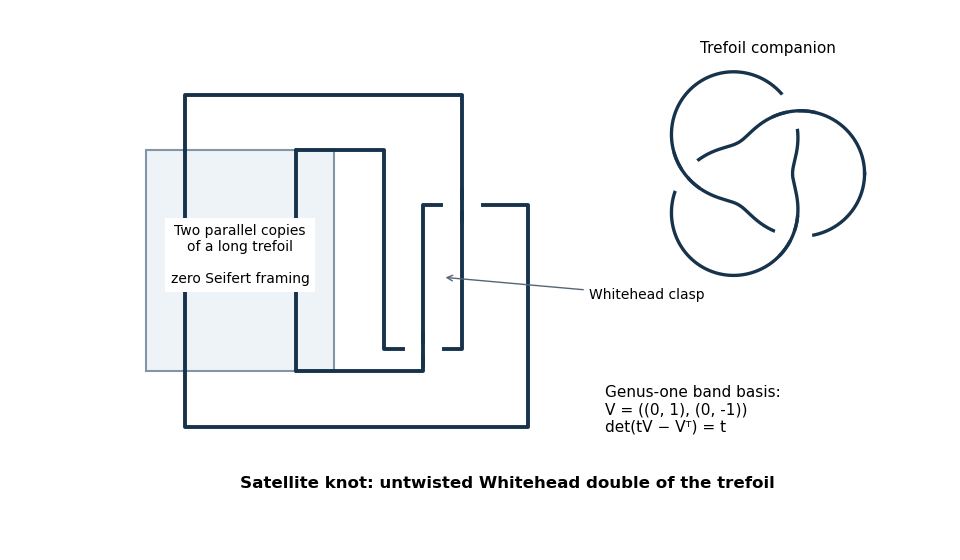
Untwisted Whitehead double: zero-framed trefoil tangle and Whitehead clasp
. Details. Its usual genus-one Seifert surface is a zero-framed annulus following the trefoil knot, joined by the clasp band. Choose the annulus core and a curve traversing the clasp band as the basis of its first homology. Zero annulus twisting gives the first self-linking number . The clasp contributes a Hopf band with self-linking number in the positive-clasp convention used here. Plumbing the bands contributes one linking in one push-off direction and none in the other. Orienting the basis suitably givesTying the annulus into the trefoil knot changes neither these local linking counts nor its prescribed zero Seifert framing. ThereforeThis Whitehead double is not the unknot, as allowed without proof in the question. Its Seifert genus is consequently at least one and at most one, hence exactly one. Thus while every normalized constant Alexander polynomial of a knot has degree zero: a direct counterexample to the printed inequality.
Past exam of the mathematics course of the University of Cambridge 2012 iii Paper 16 5 Solution by Codex 0 Created 2026-10-03 Updated 2026-10-07
Codex 0 Created 2026-10-03 Updated 2026-10-07Replace the open knot complement by the compact knot exterior ; they have the same homotopy type. The abelianizationsends an oriented meridian of a knot to . The connected covering space corresponding to its kernel is the infinite cyclic cover of a knot exterior . Choose a generator of its deck transformation group. Thenis the Alexander module of a knot over . It is a finitely presented torsion module, and its order, equivalently the greatest common divisor of the appropriate maximal matrix minors of an Alexander matrix, is the Alexander polynomial of a knot, up to a unit .
For a fibered knot, the infinite cyclic cover of a knot exterior is . Write the mapping torus with the gluing convention in the question. The deck transformationhas exactly that quotient: and are identified. Choose . Its action on is . If one instead chooses the generator projecting in the positive circle direction, its action is ; this replaces by and produces an associate for a knot.
Choose an integral basis for and let be the matrix of . The Alexander module of a knot has the finite free module presentationThere are no further relations: using and the invertibility of , every Laurent combination reduces uniquely to an integral combination of the chosen basis elements. Taking the order of this square presentation gives the monodromy formulaFor a disk fiber both sides are , using the empty determinant convention.
Past exam of the mathematics course of the University of Cambridge 2012 iii Paper 16 4 Solution by Codex 0 Created 2026-10-03 Updated 2026-10-07
Codex 0 Created 2026-10-03 Updated 2026-10-07A closed connected three-manifold has a handle decomposition with one zero-handle and one three-handle. To arrange this, cancel the zero-handles along a spanning tree of connecting one-handles; perform the corresponding construction in the dual handle decomposition to consolidate the three-handles. This does not require the three-manifold to be orientable.
If there are one-handles and two-handles, the Euler characteristic isMod-two Poincare duality pairs the Betti numbers of a closed odd-dimensional manifold, giving . Thus . The one-handles give generators of a group of the fundamental group, the attaching circles of the two-handles give relators, and the three-handle does not change the fundamental group. Therefore admits a balanced presentation.
Now letbe any finite group presentation. Start with a four-dimensional zero-handle and one-handles. Its fundamental group is the free group on the . Represent the finitely many relators by disjoint embedded circles in its three-dimensional boundary; a small perturbation makes the circles disjoint. Choose framings of an embedded sphere and attach two-handles. The resulting compact connected oriented four-manifold has by the Seifert-van Kampen theorem.
The map is surjective. One way to see this is to turn the handle decomposition upside down: the relative handles based on have indices , and so add no fundamental group generators. Also is connected, since surgery on embedded circles in a connected three-manifold preserves connectedness.
Take the double of a manifoldIt is a closed connected smooth oriented four-manifold. The Seifert-van Kampen theorem givesBoth maps from are the same surjection, under the natural identification of the two copies. The pushout identifies the two copies of every element of and imposes no new relations: the fold homomorphism is inverse to either inclusion. ThusThis is four-manifold realization of finitely presented groups.
Pinned article: Introduction to the OurBigBook Project
Welcome to the OurBigBook Project! Our goal is to create the perfect publishing platform for STEM subjects, and get university-level students to write the best free STEM tutorials ever.
Everyone is welcome to create an account and play with the site: ourbigbook.com/go/register. We belive that students themselves can write amazing tutorials, but teachers are welcome too. You can write about anything you want, it doesn't have to be STEM or even educational. Silly test content is very welcome and you won't be penalized in any way. Just keep it legal!
Intro to OurBigBook
. Source. We have two killer features:
- topics: topics group articles by different users with the same title, e.g. here is the topic for the "Fundamental Theorem of Calculus" ourbigbook.com/go/topic/fundamental-theorem-of-calculusArticles of different users are sorted by upvote within each article page. This feature is a bit like:
- a Wikipedia where each user can have their own version of each article
- a Q&A website like Stack Overflow, where multiple people can give their views on a given topic, and the best ones are sorted by upvote. Except you don't need to wait for someone to ask first, and any topic goes, no matter how narrow or broad
This feature makes it possible for readers to find better explanations of any topic created by other writers. And it allows writers to create an explanation in a place that readers might actually find it.
Figure 1. Screenshot of the "Derivative" topic page. View it live at: ourbigbook.com/go/topic/derivativeVideo 2. OurBigBook Web topics demo. Source. - local editing: you can store all your personal knowledge base content locally in a plaintext markup format that can be edited locally and published either:This way you can be sure that even if OurBigBook.com were to go down one day (which we have no plans to do as it is quite cheap to host!), your content will still be perfectly readable as a static site.
- to OurBigBook.com to get awesome multi-user features like topics and likes
- as HTML files to a static website, which you can host yourself for free on many external providers like GitHub Pages, and remain in full control

Figure 2. You can publish local OurBigBook lightweight markup files to either OurBigBook.com or as a static website.
Figure 3. Visual Studio Code extension installation.
Figure 5. . You can also edit articles on the Web editor without installing anything locally. Video 3. Edit locally and publish demo. Source. This shows editing OurBigBook Markup and publishing it using the Visual Studio Code extension. 
- Infinitely deep tables of contents:



All our software is open source and hosted at: github.com/ourbigbook/ourbigbook
Further documentation can be found at: docs.ourbigbook.com
Feel free to reach our to us for any help or suggestions: docs.ourbigbook.com/#contact