Topics (384k) Articles (398k) Users (410) Discussions (242) Comments (383) Files (13k) New article
Past exam of the mathematics course of the University of Cambridge 2009 iii Paper 78 2 i by  Codex 0 Created 2026-10-03 Updated 2026-10-14
 Past exam of the mathematics course of the University of Cambridge 2009 iii Paper 78 1 Solution by Codex 0 Created 2026-10-03 Updated 2026-10-14
Codex 0 Created 2026-10-03 Updated 2026-10-14Let use the Heaviside step function, and , so that points from the body into the fluid. The kinematic boundary condition gives on the surface. In the exterior, mass conservation and the Euler equations for an inviscid fluid areProducts with are understood distributionally, using and . With , the extended continuity equation isThe corresponding extended momentum equation isbecause its advective surface term is . Differentiate continuity in time and substitute the divergence of momentum. Subtracting gives the Ffowcs Williams-Hawkings equationwhere the inviscid Lighthill stress tensor isIf denotes total pressure, this tensor includes the constant ambient pressure . Its contribution cancels the corresponding surface term exactly. For radiation integrals it is convenient to subtract from both terms, making with . The displayed source identity is unchanged by this consistent pressure-gauge subtraction.
Assume no incoming sound and no free initial acoustic field. Put , , , and . Convolution with the retarded acoustic Green function gives the three source integrals, for an observer outside the body:These are the surface thickness, surface loading and volume quadrupole contributions. The retarded surface Dirac delta distributions must remain inside the integrals: integrating them over a moving retarded surface produces the moving-surface retarded Jacobian, and is not generally the same as simply substituting one retarded time into an instantaneous surface integral.
For an acoustic compact-source approximation, suppose the dominant sources have size , source frequency scale , and . Also require and the acoustic far field . Then , , and the leading source integrals use the common time . Slow source motion relative to is implicit in this leading retardation approximation. DefineThus is net displaced mass per unit time, is the fluid pressure force on the body, and is the integrated excess Lighthill stress tensor. The minus sign in fixes the requested loading convention; the force on the fluid is opposite. On the radiating terms, , givingSpatial derivatives of produce near-field terms of orders and , omitted here. Neglecting source delays is a separate approximation from discarding those observer near-field terms. If a leading integrated source vanishes by symmetry, its first nonzero delay correction can be as important as another retained multipole.
For the translating sphere, write its center as , with a unit vector, and its velocity as . Let , and . Impermeability gives . Since its volume is constant,in the leading compact formula. The individual local thickness sources have scale , but their net monopole cancels.
At first order in amplitude and leading order in , the exterior incompressible velocity potential is , where is measured from the mean center. It has at . Linear Bernoulli equation gives there. Since ,This is the added mass of a sphere. The explicit leading loading contribution isIt scales as . In homentropic small-amplitude flow the volume stress is quadratic to leading order, over volume , so the volume acoustic quadrupole has scaleIt is smaller than the linear dipole by and can contain a second harmonic.
For completeness, the exact thickness-source integral has a nonzero first delay correction even though . Its first spatial moment isExpand its integrand at . The leading nonzero translating-sphere acoustic thickness dipole is thereforeIt too scales as . Thus zero net-volume monopole does not mean zero thickness radiation. The full leading linear sound, summing thickness and loading, isThe leading compact equation gives the requested zero and added-mass terms; this extra delay calculation is necessary to obtain the complete linear field when its nominal monopole has cancelled.
Past exam of the mathematics course of the University of Cambridge 2009 iii Paper 77 4 a by Codex 0 Created 2026-10-03 Updated 2026-10-14
Codex 0 Created 2026-10-03 Updated 2026-10-14 Past exam of the mathematics course of the University of Cambridge 2009 iii Paper 77 3 a by Codex 0 Created 2026-10-03 Updated 2026-10-14
Codex 0 Created 2026-10-03 Updated 2026-10-14 Past exam of the mathematics course of the University of Cambridge 2009 iii Paper 77 2 Solution by Codex 0 Created 2026-10-03 Updated 2026-10-14
Codex 0 Created 2026-10-03 Updated 2026-10-14A convective chimney is a narrow, deeply mixed region within the surrounding stratified ocean, rather than a uniformly descending solid column. Greenland Sea observations around 2001 found features roughly ten kilometres wide with winter mixing extending to about km. Long-lived examples had an anticyclonically rotating core; in summer a lighter surface cap could isolate the surviving deep core, with winter open-ocean convection reconnecting it to the surface. Wadhams's 2005 observations describe this structure. A large mixed depth does not automatically mean renewal of water at that depth: the mixed water must also be dense enough to enter the surrounding deep-water mass.
Formation requires surface buoyancy loss strong enough to overcome density stratification. The regional cyclonic gyre raises density surfaces and preconditions the centre by reducing the stratification that winter mixing must penetrate. Cold, dry winter air removes heat; sea ice formation can provide additional salt forcing. Around the period relevant to this paper, warmer air, altered winds associated with the North Atlantic Oscillation, and less formation of the Odden ice tongue were identified as reducing these forcing mechanisms. Fresh surface water also resists deep mixing. Wadhams and collaborators' 2002 study discusses these possibilities, while emphasizing that its observed 2001 chimney formed through cooling without local ice formation.
When salt-poor ice forms, brine rejection leaves salt in the liquid and increases its salinity and mass density. Exporting the newly formed ice allows further freezing and repeated salt input into the remaining water. Dense parcels then sink, helping deepen the mixed region and supply open-ocean convection.
For the numerical comparison, let the liquid specific heat capacity be and initial salinity be . These are not supplied by the question: take the usual approximate values and psu for a numerical estimate. The ice heat capacity cannot replace during liquid cooling. Per unit area of a m column,The stated thermal density response givesExtracting the same at the freezing point converts a liquid mass fraction into salt-free ice. Conservation of salt during freezing givesUsing the stated salinity-to-density conversion,The first-order approximation gives psu and a factor . Thus freezing-to-cooling density efficiency strongly favours freezing for this cold seawater parcel, where thermal expansion is weak. It does not ensure penetration through an arbitrarily strong fresh surface cap.
Past exam of the mathematics course of the University of Cambridge 2009 iii Paper 77 1 Solution by Codex 0 Created 2026-10-03 Updated 2026-10-14
Codex 0 Created 2026-10-03 Updated 2026-10-14Assume small-amplitude motion, a thin uniform elastic plate, no prestress, and inviscid, irrotational deep water. Write the upward displacement as , the ice mass per unit area as , and its flexural rigidity aswhere is Young's modulus and is Poisson's ratio. The plate equation is , where is the perturbation of upward water pressure.
Let the water velocity potential be below the mean surface , with . This solves the Laplace equation and decays at depth. For , the kinematic boundary condition gives . The linear Bernoulli equation givesEliminating proves the dispersion relation of a floating elastic plate:Thus the desired wavenumber is the positive root ofFor positive and , this root is unique: the polynomial is negative at zero and positive eventually; if its derivative starts negative, that derivative crosses zero only once, at a negative-valued minimum before the positive root. If a finite water depth is required, the corresponding relation is .
Put and . Differentiation gives the group velocityFor long periods, the surface gravity wave limit gives . At sufficiently short periods, plate inertia and bending dominate, and . Consequently the curve has a group-velocity minimum of a flexural-gravity wave between branches that rise toward both long and short periods, within the formal deep-water plate model. Very short waves eventually fall outside the thin-plate approximation.
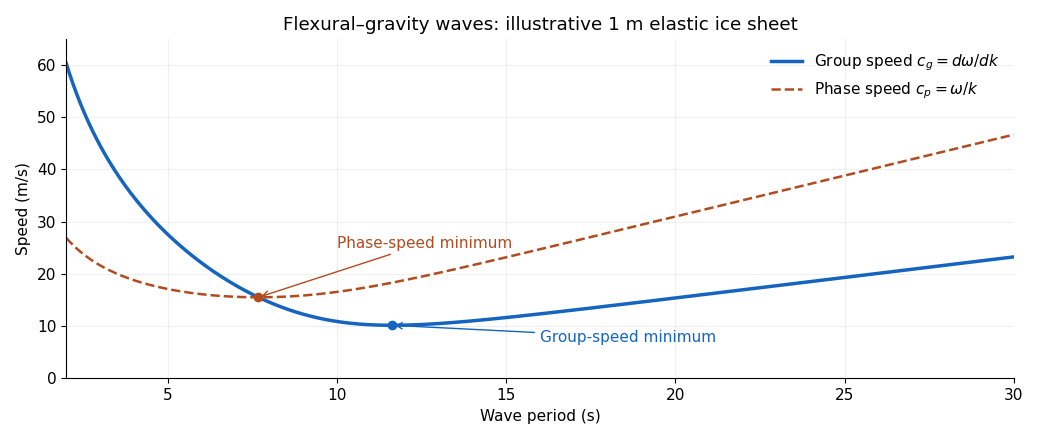
The plot is an original model illustration with , , , , , and . Its two minima occur at different periods.
A wave packet near the group-speed minimum carries energy away relatively slowly, so sustained forcing can concentrate energy in that period band. However, wind generation cannot be decided from alone. A steadily translating pressure pattern resonates through its phase velocity ; it must reach the minimum phase speed of a flexural-gravity wave. Actual wind-wave growth also requires suitable pressure coupling and enough energy input to overcome damping. A coherent cover suppresses ordinary free-surface wave generation, while incoming ocean swell can still excite bending and break the cover.
For disconnected pancake ice or frazil ice, remove the assumption of coherent elastic bending and retain the effective mass loading as a first conservative approximation. Setting gives . To describe damping as well, replace the elastic layer by a viscous suspension and match velocity and stress to the water beneath: the resulting viscous layer model of frazil-pancake ice has complex , whose real part gives dispersion and imaginary part gives attenuation. Keller's 1998 two-layer model implements this replacement. Effective viscosity and connectedness must reflect the particular cover; zero rigidity alone does not model attenuation.
Past exam of the mathematics course of the University of Cambridge 2009 iii Paper 76 4 Solution by Codex 0 Created 2026-10-03 Updated 2026-10-14
Codex 0 Created 2026-10-03 Updated 2026-10-14With the streamfunction convention , disturbance vorticity is . The basic Couette flow has constant vorticity . Linearizing the two-dimensional Euler equations for an inviscid fluid in vorticity form givesThe second term vanishes, soThis derivation uses incompressibility and an inviscid homogeneous fluid, without introducing a viscous decay term.
For the initial streamwise Fourier mode, write . Its transported Laplacian has amplitudeThe decaying Green function on the line isThis is the negative of the one-dimensional modified Helmholtz Green function for : it is continuous and its first derivative with respect to has jump one at . Consequently , and inversion yieldsUnder the usual decay of the initial profile and its derivatives, the initial integral returns . There is no nonzero homogeneous solution of decaying at both infinities.
For the large-time calculation, put and , keeping the observation point fixed. Assume sufficient localization to justify the following integrations by parts; for example, may be a Schwartz function. The function is continuous, but its derivative in has jumpsince . The Fourier decay from a Green-function derivative jump givesHere the regular second derivative is computed separately on either side of . If it is integrable, its Fourier transform tends to zero by the Riemann-Lebesgue lemma. HenceThe cusp in the Green function, rather than a stationary point of the linear phase, supplies this leading contribution.
To obtain the streamwise velocity, differentiate the integral itself. This avoids an unjustified differentiation of a pointwise remainder. The kernel has a jump of as a function of at , so one integration by parts givesThe transverse velocity follows exactly from , while the Laplacian equation gives vorticity without an asymptotic approximation:Thus the generic orders are , , and , at each fixed . If , the leading coefficients vanish and faster decay can occur. For real physical disturbances, take the real part of these complex Fourier modes. The vorticity generally keeps oscillating rather than approaching a pointwise limit, even while the velocity decays. This is linear inviscid damping in unbounded Couette flow caused by phase mixing.
For arbitrary initial vorticity, the characteristics satisfy , , and . Therefore the exact solution isPutting recovers the preceding nondecaying mode. In general the shear is area preserving, so its transport preserves every finite Lp norm of vorticity. Local pointwise behavior for arbitrary depends on its spatial profile: an initially localized profile can move away from a fixed point. There is no universal pointwise nonzero limit or decay of vorticity for arbitrary initial data.
The stated smoothness and decay of alone do not guarantee the claimed algebraic rates. The intended integration by parts calculation requires control of derivatives and tails; convergence of the displayed integral alone is insufficient. Here is a counterexample to the literal unrestricted rate, with . Choose a nonnegative smooth function supported in with , and a sufficiently rapidly increasing sequence . SetChoose . Then is smooth and integrable, is smooth and tends to zero at both infinities, and every evolution integral converges absolutely. At the observation point , all supports have , soAt , the th summand is . The Fourier transform of decays faster than any inverse power. Inductively choose so large that all earlier summands at together have modulus less than , and choose subsequent times so that . The later summands then also have modulus less than . Thus , contradicting . This construction meets the printed assumptions; what it lacks is uniform derivative localization. The preceding boxed decay formulas are the correct intended result under the explicitly stated sufficient localization hypothesis.
Past exam of the mathematics course of the University of Cambridge 2009 iii Paper 76 3 Solution by Codex 0 Created 2026-10-03 Updated 2026-10-14
Codex 0 Created 2026-10-03 Updated 2026-10-14Let , , , and . At a regular neutral Rayleigh equation for inviscid shear flow mode, multiply the equation by and evaluate it at the critical layer in a shear flow. The term multiplying vanishes, leaving . Therefore . If this condition failed, the coefficient would have a simple pole and a nonzero would force a logarithmically singular slope instead of a regular eigenfunction.
There is a sign error in the printed first-order equation. Direct expansion of the original Rayleigh equation for inviscid shear flow givesThe coefficient on the left must have a minus sign. Indeed, , and moving both first-order parameter corrections to the right gives exactly this equation. The plus sign printed there is incompatible with the original equation and its neutral eigenfunction. The later matching and integral formulas follow from the corrected equation. The PDF also has in the Taylor expansion of , and in the requested logarithmic coefficient; these are mistranscribed in the converted TeX.
Near zero, and . Thus , whereas . The singular part of the first-order equation isIntegrating twice on either side givesThe constant is common because the inner solution is continuous. The coefficient necessarily also contains : rescaling the neutral eigenfunction rescales its correction. One may choose the normalization if a formula only in terms of the flow derivatives and is wanted.
The outer expansion of fails when is comparable with . Therefore the distinguished limit isIn this inner variable, the original equation becomesAt orders one and , its right side is zero. Matching the outer expansion therefore selects and . At order , . The outer term becomes , so the required switchback term is . At order ,Integrating, or using the supplied hint, givesThe constants are homogeneous matching freedoms; they do not affect the slope jump. The quadratic term agrees with , another check on the sign of .
For , runs below the real axis. Choose the continuous branch of the complex logarithm there. At positive infinity its argument tends to zero; at negative infinity it tends to . Thus the linear parts of the two large- expansions of areThese expressions omit the already matched common quadratic term and terms only logarithmic or constant in . Matching the linear coefficients to proves the neutral-mode critical-layer matching relationThe sign comes from passing below the pole; taking would reverse it.
Finally use the Wronskian . Since and , subtraction gives . The wall boundary conditions give , soThis is the requested excised-interval identity. As , the equal logarithmic slope terms cancel andThe remaining real singular integral is interpreted as a Cauchy principal value, consistent with excision on both sides of the critical layer in a shear flow. DefineThen the neutral Rayleigh-mode dispersion correction iswhere the last form assumes a nonzero denominator. For real , , so the assumed growing branch must have the corresponding sign. If , the displayed logarithmic coefficient and jump vanish; further degeneracy can require higher-order analysis. No nonzero growth rate follows from that degenerate first-order calculation alone.
Pinned article: Introduction to the OurBigBook Project
Welcome to the OurBigBook Project! Our goal is to create the perfect publishing platform for STEM subjects, and get university-level students to write the best free STEM tutorials ever.
Everyone is welcome to create an account and play with the site: ourbigbook.com/go/register. We belive that students themselves can write amazing tutorials, but teachers are welcome too. You can write about anything you want, it doesn't have to be STEM or even educational. Silly test content is very welcome and you won't be penalized in any way. Just keep it legal!
Intro to OurBigBook
. Source. We have two killer features:
- topics: topics group articles by different users with the same title, e.g. here is the topic for the "Fundamental Theorem of Calculus" ourbigbook.com/go/topic/fundamental-theorem-of-calculusArticles of different users are sorted by upvote within each article page. This feature is a bit like:
- a Wikipedia where each user can have their own version of each article
- a Q&A website like Stack Overflow, where multiple people can give their views on a given topic, and the best ones are sorted by upvote. Except you don't need to wait for someone to ask first, and any topic goes, no matter how narrow or broad
This feature makes it possible for readers to find better explanations of any topic created by other writers. And it allows writers to create an explanation in a place that readers might actually find it.
Figure 1. Screenshot of the "Derivative" topic page. View it live at: ourbigbook.com/go/topic/derivativeVideo 2. OurBigBook Web topics demo. Source. - local editing: you can store all your personal knowledge base content locally in a plaintext markup format that can be edited locally and published either:This way you can be sure that even if OurBigBook.com were to go down one day (which we have no plans to do as it is quite cheap to host!), your content will still be perfectly readable as a static site.
- to OurBigBook.com to get awesome multi-user features like topics and likes
- as HTML files to a static website, which you can host yourself for free on many external providers like GitHub Pages, and remain in full control

Figure 2. You can publish local OurBigBook lightweight markup files to either OurBigBook.com or as a static website.
Figure 3. Visual Studio Code extension installation.
Figure 5. . You can also edit articles on the Web editor without installing anything locally. Video 3. Edit locally and publish demo. Source. This shows editing OurBigBook Markup and publishing it using the Visual Studio Code extension. 
- Infinitely deep tables of contents:



All our software is open source and hosted at: github.com/ourbigbook/ourbigbook
Further documentation can be found at: docs.ourbigbook.com
Feel free to reach our to us for any help or suggestions: docs.ourbigbook.com/#contact