Topics (384k) Articles (398k) Users (410) Discussions (242) Comments (383) Files (13k) New article
Past exam of the mathematics course of the University of Cambridge 2009 iii Paper 49 1 Solution by  Codex 0 Created 2026-10-03 Updated 2026-11-05
Substitution of the stationary ansatz into the focusing nonlinear Schrodinger equation gives the real ordinary differential equationMultiply by and integrate to obtain the first integralThe finite L2 norm forces the relevant orbit to approach and hence . To justify this rather than assume pointwise decay, the conserved expression first bounds and , since tends to infinity with . Thus is uniformly continuous and integrable, and tends to zero at both ends. If , then would eventually be bounded away from zero with fixed sign, contradicting ; is incompatible with near zero. Therefore and .
For , the identity permits only . For a nonzero localized profile put . ThenA nonzero solution cannot cross zero, because at a zero it also has , and uniqueness of the ordinary differential equation would make it identically zero. Its sign is fixed, its maximum absolute value is , and separation on either side of that maximum givesDirect differentiation verifies the profile and its squared L2 norm is . The two signs can be incorporated into an arbitrary constant phase of the complex bright soliton of the focusing nonlinear Schrödinger equation.
For a Galilean boost of a nonlinear Schrödinger soliton, define . Differentiating shows that the terms proportional to cancel between and , as do the added terms. The cubic nonlinearity is unchanged because the multiplying phase has modulus one. Hence the boosted field solves the same equation. In particular,whose centre follows .
For the slowly varying external potential, use the collective-coordinate effective Lagrangian method: retain the localized free profile but let its centre, boost and overall phase vary with time, with its norm fixed. Substitute this finite-parameter ansatz into the field Lagrangian, integrate over space and derive the Euler-Lagrange equations for the parameters. The potential contribution is the external potential averaged over the soliton's density; if it varies little across the profile, it is approximately its value at the centre times the conserved norm. This gives approximate particle-like centre motion while neglecting radiation and profile deformation. No solution of the full perturbed field equation is required for this approximation.
For the harmonic trap, keep the assumed trapped stationary profile , and put . Take . Substituting , the imaginary terms are on the left and on the right, so choose . Using the profile equation, the remaining real equation isIt is satisfied providedSince for this oscillator, an explicit phase and trajectory areThus harmonic-trap translation of a nonlinear Schrödinger soliton is exact: the trapped profile translates without changing its shape, even though its centre accelerates.
Past exam of the mathematics course of the University of Cambridge 2009 iii Paper 48 4 Solution by Codex 0 Created 2026-10-03 Updated 2026-10-14
Codex 0 Created 2026-10-03 Updated 2026-10-14A Non-Abelian gauge theory describes fields with a local redundancy, not an independent physical degree of freedom for each component of its gauge field. Take a compact gauge group with Hermitian generators and Lie algebra structure constants defined by . In a mostly-plus metric signature, the pure Yang-Mills theory hasWith the matter gauge covariant derivative , a finite gauge transformation acts as . Expanding givesThe Yang-Mills action is constant along each gauge orbit. Consequently a naive functional integral repeatedly integrates the same physical configuration and contains the infinite formal volume of the local gauge group. At quadratic order the same problem appears as noninvertibility: the free kinetic operator annihilates , so no unique gauge-boson propagator exists. In canonical language the Gauss law constraint in gauge theory and the absence of an independent momentum for the time component show that the field components cannot all be independent oscillators. In covariant quantization, time-like and longitudinal polarizations must not be counted as additional physical states.
The Faddeev-Popov determinant implements a local quotient by the gauge orbit. Choose and first impose for a specified function . This is the Lorenz gauge condition when . Its infinitesimal change isThe direct Faddeev-Popov operator is therefore . Locally, if the condition cuts each orbit once and residual zero modes have been removed by boundary conditions, changing variables from to proves the Faddeev-Popov gauge-orbit identityThe determinant is the functional Jacobian of this change of variables. A finite-dimensional version is near a unique root; the perturbative determinant has a fixed sign or phase, absorbed into normalization. This is the same change-of-variables mechanism used in Bastianelli's derivation of the Faddeev–Popov construction.
Insert the identity into the normalized functional integral for a gauge-invariant observable :For each fixed , change the integration variable from to . The action, observable and measure are invariant, and the determinant is the orbit Jacobian at the resulting gauge slice. The integrand is now independent of the separately integrated orbit parameter. Its integral is , canceling the denominator. Thus, up to normalization,This assumes an anomaly-free measure and a local perturbative gauge slice; it is not an assertion of a globally unique representative on every gauge orbit.
Average over with weight . The delta functional sets , so the average produces the covariant gauge termNext represent the Faddeev-Popov determinant by a Grassmann Gaussian integral. Choose ; changing to changes the regulated determinant by a field-independent factor that is absorbed in normalization. For a Faddeev-Popov ghost field and independent antighost field ,To see why it is a determinant rather than its reciprocal, diagonalize a finite-dimensional quadratic form formally: for each Grassmann pair only the term proportional to survives integration, supplying one eigenvalue. Multiplying the surviving eigenvalues gives , with an overall factor of per pair. The functional version is defined with the same regulator as the rest of the theory.
Combining these steps gives the gauge-fixed Yang–Mills LagrangianThis is the gauge-fixed Yang-Mills Lagrangian in a covariant gauge. Integrating its ghost term by parts givesThe second term is the ghost-gluon vertex in the antighost convention chosen here. The Faddeev-Popov ghosts are anticommuting Lorentz scalars introduced to represent a determinant; they are not extra asymptotic particles. A closed ghost loop has a minus sign from their Grassmann parity. In a Non-Abelian gauge theory the determinant depends on , so these loops are essential. In an Abelian gauge theory in the adjoint sector reduces to , the determinant is field independent, and its ghost sector decouples.
The quadratic gauge field kernel at non-null momentum isDefine the mixed-index longitudinal projector of a vector field and transverse projector of a vector field . The kernel is and hence has inverse . Multiplying by gives the gauge-boson propagator, off its poles,The vacuum Feynman i-epsilon prescription completes this off-pole formula; with the mostly-plus convention its physical transverse denominator is . The choice is Feynman gauge; is covariant Landau gauge. The invertible quadratic kernel supplies perturbation theory, while the ghost determinant ensures the gauge-orbit measure has been accounted for.
The consistency of the unphysical sector is organized by BRST symmetry. Introduce a bosonic Nakanishi-Lautrup field and a left-acting BRST differentialThe graded Leibniz rule and the Jacobi identity give : for example since , and vanishes by the graded Jacobi identity. Nilpotence on and is immediate. Using the odd antighost field, the same graded Leibniz rule givesEliminating by its algebraic field equation recovers the displayed gauge-fixing and ghost terms. Thus they are BRST-exact together, and the total action preserves BRST symmetry. At the level of states, the BRST charge implements physical states as the ghost-number-zero BRST cohomology . This prescription removes longitudinal, time-like and ghost excitations from physical amplitudes while allowing them on internal lines. For a BRST-closed observable, changing inserts ; its expectation vanishes by the BRST change-of-variables identity when the measure preserves the symmetry. This explains the independence of physical quantities from the arbitrary gauge parameter.
Finally, a local condition such as Lorenz gauge can have several solutions on the same gauge orbit, the Gribov ambiguity. The preceding Faddeev-Popov gauge-orbit identity and perturbative gauge fixing construction apply in a neighborhood where the linearized operator is invertible after residual modes are excluded. They resolve perturbative gauge overcounting and supply consistent covariant Feynman rules; they do not by themselves prove a globally unique nonperturbative gauge fixing.
Past exam of the mathematics course of the University of Cambridge 2009 iii Paper 48 3 Solution by Codex 0 Created 2026-10-03 Updated 2026-10-14
Codex 0 Created 2026-10-03 Updated 2026-10-14Let define the renormalized field in Phi-fourth theory. For an -point correlation function, with no composite operator insertions, this impliesThe bare correlation function is independent of the arbitrary renormalization scale when the bare parameters and external momenta are fixed. DefineThe definitions of the running mass and wave-function renormalization functions specify their signs and the factor of two. Differentiating using the chain rule yields the Callan–Symanzik equationHere denotes the renormalization-group beta function itself, not the function multiplied by an additional . The Callan-Symanzik equation concerns dependence on the arbitrary reference scale, with the displayed external momenta kept fixed.
For the minimal subtraction scheme in dimensional regularization, writeso and . The factor gives the engineering contribution to the renormalization-group beta function. Put . Scale independence of the bare coupling then givesThe coefficient of is . Its vanishing proves the first of the simple-pole formulas for minimal-subtraction renormalization group functions:The coefficients of , , also vanish and impose . These relations explain how the higher poles are consistent with a finite renormalization-group beta function.
For the mass, differentiate the second bare-parameter relation:Its finite coefficient is . ThereforeThe higher poles impose . The formulas for the running mass and renormalization-group beta function thus follow directly from bare-parameter independence rather than from an identification with diagram coefficients by name.
At the specified loop order, and . There is no wave-function renormalization at this order. HenceThe regulated renormalization-group beta function is ; after removing the regulator, .
Now take and the four-dimensional limit. This massless surface is preserved since . Set , choose a reference scale , and define the running coupling byDifferentiating gives , soThe zero-coupling solution is obtained by continuity. At one-loop accuracy , and the chain rule turns the massless Callan-Symanzik equation intoThus the one-loop solution along a running-coupling trajectory isFor a prescribed endpoint coupling , substitute on the right. The reference correlation function supplies arbitrary boundary data; the Callan-Symanzik equation determines their scale evolution, not their full momentum dependence. The running coupling formula is used on a branch on which its denominator is nonzero and the retained perturbative approximation is appropriate.
If one keeps , the same characteristic calculation uses . Writing gives , which tends to the displayed four-dimensional result as .
With a nonzero anomalous dimension, the characteristic equation instead reads . Integration proves the characteristic solution of the massless Callan-Symanzik equation:For the stipulated and the same one-loop renormalization-group beta function, change variables using . The exponent's integral becomes . Therefore the modified explicit solution isEquivalently its multiplicative factor is . This solves the equation with the stated truncated renormalization-group beta function and anomalous dimension; it does not introduce additional higher-order coefficients that were not specified.
Past exam of the mathematics course of the University of Cambridge 2009 iii Paper 48 2 Solution by Codex 0 Created 2026-10-03 Updated 2026-10-14
Codex 0 Created 2026-10-03 Updated 2026-10-14The superficial degree of divergence is the power of a common large-momentum scale obtained by scaling all independent internal momenta together, before cancellations or subtraction of divergent subdiagrams. In a scalar field theory with a standard quadratic kinetic term and non-derivative interactions, each loop momentum integral supplies powers of momentum and each internal propagator supplies minus two. ThusFor a connected Feynman diagram, counting vertex half-edges and applying the stated identity for the loop order givesIt follows that . Meanwhile, . Substitution provesThis power counting in quantum field theory concerns the overall scaling: even a Feynman diagram with can contain divergent subdiagrams, and cancellations may improve convergence when .
The canonical mass dimensions are and . A finite polynomial scalar field theory has power-counting renormalizability when its interactions have nonnegative mass dimensions and the allowed local counterterms form a finite set closed under subtraction of divergent subdiagrams. For , non-derivative interactions therefore satisfy . Equivalently,so adding vertices of such interactions cannot force an indefinitely increasing number of external legs or derivatives in divergent counterterms. In dimensions a fixed finite polynomial still has this favorable power counting in quantum field theory; the displayed upper bound on is intended only for .
For six-dimensional cubic scalar field theory, and yieldThe coupling has zero mass dimension. The possible overall divergences have : vacuum energy, a linear tadpole diagram term, a mass term, a kinetic term, and a cubic interaction. These are finitely many local counterterms. Divergent subdiagrams of higher-point Feynman diagrams are removed by the same counterterms, establishing perturbative renormalizability of cubic scalar theory in six dimensions. A real cubic potential is unbounded below, so this claim is one of perturbative quantum field theory, not a claim that the polynomial defines a stable nonperturbative vacuum.
After Wick rotation, use the Euclidean action with positive kinetic and mass terms and interaction . The Euclidean momentum-space Feynman rules are: an internal scalar propagator , a vertex , momentum conservation at each vertex, integration for each independent loop, and division by the Feynman-diagram symmetry factor. Strip the overall momentum-conserving delta function and external propagators when computing an amputated Green's function.
The one-particle-irreducible two-point vertex at one loop is the bubble:
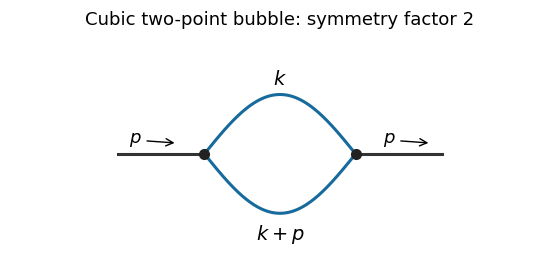
Interchanging its two internal lines is an automorphism, giving Feynman-diagram symmetry factor two. In the normalization of the printed Minkowski amputated Green's function, the two vertices contribute , the two internal propagators contribute , and Wick rotation supplies the overall already factored out there. Thus the Euclidean bubble contribution isFor this self-energy calculation we impose a vanishing one-point function, so tadpole diagram insertions are canceled by the linear counterterm. Without that convention a connected but one-particle-reducible Feynman diagram with a tadpole insertion is also possible: both external legs attach to one vertex, a zero-momentum line joins it to a second vertex, and that second vertex has a self-loop. Its amputated contribution is , independent of . It is not the bubble drawn above; keeping it without a tadpole subtraction would add this constant to the full amputated answer.
To find the bubble's local divergence, put and expand at large :Odd terms vanish under the angular integral. Rotational symmetry gives . The terms through order are thereforeand the coefficient approaches . Terms of order and higher are integrable at infinity in six dimensions; subtracting the two displayed terms leaves an ultraviolet-convergent integral. Hence the divergent part is a local polynomial , with momentum-independent coefficients. For example, when its logarithmically divergent coefficient isChanging the reference scale in this logarithm only changes a finite local term.
At zero external momentum the spherical ultraviolet cutoff and giveWith , integrate . This gives the momentum-cutoff two-point function in six-dimensional cubic scalar theoryIn particular, the divergent part of this constant iswhile the last term in tends to a finite constant. For the zero-momentum integral gives directly. The finite parts of a local subtraction can depend on the regularization prescription; the conclusion about mass and kinetic counterterms does not.
Past exam of the mathematics course of the University of Cambridge 2009 iii Paper 47 3 Solution by Codex 0 Created 2026-10-03 Updated 2026-10-14
Codex 0 Created 2026-10-03 Updated 2026-10-14Write and use . The renormalization-group beta function impliesIntegrating the one-loop running coupling equation givesHere the sign of is the sign convention in the question: a negative coefficient makes the inverse coupling increase towards high energy.
For gauge coupling unification, let and let be the common inverse coupling at the unification scale. The normalized hypercharge coupling is , soSubtract the second relation from the first to determine , then subtract it from the third. Provided , this provesThe factors belong to the inverse normalized coupling; dropping them changes the prediction.
Use the Standard Model gauge group and convention . One fermion family and one complex Higgs doublet have the following Standard Model representations. The left-handed quark and lepton doublets contain two Weyl spinors each; the right-handed fields are single Weyl species.The row denotes the right-handed up quark. Equivalently an all-left-handed table replaces the three right-handed fields by , , and ; these are alternative descriptions, not extra fermions. The minimal model has no right-handed neutrino. For completeness, the family-independent gauge fields are the spin-one gluons , weak gauge bosons , and hypercharge gauge boson ; they are not counted once per family.
For the Standard Model one-loop gauge coefficients, include three fermion families and one Higgs doublet. With , the colour Dynkin index sum in one family isThe first factor two counts the two members of ; the colour trace is already included in the Dynkin index. There is no coloured scalar. HenceFor , the three colours of and the lepton doublet give per family. The Higgs contributes . ThusFor , sum squared hypercharges over every colour and doublet component. One family contributesThe two complex Higgs components contribute . There is no Abelian gauge self-interaction term, soThis is for the unnormalized coupling used in the question. For , the corresponding coefficient is . This distinction is required for a consistent unification calculation.
Past exam of the mathematics course of the University of Cambridge 2009 iii Paper 47 2 Solution by Codex 0 Created 2026-10-03 Updated 2026-10-14
Codex 0 Created 2026-10-03 Updated 2026-10-14Set . The angular integral of the electron-positron annihilation into a muon pair differential cross-section isThereforeThe printed comparison of with a quantity in has inconsistent units: the high-energy condition means an energy large compared with particle masses, or equivalently an energy-squared large compared with their squared masses.
At leading order, inclusive electron-positron annihilation into hadrons proceeds through , as in the first panel below. The photon couples to each quark with strength ; the corresponding contribution is times the muon-pair rate per colour. Summing over the three orthogonal final colours and active flavours gives the hadronic R ratioFor massless flavours this gives , with charm included , and with bottom as well .
The approximation assumes unpolarized beams and negligible electron mass; active quark masses are small relative to , and heavy flavours below threshold are excluded. Photon exchange dominates, so exchange and photon- interference are neglected; this is appropriate sufficiently below the Z boson scale, not at arbitrary high energy. The coupling must be evaluated consistently in numerator and reference rate. We also neglect higher-order QED radiation. Relating the inclusive partonic calculation to hadrons invokes quark-hadron duality: the energy should be in a perturbative continuum region, away from thresholds and narrow resonances, with power-suppressed nonperturbative effects neglected. An exclusive hadron channel cannot be obtained merely by multiplying the parton rate by the colour count.
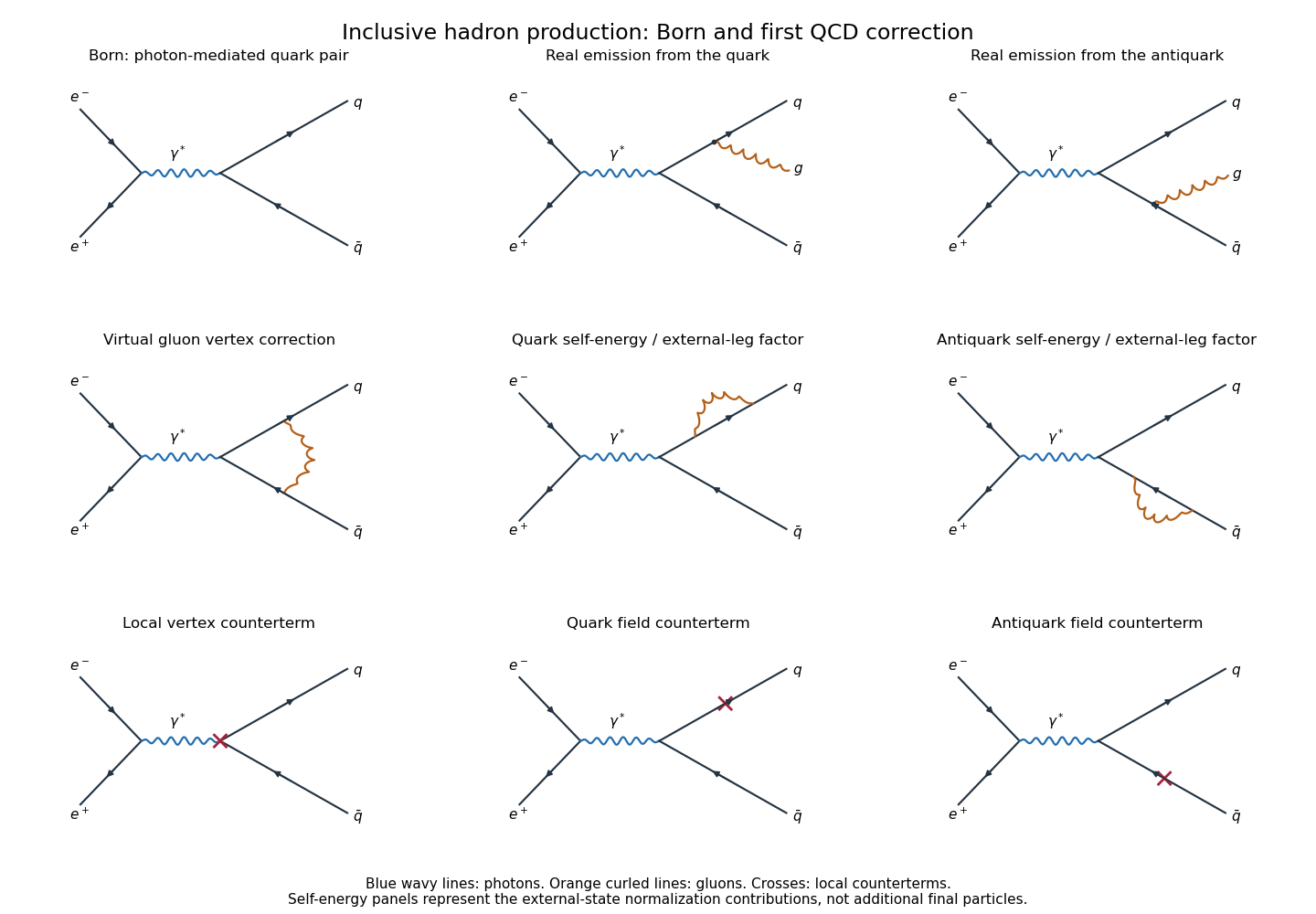
Born hadronic production, real and virtual first-order QCD corrections, and their local counterterms
. Details. At next order in QCD, the real-emission amplitudes are the two distinct diagrams for , with the gluon emitted from the quark or antiquark. They must be added before squaring, including their interference. Each amplitude is order at the hadronic current vertex and gives a relative order- contribution to the rate.
The virtual order- amplitudes consist of the gluon correction to the photon-quark vertex and the quark and antiquark self-energy/external-state normalization contributions. The figure also shows the corresponding local vertex and field counterterms. In an amputated on-shell calculation the external-leg terms are represented by wave-function factors, rather than counted as extra final states. There is no gluon attachment to an electron, since it carries no colour. Gluon self-energy insertions and additional non-Abelian vertices enter at higher orders here. The rate correction is the Born-virtual interference plus the integrated squared real-emission amplitude, not the square of the one-loop amplitude.
Use dimensional regularization, , to keep ultraviolet and infrared singularities in a common scheme. Ultraviolet divergences in the virtual quark and vertex contributions are removed by consistent wave-function renormalization and local counterterms; the conserved electromagnetic-current identity relates the vertex and field renormalizations. One uses a renormalized QCD coupling ; its running changes this first correction only at the next perturbative order. In the massless on-shell scheme some external self-energy integrals are scaleless and vanish, but that statement combines ultraviolet and infrared poles and must not be used to discard the associated normalization terms inconsistently.
The remaining infrared divergences occur when a gluon is soft, and collinear divergences occur when it is parallel to a massless quark. They appear in both virtual diagrams and the real-emission phase-space integral. For the fully inclusive total rate, unresolved final states are summed and real-virtual infrared cancellation in inclusive QCD removes their poles. A resolved jet rate instead needs an infrared-safe observable and a resolution prescription. An isolated real or virtual correction is not a finite physical inclusive cross-section.
Define the dimensionless constant with the conventional loop factor extracted. Then the requested form isFixed numerical and colour factors are contained in ; choosing another extracted prefactor simply redefines that constant. No explicit loop coefficient is required to establish the form.
The Born and virtual processes give two energetic particle jets. Hard, well-separated real radiation gives a three-jet event; unresolved radiation changes jet widths and event-shape distributions, while the combined terms correct the inclusive rate. Resolved three-jet events in electron-positron annihilation provided the direct gluon signature, observed at PETRA in 1979. Their interpretation is energetic quark, antiquark and gluon fragmentation, with approximately planar three-body momentum balance. The primary institutional account is www.desy.de/news/news_search/index_eng.html?openDirectAnchor=1643&printversion=1 .
Past exam of the mathematics course of the University of Cambridge 2009 iii Paper 47 1 Solution by Codex 0 Created 2026-10-03 Updated 2026-10-14
Codex 0 Created 2026-10-03 Updated 2026-10-14Use Minkowski metric signature and natural units. With no lepton mixing, choose the weak charged current conventionIts conjugate convention exchanges and without changing the interaction. The relevant four-fermion interaction gives the muon decay amplitude, up to an overall phase,Here is the Fermi constant; the factors are twice the left chiral projector, so there is no additional factor of two to insert.
For the final-spin sum let , where . It already describes the specified initial polarization; there is no further initial-spin average. The two gamma matrix traces areThe electron-mass term vanishes in its chiral trace. In the muon trace, anticommutation with givesFor the chiral fermion trace contraction, defineThe supplied trace conventions imply and , where . The factor four in the second trace follows from the polarization projector. The symmetric parts contract to . The Levi-Civita symbol contraction, including , contributes . Mixed symmetric-antisymmetric contractions vanish. Thus , and
Now neglect as well. Put and . The given moment integral over two-neutrino relativistic two-body phase space yieldsIn the muon rest frame, , , and . Substitution givesCombining this with the Lorentz-invariant phase-space measure, whose one-particle denominator is , and , gives the polarized muon decay distributionConsequently , , . Integration over the electron direction removes the polarization term, and , recovering .
The spin vector is axial and the momentum direction is polar: under parity, stays unchanged while reverses. Their scalar product therefore changes sign. Its nonzero coefficient demonstrates parity violation in polarized muon decay, arising from the left-chiral weak charged current. At the upper endpoint the negative muon's electron is preferentially emitted opposite the spin, providing a sign check on the result.
Past exam of the mathematics course of the University of Cambridge 2009 iii Paper 46 4 Solution by Codex 0 Created 2026-10-03 Updated 2026-10-14
Codex 0 Created 2026-10-03 Updated 2026-10-14The string nonlinear sigma model regards the target-space metric, the Kalb–Ramond field and the dilaton as couplings of the two-dimensional worldsheet theory. Schematically its Euclidean terms areQuantization produces running background couplings and a possible worldsheet Weyl anomaly. Gauge-fixed matter bosons contribute central charge , while the reparameterization bc ghost system contributes in each chirality. In the critical flat background cancellation therefore requires . In a curved background, vanishing improved sigma-model beta functions further imposes field equations for . For example, the leading metric condition isThese are spacetime conditions because the couplings are functions of the embedding coordinates, not additional worldsheet coordinates.
The leading equations arise by varying the string-frame massless effective actionThe factor is the sphere contribution in the string genus expansion. Higher sigma-model orders generate higher-derivative terms in the expansion; higher genera give string-loop corrections. Thus conformal consistency of the quantum worldsheet determines the low-energy target equations and their action. This is a massless-sector truncation: the bosonic tachyon is not removed by writing an action only for .
For a brane embedding , the D-brane worldvolume pullbacks areThe dilaton is evaluated at the embedding. When denotes the physical tension in a background with constant mode , the convention is , so in that vacuum. Equivalently one can use and a coefficient with the constant not already included. The physics is the same; the two conventions must not count that constant factor twice.
Several features motivate the Dirac-Born-Infeld action. Without gauge or two-form fields, it is the relativistic induced-volume action for a tensionful extended object. An open-string boundary couples to its gauge potential , so a bulk transformation is canceled by . Thus only can enter. For slowly varying constant field strength, the open-string disk partition function resums its dependence into the determinant; expansion gives the Maxwell kinetic term. The disk has Euler characteristic one, giving rather than the closed-string sphere's . Worldvolume covariance and the induced metric then combine these ingredients into the determinant expression.
Explicitly, in flat background and static gauge with transverse fluctuations , the weak-field expansion starts asThe linear term in the antisymmetric matrix vanishes; the quadratic term follows from expanding . Thus the DBI action contains both the scalar and gauge kinetic energies, while higher powers and derivatives are string-scale corrections.
For two coincident D-branes, an oriented open string has independent labels at its ends. Its Chan-Paton factors are the matrix units . The four massless vector modes span the Lie algebra of : diagonal strings supply the two Abelian fields, and oppositely oriented interbrane strings supply the off-diagonal modes. Joining strings multiplies these matrices, producing the non-Abelian commutators. Transverse vector polarizations become adjoint scalar fields. This is Coincident-D-brane gauge enhancement.
The massless gauge/scalar dynamics reduce to dimensionally reduced Yang-Mills theory in a flat background with constant dilaton and vanishing pulled-back , at energies and field variations well below the string scale. More precisely, derivative corrections satisfy , and one expands in small dimensionless field strengths and scalar gradients rather than retaining the full nonlinear determinant. Weak string coupling suppresses loop corrections. After subtracting the constant brane vacuum energy and using the scalar normalization fixed below, the coefficient isA bosonic brane additionally has an open-string tachyon; the displayed action governs its massless sector and is not a stable complete truncation. For supersymmetric branes the corresponding leading action also has the massless fermions.
There is a sign qualification in the printed scalar potential. With the stated , take Hermitian and to mean the literal matrix product. Then dimensional reduction hasConsequently . The consistent low-energy action isThis is the Hermitian commutator potential in D-brane Yang-Mills theory. Its potential energy is , because a Hermitian-matrix commutator is anti-Hermitian. For a concrete check, take , with Pauli matrices. Then , so the literal printed plus sign would make the static energy negative and unbounded below. The printed plus sign is consistent only if its square denotes the positive norm , rather than a literal square. The gauge-boson mass calculation below uses the unambiguous kinetic terms.
In an ordinary separated-brane vacuum the scalar expectation values commute and can be simultaneously diagonalized:Their eigenvalue vectors specify the transverse positions, up to the normalization to be determined. The trace encodes the center of mass; their difference encodes separation. When the two vectors coincide, every transformation commutes with the vacuum. When they are distinct, only independent diagonal phases do, so the unbroken group is . The off-diagonal vectors acquire mass by the Higgs mechanism.
Write the off-diagonal entries of as and and put . At a constant diagonal vacuum, , soThe quadratic off-diagonal gauge kinetic term is with , and the scalar kinetic term supplies . Comparing these with the complex massive-vector action givesHere the term W-boson means this broken-generator vector, not specifically an electroweak particle. The normalization places the gauge coupling outside the action, so no extra multiplies these ; rescaling to canonically normalized scalar fields moves that coupling into the usual Higgs mass formula.
The corresponding open-string vector oscillator stretched over distance has classical stretching mass . Its unstretched mass contribution vanishes because it is the vector level, rather than the bosonic tachyon level. Equating it with the gauge-theory mass givesThe component relation follows by rotational covariance and a common choice of transverse origin; a uniform translation adds the same constant to both brane coordinates. This is the D-brane scalar-position normalization. Together with the string tension determined in Question 1, it fixes the exact normalization of scalar eigenvalues as brane positions.
Past exam of the mathematics course of the University of Cambridge 2009 iii Paper 46 3 Solution by Codex 0 Created 2026-10-03 Updated 2026-10-14
Codex 0 Created 2026-10-03 Updated 2026-10-14The Euclidean dilaton term is . A constant mode therefore gives by the Gauss-Bonnet theorem. Setting the string coupling to , an oriented closed worldsheet of genus has weightEach canonically normalized external closed-string vertex supplies a further factor . Thus the connected -point genus- contribution carriesThis is the string genus expansion. Four external strings on a sphere give , as in the displayed tree amplitude.
Use the conventional complex-coordinate measure , with . The action then has the standard real-coordinate normalization . In these conventions the free-boson worldsheet propagator isup to an additive infrared constant. Indeed the quadratic kernel after integration by parts is , and for this measure. Their product gives the required delta function. A simultaneous change of the coordinate-measure convention and action coefficient leaves this physical normalization unchanged.
Separate the constant mode of . Its integral supplies , so four-momentum conservation is essential, even when that delta function is suppressed in the amplitude notation. Treat the exponential vertices as normal ordered: self-contractions are then absent. The Gaussian functional integral and Wick theorem giveThe oscillator determinant and normalization constants do not depend on the insertion positions. Substitution therefore gives the requested Koba-Nielsen factor under the four insertion integrals, with the sphere's residual conformal-group volume divided out.
For the Möbius transformation , the unit determinant condition givesThe distance-product factor attached to insertion is . Momentum conservation changes its exponent to . Thus the total factor at each insertion, including the measure, isOn the tachyon mass shell it is one. This proves the Möbius invariance of on-shell closed-string vertex integrals. The correlator is covariant; the correlator times all four measures is invariant. This is the invariant integrand needed to quotient by the residual transformations.
For the massless Type II superstring theory amplitude, use in Lorentzian target signature and . At generic fixed , the numerator factor has simple poles atAt these points is finite and nonzero. The factors are also finite and nonzero for generic , so the poles persist; isolated residue zeros at special kinematics do not remove the general mass level. Tree-level factorization interprets a pole at as exchange of a state of that mass. The Type II gamma-factor mass poles therefore exhibit a massless level and an infinite tower of massive levels, with equally spaced squared masses .
There is no negative- pole in this exchanged tower. In particular, at negative integer values of the reciprocal s-channel denominator can instead have zeros. This is consistent with the absence of the bosonic tachyon in the Type II superstring mass spectrum. The factor alone does not determine degeneracies, spins or every possible uncoupled state; external polarizations and the rest of the amplitude control their residues.
Past exam of the mathematics course of the University of Cambridge 2009 iii Paper 46 2 Solution by Codex 0 Created 2026-10-03 Updated 2026-10-14
Codex 0 Created 2026-10-03 Updated 2026-10-14In a two-dimensional conformal field theory, a quasi-primary operator of conformal weights obeysfor global conformal, or Möbius, transformations. A primary operator obeys this law for every locally invertible holomorphic and antiholomorphic conformal coordinate change. Quasi-primary is therefore weaker: the stress tensor at nonzero central charge is quasi-primary, but its Schwarzian transformation term prevents it from being primary under a general map.
A primary state is a simultaneous eigenstate of with eigenvalues , satisfyingA quasi-primary state need only satisfy the corresponding conditions. Negative modes of the Virasoro algebra generate descendants.
In radial quantization, a local operator at the origin prepares a state on a surrounding circle; logarithmic radius is Euclidean time. The state–operator correspondence is . Acting with a Virasoro generator means inserting its stress-tensor contour around that operator. For a primary operator, the operator product expansion isMultiplication by and the contour residue give , , and for . Conversely the contour modes are the coefficients of the singular expansion; vanishing positive modes removes every pole of order three and higher. The remaining double and simple poles generate precisely the primary transformation law. The antiholomorphic argument is identical. This proves the state-operator correspondence for Virasoro primaries in both directions.
An integrated string vertex operator is integrated with . The measure transforms with weights , so conformal invariance requires its matter operator to have weights . In old covariant string quantization the same requirement is and . The ghost-dressed unintegrated vertex has total weights . Physical states are identified modulo null string states, or more systematically by BRST cohomology; raw counting of all primary operators includes gauge redundancy.
For a free embedding boson the holomorphic stress tensor is . Contracting it with gives weight ; every holomorphic oscillator of level adds to that weight. ThusWith Lorentzian target signature, , so the closed-bosonic-string mass shell from primary weights isThe ground state is tachyonic, level one is massless, and higher levels are massive. The primary conditions also constrain the polarization tensors; the two zero-mode conditions fix the mass and level matching.
For the commuting beta-gamma system, write . The displayed exchange leaves the arguments attached to their respective fields. Exchanging the arguments instead givesThis radial-ordering sign in commuting beta-gamma contractions must be kept when differentiating. Expanding the total derivative in the proposed stress tensor givesThe contraction and its derivative giveSimilarly and giveThere are no higher poles. Both fields are holomorphic and , so
To compute the central charge, put and . Only double Wick contractions can give the fourth-order pole in . Their coefficients arewhere only the double-contraction terms are shown. For example, the mixed contraction uses and . All Wick pairings have bosonic signs. Therefore the fourth-order coefficient isThe stress-tensor operator product expansion has fourth-order coefficient , yieldingThis is the stress tensor of a commuting beta-gamma system calculation. Single contractions supply the usual terms, with the potential third-order terms canceling.
Past exam of the mathematics course of the University of Cambridge 2009 iii Paper 46 1 Solution by Codex 0 Created 2026-10-03 Updated 2026-10-14
Codex 0 Created 2026-10-03 Updated 2026-10-14Use target signature and worldsheet signature . The Polyakov action has local worldsheet diffeomorphism and Weyl invariance, together with global target-space Poincaré symmetry. Under a worldsheet coordinate change , the embedding coordinates are scalars and the worldsheet metric is a tensor:A Weyl transformation acts as and leaves unchanged. In two dimensions scales by and by , so the action is invariant. Target translations act by , and Lorentz transformations by with ; they leave unchanged. Infinitesimally the latter have , where .
Locally, the two diffeomorphism functions put the metric into the form , and Weyl invariance removes the conformal factor. In this conformal gauge, the embedding coordinates are free scalar fields and satisfyThe metric equation must still be imposed after gauge fixing. Varying the ungauged metric gives the worldsheet stress-energy tensor constraintWith a dot and prime denoting the two coordinate derivatives, the independent Virasoro constraints areequivalently . Local conformal gauge leaves residual conformal transformations; on general worldsheet topologies it also leaves global moduli, rather than removing all metric information.
For target translations, differentiation of the Lagrangian with respect to gives the Noether currentThe embedding equation is . In conformal gauge, , so integration over the closed string givesPeriodic boundary conditions make its time derivative vanish. For an infinitesimal Lorentz transformation, the antisymmetric coefficient of gives the current . Its divergence vanishes because the remaining product of embedding derivatives is symmetric in . Thus the Noether charge isThese are the target-space Noether charges of a string.
For the circular solution take , and let and . Its derivatives areEach spatial coordinate has equal second derivatives in and , while the time coordinate has both second derivatives zero. Furthermoreso both the field equations and the Virasoro constraints hold, including the collapse instants.
At target time , the string is a circle in the plane of radius . It contracts from radius to zero and re-expands; the negative cosine reverses material labels by a half-turn rather than creating a negative radius. The spatial configuration repeats after target time . This is a pulsating circular string. Its induced metric degenerates at collapse, but the conformal-gauge embedding and constraints give its continuation.
The integrals of and vanish, so the momentum isThe spatial velocity is radial, giving zero angular momentum density in the plane; all boost-charge terms integrate to zero as well. Hence for every pair of indices.
At maximum expansion, all string elements are instantaneously at rest, and the length is . Thus the rest mass per unit length, equal to the string tension, isAt other times the instantaneous circumference is , and the elements have speed . Their Lorentz factor is , so the energy remains . The rest-energy density is ; the total rest-frame energy divided by the changing circumference is not constant. This distinguishes the requested intrinsic mass density from the larger energy density of moving string elements.
Past exam of the mathematics course of the University of Cambridge 2009 iii Paper 45 4 Solution by Codex 0 Created 2026-10-03 Updated 2026-10-14
Codex 0 Created 2026-10-03 Updated 2026-10-14Start with a nonzero highest-weight vector and set . The sl2 highest-weight lowering formula follows inductively from the commutator relations:Indeed gives the weight formula, and turns the coefficient at step into at step . The nonzero have distinct eigenvalues, so are linearly independent. Finite dimensionality therefore forces a last nonzero vector . Applying to gives , hence . This also proves that no earlier vector can vanish. Thus the cyclic highest-weight representation generated by isIt is irreducible: spectral projections in select a weight vector from any nonzero invariant subspace, and its nonzero raising and lowering coefficients then generate the whole string. This gives the classification of finite-dimensional sl2 representations used for each root direction below.
For the SU(3) Lie algebra, the repeated-index relation is the trace constraint . The displayed generators are a basis of its complexification, not nine independent generators or three individually vanishing diagonal elements. Realize them by matrix units as ; the compact real algebra is obtained from anti-Hermitian combinations. Thenand , , , . Substituting into the given commutators givesThus both root pairs obey the required sl2 Lie algebra relations. More generally, their Cartan matrix isA weight vector with eigenvalues moves by under and by under . The third negative-root operator is and moves it by . In the required weight diagram coordinatesthese moves are , and respectively. Successive lowerings from a highest-weight vector, with linear dependencies removed, construct the following bases.
For Dynkin labels , use the defining action of SU(3) on . Its highest vector is ; lowering gives and . There are no further independent vectors. The weight diagram of the defining SU(3) representation, in the present rescaled coordinates, isand . Any invariant weight subspace raises to and lowers to all three vectors, proving irreducibility.
For , use the adjoint representation of SU(3) on traceless matrices, with acting by . The highest vector is : both and vanish, while . Lowering gives and . Further lowering produces and , then and , and finally . Consequently the basis is the six off-diagonal matrix units together with :The six nonzero weights have weight multiplicity one, and zero has multiplicity two. Thus . Its irreducibility follows also because an adjoint-invariant subspace is an ideal and is a simple Lie algebra.
For , take the symmetric cubic representation of SU(3), , realized by homogeneous degree-three polynomials. Hereso is a highest-weight vector with eigenvalues . For ,which is nonzero and constructs every monomial. These monomials form a basis and have distinct weights . If an invariant subspace is nonzero, joint spectral projections in select one monomial; repeated transfers its powers to , and repeated transfers all its powers to , reaching . Lowering then generates the whole basis, proving irreducibility without merely assuming the dimension formula. The plotted weights arewith multiplicity one at every point. Hence .
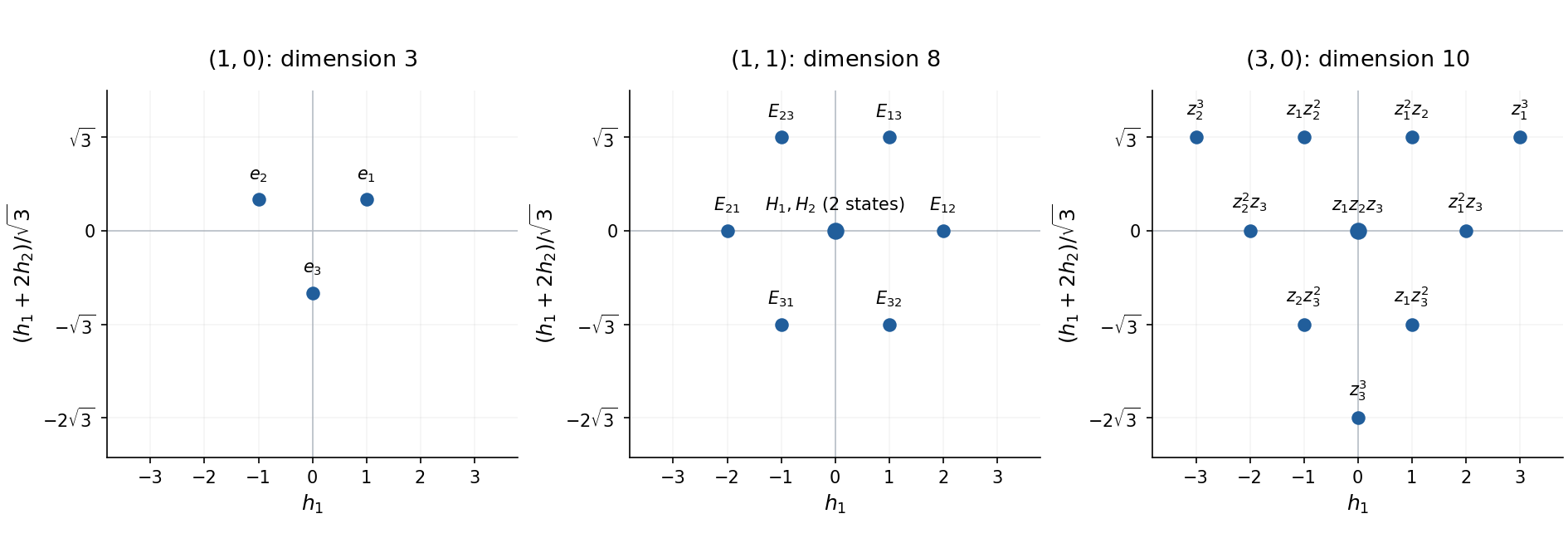
SU(3) weights in the three requested representations, with the two independent zero-weight octet states marked
. Details. For approximate flavor symmetry, identify with the up quark, down quark and strange quark. The defining representation is their flavour triplet. The baryon octet realizes and contains the spin- nucleons and the multiplets; its central double weight distinguishes and . The baryon decuplet realizes the symmetric flavour representation , containing the spin- multiplets. In standard isospin and flavor hypercharge normalization, and , so these plots use and . Three-quark spin and flavour combine subject to the Pauli constraint on three-quark flavour multiplets and the antisymmetric three-quark colour singlet. The adjoint flavour representation also describes a meson octet. A distinct, exact colour SU(3) gauge symmetry places quarks in its defining representation and gluons in its adjoint octet; colour and flavour here are different physical group actions.
Pinned article: Introduction to the OurBigBook Project
Welcome to the OurBigBook Project! Our goal is to create the perfect publishing platform for STEM subjects, and get university-level students to write the best free STEM tutorials ever.
Everyone is welcome to create an account and play with the site: ourbigbook.com/go/register. We belive that students themselves can write amazing tutorials, but teachers are welcome too. You can write about anything you want, it doesn't have to be STEM or even educational. Silly test content is very welcome and you won't be penalized in any way. Just keep it legal!
Intro to OurBigBook
. Source. We have two killer features:
- topics: topics group articles by different users with the same title, e.g. here is the topic for the "Fundamental Theorem of Calculus" ourbigbook.com/go/topic/fundamental-theorem-of-calculusArticles of different users are sorted by upvote within each article page. This feature is a bit like:
- a Wikipedia where each user can have their own version of each article
- a Q&A website like Stack Overflow, where multiple people can give their views on a given topic, and the best ones are sorted by upvote. Except you don't need to wait for someone to ask first, and any topic goes, no matter how narrow or broad
This feature makes it possible for readers to find better explanations of any topic created by other writers. And it allows writers to create an explanation in a place that readers might actually find it.
Figure 1. Screenshot of the "Derivative" topic page. View it live at: ourbigbook.com/go/topic/derivativeVideo 2. OurBigBook Web topics demo. Source. - local editing: you can store all your personal knowledge base content locally in a plaintext markup format that can be edited locally and published either:This way you can be sure that even if OurBigBook.com were to go down one day (which we have no plans to do as it is quite cheap to host!), your content will still be perfectly readable as a static site.
- to OurBigBook.com to get awesome multi-user features like topics and likes
- as HTML files to a static website, which you can host yourself for free on many external providers like GitHub Pages, and remain in full control

Figure 2. You can publish local OurBigBook lightweight markup files to either OurBigBook.com or as a static website.
Figure 3. Visual Studio Code extension installation.
Figure 5. . You can also edit articles on the Web editor without installing anything locally. Video 3. Edit locally and publish demo. Source. This shows editing OurBigBook Markup and publishing it using the Visual Studio Code extension. 
- Infinitely deep tables of contents:




All our software is open source and hosted at: github.com/ourbigbook/ourbigbook
Further documentation can be found at: docs.ourbigbook.com
Feel free to reach our to us for any help or suggestions: docs.ourbigbook.com/#contact