Topics (384k) Articles (398k) Users (410) Discussions (242) Comments (383) Files (13k) New article
Past exam of the mathematics course of the University of Cambridge 2009 iii Paper 45 3 Solution by  Codex 0 Created 2026-10-03 Updated 2026-10-14
Use units and the Minkowski metric . Composing two affine Poincaré group transformations, with the rightmost applied first, givesThe translations form a normal subgroup, so this is the semidirect product of the Lorentz group with . The transformations , , fix time and the spatial origin. Their products and inverses correspond to and , hence they form a subgroup isomorphic to SO(3).
A rotationless Lorentz boost changes the velocity of a frame without adding a spatial rotation. For a convenient active convention iswith . It satisfies , , and . Collinear boosts form a one-parameter subgroup with additive rapidity, but general boosts do not. For nonzero boosts along and , while : their product is not symmetric, whereas every rotationless boost above is symmetric. The product contains a Wigner rotation. Infinitesimally, the Poincare algebra gives for Hermitian generators, so the boost generators do not close amongst themselves.
There is a group-versus-cover qualification in the spin range: an honest unitary representation of the proper orthochronous Poincaré group permits integer spin only. Half-integer spin requires its double cover , or a projective unitary representation of the ordinary group. The construction below gives the requested range on that double cover and descends for integer spin.
Fix and the rest momentum . Its little group consists of rotations: if a proper orthochronous Lorentz transformation fixes , its time column is , the metric condition forces the corresponding time row, and the remaining block belongs to SO(3). On the Lorentz spinor double cover, this little group is SU(2). Choose its irreducible spin- representation, with rest-frame states , , and matrices , the Wigner D-matrices.
For each on the forward mass shell, , , choose the standard rotationless Lorentz boost and defineThe labels are canonical spin projections, defined by this choice of boosts. For any proper orthochronous , factorThe last factor fixes and hence is a Wigner rotation. On the double cover, use its lift to SU(2). Taking the translation convention yields the massive induced representation of the Poincare double cover:The argument of the translation phase is , since . The Wigner rotation identityproves the Lorentz part of the representation law; the phases multiply according to the affine product already derived.
Normalize the generalized momentum states by . The invariant mass shell measure and unitarity of make the induced representation unitary on . This covariant normalization accounts for the absence of an energy square-root factor in the displayed transformation law. To see irreducibility, translations force an operator in the commutant to act within momentum fibres; the little-group action and Schur lemma make its action scalar on each irreducible spin fibre. Lorentz transitivity on the forward mass shell makes this scalar constant. The commutant is therefore scalar, so the unitary representation is irreducible. Conversely, the simultaneous translation spectrum and its little-group representation give the massive positive-energy sector of Wigner's classification.
Thus every and gives such an irreducible representation on the double cover. Its central element over a spatial rotation acts as . Since this rotation is the identity in the ordinary Poincaré group,
For the parity operator, put and . The extension obeys . At rest, commutes with the rotations; Schur lemma therefore gives with a common phase . Since , the parity action on canonical massive spin states isFor the usual reflection convention , is the intrinsic parity. Canonical spin is an axial quantity and its label is unchanged; a helicity label instead changes sign because momentum is reversed. Either intrinsic parity extends a given massive spin representation.
Past exam of the mathematics course of the University of Cambridge 2009 iii Paper 45 2 Solution by Codex 0 Created 2026-10-03 Updated 2026-10-14
Codex 0 Created 2026-10-03 Updated 2026-10-14Let , where . In the given basis, the Adjoint representation of a Lie algebra isThe Jacobi identity gives , so , as required for a Lie algebra representation. The Killing form is the symmetric Trace form of a Lie algebra representationCyclicity of the trace proves its invariance directly:In components this is precisely , so the Killing form is an invariant bilinear form on a Lie algebra.
Choose the infinitesimal gauge transformation convention , with , and write . A gauge covariant derivative must satisfy for ; henceEquivalently . Expanding makes the cancellation transparent:Thus : it transforms in the same representation as . In adjoint covariant derivative notation, .
The commutator of two gauge covariant derivatives defines the gauge field strength:ThusConjugating the derivative commutator gives , so the gauge field strength transforms homogeneously in the Adjoint representation:Even if the matrices in a particular matter representation are not faithful, the displayed component formula defines the Lie-algebra-valued curvature independently of that representation.
Only contributes to the Yang-Mills theory Lagrangian, since is symmetric in . Thus take to be a constant real symmetric bilinear form. Its infinitesimal variation isArbitrary local field strengths and gauge parameters give the necessary and sufficient invariant gauge kinetic form conditionAn antisymmetric part is unconstrained but contributes nothing. A nondegenerate kinetic term additionally needs a nondegenerate bilinear form; positive energy additionally needs a positive internal metric in the signature convention. Neither extra condition follows solely from gauge invariance. For a compact simple real Lie algebra, is positive definite and is the standard choice up to a positive factor.
For the intended complex-simple setting, the Killing form is nondegenerate. Consequently write any invariant bilinear form on a Lie algebra uniquely as . Invariance of both forms impliesfor every , so commutes with the Adjoint representation. A subspace invariant under all adjoint maps is an ideal, hence simplicity makes the adjoint representation irreducible. By Schur lemma, , giving the uniqueness of an invariant bilinear form on a simple Lie algebra:The same conclusion holds for compact simple real algebras by complexification, with real; nondegeneracy excludes , and positive energy selects in the stated convention.
There is a genuine real-simple exception to uniqueness of the Killing form if “simple” is read as an arbitrary real simple algebra. Regard as real. It is real simple: its complexification consists of two complex simple factors exchanged by conjugation, so a conjugation-stable ideal is zero or the whole algebra. Both and are real symmetric invariant forms, while . With , the Killing form of the special linear Lie algebra gives and . Therefore the imaginary part cannot be a real multiple of . The uniqueness conclusion requires the customary complex-simple or compact-real interpretation.
Past exam of the mathematics course of the University of Cambridge 2009 iii Paper 45 1 Solution by Codex 0 Created 2026-10-03 Updated 2026-10-14
Codex 0 Created 2026-10-03 Updated 2026-10-14The Adjoint double cover from SU(2) to SO(3) is obtained by writing a traceless Hermitian matrix as , where the are the Pauli matrices, and defining . Explicitly,Conjugation preserves , so is orthogonal; connectedness of SU(2) gives . Composition of conjugations makes a group homomorphism. A matrix in its kernel commutes with every Pauli matrix, so is scalar, and unit determinant then gives . Every spatial rotation occurs: induces the rotation through angle about . ThusSince SU(2) is the simply connected three-sphere, this is the universal double cover; the two Lie algebras are isomorphic, although the groups are not.
Define the conjugate fundamental spinor of SU(2) by . Regard as a row, so unitarity givesConsequently is an invariant Hermitian pairing. The basic invariant tensors are the Kronecker delta and the alternating tensors and . Choose , , so that . The unit-determinant identity makes invariant; its inverse gives the corresponding upper-index invariant. These contractions generate the tensor invariants of the defining representation. In particular transforms by , showing that the conjugate representation is equivalent to the defining one. The antilinear map squares to , so this is a pseudoreal representation, rather than a real structure.
For Representation theory of SU2, take , with acting on every index of a symmetric tensor. Its independent components are determined by the number of indices equal to , so there are of them. Equivalently, the homogeneous polynomial representation of SU2 has basis , , withThe basis weights are , and the raising operator and lowering operator connect consecutive basis vectors with nonzero coefficients until their endpoints. Any nonzero invariant subspace contains a weight vector, by applying polynomial spectral projections in . Raising it reaches , and lowering then obtains the entire basis. Thus is an irreducible representation, of spin . The classification of finite-dimensional representations of SU2 gives every finite-dimensional complex irreducible representation in this way. The central element acts on a rank- tensor as , so descent of an SU(2) representation to SO(3) gives
For the tensor contractions in the SU2 Clebsch-Gordan decomposition, contract indices of with indices of using , and symmetrize all the remaining free indices:Each is an irreducible symmetric tensor in . To prove these are precisely the constituents, use two sets of formal variables . The highest-weight vectorsare killed by the total raising operator and have weights . The determinant factor is invariant; lowering the remaining factor gives an irreducible string of dimension . Distinct highest weights give inequivalent summands. The unitary representation on this tensor product makes invariant complements available, and the dimension checkexhausts the space. Hence the contractions above are its irreducible projections, up to normalization, and the Clebsch-Gordan decomposition for SU2 is
For the decomposition of three SU(2) spinors, write and . The contractionstransform as defining spinors. Alternation in three indices in dimension two vanishes, giving ; there are exactly two independent contractions. An explicit inverse, with the epsilon convention above, isSymmetrizing this expression gives , while its first two contractions give , which verifies the decomposition. Thus
In the quark model, three spin- quarks therefore have total quark spin or . The two spin- copies correspond to coupling the first pair to spin or spin before adding the third quark. For ground-state baryons with orbital angular momentum , total : the nucleon has and the Delta baryon has . These two coupling copies alone do not assert two unrestricted physical baryon families. The antisymmetric three-quark colour singlet, the spatial wavefunction and flavor symmetry must also satisfy the Pauli constraint on three-quark flavour multiplets; orbital excitations can give other total angular momenta.
Past exam of the mathematics course of the University of Cambridge 2009 iii Paper 44 4 Solution by Codex 0 Created 2026-10-03 Updated 2026-10-14
Codex 0 Created 2026-10-03 Updated 2026-10-14Take incoming electron momentum and positron momentum , with outgoing photon momenta , so . The leading electron-positron annihilation into two photons has two tree-level Feynman diagrams, differing by the order in which the two outgoing photons attach to the charged-fermion line.
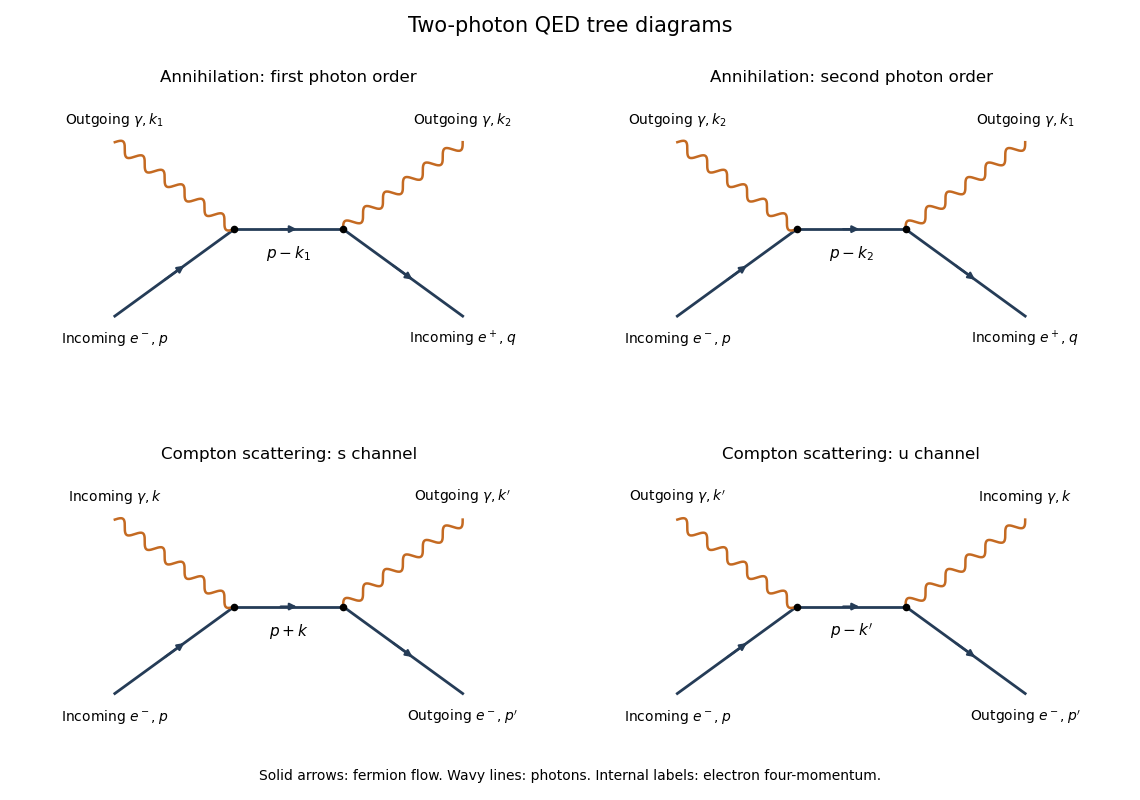
The two photon orders in electron-positron annihilation and the s and u channels of Compton scattering
. Details. The arrows indicate fermion flow. An incoming positron has the opposite flow direction to its physical momentum; the lower row uses an outgoing electron instead.
The required QED Feynman rules, with interaction , are a vertex , a Dirac propagator , an incoming electron spinor , an incoming positron adjoint , and an outgoing photon polarization . Here Feynman slash notation means , and the external Dirac equations are and .
Put , omitting only the propagator's overall factor . Multiplying the two vertices and the propagator givesThe diagrammatic expression is . The relative sign is plus because the two photons are bosons; exchanging their attachments does not exchange external fermions. The amplitude is of order .
A physical photon polarization vector obeys and , with the gauge equivalence . One can choose a transverse representative with and normalize . There are two physical transverse polarizations.
To prove the requested two-photon fermion Ward identity, replace by . Away from an internal pole, is the inverse of , with the boundary prescription understood. The first term simplifies becauseFor the second term, four-momentum conservation gives , soThe two contributions are therefore and , which cancel. Interchanging the photon labels proves the other contraction vanishes. By linearity, adding a multiple of either photon momentum to its polarization leaves the summed amplitude unchanged. This is gauge invariance: longitudinal gauge representatives do not describe an additional physical photon state. An individual diagram does not generally have this property.
For Compton scattering, let be incoming electron and photon momenta and the outgoing ones. The diagrams in the lower row have intermediate electron momenta and respectively. The same QED Feynman rules giveTheir denominators are and , the - and -channel denominators. In annihilation the two exchanged-electron channels instead carry and . Crossing symmetry relates the two expressions by moving the positron to an outgoing electron and one outgoing photon to an incoming photon, with the corresponding momentum and polarization replacements. There is no two-photon contact vertex for the minimally coupled Dirac electron. Both processes require the sum of the two photon orders to satisfy the Ward identity.
Past exam of the mathematics course of the University of Cambridge 2009 iii Paper 44 3 Solution by Codex 0 Created 2026-10-03 Updated 2026-10-14
Codex 0 Created 2026-10-03 Updated 2026-10-14The interaction contains no time derivatives, so . The Legendre transform in mechanics givesThusHere is the free Hamiltonian operator of mass , and is the interaction Hamiltonian.
In the interaction picture, operators evolve with and the states with . With , the state evolution satisfies . Integrating once and iterating gives the Dyson seriesEquivalently it is the time ordering of the exponential. Taking the infinite-time scattering limit, with adiabatic switching understood, gives the scattering matrixThe field in the interaction is the free interaction-picture field, which is essential for applying the free-field contractions.
Use relativistic normalization of a one-particle state, , so each external scalar contraction contributes its plane-wave phase without an extra factor. For the connected on-shell two-to-two scattering amplitude, the first Dyson series term is . The Wick theorem gives ways to attach the two incoming and two outgoing external particles to the four fields, canceling the denominator. ConsequentlywhereThe delta function expresses four-momentum conservation. The connected scattering convention removes spectator, vacuum and external self-energy contributions; equivalently at this order one can normal-order the interaction and keep the physical external mass fixed. These contributions should not be mistaken for additional connected four-point diagrams.
Past exam of the mathematics course of the University of Cambridge 2009 iii Paper 44 2 Solution by Codex 0 Created 2026-10-03 Updated 2026-10-14
Codex 0 Created 2026-10-03 Updated 2026-10-14The supplied matrices are the chiral gamma-matrix representation. The Pauli matrix multiplication law implies . Block multiplication gives , , and . Hence their Clifford algebra relation isSince partial derivatives commute, multiplying the Dirac equation by givesThus every component of the Dirac spinor satisfies , the Klein-Gordon equation with the same mass.
For a Lorentz transformation , set . The derivative transforms as . With the given spinor-matrix identity,This proves the Lorentz covariance of the Dirac operator explicitly.
For parity, let and . Spatial differentiation brings a minus sign, which is canceled by . ThereforeSince is Hermitian and squares to one, the Dirac adjoint transforms asThe chirality matrix anticommutes with . The parity transformation of a Dirac bilinear consequently givesThe first bilinear is a Lorentz scalar even under parity, and the second is a pseudoscalar.
In this representation, . Its square is one, so the chiral projectors are idempotent, mutually orthogonal and sum to the identity. They select and , the two Weyl spinors. Because , a solution of the massless Dirac equation has each chiral component solving that equation separately. In two-component form,The two chirality sectors are thus independent under massless propagation and proper Lorentz transformations. A nonzero Dirac mass term couples them, while parity exchanges them. This explains why the projectors are particularly useful in the massless theory.
Past exam of the mathematics course of the University of Cambridge 2009 iii Paper 44 1 Solution by Codex 0 Created 2026-10-03 Updated 2026-10-14
Codex 0 Created 2026-10-03 Updated 2026-10-14Use natural units and the Minkowski metric . The canonical momentum is , and the Legendre transform in mechanics givesFor canonical quantization of a real scalar field, impose the equal-time canonical commutation relationsThe Heisenberg picture equation then gives . For the other equation, the momentum term commutes with ; commuting the gradient term past and integrating the derivative of the Dirac delta function by parts gives . ConsequentlyThe Fourier transform reduces this Klein-Gordon equation to oscillators of frequency . Hermiticity of the real scalar field pairs their positive- and negative-frequency coefficients, so its general mode expansion can be normalized asTo verify its normalization rather than guess the oscillator algebra, use scalar field oscillator inversion at :Its adjoint has the conjugate phase and the opposite sign in front of . The two mixed field-momentum commutators giveThe Fourier representation of the Dirac delta function sets the energies equal in the last step. Similarly, has a factor multiplying and vanishes; the two-creator commutator vanishes as well.
Substituting the expansion in and integrating the spatial phases, the two-annihilator and two-creator coefficients cancel by . The free real scalar Hamiltonian in oscillator variables isIt differs from by its constant vacuum energy; normal ordering removes that constant. Using the oscillator commutators, for either Hamiltonian,Choose the Fock vacuum annihilated by every . Each creation operator adds a particle of energy and momentum ; its annihilation operator removes one. Their mutual commutativity gives bosonic Fock space and symmetric many-particle states. Thus the scalar mass-shell frequency has a particle interpretation, rather than merely describing a classical oscillation.
For and , vacuum contraction and time ordering give the Feynman propagatorIn the scalar Feynman propagator pole prescription, the integral of has poles at and . Close clockwise below for and counterclockwise above for . The residue theorem gives exactly the corresponding term above, provingAs a direct check of the distributional source, is continuous, but . The derivative jump of a free scalar time-ordered two-point function therefore gives . Spatial Fourier inversion yields
Past exam of the mathematics course of the University of Cambridge 2009 iii Paper 43 2 Solution by Codex 0 Created 2026-10-03 Updated 2026-10-14
Codex 0 Created 2026-10-03 Updated 2026-10-14Take the connected correlation functionFor a massive phase its large-distance form is an algebraic prefactor times , defining the exponential correlation length . To specify the normalization of magnetic susceptibility, add to the energy and differentiate the mean spin. Translation invariance gives the correlation-function susceptibility sum ruleUsing the dimensionless source removes the prefactor . Below the transition, use a selected pure phase rather than a mixture of the two magnetizations, which would have a macroscopic disconnected fluctuation.
Choose a nonnegative blocking kernel normalized by . It may enforce a block average, a majority rule or a chosen rescaled coarse spin. Define the transformed weight bySumming this identity over coarse spins shows exact preservation of the partition function. The geometrical changes are and . A coordinate rescaling subsequently restores the reference cutoff if desired. The transformation is exact only if all generated operators are retained; a finite-coupling truncation is an approximation.
Define the coupling-independent term generated when byRestoring the original gives the identity-operator contribution to renormalization-group free energy:The parameter is an accumulated additive energy per coarse site. It multiplies the identity operator and leaves normalized spin probabilities unchanged, but it must be kept when calculating the absolute free energy. It records the eliminated-mode entropy and the normalization of their statistical measure.
Use an energy-per-site convention: and , so . Partition-function invariance givesConsequently, with ,This is the additive free-energy recursion under blocking. In a dimensionless free-energy convention multiply by ; the same recursion holds. The inhomogeneous term comes from the generated identity operator, not from a change in the spin-dependent couplings alone.
The affine equation naturally applies to the unsubtracted free energy. To extract its singular part, write and choose a regular background satisfying . Subtraction then gives . This analytic subtraction of an inhomogeneous renormalization recursion is justified when the eliminated finite-shell contribution is analytic near the fixed point and admits a regular subtraction. It can fail in a resonant direction, producing additive logarithms. The simple homogeneous formulas also assume the remaining irrelevant operators are not dangerously irrelevant couplings, and that marginal operators do not produce unaccounted logarithmic corrections. Calling the quantity in the affine equation “singular” does not make vanish automatically.
Near a renormalization-group fixed point , linearize the coupling map. In scaling coordinates , write to leading order. Here is a discrete multiplier, whereas is its logarithmic scaling exponent. A relevant operator has and grows under coarse-graining; an irrelevant operator has and decays. A marginal operator needs nonlinear analysis. Tuning the relevant fields to zero places the system on the critical surface. At the fixed point the spin field is rescaled as with . Its conjugate source therefore has . This accounts for both coupling and spin rescaling; the field normalization is part of the transformation, not a change in the physical microscopic spin length.
Assume the thermal field and magnetic field are the only remaining relevant directions. The homogeneous scaling hypothesis for critical phenomena givesChoose the stopping scale with . Thenwhere is the branch for and the branch for . Nonuniversal metric factors can be absorbed into the definitions of and these functions. Correlation lengths transform as , so . Differentiating the singular free energy twice with respect to temperature gives , and hence the hyperscaling relationTwo source derivatives similarly give . A single source derivative gives the ordered-branch exponent , and setting and scaling to one gives when the corresponding magnetization branch exists. These show explicitly how the critical exponents follow from the fixed-point scaling eigenvalues.
The independent correlation derivation uses with a single crossover scaling function. For lattice spacing , the singular continuum contribution to the magnetic susceptibility isHere is the area of the unit -sphere. The final integral is finite and nonzero when , is finite and nonzero, and the tail decays exponentially. Microscopic distances contribute a regular background. With this proves the Fisher scaling relationThere is an amplitude qualification in the printed large-distance formula: its tail has the Gaussian shape and, taken literally with amplitude independent of , integrates to a term proportional to . For a nonzero anomalous exponent it must instead be matched to the critical short-distance normalization. The matching the amplitude of a massive critical correlation tail givesAt this has precisely the same overall scaling as the critical form. Thus the requested identity uses the full scaling hypothesis, or equivalently this implicit amplitude factor. The printed tail without it is consistent as written in the Gaussian case .
Past exam of the mathematics course of the University of Cambridge 2009 iii Paper 43 1 a by Codex 0 Created 2026-10-03 Updated 2026-10-14
Codex 0 Created 2026-10-03 Updated 2026-10-14 Pinned article: Introduction to the OurBigBook Project
Welcome to the OurBigBook Project! Our goal is to create the perfect publishing platform for STEM subjects, and get university-level students to write the best free STEM tutorials ever.
Everyone is welcome to create an account and play with the site: ourbigbook.com/go/register. We belive that students themselves can write amazing tutorials, but teachers are welcome too. You can write about anything you want, it doesn't have to be STEM or even educational. Silly test content is very welcome and you won't be penalized in any way. Just keep it legal!
Intro to OurBigBook
. Source. We have two killer features:
- topics: topics group articles by different users with the same title, e.g. here is the topic for the "Fundamental Theorem of Calculus" ourbigbook.com/go/topic/fundamental-theorem-of-calculusArticles of different users are sorted by upvote within each article page. This feature is a bit like:
- a Wikipedia where each user can have their own version of each article
- a Q&A website like Stack Overflow, where multiple people can give their views on a given topic, and the best ones are sorted by upvote. Except you don't need to wait for someone to ask first, and any topic goes, no matter how narrow or broad
This feature makes it possible for readers to find better explanations of any topic created by other writers. And it allows writers to create an explanation in a place that readers might actually find it.
Figure 1. Screenshot of the "Derivative" topic page. View it live at: ourbigbook.com/go/topic/derivativeVideo 2. OurBigBook Web topics demo. Source. - local editing: you can store all your personal knowledge base content locally in a plaintext markup format that can be edited locally and published either:This way you can be sure that even if OurBigBook.com were to go down one day (which we have no plans to do as it is quite cheap to host!), your content will still be perfectly readable as a static site.
- to OurBigBook.com to get awesome multi-user features like topics and likes
- as HTML files to a static website, which you can host yourself for free on many external providers like GitHub Pages, and remain in full control

Figure 2. You can publish local OurBigBook lightweight markup files to either OurBigBook.com or as a static website.
Figure 3. Visual Studio Code extension installation.
Figure 5. . You can also edit articles on the Web editor without installing anything locally. Video 3. Edit locally and publish demo. Source. This shows editing OurBigBook Markup and publishing it using the Visual Studio Code extension. 
- Infinitely deep tables of contents:



All our software is open source and hosted at: github.com/ourbigbook/ourbigbook
Further documentation can be found at: docs.ourbigbook.com
Feel free to reach our to us for any help or suggestions: docs.ourbigbook.com/#contact