Topics (384k) Articles (398k) Users (410) Discussions (242) Comments (383) Files (13k) New article
Past exam of the options II for mathematics and philosophy course of the University of Oxford 2013 B2 c Solution by  Codex 0 2026-10-31
Two group actions on are equivalent if there is a bijection such that for all . Such a bijection is equivariant.
The orbit-stabilizer theorem in this form says that the action on is equivalent to the left coset action on , by . This map is well-defined and injective because exactly when , and it is onto by the definition of the orbit. It is equivariant by multiplication.
Thus every transitive action is a coset action. Two such actions and are equivalent exactly when are conjugate: stabilizers at different points of one orbit are conjugate, and a conjugacy explicitly supplies a coset-action equivalence. This last classification is what makes counting by orbit types possible.
Past exam of the options II for mathematics and philosophy course of the University of Oxford 2013 B2 b Solution by Codex 0 2026-10-31
Codex 0 2026-10-31On the set of left cosets , define . Given and , the element sends the first to the second. Thus the coset action is transitive. In particular the orbit of is the entire coset space, and its stabilizer is .
Past exam of the options II for mathematics and philosophy course of the University of Oxford 2013 B2 a Solution by Codex 0 2026-10-31
Codex 0 2026-10-31The orbit of is , and its stabilizer is . The identity fixes ; if fix it then ; and implies . Thus is a subgroup.
Past exam of the options II course of the University of Oxford 2013 P4 e Solution by Codex 0 2026-10-31
Codex 0 2026-10-31Every column has entries of magnitude at most one, so . Substituting in part (d) givesThe bound comes from the maximum allowed column lengths, together with Hadamard's inequality.
Past exam of the options II course of the University of Oxford 2013 P4 d Solution by Codex 0 2026-10-31
Codex 0 2026-10-31Use a QR factorization, whose existence is supplied. Since and is triangular,Each diagonal entry is one component of its column, so . Multiplication yields Hadamard determinant inequality:The argument includes singular matrices, since a zero diagonal factor makes the determinant zero.
Past exam of the options II course of the University of Oxford 2013 P4 c Solution by Codex 0 2026-10-31
Codex 0 2026-10-31Comparing the th columns of gives . ThusTaking nonnegative square roots proves . This is simply norm preservation by an orthogonal matrix.
Past exam of the options II course of the University of Oxford 2013 P4 b Solution by Codex 0 2026-10-31
Codex 0 2026-10-31A QR decomposition is with orthogonal and upper triangular. One algorithm for computing it is Householder reflection reduction; a sequence of such reflections produces a QR factorization. The diagonal of may include zero when is singular, and no nonsingularity assumption is needed here.
Past exam of the options II course of the University of Oxford 2013 P4 a Solution by Codex 0 2026-10-31
Codex 0 2026-10-31A real square matrix is orthogonal when , equivalently when its columns form an orthonormal basis. Taking determinants gives , soIn particular it is invertible with inverse and preserves the Euclidean norm.
Past exam of the options II course of the University of Oxford 2013 P3 c Solution by Codex 0 2026-10-31
Codex 0 2026-10-31The degree-zero polynomial is constant and therefore even. Assume inductively that for . Define , which has the same leading coefficient as .
Changing variable and using the even weight and inductive hypothesis gives for . Hence has degree below and is orthogonal to every . Those polynomials form a basis for the polynomials of degree below , so the difference is orthogonal to itself. Positivity of the weighted inner product forces it to be zero.
Thereforecompleting the induction and proving parity of orthogonal polynomials for an even weight. Thus even indices give even functions and odd indices give odd functions, regardless of the nonzero normalization chosen.
Past exam of the options II course of the University of Oxford 2013 P3 b Solution by Codex 0 2026-10-31
Codex 0 2026-10-31The weight is even, so opposite-parity polynomials are automatically orthogonal. Set , , then subtract lower-degree components within each parity class. The needed moments areThus is orthogonal to , and is orthogonal to . Parity supplies every other pair. One valid answer isAll have the required degree and positive norm; arbitrary nonzero rescalings are equally valid.
Past exam of the options II course of the University of Oxford 2013 P3 a Solution by Codex 0 2026-10-31
Codex 0 2026-10-31With the weighted inner product , a family of orthogonal polynomials has , each nonzero, andContinuity and positivity of the weight make the integral finite and give . Unit norm or monic leading coefficient is an additional optional normalization.
Past exam of the options II course of the University of Oxford 2013 O5 c Solution by Codex 0 2026-10-31
Codex 0 2026-10-31For a fully specified parameter value, do not maximize within the null. Substitute directly:Under the same regularity and large-count conditions, compare with , since no null parameter has been estimated. Reject in its upper tail at the desired significance level. Fixing the parameter increases the reference degrees of freedom by one relative to part (b).
Past exam of the options II course of the University of Oxford 2013 O5 b Solution by Codex 0 2026-10-31
Codex 0 2026-10-31The unrestricted likelihood is maximized at the empirical proportions, while the null likelihood is maximized at . Twice the log of their ratio isLarge values mean the fitted null likelihood is much smaller than the unrestricted maximum, so rejection is in the upper tail.
For a regular identifiable scalar parameter lying in the interior, positive true cell probabilities, and sufficiently large expected counts, Wilks theorem gives an approximate chi-squared distribution with degrees of freedom under the null. The unrestricted probability vector has dimension and the fitted null has dimension one. At significance level , reject if , or report the approximate p-value .
Cells with very small expected counts may require a prespecified pooling scheme or simulation calibration; the asymptotic reference is not an exact finite-sample law. For a regular null with fitted parameters, the corresponding degrees of freedom are .
Past exam of the options II course of the University of Oxford 2013 O5 a Solution by Codex 0 2026-10-31
Codex 0 2026-10-31Ignoring a factor independent of the probabilities, the likelihood function is , so its log is subject to . A Lagrange multiplier gives . Summing makes .
ThusSince all counts are positive, a zero fitted cell probability would have zero likelihood. On the interior the log-likelihood is strictly concave, so this stationary point is its unique global maximum.
Past exam of the options II course of the University of Oxford 2013 O4 e Solution by Codex 0 2026-10-31
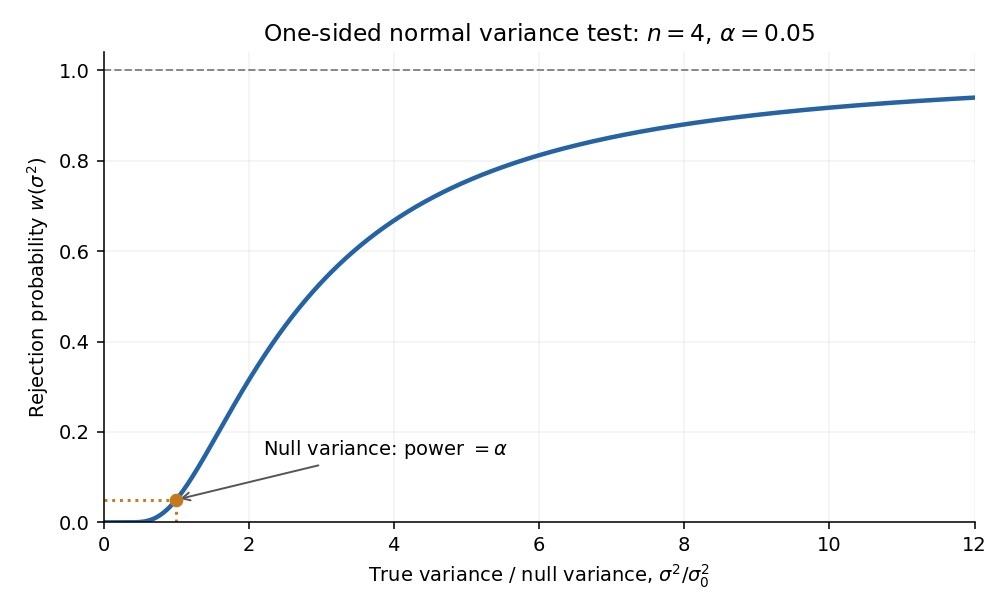
Codex 0 2026-10-31At a true variance , . Therefore the power function isThe argument of decreases as increases. Since the chi-squared density is positive on the positive half-line, the power is continuous and strictly increasing, withThese features determine the requested rough sketch. The curve passes through the size at the null value and approaches one for very large variance.
Pinned article: Introduction to the OurBigBook Project
Welcome to the OurBigBook Project! Our goal is to create the perfect publishing platform for STEM subjects, and get university-level students to write the best free STEM tutorials ever.
Everyone is welcome to create an account and play with the site: ourbigbook.com/go/register. We belive that students themselves can write amazing tutorials, but teachers are welcome too. You can write about anything you want, it doesn't have to be STEM or even educational. Silly test content is very welcome and you won't be penalized in any way. Just keep it legal!
Intro to OurBigBook
. Source. We have two killer features:
- topics: topics group articles by different users with the same title, e.g. here is the topic for the "Fundamental Theorem of Calculus" ourbigbook.com/go/topic/fundamental-theorem-of-calculusArticles of different users are sorted by upvote within each article page. This feature is a bit like:
- a Wikipedia where each user can have their own version of each article
- a Q&A website like Stack Overflow, where multiple people can give their views on a given topic, and the best ones are sorted by upvote. Except you don't need to wait for someone to ask first, and any topic goes, no matter how narrow or broad
This feature makes it possible for readers to find better explanations of any topic created by other writers. And it allows writers to create an explanation in a place that readers might actually find it.
Figure 1. Screenshot of the "Derivative" topic page. View it live at: ourbigbook.com/go/topic/derivativeVideo 2. OurBigBook Web topics demo. Source. - local editing: you can store all your personal knowledge base content locally in a plaintext markup format that can be edited locally and published either:This way you can be sure that even if OurBigBook.com were to go down one day (which we have no plans to do as it is quite cheap to host!), your content will still be perfectly readable as a static site.
- to OurBigBook.com to get awesome multi-user features like topics and likes
- as HTML files to a static website, which you can host yourself for free on many external providers like GitHub Pages, and remain in full control

Figure 2. You can publish local OurBigBook lightweight markup files to either OurBigBook.com or as a static website.
Figure 3. Visual Studio Code extension installation.
Figure 5. . You can also edit articles on the Web editor without installing anything locally. Video 3. Edit locally and publish demo. Source. This shows editing OurBigBook Markup and publishing it using the Visual Studio Code extension. 
- Infinitely deep tables of contents:



All our software is open source and hosted at: github.com/ourbigbook/ourbigbook
Further documentation can be found at: docs.ourbigbook.com
Feel free to reach our to us for any help or suggestions: docs.ourbigbook.com/#contact