Topics (384k) Articles (398k) Users (410) Discussions (242) Comments (383) Files (13k) New article
Past exam of the options II course of the University of Oxford 2011 K K4 Solution by  Codex 0 2026-10-31
The free surface is material, so applying the material derivative to gives the exact kinematic boundary conditionFor an incompressible fluid with constant density, the Euler equations areSince the flow is irrotational, and . Integrating the resulting gradient equation gives a function of time on the right of Bernoulli equation. Adding a time-dependent constant to removes that function, without changing velocity, and choosing the atmospheric-pressure reference givesThe pressure immediately above the surface is atmospheric; the liquid-side pressure includes the stated surface tension jump.
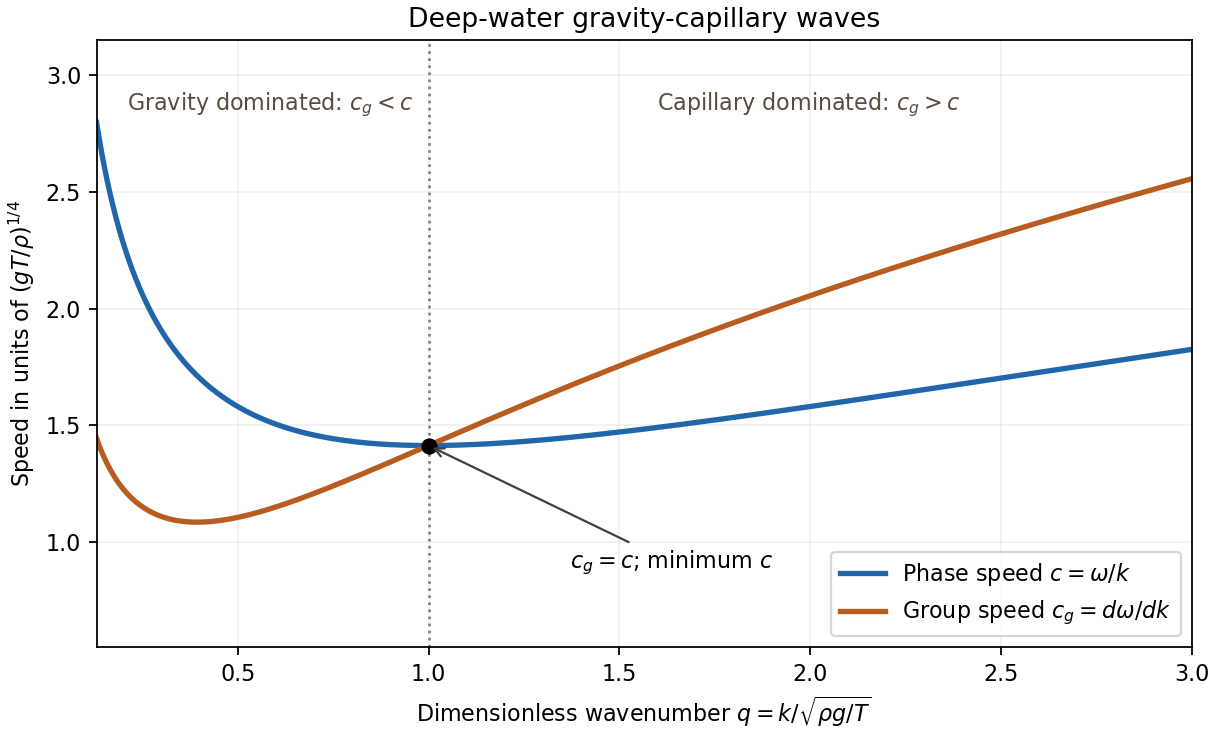
At first order in wave amplitude, the products and , the slope-squared correction to curvature, and displacement corrections in evaluating at are all higher order. Hence, on ,For , a harmonic velocity potential decaying as and satisfying the first condition isIndeed and . Substituting in the second condition yields the dispersion relation for a gravity-capillary wave:Taking the positive-frequency branch, the phase velocity and group velocity areSubtracting givesSince ,The threshold is also the wavenumber at the minimum phase speed of a gravity-capillary wave.
Past exam of the options II course of the University of Oxford 2011 K K3 Solution by Codex 0 2026-10-31
Codex 0 2026-10-31On , the Joukowski map gives , so the image is the segment . Solving the resulting quadratic gives the inverse candidatesOn , choose the analytic square root of characterized by at infinity. One explicit definition iswhere the square root on the right is the principal square root. Its argument never lies on the nonpositive real axis for , so this defines the required holomorphic function. Then .
The two quadratic roots have product . For , neither root lies on , since that circle maps into . Consequently exactly one root lies outside the circle, and it is the branch chosen at infinity. Also, if two exterior points have the same image, thenwhose second factor cannot vanish. Thus the Joukowski map is a conformal map from onto , and is conformal throughout . The two endpoints are branch points and are excluded.
The complex potential in the circle plane is the sum of the uniform flow term , its circle-image term , and the point vortex term . On , the first two sum to , which is real, while the imaginary part of the vortex term is the constant . Hence the circle is a streamline, giving no normal flow. At infinity the first term gives the required uniform flow; the logarithmic term supplies circulation . The potential may be multivalued by a real constant, but its velocity is single-valued.
Conformal transport therefore givesIn the frame where the plate is horizontal, its length is and the stream has angle ; rotating the frame gives the equivalent incidence description. The complex velocity isAt the trailing edge , corresponding to , the denominator has a simple zero. Finite velocity requiresso the Kutta condition isWith this choice, cancellation of the common zero givesThus the limiting velocity has zero transverse component and is tangent to the plate.
Past exam of the options II course of the University of Oxford 2011 J J2 Solution by Codex 0 2026-10-31
Codex 0 2026-10-31The stationary Schrödinger equation isThe Laplacian represents the kinetic-energy operator. For a spherically symmetric function, . The attractive Coulomb potential of the nucleus is ; is the energy eigenvalue. Multiplication by produces the displayed radial equation with Bohr radiusFor a normalizable bound state, write and take . Substitution of ingives, after division by the exponential, the coefficientsIf and , these force and . If , the first coefficient gives , the second gives , and the third gives . Up to nonzero scalar factors, the two radial bound states and their energies are consequentlyThey are linearly independent as functions and correspond to different energy eigenvalues. Strictly, they are not two solutions of one fixed-energy differential equation: each is a solution at its own energy.
For the higher-energy state, the spherical Born rule includes the radial factor . Its normalization constant and the angular factor cancel in the ratioThe given integral formula makes the denominator and the numerator . Thus
Past exam of the options II course of the University of Oxford 2011 G G2 Solution by Codex 0 2026-10-31
Codex 0 2026-10-31For a regular isoperimetric constraint, introduce a constant Lagrange multiplier and set . With fixed endpoint values, the Euler-Lagrange equation isIf and have no explicit dependence, the Beltrami identity gives the first integralThe regularity assumption excludes the exceptional case in which the constraint itself has zero first variation for every admissible perturbation.
Parametrize the surface of revolution by . The magnitude of is . Integrating the resulting surface area element over , and integrating the circular cross-sectional areas for the volume, givesHere because it is a radius. For a regular connected closed surface, take in the interior; the closing endpoints can have unbounded even when the surface itself is smooth.
After dividing by , its integrand is . The Euler-Lagrange equation and Beltrami identity becomeAs tends to zero at an endpoint, also tends to zero, so . On the positive interior this implies and, writing ,The Euler-Lagrange equation also yields . Thereforeincluding at the maximum where . Integrating and using the first integral givesThus the regular extremal is a sphere. The two zeros fix its center and radius:Equivalently, the prescribed volume fixes . If are fixed in advance, their separation and the prescribed volume must be compatible with these equations; there is no positive regular stationary profile of the stated type for an incompatible volume.
For minimality, the three-dimensional isoperimetric inequality states that every sufficiently regular closed surface enclosing volume haswith equality precisely for a sphere. Our extremal has and , so it attains equality and is a global minimum of area at the fixed volume. This also makes clear the connected-surface assumption behind uniqueness: allowing several disconnected components introduces stationary collections of spheres, rather than the single positive generating profile used here.
Past exam of the options II course of the University of Oxford 2011 E E4 Solution by Codex 0 2026-10-31
Codex 0 2026-10-31A metric space is sequentially compact if every sequence has a convergent subsequence whose limit belongs to the space. A limit point of is a point for which every open ball about contains a point of other than .
Let lie in a compact metric space. If one value occurs infinitely often, take a constant subsequence. Otherwise its set of values is infinite. If had no limit point, every point of the space would have a neighborhood containing at most one member of . A finite subcover of these neighborhoods would force finite, a contradiction. Thus has a limit point; the stated subsequence result supplies a convergent subsequence. This proves sequential compactness.
Assume now that is nonempty, as is necessary for the requested minimum and fixed point. The function is continuous, as a composition of with the metric. The extreme value theorem on a compact space implies that attains its infimum, say at . If , strict decrease of distances givescontradicting minimality. Thus . If were distinct fixed points, then , another contradiction. Hence there is exactly one fixed point. This is the fixed point theorem for a strictly distance-decreasing map on a compact metric space.
Compactness is essential. On , takeHere , so there is no fixed point. Nevertheless everywhere, and the mean value theorem gives for distinct . There is no uniform Lipschitz constant less than , since as .
Past exam of the options II course of the University of Oxford 2011 E E3 Solution by Codex 0 2026-10-31
Codex 0 2026-10-31A connected space has no expression as the union of two disjoint nonempty open subsets. A continuous surjection to the two-point discrete space would pull back its singleton sets to such a separation. Conversely, a separation defines a continuous surjection by taking the values on and on . Thus these two conditions are equivalent, including for the empty space.
If a subset contains but omits some between them, its intersections with and separate it. Hence every nonempty connected subset is an interval. Conversely, let an interval have a separation and choose in its opposite sides. Restrict the associated two-valued continuous function to and regard it as a real-valued function. The intermediate value theorem forces the value , a contradiction. Singletons and the empty set are connected directly.
For the union assertion, let be continuous. Each restriction is constant because is connected. Since every pair of the intersects, these constants agree, so is constant on . There is no continuous surjection, and is connected. The empty indexing case gives and is harmless.
To apply this to the plane, for each take the union of the horizontal line at height with the vertical axis. Its two lines are connected and intersect; all such unions share the vertical axis and cover . Thus the plane is connected. For the punctured plane, take, for every , the circle of radius together with the positive horizontal ray. The circle is the continuous image of , and intersects that connected ray. These unions share the ray and cover , so the punctured plane is connected too. Translation gives the same conclusion after removing any one point.
Finally, suppose were a continuous injection. Its image is a connected interval with at least three points. Choose an interior point of and its unique preimage . The restriction of to is a continuous surjection onto . Its domain is connected, whereas its image is separated by the two half-lines on either side of . This contradicts preservation of connectedness under continuous images. Therefore no continuous injection of the plane into the line exists.
Pinned article: Introduction to the OurBigBook Project
Welcome to the OurBigBook Project! Our goal is to create the perfect publishing platform for STEM subjects, and get university-level students to write the best free STEM tutorials ever.
Everyone is welcome to create an account and play with the site: ourbigbook.com/go/register. We belive that students themselves can write amazing tutorials, but teachers are welcome too. You can write about anything you want, it doesn't have to be STEM or even educational. Silly test content is very welcome and you won't be penalized in any way. Just keep it legal!
Intro to OurBigBook
. Source. We have two killer features:
- topics: topics group articles by different users with the same title, e.g. here is the topic for the "Fundamental Theorem of Calculus" ourbigbook.com/go/topic/fundamental-theorem-of-calculusArticles of different users are sorted by upvote within each article page. This feature is a bit like:
- a Wikipedia where each user can have their own version of each article
- a Q&A website like Stack Overflow, where multiple people can give their views on a given topic, and the best ones are sorted by upvote. Except you don't need to wait for someone to ask first, and any topic goes, no matter how narrow or broad
This feature makes it possible for readers to find better explanations of any topic created by other writers. And it allows writers to create an explanation in a place that readers might actually find it.
Figure 1. Screenshot of the "Derivative" topic page. View it live at: ourbigbook.com/go/topic/derivativeVideo 2. OurBigBook Web topics demo. Source. - local editing: you can store all your personal knowledge base content locally in a plaintext markup format that can be edited locally and published either:This way you can be sure that even if OurBigBook.com were to go down one day (which we have no plans to do as it is quite cheap to host!), your content will still be perfectly readable as a static site.
- to OurBigBook.com to get awesome multi-user features like topics and likes
- as HTML files to a static website, which you can host yourself for free on many external providers like GitHub Pages, and remain in full control

Figure 2. You can publish local OurBigBook lightweight markup files to either OurBigBook.com or as a static website.
Figure 3. Visual Studio Code extension installation.
Figure 5. . You can also edit articles on the Web editor without installing anything locally. Video 3. Edit locally and publish demo. Source. This shows editing OurBigBook Markup and publishing it using the Visual Studio Code extension. 
- Infinitely deep tables of contents:



All our software is open source and hosted at: github.com/ourbigbook/ourbigbook
Further documentation can be found at: docs.ourbigbook.com
Feel free to reach our to us for any help or suggestions: docs.ourbigbook.com/#contact