Given the view of the Standard Model where the electron and quarks are just completely separate matter fields, there is at first sight no clear theoretical requirement for that.
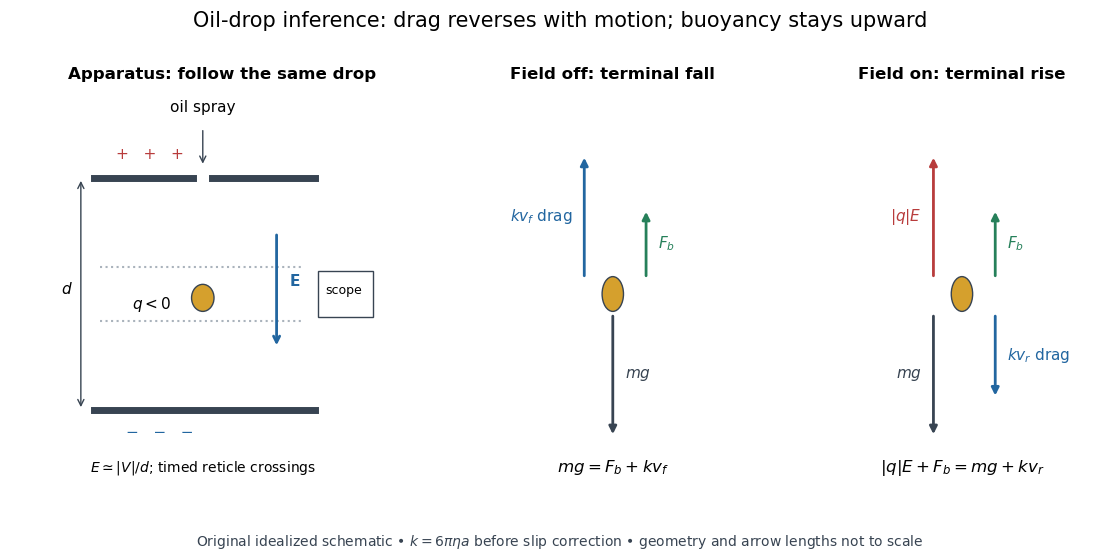
The beautiful experimental idea behind the oil drop experiment is to determine a microscopic electric charge by watching a visible carrier move. In his 1913 paper, Millikan timed the descent and electrically driven ascent of individual oil drops, repeatedly changing a drop's electric charge through capture of air ions. His apparatus used parallel plates separated by 16mm, a roughly 5300V source, and an optical scale to measuretraveldistances. He reported multiple relationships among a given drop's inferred electric charges. He also found that uncorrected Stokes's law gave asize-dependent inferred elementary unit, and introduced apressure-dependent slip correction. These were measured relationships with calibration and modeluncertainties, not exact readings of today's defined e. [ref]
The observed direction of response, with known field polarity, supplies the sign of q. A suspended drop gives the alternative balance ∣q∣E=W, but it still requires adetermination of W: balancing a drop alone does not determine its electric charge.
For an explicitly invented continuum example, stipulate a=1μm, ρo=900kgm−3, ρa=1.2kgm−3, η=1.8×10⁻⁵Pas, g=9.81ms−2, q=−5e and a downward E=105Vm−1. The balances predict W≃3.69×10⁻¹⁴N, vf≃0.109mms−1 and vr≃0.127mms−1. Substituting those speeds recovers ∣q∣=5e within rounding. This checks the algebra; it is not a precision prediction for real micrometre drops, which need a slip correction.
The inference has two distinct parts. Compare inferred electric charges or charge changes with a common unit, seeking qi≃nie within uncertainty, rather than demanding exact ratios of rounded measurements. Then establish the absolute scale through electric field, density, dynamic viscosity and distance/time calibration. If the observed steps are all even multiples, their common spacing alone cannot exclude an unobserved smaller unit. Air motion, evaporation and mistimed crossings can alter inferred electric charge without an ion-capture event. Small Reynolds numbersupports Stokes's law, but does not by itself justify its no-slip continuum coefficient: a significant ratio of air mean free path to drop radius requires a slip correction. Millikan's comparison of different drop sizes and pressures addressed that systematic limitation; the modern PASCO manual also includes the correction. Agreement supports charge quantization for the observed carriers within experimental resolution, rather than proving a universal statement about every possible particle.