
Past exam of the mathematics course of the University of Cambridge 2007 ii Paper 4 10A Solution Created 2026-09-24 Updated 2026-10-14
Here , so the perturbation equation becomes . A trial gives , with roots . ThusThe pure growing mode obeys ; for generic data the decaying component eventually becomes negligible, though the growing-mode normalization must be determined from both initial data.
With , the physical wavelength is . Equating it to the Hubble radius , and using , givesGrowing-mode evolution from crossing to today multiplies the perturbation amplitude by . Hence the supplied horizon-crossing variance givesThis conclusion uses the stated matter-dominated growing-mode approximation over the relevant evolution, rather than an additional radiation-era transfer function.
Past exam of the mathematics course of the University of Cambridge 2007 ii Paper 3 9C Solution Created 2026-09-24 Updated 2026-11-05
Put and . The Euler-Lagrange equations are and , where . Adding shows that is conserved. Subtracting gives the equation of a simple pendulumThe relative equilibria are and modulo . The relative energy has a strict minimum at zero, proving stability there. Linearization gives near zero and near , so the latter is unstable. The small-oscillation period is . These are equilibria of the relative angle; a nonzero conserved total angular momentum permits common rotation of both particles.
Past exam of the mathematics course of the University of Cambridge 2007 ii Paper 3 8B iii Created 2026-09-24 Updated 2026-09-24
Past exam of the mathematics course of the University of Cambridge 2007 ii Paper 3 8B ii Created 2026-09-24 Updated 2026-09-24
Past exam of the mathematics course of the University of Cambridge 2007 ii Paper 3 8B i Created 2026-09-24 Updated 2026-09-24
Past exam of the mathematics course of the University of Cambridge 2007 ii Paper 3 7E Solution Created 2026-09-24 Updated 2026-10-14
A form of the Poincaré-Bendixson theorem states that a nonempty omega-limit set of a forward orbit of a planar autonomous vector field, contained in a compact region and containing no equilibrium, is a periodic orbit.
Set . Direct calculation givesbecause . At the inner boundary the flow points into or along the annulus, and at the outer boundary it does likewise. Smoothness and these inequalities make the compact annulus forward invariant.
For nonzero , write , . Thenthroughout the annulus. Hence it contains no equilibrium. Any orbit starting there remains compactly trapped, has a nonempty omega-limit set, and the Poincaré-Bendixson theorem supplies the required periodic orbit in the stated annulus. For the annulus reduces to itself, and there , giving the periodic orbit directly.
Past exam of the mathematics course of the University of Cambridge 2007 ii Paper 3 6B Solution Created 2026-09-24 Updated 2026-10-14
The pair-birth rate here is the constant immigration rate , while deaths occur at total rate . This interpretation is fixed by the requested mean formula. With and for , the master equation isThe Markov jump-process generator acts as . Taking gives , henceFor the second moment , the two jumps give . Differentiating therefore yields . Substitution of the mean and solution of this scalar linear equation giveThus , assuming and finite initial second moment. This is pair immigration with linear deaths; births at rate would be a different model and would not give the printed mean.
Past exam of the mathematics course of the University of Cambridge 2007 ii Paper 3 5I Solution Created 2026-09-24 Updated 2026-10-14
Write . Ignoring only terms independent of , the Poisson log-likelihood is . The multinomial model is defined on the constraint , since its probabilities must sum to one. On this constraint its full log-likelihood satisfieswhere both likelihoods include the same terms. Thus they differ by a constant on the admissible multinomial parameter set.
If the Poisson maximum-likelihood estimator has , it is feasible for the multinomial problem, and no feasible parameter can have a larger likelihood than it. Consequently it is also a multinomial maximum. With the usual uniqueness and identifiability assumption,Without uniqueness, the precise conclusion is that is a multinomial maximizer; arbitrary independently chosen maximizers need not be identical. This qualification is necessary for a general unspecified parametrization.
In a log-linear generalized linear model with an unrestricted intercept, differentiation with respect to that intercept gives . Thus the fitted total automatically equals . One can fit independent Poisson cell counts using the usual GLM machinery and recover the multinomial fitted probabilities as . The result is constrained Poisson and multinomial likelihood equivalence, not an assertion that the sampling experiments themselves are identical.
Past exam of the mathematics course of the University of Cambridge 2007 ii Paper 3 4G Solution Created 2026-09-24 Updated 2026-10-14
The polynomials are over , and multiplication gives . A cyclic code of length seven generated by a degree-three polynomial has dimension : the multiples with are distinct representatives, so its rank is four.
The root has order seven in : it is neither zero nor one, and the multiplicative group has prime order seven. A weight-one word cannot vanish at . A weight-two word , with distinct indices between zero and six, cannot vanish either, because that would give . Every codeword vanishes at , so its nonzero weight is at least three. Since itself has weight three,From obtain and . Therefore . The one-bit error has precisely this syndrome, so correcting it givesIts distance from the received word is one. The minimum distance three makes this nearest codeword unique: two codewords each at distance one from the received word would be at distance at most two from each other.
Past exam of the mathematics course of the University of Cambridge 2007 ii Paper 3 3G Solution Created 2026-09-24 Updated 2026-10-14
For a plane crystallographic group, the translation subgroup consists of translations by vectors in a rank-two lattice ; the lattice is this additive group of translation vectors. The point group is the image under the linear-part homomorphism , equivalently . Conjugating a translation by an isometry with linear part gives translation by , so every point-group element preserves .
Choose a lattice basis. A point-group rotation is represented in that basis by an integral matrix, because it maps lattice vectors to lattice vectors, and its inverse does likewise. The trace is therefore an integer. In an orthonormal basis the same rotation has trace , which lies between minus two and two. Hence . The value two gives the identity, while the other values give angles , , , or . Thus every nonidentity rotation has orderThis proves the crystallographic restriction theorem from the lattice action rather than assuming the classification of wallpaper groups.
Past exam of the mathematics course of the University of Cambridge 2007 ii Paper 3 38C b Created 2026-09-24 Updated 2026-10-14
Past exam of the mathematics course of the University of Cambridge 2007 ii Paper 3 38C a Created 2026-09-24 Updated 2026-09-24
Past exam of the mathematics course of the University of Cambridge 2007 ii Paper 3 37C Solution Created 2026-09-24 Updated 2026-10-14
Let the rapidly varying phase be , so and . The dispersion law is the Hamilton-Jacobi equation . Differentiating it and following a path with group velocity gives the ray tracing equationsThe final relation is obtained by the chain rule along that path; its two spatial terms cancel.
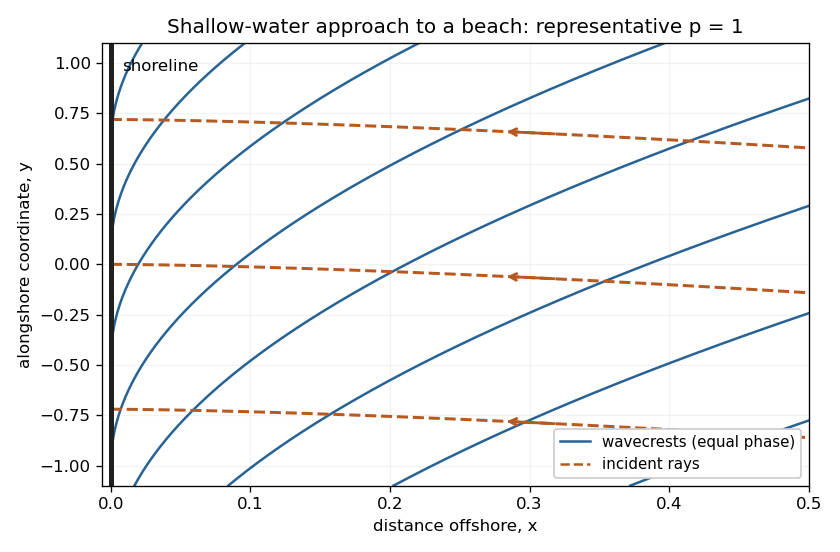
The medium is stationary and independent of , so and are conserved. For deep water far from shore, . Choose the incident branch with and ; choosing the opposite alongshore direction changes its sign. Since the dispersion relation depends on direction only through , the group-velocity component ratio is . Hence the required implicit ray equation isNear shore, and . Thus , whose integral givesThe rays approach the shoreline normally. A crest is a level set of . Its slope is , so crests become parallel to the shoreline. Their separation in the shore-normal direction is and decreases to zero. These are formal ray asymptotics; for , the slow-variation assumption eventually fails arbitrarily close to the shoreline. The sketch shows a representative shallow-water case ; it illustrates these limiting directions rather than assuming that value in the derivation.

Past exam of the mathematics course of the University of Cambridge 2007 ii Paper 3 36B ii Created 2026-09-24 Updated 2026-09-24
Past exam of the mathematics course of the University of Cambridge 2007 ii Paper 3 36B i Created 2026-09-24 Updated 2026-09-24
Past exam of the mathematics course of the University of Cambridge 2007 ii Paper 3 35E Solution Created 2026-09-24 Updated 2026-10-14
In the instantaneous rest frame the total radiation has zero net three-momentum, so its emitted four-momentum is proportional to the four-velocity. A Lorentz boost multiplies its energy by , while the elapsed coordinate time for the source is also multiplied by . Their ratio, total instantaneous radiated power, is therefore invariant. This concerns total emitted power, not the directional flux or an observer's photon arrival rate.
Use the metric of signature and dots for proper-time derivatives. From obtain , where . Differentiating givesSquaring in the Minkowski metric, using , gives , henceIn the rest frame, is the squared ordinary acceleration, so invariance of power and the low-speed Larmor formula give . In terms of coordinate-time acceleration , this is the Lienard formulaFor circular motion perpendicular to , and the Lorentz force gives . ThusAt low speed , reproducing ordinary Larmor radiation with magnetic acceleration .
Past exam of the mathematics course of the University of Cambridge 2007 ii Paper 3 34D Solution Created 2026-09-24 Updated 2026-10-14
Periodic boundary conditions give wavevectors . Each state occupies area in wavevector space. A ring of radius contains states. With , , givingThere is no spin degeneracy. At temperature , set . The Bose occupation integral givesThe integral follows by expanding the denominator as and integrating each positive term.
As , this density diverges. Thus the excited states never have a finite maximum capacity at a positive temperature: every finite prescribed density can be accommodated with a strictly negative chemical potential. The ground-state occupation then stays finite as area tends to infinity and its fraction vanishes. Hence there is no Bose-Einstein condensation at any positive temperature in this homogeneous ideal two-dimensional gas. At exactly zero temperature the ground state is occupied; the printed phrase about any temperature is understood as absence of a nonzero critical temperature, not exclusion of that zero-temperature limit.
Past exam of the mathematics course of the University of Cambridge 2007 ii Paper 3 33A Solution Created 2026-09-24 Updated 2026-10-14
Let . The exact frequency has expansion . The ratio , while the coefficient of the orthogonal state is uniformly . Hence the supplied solution reduces towith phase error , which is over one cycle. This is the adiabatic approximation: the system remains in the instantaneous positive-energy eigenstate, with energy .
Thus the dynamic phase is and the geometric phase is , in the gauge for printed in the PDF. For one cycle , the Berry phase isminus half the solid angle swept by the field direction.
To calculate the requested integral, use . It has ; its radial and polar-angle connection components vanish in this gauge. Along the circle in parameter space, runs from zero to , so , agreeing with the exact-solution limit.
Past exam of the mathematics course of the University of Cambridge 2007 ii Paper 3 32D Solution Created 2026-09-24 Updated 2026-10-14
The oscillator operators satisfy and . Substitution into the kinetic and potential energies givesThe number operator is nonnegative because . The commutators and lower and raise an eigenvalue by one. If an eigenvalue were a noninteger , repeated lowering would produce a nonzero eigenvector with eigenvalue between zero and one, and one further lowering would have negative eigenvalue; its norm is nonzero because . This contradicts nonnegativity. Thus only nonnegative integers are allowed. The normalized Gaussian solves , and raising it supplies every level, withFor the three-dimensional unperturbed oscillator the product states are , with energy .
Write the perturbation as , where . Its ground-state expectation is zero. Acting on the ground state, it produces , each with coefficient . They lie above the ground state, so second-order perturbation theory givesIn the first excited subspace with basis , the first-order perturbation matrix is . Its symmetric eigenvector has eigenvalue , while the perpendicular two-dimensional space has eigenvalue . Thus the lowest excited triplet splits intoAs an independent check, diagonalizing the quadratic potential gives normal frequencies and twice; their small- expansions reproduce both results.
Past exam of the mathematics course of the University of Cambridge 2007 ii Paper 3 31E Solution Created 2026-09-24 Updated 2026-10-14
Use the Fourier convention and sufficiently rapidly decaying smooth initial data. A scalar Lax pair for the linear equation isDifferentiate the first equation in time and use the second and its spatial derivative. The terms involving and cancel, leaving , exactly the linear equation.
The spatially normalized solutions are for , and for . Integration by parts gives . Their difference is ; Fourier transformation of the evolution gives . Set . ThenThe Cauchy integral solution is , and reconstruction gives the usual inverse Fourier solution.
For the nonlinear deformation, put and . The matrix Lax pair isA direct multiplication gives the off-diagonal entries of as and , with zero diagonal. Hence compatibility is precisely the two requested nonlinear equations.
Here is a normalized Riemann-Hilbert problem for this pair, in the case without discrete scattering poles. Let be its two reflection data determined from the initial spatial scattering problem, and set . Deform the triangular jump toThe data are time-independent in this convention; their spatial and temporal oscillations are displayed explicitly. Setting and recovers the linear problem. Thus the diagonal correction is necessary when the second off-diagonal jump is introduced; omitting it would destroy determinant one.
To verify the deformation rather than merely name it, note and . Therefore and have no jump. Analyticity and the expansion at infinity make them, by Liouville's theorem, respectively and . The first expansion gives , soThe constant term of the second expression is . In the first equation's next coefficient, its off-diagonal part equals and its diagonal part equals . Hence , exactly the displayed nonlinear Lax pair. This proves that the reconstructed functions obey the required PDEs.
Finally let be the Cauchy integral operator on the real axis, its lower boundary value, and . The jump relation and normalization giveThis is the requested linear singular integral equation for the inverse problem: it is linear in the unknown matrix once the scattering data are given. Reconstruction is and .
For completeness, generic simple discrete eigenvalues add the following residue data. At an upper-half-plane pole , use ; at a lower-half-plane pole use , with the norming constants determined by the initial spatial scattering problem. Impose . The nilpotent matrices make this limit well-defined. If denotes the residue, the full linear inverse system isThe reconstructed field formulas acquire and respectively. This includes the soliton terms when they occur; the preceding pure-jump formula is their pole-free special case. These standard scattering formulations assume no spectral singularity on the real contour and simple discrete eigenvalues; repeated poles require the corresponding higher-order pole conditions.
There are unlisted articles, also show them or only show them.