
Past exam of the mathematics course of the University of Cambridge 2007 ii Paper 3 12F i Created 2026-09-24 Updated 2026-09-24
Past exam of the mathematics course of the University of Cambridge 2007 ii Paper 3 11F Solution Created 2026-09-24 Updated 2026-10-14
The Chinese remainder theorem says that for pairwise coprime positive moduli , the map is an isomorphism; in particular prescribed residues have a unique solution modulo the product.
Write , with and . Choose and . The Chinese remainder theorem supplies . The binomial theorem gives , since every nonconstant term is divisible by ; also . Thus , whereas . Its multiplicative order is exactly .
For odd define the Jacobi symbol , using the Legendre symbol, with . It is zero if shares a prime factor with . For example , but the square residues modulo nine are , so two is not a square.
For positive odd coprime , Jacobi reciprocity isFactor and and multiply quadratic reciprocity for each prime pair. Its sign exponent is . For odd numbers, , so this exponent has the same parity as . Multiplicativity of the Legendre symbol gives the two Jacobi products, proving the formula. If are not coprime, both sides of the displayed reciprocity equality are zero.
For the previously constructed , every prime divisor of sees residue one, so . But , because and is odd. The order- unit therefore has . This supplies a unit failing the proposed test.
Finally the passing units form the kernel of the homomorphismMultiplicativity makes this a homomorphism, and the failing unit shows its kernel is proper. A proper subgroup has index at least two. Hence the test fails on at least half the units modulo .
Past exam of the mathematics course of the University of Cambridge 2007 ii Paper 3 10A Solution Created 2026-09-24 Updated 2026-10-14
Chemical equilibrium gives , since the photon chemical potential is zero. Set . The degeneracies and approximate masses give prefactors for protons, neutrons and helium. ThusHere the binding energy uses ; the PDF prints in that mass relation, a dimensional typo.
Baryon conservation gives . In adiabatic expansion without photon-producing entropy release, and , so stays constant. This statement is for that epoch; entropy transfer such as electron-positron annihilation modifies the photon normalization.
Since the density ratio equals , substitution of the given photon density yieldsAt MeV, MeV and MeV, the right side is about . Unity therefore corresponds to , illustrating the stated very rough temperature estimate for a cosmological baryon-to-photon ratio of order to . A numerical value of is necessary; it is not specified in the question. The exponential makes the temperature estimate far less sensitive than the ratio itself to order-one prefactors.
Actual helium synthesis must proceed through light intermediates. The deuterium bottleneck persists because deuterium's much smaller binding energy allows the abundant high-energy photon tail to destroy it. Only at a lower temperature do enough deuterons survive to initiate efficient reactions leading to helium. Direct four-nucleon assembly at the equilibrium temperature is ineffective.
Past exam of the mathematics course of the University of Cambridge 2007 ii Paper 2 9C Solution Created 2026-09-24 Updated 2026-11-05
The Euler-Lagrange equations areUsing time independence of the vector potential gives , which is the component form ofTaking its scalar product with the velocity shows : the kinetic energy is constant, since the magnetic force does no work.
Past exam of the mathematics course of the University of Cambridge 2007 ii Paper 2 8B Solution Created 2026-09-24 Updated 2026-10-14
Near zero the integrand is asymptotic to , and at infinity it decays exponentially. The defining integral therefore converges and is analytic for , by locally uniform domination, also allowing logarithmic factors for differentiation. Multiplication by the entire function does not enlarge the domain of the unevaluated integral itself.
On , subtract the two convergent integrals and useThe substitution gives . Thusfirst there and then wherever the two analytic continuations agree. The Riemann zeta function is meromorphic on the plane with its only pole a simple pole at one. The prefactor has a simple zero there, . It cancels the pole, giving . Elsewhere both factors are holomorphic. The analytic continuation of is entire; it is the Dirichlet eta function.
Past exam of the mathematics course of the University of Cambridge 2007 ii Paper 2 7E Solution Created 2026-09-24 Updated 2026-10-14
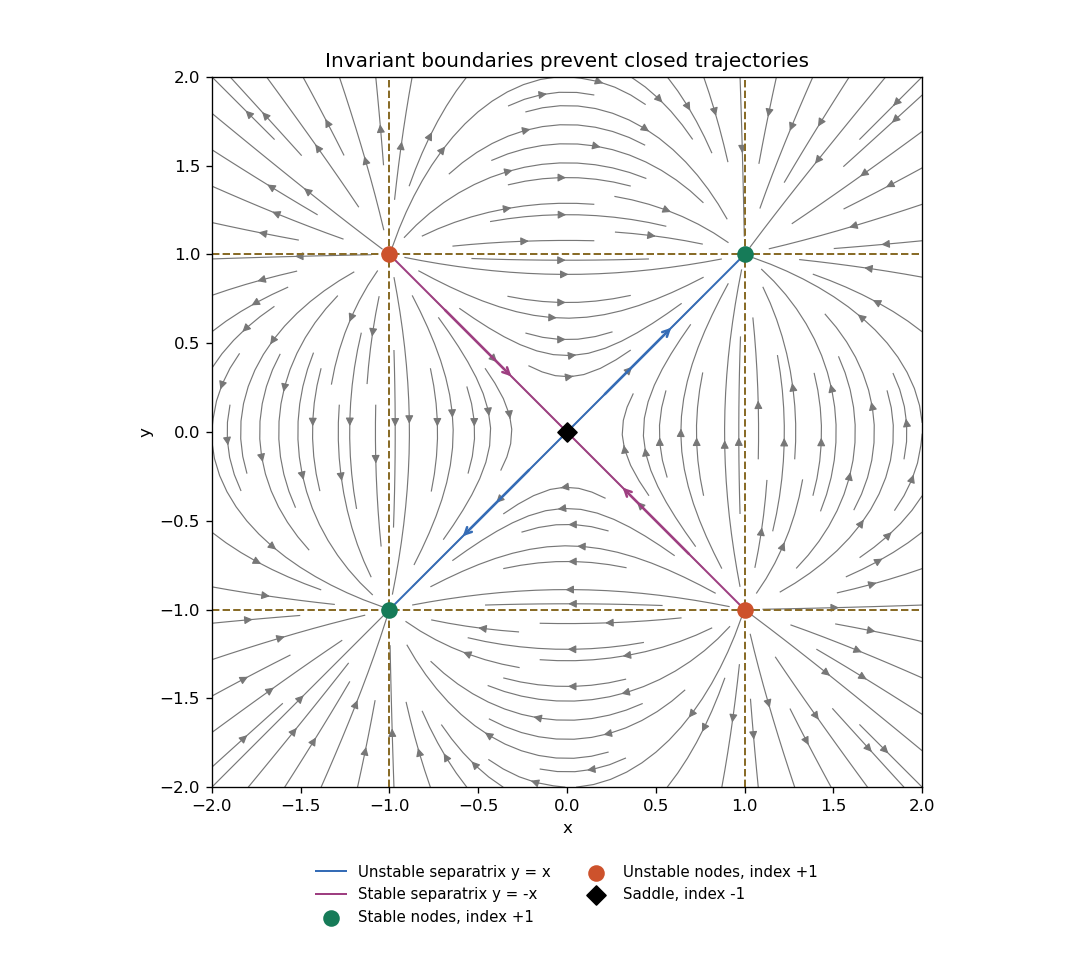
The simultaneous zeros are the origin and the four corners . The Jacobian matrix isAt the origin its eigenvalues are , with eigenvectors , so the origin is a saddle equilibrium of Poincaré index . At a corner . Thus and are stable nodes; and are unstable nodes, all of index . Although the node eigenvalues coincide, the equilibria are hyperbolic and their stability follows from their strictly signed real eigenvalues.
The lines and are invariant and divide the plane into nine convex regions. A nonconstant periodic trajectory cannot cross any of these lines by uniqueness, and cannot be contained in one of them because one-dimensional autonomous flows have no nonconstant periodic solutions. It must therefore lie inside one region. The central region contains only the origin, whose index is ; all other regions contain no equilibria. But a simple periodic orbit has index , equal to the sum of the enclosed equilibrium indices. Its interior stays in the same convex region, giving a contradiction in either case. There are no periodic orbits.
Away from the invariant lines, trajectory curves have the first integralsince both logarithmic derivatives equal . The diagonal is the unstable separatrix of the origin, leading toward the two sinks; is its stable separatrix, coming from the two sources. The diagram shows these separatrices, the invariant lines and the direction field.

Past exam of the mathematics course of the University of Cambridge 2007 ii Paper 2 6B Solution Created 2026-09-24 Updated 2026-10-14
First-season recruits in year contribute . Seeds produced in year that survive two winters, fail first-season germination and germinate in their second season contribute . HenceThis treats recruitment from older seeds as absent; otherwise the two-season recurrence would need further terms. The characteristic polynomial is . For distinct roots,with constants determined by two initial values. For , the recurrence is first order after the initial step; for it gives . These describe the zero-root degeneracies without interpreting in the formula.
Since , . The positive root is less than one exactly when : the polynomial is nonpositive at zero, has only one positive root, and its value at one is . ThereforeThis is the decay condition for the two-season seed-bank recurrence. The deterministic model describes expected or averaged abundance; literal eventual integer extinction requires that interpretation. A corresponding branching model with geometrically decaying expected abundance becomes extinct almost surely, since the probability of any surviving plants is at most the expected number.
Past exam of the mathematics course of the University of Cambridge 2007 ii Paper 2 5I Solution Created 2026-09-24 Updated 2026-10-14
The independent Laplace distribution responses have log likelihoodFor every fixed positive , maximizing this expression means minimizing the sum of absolute residuals. Thus is a least absolute deviations estimate, not a least-squares estimate. Such a minimizer exists: minimize the distance in the finite-dimensional closed column space of the design matrix. It need not be unique if the data or design allow multiple minimizers.
Write . For , differentiating the profiled log likelihood gives . Its unique maximum isIf the fitted residual sum is zero, the likelihood instead increases without bound as : there is no joint maximum with the stated positive scale parameter. The displayed estimate then denotes the boundary limit, not an admissible positive-scale MLE.
An ordinary exponential dispersion family has log density , so changing the mean changes the log density by an affine function of . For two distinct Laplace locations , their log-density difference is , with different slopes on the intervals separated by the two locations. It is not affine in . Equivalently the kink at moves with the parameter. The Laplace location family is not an ordinary exponential dispersion family.
Past exam of the mathematics course of the University of Cambridge 2007 ii Paper 2 4G Solution Created 2026-09-24 Updated 2026-10-14
A digital signature lets the holder of a private key authenticate a message so that anyone with the corresponding trusted public key can verify its origin and integrity. The signature does not conceal the message. Public-key certification, a suitable message hash and protection of the signing key are needed for that interpretation.
For the ElGamal signature scheme, choose a large prime and a primitive root modulo . The secret key is , and the public key is with . Represent the message by a hash modulo . Choose a fresh secret nonce coprime to and setThe signature is . After checking the prescribed ranges, the verifier accepts whenA genuine signature passes because . The security aim is that someone without cannot efficiently produce a valid signature on a new authenticated message. Nonce secrecy and freshness matter: reuse gives linear congruences relating two message hashes, the nonce and the secret key. Signing unhashed arbitrary messages also permits algebraic forgeries, so the hash is part of the practical scheme.
Past exam of the mathematics course of the University of Cambridge 2007 ii Paper 2 3G Solution Created 2026-09-24 Updated 2026-10-14
Here a planar lattice means a discrete subgroup of the additive Euclidean plane; full rank is not required. Discreteness at zero gives an such that distinct lattice points are at least apart. Consequently every bounded set contains only finitely many lattice points, by placing disjoint small disks around them. If the group is zero, it has the stated one-generator form with .
Otherwise choose a shortest nonzero lattice vector . Every lattice point on its line is an integer multiple: subtract the nearest integer multiple of from a putative noninteger multiple to obtain a nonzero shorter vector, a contradiction. This already proves the one-generator case when all lattice points lie on that line.
For the remaining case choose the perpendicular orientation so that some point has positive height above the line of . Reduce its parallel component modulo into . Among reduced points of positive height there is a least height . Indeed, heights tending to zero would give infinitely many points in a bounded strip, contrary to the finiteness just proved; bounded sets also ensure that a positive infimum is attained. Choose at height .
Given any lattice vector , subtract an integer multiple of so that its height lies in , then reduce its parallel component modulo . Minimality of forces the residual height to be zero, and the one-dimensional argument forces the residual to be an integer multiple of . ThereforeTogether with the rank-one and zero cases this proves the planar discrete-subgroup basis assertion. Under the alternative convention that a Euclidean lattice must have full rank, only the two-generator case is called a lattice.
Past exam of the mathematics course of the University of Cambridge 2007 ii Paper 2 38C b Created 2026-09-24 Updated 2026-09-24
Past exam of the mathematics course of the University of Cambridge 2007 ii Paper 2 38C a Created 2026-09-24 Updated 2026-09-24
Past exam of the mathematics course of the University of Cambridge 2007 ii Paper 2 37C Solution Created 2026-09-24 Updated 2026-10-14
For an isentropic perfect gas, and . The one-dimensional Euler equations give and , where . Since , these becomeAdding the appropriate terms showsThese are the Riemann invariants. A simple wave is a solution in which one invariant is spatially and temporally constant, so all local state variables depend on the other one. For a right-moving wave connected to rest, the minus invariant is zero and . The plus characteristic then has speed , givingFor the supplied damped equation put . Along , , so an initial label givesThis solves the initial-value problem while the label map remains invertible. Its derivative is . Nonnegative slopes cannot cause crossing; for negative slopes, the condition keeps that derivative strictly positive. Hence the stated damping condition prevents shock formation at every finite time. Equality also avoids a finite-time crossing, although the derivative may tend to zero as time tends to infinity. The strict inequality in the question is sufficient rather than necessary.
Past exam of the mathematics course of the University of Cambridge 2007 ii Paper 2 36B iii Created 2026-09-24 Updated 2026-09-24
Past exam of the mathematics course of the University of Cambridge 2007 ii Paper 2 36B ii Created 2026-09-24 Updated 2026-09-24
Past exam of the mathematics course of the University of Cambridge 2007 ii Paper 2 36B i Created 2026-09-24 Updated 2026-09-24
Past exam of the mathematics course of the University of Cambridge 2007 ii Paper 2 35A Solution Created 2026-09-24 Updated 2026-10-14
The connection is torsion-free, so on a scalar is symmetric in . A covector also carries a connection acting on its own index, and commuting derivatives gives curvature, generally nonzero.
Use the curvature convention , consistent with the identity requested in the PDF. Some texts define the opposite Riemann sign, reversing both formulas. Expanding the prescribed derivative combination of the Killing equation givesThe three commutator terms are , by antisymmetry in the last two indices and the first Bianchi identity. ThusIn flat Cartesian Minkowski coordinates this says . Hence all Killing fields are affine:The constant term gives four translations and the antisymmetric term six Lorentz generators, rotations and boosts. Conversely every such field satisfies the Killing equation.
For the static block metric, time derivatives vanish and , . The Christoffel formula gives and . The vector has covector components , . Its only potentially nonzero derivatives are and ; spatial-spatial and time-time derivatives vanish. Their symmetric sums are zero, proving is a Killing vector field.
Past exam of the mathematics course of the University of Cambridge 2007 ii Paper 2 34D Solution Created 2026-09-24 Updated 2026-10-14
For a fixed amount of simple compressible material, and gives . Equality of mixed partial derivatives of therefore yields the Maxwell relationIn the insulated throttling process, piston work into the gas is and work out is . Neglecting changes in macroscopic kinetic and gravitational energy, the first law gives . Thus , so enthalpy is conserved. The irreversible process is not assumed isentropic.
Since and , one has . Therefore the Joule-Thomson coefficient isFor an ideal gas, at fixed pressure and , so . A pressure drop has , so cooling, , requires in the operating range.
Past exam of the mathematics course of the University of Cambridge 2007 ii Paper 2 33A Solution Created 2026-09-24 Updated 2026-10-14
For a self-adjoint Hamiltonian operator bounded below, the Rayleigh-Ritz variational principle says . Expanding in energy eigenstates proves this, since the quotient is a weighted average of energies. Optimize a tractable trial family to obtain an upper bound on the ground energy.
If , a regular trial error gives the exact cancellationThe linear terms vanish because . Here is a fixed finite-energy direction, or is uniformly bounded in the quadratic-form norm. A Hilbert-space norm bound alone is insufficient for an unbounded Hamiltonian operator: a norm- admixture of an eigenstate with energy of order can have order-one energy error. The usual quadratic-error claim therefore presupposes a controlled-energy perturbation.
For the first excited energy minimize the quotient on states orthogonal to the exact ground state. Alternatively diagonalize in a trial subspace and use the min-max principle: its second Ritz eigenvalue is an upper bound for the second exact eigenvalue. An arbitrary trial function without either orthogonality or a min-max construction need not bound the first excited level.
The one-dimensional even potential has even ground state and odd first excited state, by the Sturm oscillation ordering. Choose the automatically orthogonal odd trial function , . Integration by parts gives the kinetic numerator , and the given Gaussian moments giveFor example, the kinetic factor is , while the potential factors are and . Differentiation gives the unique positive minimizer . ThusThis is an upper estimate, not an exact eigenvalue. Improve it with odd polynomial-Gaussian trial functions such as , or a larger odd Ritz basis, and optimize the width. The parity restriction keeps all such states orthogonal to the even ground state.
Past exam of the mathematics course of the University of Cambridge 2007 ii Paper 2 32D Solution Created 2026-09-24 Updated 2026-10-14
Write for product spin states, and . A highest-weight state is killed by . For the unique state is . In the subspace, kills exactly when . In the subspace it kills exactly when . Normalizing givesThe left states are coupled states and the right states are product states. Lowering commutes with particle interchange, so the whole spin- multiplet has the exchange sign of its highest-weight state: for and for , or . Integer-spin identical particles are bosons; their spatial partial wave changes by under interchange. Symmetry of the full state therefore requires even.
For decay from total angular momentum one, coupling requires . The case forces and violates Bose symmetry. For , the allowed range is and symmetry leaves . For , the range is and symmetry leaves . The identical particles' intrinsic parity product is , so total final parity is . HenceThis uses the stated massive-spin angular-momentum model; no additional restrictions for massless transverse vector particles have been assumed.
There are unlisted articles, also show them or only show them.