
Past exam of the mathematics course of the University of Cambridge 2005 ii Paper 1 4J Solution Created 2026-09-24 Updated 2026-10-14
Shannon-Fano coding orders symbols by decreasing probability and recursively splits each consecutive block into two groups with probability totals as close as possible, appending bits zero and one. Huffman coding instead repeatedly merges the two least probable nodes, constructs a binary tree upwards, and then assigns the branch bits. Both yield prefix codes, so a concatenation can be decoded without separators; Huffman coding minimizes expected length among binary prefix codes.
For the specified probabilities, the first Shannon-Fano coding split is of mass versus the remaining mass . Split the latter into of mass and of mass , and then split off . One resulting code isIts expected word length is .
The Huffman coding merges are , , , and . Reading the resulting tree gives the same code lengths , and it may give exactly the displayed code if the branch bits are chosen accordingly. Its expected length is also bits. The methods agree here; their agreement on this particular distribution is not a claim that the two procedures always coincide.
Past exam of the mathematics course of the University of Cambridge 2005 ii Paper 1 3G Solution Created 2026-09-24 Updated 2026-10-14
A discrete subgroup of the Euclidean isometry group has the identity isolated in the group topology. Equivalently, no sequence of distinct group elements converges to the identity; translating neighbourhoods then isolates every element. Such a subgroup is closed, and its intersection with any compact subset is finite: otherwise two elements of a convergent sequence would have quotient tending to the identity.
Write each Euclidean isometry uniquely as , . Its linear part gives the group homomorphism , since the linear part of a composite is the product of the linear parts. Its kernel is exactly the translation subgroup . The translation vectors form a discrete additive subgroup .
If , choose a shortest nonzero vector , possible by discreteness and finiteness in compact balls. On its line, Euclidean division of a scalar coefficient by one proves : a nonzero remainder would be shorter than . If all vectors are collinear, this finishes the proof. Otherwise orient the perpendicular coordinate so some vector has positive height. Reduce every vector's component along modulo into a bounded interval. Among vectors with positive height at most that of a chosen vector, these reduced representatives lie in a compact rectangle and are finite. Choose with the smallest such positive height. Subtracting an integer multiple of from any vector of reduces its height into ; minimality makes the remainder's height zero, so it is an integer multiple of . ThusThis derives the rank-at-most-two translation lattice rather than assuming every discrete subgroup of the plane is a full lattice.
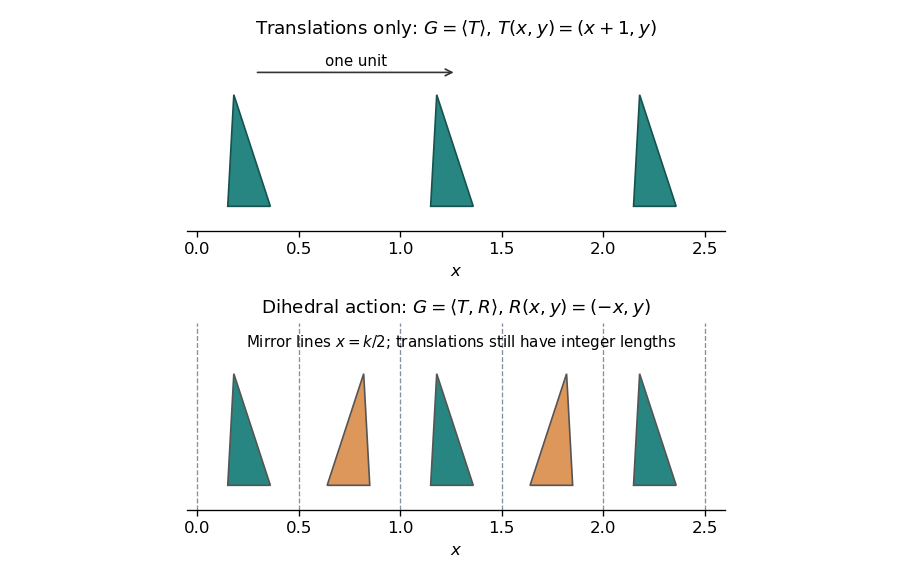
Two examples with are the group generated by alone, and the infinite dihedral group generated by together with . The latter has ; its elements are translations and reflections , whose mirror lines are . The first group preserves the orientation of every translated motif; the second also reverses it across these mirrors.
Past exam of the mathematics course of the University of Cambridge 2005 ii Paper 1 38A b Created 2026-09-24 Updated 2026-09-24
Past exam of the mathematics course of the University of Cambridge 2005 ii Paper 1 38A a Created 2026-09-24 Updated 2026-09-24
Past exam of the mathematics course of the University of Cambridge 2005 ii Paper 1 37E Solution Created 2026-09-24 Updated 2026-10-14
The isotropic elastic displacement equation is . With , its dilational and shear potentials satisfyFor the specified two-dimensional potential, , .
Choose a real wave number and put . Decay into requires the combinationswith . Real parts give the physical fields. Then and , times the common propagating factor. The free surface requires and . At zero these becomeA nonzero pair exists precisely whenFor such a root, one can choose and , providing the requested wave explicitly. Squaring and excluding the static zero root gives the equivalent Rayleigh polynomialThe physical positive root is unique as allowed in the question. All factors of cancel in the speed equation, so the Rayleigh surface wave is nondispersive, with determined only by the material constants. The potentials decay exponentially over depths of order .
Past exam of the mathematics course of the University of Cambridge 2005 ii Paper 1 36E ii Created 2026-09-24 Updated 2026-10-14
Past exam of the mathematics course of the University of Cambridge 2005 ii Paper 1 35C Solution Created 2026-09-24 Updated 2026-10-14
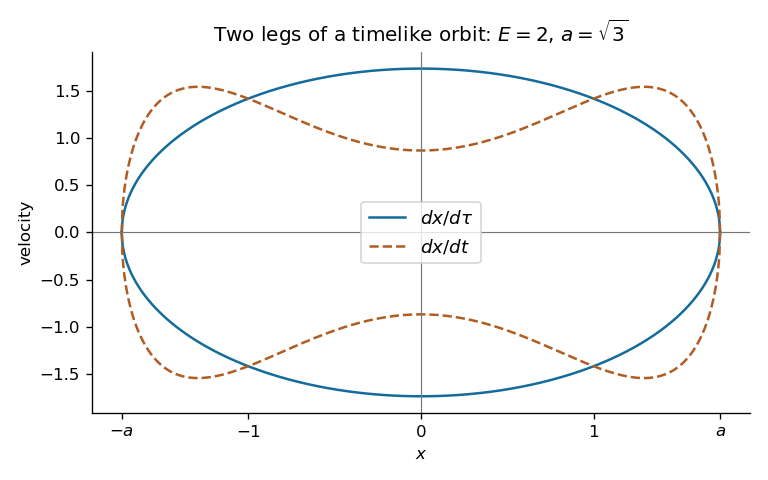
Stationarity gives the conserved Killing energy per unit rest mass , where dots here denote proper-time derivatives. It measures energy relative to the time-translation Killing field; a static local observer measures . Timelike normalization isEliminating and setting givesThus, on each increasing/decreasing leg respectively, and . The printed positive differentials describe the increasing leg, not both legs at once. Differentiation along a leg gives , extending smoothly through the turning points. Hence and the proper-time period is .
The requested velocity sketches are the branches and . They share the turning points and opposite signs on the two legs; their speed ratio is , smaller than one near zero and larger than one near the endpoints. The supplied integral is the coordinate time from to , equal to . The return leg takes the same time, so the coordinate-time period is also .


For the perturbed metric the same Killing conservation gives , and normalization becomes . Since ,Both weights without are even in . Oddness of makes its integral over the symmetric excursion vanish. Each increasing leg therefore still takes in either clock; the decreasing leg takes the same integrals with reversed orientation. Both periods remain exactly , although the proper-time waveform is no longer generally sinusoidal. This is the odd radial perturbations preserve timelike-geodesic periods mechanism. Smoothness of the metric and positivity of ensure regular turning and monotone coordinate time.
Past exam of the mathematics course of the University of Cambridge 2005 ii Paper 1 34B Solution Created 2026-09-24 Updated 2026-10-14
Lowering indices with the stated metric reverses the sign of each time-space component and leaves each space-space component unchanged. Contracting the two antisymmetric tensors, counting each unordered index pair twice, givesThese are independent Lorentz scalars; their signs follow from the explicit dual convention in the PDF.
Put and . In the parallel-field frame, invariance gives and . The positive product forces the two vectors to have the same orientation, so the use of positive magnitudes is legitimate. Substitution of gives . Its positive solution is . With ,The denominator is positive for every real . The other quadratic root is negative and cannot be a squared magnitude. No explicit boost transformation is needed because the two invariants determine the magnitudes uniquely in a frame where the fields are parallel.
Past exam of the mathematics course of the University of Cambridge 2005 ii Paper 1 33B Solution Created 2026-09-24 Updated 2026-10-20
The differential scattering cross-section is scattered rate per unit solid angle divided by incident flux. For the outgoing scattering solution, the incident plane wave has current magnitude , while the outgoing spherical wave has radial current . ThereforeThe incoming plane-wave normalization and outgoing radiation condition select the physical scattering state.
The time-independent Schrödinger equation is , equivalently . The given outgoing Helmholtz fundamental solution has source . Multiplying it by the source and adding the incident homogeneous solution givesApplying verifies its equation and sign. At large , and over the potential's support. ConsequentlyThe Born approximation replaces by the incident wave, givingIt requires weak wave distortion. A sufficient smallness condition from the integral equation is ; for a bounded potential of range this is of order . At high energy a small accumulated phase and weak deflection can also justify the approximation, but small potential relative to energy alone is not sufficient for an arbitrarily long interaction range.
For the exponentially screened potential, angular integration in its Fourier transform givesIt is not compactly supported, but for its decay gives the same scattering asymptotics and convergent integrals. Since ,Thus the Born amplitude in this limit is independent of when expressed using and angle; its squared magnitude is the Rutherford cross-section. This is a fixed-nonzero-angle limit of the Born formula. It does not establish uniform validity in the forward direction or preserve the short-range outgoing-wave asymptotics for the unscreened Coulomb potential.
Past exam of the mathematics course of the University of Cambridge 2005 ii Paper 1 32D Solution Created 2026-09-24 Updated 2026-10-14
The commutator gives . Hence and . Starting with the normalized vacuum, repeated application gives , proving unit norm. The number operator then has eigenvalue , soDifferent levels are orthogonal because the Hamiltonian is self-adjoint and their eigenvalues are distinct.
For the perturbation, the ground-state diagonal matrix element is zero, while . The nondegenerate second-order perturbation formula consequently givesFor , . The lower and upper intermediate levels contribute respectively and , giving to second order.
For the exact completion of the square isThe shifted operators , have the same commutator and are unitarily related to the original ones by a displacement operator. Their vacuum is the coherent state with amplitude . Therefore every exact level shifts by .
The stability of monomial ladder-operator perturbations gives a necessary qualification to the request for a lowest level for every . For and real nonzero , a coherent state of amplitude has energy expectation . Choose the phase so the last term is negative. As the expectation tends to minus infinity, so the perturbed Hamiltonian has no true ground state. The displayed second-order answer is then the formal perturbative coefficient of the branch from the unperturbed vacuum, not an exact lowest eigenvalue. For stability requires ; for the completed-square Hamiltonian is bounded below for every real .
Past exam of the mathematics course of the University of Cambridge 2005 ii Paper 1 31D c Created 2026-09-24 Updated 2026-09-24
Past exam of the mathematics course of the University of Cambridge 2005 ii Paper 1 31D b Created 2026-09-24 Updated 2026-09-24
Past exam of the mathematics course of the University of Cambridge 2005 ii Paper 1 31D a Created 2026-09-24 Updated 2026-09-24
Past exam of the mathematics course of the University of Cambridge 2005 ii Paper 1 30A Solution Created 2026-09-24 Updated 2026-10-14
An asymptotic power series about means that for every fixed ,as through the specified domain. It makes no assertion that the infinite series converges at nonzero . If a power series converges in a neighbourhood, choose a smaller fixed convergence radius : absolute convergence bounds its tail after by for . Thus a convergent power series is also asymptotic. The coefficients are unique, successively recovered byIf two expansions first differed at index , division of their difference by would contradict this limit.
For the given integral, use the exact finite identity . The gamma integral givesConsequentlyFor the denominator is at least one, soThe empty product for is one. The bound is exactly the magnitude of the next omitted term. For the asymptotic definition through degree , take , giving an remainder. Only a finite expansion was integrated; interchanging a divergent infinite series with the integral would be invalid. Indeed the ratio of consecutive term magnitudes is , so this formal series diverges at every fixed .
Past exam of the mathematics course of the University of Cambridge 2005 ii Paper 1 2F Solution Created 2026-09-24 Updated 2026-10-14
The hyperbolic cosine has the absolutely convergent expansion . Suppose its value were a rational , with . For sufficiently large , . Multiplying by makes the assumed value an integer, and every term of the partial sum through is also an integer. Their difference is the positive remainderLet . Every new pair of factorial factors is at least , so for . No integer lies strictly between zero and one. This contradiction proves is irrational. The argument uses a finite integer partial sum and a controlled tail; it does not infer irrationality merely from an infinite expansion.
Past exam of the mathematics course of the University of Cambridge 2005 ii Paper 1 29C Solution Created 2026-09-24 Updated 2026-10-14
For a regular defining function , the hypersurface is non-characteristic when the characteristic vector has nonzero normal component:For this is precisely . The defining function must also have nonzero gradient so that it actually defines a hypersurface.
The method of characteristics gives , , , . Starting at , the first two coordinates rotate clockwise through characteristic time and . Solving back for the initial point givesIt meets the data and is when is .
For the rotationally invariant data, . As it tends to zero for fixed , diverges to positive infinity for fixed and nonzero radius, and retains the initial value on . It is identically zero on the vertical axis. There is no regular limit across the initial plane. At that plane is characteristic and the data would need to satisfy ; the chosen radial data violate this except at the origin, explaining the singular limit.
Past exam of the mathematics course of the University of Cambridge 2005 ii Paper 1 28J Solution Created 2026-09-24 Updated 2026-10-14
The reservation bid price for a claim is the fixed cash payment which leaves the agent indifferent: . For Gaussian wealth , exponential utility is , so its certainty equivalent is . For , subtracting the original certainty equivalent givesThe marginal price is positive when the claim hedges the agent's endowment, negative when it adds positively correlated risk, and zero for an uncorrelated zero-mean infinitesimal position.
Assume , so the claim is nontrivial. Buying units at per-unit price changes the certainty equivalent by . This strictly concave quadratic is maximized at . Market clearing givesAt the optimum the certainty-equivalent gain isThe maximal expected utility equals the original negative utility multiplied by , hence is improved. Paying a fixed amount removes exactly that gain, proving it is the fixed-payment value of market access. If , the Gaussian claim vanishes almost surely, all its covariances vanish, and the appropriate price and access value are zero; the printed formulas with a variance denominator require the nontrivial-claim assumption.
Past exam of the mathematics course of the University of Cambridge 2005 ii Paper 1 27I Solution Created 2026-09-24 Updated 2026-10-14
Wilks theorem states that, under an interior null parameter and the usual identifiability, smoothness and nonsingular-information regularity conditions, for nested models converges under the null to a chi-square distribution with degrees of freedom equal to the difference of parameter dimensions. Boundary or nonidentifiable nulls need not have this distribution.
Write , and . The unrestricted maximum-likelihood estimates are and . Under the null the variance estimate is . Substituting both maxima into the Gaussian likelihood givesThis is for , with positive true variance; almost surely. The lost parameter dimension is one, even though variance is estimated in both models.
The two-sided Student t-test uses , where , and rejects when . Under the null has exactly the Student t-distribution with degrees of freedom. The likelihood-ratio statistic isunder the null, so its chi-square approximation agrees asymptotically with the squared asymptotic standard-normal t statistic. In fact the expression is strictly increasing in : with exact finite-sample calibration the tests have identical rejection regions for every , not just approximately for large samples.
Past exam of the mathematics course of the University of Cambridge 2005 ii Paper 1 26I b Created 2026-09-24 Updated 2026-09-24
Past exam of the mathematics course of the University of Cambridge 2005 ii Paper 1 26I a Created 2026-09-24 Updated 2026-09-24
There are unlisted articles, also show them or only show them.