
Past exam of the mathematics course of the University of Cambridge 2005 ib Paper 3 20D c Created 2026-09-24 Updated 2026-09-24
Past exam of the mathematics course of the University of Cambridge 2005 ib Paper 3 20D b Created 2026-09-24 Updated 2026-09-24
Past exam of the mathematics course of the University of Cambridge 2005 ib Paper 3 20D a Created 2026-09-24 Updated 2026-09-24
Past exam of the mathematics course of the University of Cambridge 2005 ib Paper 3 1C Solution Created 2026-09-24 Updated 2026-10-14
The conjugate group elements relation is when for some . It is reflexive by taking the identity, symmetric because , and transitive because and imply . Hence it is an equivalence relation.
For a finite group, the centralizer is a subgroup. The map has equal values at exactly when . Its fibers are therefore the left cosets of , givingBy Lagrange's theorem, this index divides . This is also the orbit-stabilizer theorem for the conjugation action, with the centralizer as stabilizer.
Past exam of the mathematics course of the University of Cambridge 2005 ib Paper 3 19F Solution Created 2026-09-24 Updated 2026-10-14
Split with , the negative unit subdiagonal and the positive unit superdiagonal. The Jacobi method uses , soThe Gauss-Seidel method uses , giving by forward substitutionBoth iterations converge for every initial error exactly when their spectral radius is below one, since the error evolves as powers of the iteration matrix.
For Jacobi, the leading tridiagonal determinant recurrence is , with . ThusIts roots are and . Expanding the Gauss-Seidel determinant givesso its nonzero eigenvalues are . ThereforeThe skew-tridiagonal Jacobi and Gauss-Seidel iterations consequently have the same convergence range:Equality fails the every-start convergence condition, and larger magnitudes have unstable modes. The nonsymmetric matrix does not permit an unexamined positive-definite-matrix convergence argument.
Past exam of the mathematics course of the University of Cambridge 2005 ib Paper 3 18E Solution Created 2026-09-24 Updated 2026-10-14
Differentiate the velocity potential in polar coordinates:At the normal velocity is zero. At large radius these components tend to , the polar components of uniform flow in the positive direction. The circulation around any concentric circle is . Although the potential's circulation term is multivalued, its velocity is single-valued and irrotational away from the excluded axis.
For steady inviscid constant-density flow, Bernoulli equation gives . On the cylinder, , soIn the displayed force integral, every constant or term has zero cosine and sine first moments. The cross term in pressure is . Therefore, using exactly the positive-sign convention printed,per unit axial length, since .
With the usual normal directed outward from the cylinder into the fluid, pressure exerts traction , so the physical force of the fluid on the cylinder is instead . The positive integral printed in the question has the opposite sign. This makes the convention explicit and is consistent with the Kutta–Joukowski theorem for positive counterclockwise circulation.
Past exam of the mathematics course of the University of Cambridge 2005 ib Paper 3 17H Solution Created 2026-09-24 Updated 2026-10-14
In vacuum without sources, Maxwell equations are , , and . For , , both divergences remain zero, andThis proves the quarter-turn electromagnetic duality transformation.
A perfect conductor has zero electric field in its bulk. Continuity of tangential electric field therefore gives at its surface. Faraday's law makes a nonzero-frequency magnetic field vanish in that bulk, and continuity of its normal component gives for the wave field. An independently trapped static magnetic flux is not excluded by perfect conductivity alone; the stated condition applies to the oscillating field under consideration.
For amplitudes with dependence , let and suppose . With and , define the transverse-magnetic family of scalar-potential conducting waveguide modes byThe electric divergence is ; the magnetic divergence is zero because the transverse field is a rotated gradient. Direct differentiation gives and , where longitudinal differentiation means multiplication by . Thus all vacuum equations hold, with .
On a wall parallel to , makes both and the boundary-tangential derivative of vanish. It also makes proportional to that tangential derivative, hence zero. This proves the Dirichlet boundary condition supplies both conductor conditions.
For a transverse-electric family, use duality and rescale the potential, or check directly thatsatisfies the same equations. If is the cross-sectional wall tangent, then and . Consequently , a Neumann boundary condition, supplies both wall conditions. Duality exchanges the field constructions, but does not preserve electric-conductor boundary conditions without this new boundary test.
Past exam of the mathematics course of the University of Cambridge 2005 ib Paper 3 16G Solution Created 2026-09-24 Updated 2026-10-14
For an axisymmetric potential, insert into the time-independent Schrödinger equation and divide by . The polar Laplacian separates the angular equation fromSingle-valuedness under gives , with an angular eigenbasis . Linear combinations of the degenerate modes are also possible.
Inside the circular infinite quantum well, put . The equation becomesThe physical solution must be regular at the origin, behaving as for , or with finite value and zero radial derivative for . At the infinite wall impose . The printed question's boundary phrase uses capital ; it means the radial position , not a value imposed on the radial wavefunction. The singular Bessel function of the second kind is excluded; mere square-integrability of its logarithmic singularity would not put it in the ordinary finite-energy Hamiltonian domain.
For , multiply the equation by and insert . The coefficient of gives , and subsequent coefficients giveAll odd coefficients vanish, , and . The regular solution is a multiple of the Bessel function of the first kind . Its requested fourth-order estimate isTherefore the first positive zero of this truncation is , givingThe ground state is in the sector because nonzero angular modes add nonnegative centrifugal kinetic energy to the radial energy form. This quartic truncation of the Bessel function J0 is only a rough local-series estimate, not an exact eigenvalue or a certified variational bound; its double zero warns that the truncation does not reproduce the simple zero of the full function.
Past exam of the mathematics course of the University of Cambridge 2005 ib Paper 3 15H Solution Created 2026-09-24 Updated 2026-10-14
Write at the ordinary point zero. Substituting into the Legendre differential equation and comparing coefficients givesThe two arbitrary coefficients generate the even and odd series separately, convergent at least for . A nonzero polynomial of degree has top coefficient satisfying , so is necessary. For this value the recurrence in parity terminates at degree , while the other parity cannot terminate unless its initial coefficient is zero. Thus a polynomial solution exists and is unique up to scale, with .
For Orthogonality of Legendre polynomials, write the equation in self-adjoint form . Multiply it by , subtract the equation for multiplied by , and integrate. The boundary term is , because the functions are polynomials. For the eigenvalues differ, giving . For , the integral of the square is positive. Hence with .
Let . The supplied operator means , which equals . Expand in the given identity and use the Legendre equation. Each coefficient satisfieswhose solutions are . Regularity at removes . At , normalization and give , so . ThusA rigorous justification for the expansion and operations is to begin with the Taylor series of in . It converges uniformly for , . Its coefficient is a degree- polynomial in , and the differential identity makes that coefficient solve the degree- Legendre equation. Its value at one is one, so it is exactly . This avoids assuming an unjustified endpoint convergence of an arbitrary orthogonal expansion.
Square the generating series and integrate, using uniform convergence and orthogonality:Comparing coefficients proves the generating function and norm of Legendre polynomials result
Past exam of the mathematics course of the University of Cambridge 2005 ib Paper 3 14A Solution Created 2026-09-24 Updated 2026-10-14
For a function holomorphic on and inside a positively oriented simple closed contour , the Cauchy integral formula givesIf an entire function is bounded by , apply the derivative formula on a radius- circle about any to obtain . Letting makes every derivative zero, so is constant. This proves Liouville theorem directly.
For the given meromorphic function, the growth bound excludes poles outside the bounding disc. Its poles inside are finite in number, since poles cannot accumulate at a finite point of a meromorphic function. Subtract all their finite principal parts:The remainder is entire. The rational sum is at infinity. If , this makes ; the Cauchy estimates at zero give for , hence these derivatives vanish. Its Taylor series is a polynomial of degree at most . If , then at infinity, so it is bounded and equals zero by Liouville. In both cases, adding back the principal parts provesThis proof of polynomial growth forces a meromorphic function to be rational includes negative integers , not only the polynomial-growth case .
Past exam of the mathematics course of the University of Cambridge 2005 ib Paper 3 13B Solution Created 2026-09-24 Updated 2026-10-14
For a homogeneous function, fix and differentiate at . The chain rule givesConversely, assume this derivative identity throughout . Along a positive ray define . The ray stays in by hypothesis, and linearity of the derivative givesTherefore is constant on the connected interval and equals . Hence for every positive . This proves Euler differential identity characterizes homogeneity; no connectedness assumption on the whole domain is needed.
Past exam of the mathematics course of the University of Cambridge 2005 ib Paper 3 12A Solution Created 2026-09-24 Updated 2026-10-14
Project from the north pole along the line through a sphere point onto the equatorial plane , identified with . Parameterizing this line givesThe inverse stereographic projection isNegating the three sphere coordinates consequently sends to , with interchanged. This proves the antipodal stereographic coordinate relation.
A nonidentity Möbius transformation has . For , its fixed points are the roots of , giving one or two distinct points. If and , there is one finite root and the fixed point infinity. If , , and , it is a translation and only infinity is fixed. The remaining case is the identity, already excluded. Thus the claim includes fixed points at infinity, not just finite solutions of the quadratic.
A nontrivial rotation of the sphere fixes exactly the two poles on its axis, which are antipodal. It therefore gives exactly two fixed stereographic points with . Here the nonzero rotation angle is understood modulo ; an angle that is a whole multiple of would be the identity.
Conversely, use a sphere rotation whose Möbius map sends the two antipodal fixed points to . The conjugate fixes both, hence equals for some . If , write ; the inverse stereographic formula shows that this rotates while leaving fixed. Conjugating back by the rotation gives a sphere rotation. If , for every finite . If , for every , in the sphere topology. Pulling these conclusions back proves the antipodal fixed-point classification of Möbius transformations: either the map is a sphere rotation or one fixed point attracts every point except the other fixed point.
Past exam of the mathematics course of the University of Cambridge 2005 ib Paper 3 11C ii Created 2026-09-24 Updated 2026-09-24
Past exam of the mathematics course of the University of Cambridge 2005 ib Paper 3 11C i Created 2026-09-24 Updated 2026-09-24
Past exam of the mathematics course of the University of Cambridge 2005 ib Paper 3 10B Solution Created 2026-09-24 Updated 2026-10-14
On the smooth-function space, the product rule gives while . Hence , and both maps preserve the stated smooth space.
For general operators with this commutator relation, use . Induction gives for . Since ,Every displayed vector lies in , so is invariant under , as well as under . Iterating the lowering formula gives for , and zero for .
Suppose a nontrivial finite linear dependence has highest nonzero term . Applying kills all lower terms and yields . The field is real, , and , so this contradicts . Thus the entire sequence is linearly independent. This identity commutator cyclic ladder also proves that such a representation with a nonzero vector in the kernel of cannot be finite dimensional.
Past exam of the mathematics course of the University of Cambridge 2005 ib Paper 2 9D Solution Created 2026-09-24 Updated 2026-10-14
In a finite two-person zero-sum game the row player chooses , the column player chooses , and the row player receives while the column player receives . The row player maximizes that payoff and the column player minimizes it. Mixed strategies are probability vectors and , giving expected row payoff .
Against a fixed row mixture, the worst column is a pure column, so the row problem introduces its guaranteed payoff :Similarly the column player minimizes an upper guarantee :The values are unrestricted real variables; no positivity shift of the matrix is required.
To see the linear programming duality explicitly, introduce nonnegative multipliers for the first problem's payoff inequalities and multiplier for its normalization. Its upper-bound Lagrangian isThe supremum over free and nonnegative is finite precisely when and , and is then . Minimizing it gives the displayed column problem, proving that the programs are a dual pair.
A sufficient optimality certificate is a pair of probability vectors and a common value satisfyingEquivalently, both programs are feasible with equal values. Positive-probability rows then have and positive-probability columns have , the complementary slackness conditions. These conditions certify a saddle point and hence optimal mixed strategies for both players.
Past exam of the mathematics course of the University of Cambridge 2005 ib Paper 2 8E Solution Created 2026-09-24 Updated 2026-10-14
The intended dynamical assumption is steady inviscid Euler flow of constant density, with conservative body-force potential . Its equation is . The vector identitythen givesWith no body force take . Taking the scalar product with yields , so the Bernoulli function is constant along streamlines, though not necessarily the same constant on different streamlines.
Choose the planar streamfunction convention . Then with , andIf locally , comparison with giveson the nonstagnant part of that flow. It extends to isolated stagnation points by continuity. Where the streamfunction is constant on an entire open region, cancellation of its zero gradient alone imposes no derivative condition on an arbitrarily extended .
Steadiness and incompressibility alone, without the inviscid dynamical assumption, do not imply the stated identity. In a steady Newtonian viscous flow the correct form has . For example, a pressure-driven planar Poiseuille flow has a nonzero streamwise pressure gradient balanced by viscosity, while has no streamwise component. This identifies the required qualification of the printed premise.
Past exam of the mathematics course of the University of Cambridge 2005 ib Paper 2 7G Solution Created 2026-09-24 Updated 2026-10-14
Set , and . In Alice's inertial coordinates the departure, turn and return events are , and . Alice's worldline is vertical; Bob's consists of two straight timelike segments of slopes , joined by the short turnaround. Equal speeds and the same endpoints give equal coordinate durations on the two legs.
The Minkowski proper-time element for Bob is , while Alice at rest has . Integrating on both legs givesAcceleration itself need not cause a large direct change in the clock rate. Its role is to make Bob change inertial frames and reunite with Alice, so the two worldlines have different proper lengths between the same events.
To describe Bob's assignment of Alice's age, apply relativity of simultaneity to lines of equal coordinate time in his instantaneous inertial frames. At the turn the outbound line is ; it intersects Alice at . The inbound line is and intersects her at . Thus the negligibly short change of rest frame advances Bob's assigned Alice age by . On each inertial leg he assigns Alice an aging rate per unit of his own proper time, but the frame dependence expressed by relativity of simultaneity removes the apparent symmetric-time-dilation paradox.
If “sees” means clocks read from received light, there is no instantaneous jump in Alice's displayed age. A light signal received at Bob's event was emitted from Alice at . On the outbound leg ; on the inbound leg . Consequently the observed aging rates per Bob proper time areHe receives slowly running, redshifted clock signals on the outward leg and rapidly running, blueshifted signals on the return. Integrating both rates over the equal proper durations gives total received Alice aging , with the two expressions continuous at the turn.
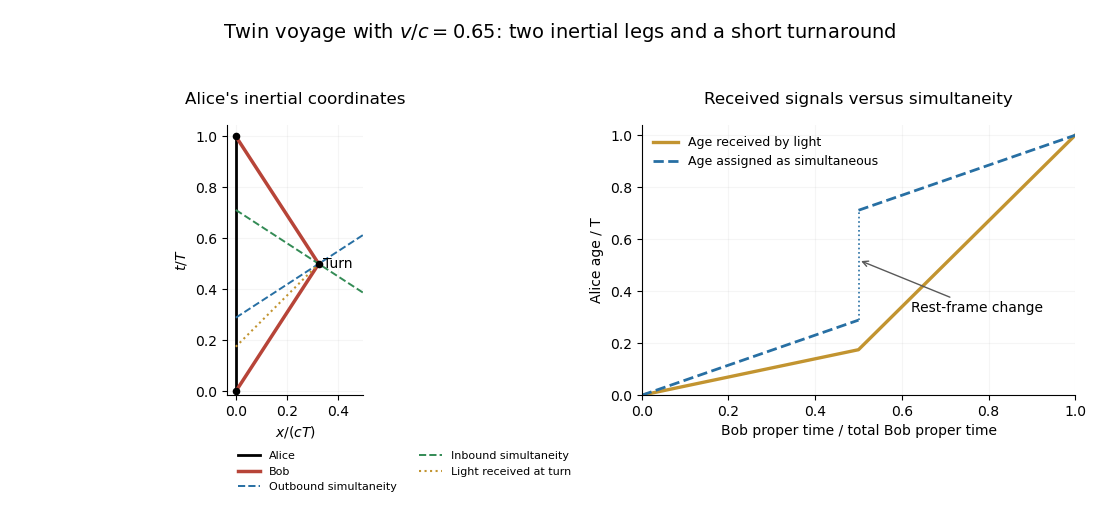
Twin voyage: inertial worldlines, turnaround simultaneity lines, and Alice ages assigned or optically received by Bob
. Details. 
The diagram distinguishes the reassignment due to relativity of simultaneity from the continuous optical observation; both descriptions give the same ages when the twins meet again.
Past exam of the mathematics course of the University of Cambridge 2005 ib Paper 2 6H Solution Created 2026-09-24 Updated 2026-10-14
In SI units, the sourced Maxwell equations areTake the divergence of the last equation. The divergence of a curl vanishes; using the first equation gives the necessary local conservation lawFor sources supported in a fixed region, integrate over a containing surface where the current vanishes. The divergence theorem givesThus the total charge is constant. For each component of the electric dipole moment, integration by parts givesThe surface term again vanishes, soSmooth compact support suffices for these manipulations; equivalently one may integrate the charge continuity equation over all space and use the fixed support to identify the integrals with those over .
Past exam of the mathematics course of the University of Cambridge 2005 ib Paper 2 5E Solution Created 2026-09-24 Updated 2026-10-14
Use the causal Green function: it vanishes before the forcing time . For it solves the homogeneous equation, is continuous at with value zero, and has first-derivative jump one. These conditions giveIndeed the right derivative at the forcing time is one and the left derivative is zero, so distributionally. If , use the continuous limit on its causal support.
There are unlisted articles, also show them or only show them.