
Past exam of the mathematics course of the University of Cambridge 2005 ii Paper 1 25J Solution Created 2026-09-24 Updated 2026-10-14
A pi-system is a collection closed under finite intersections. The uniqueness theorem says that two probability measures agreeing on a generating pi-system agree on its generated sigma-field. For finite measures one also fixes the total mass; for a sigma-finite version one requires a covering sequence from the pi-system with finite common masses. Adding the whole space to a pi-system of events causes no change to its generated sigma-field and preserves the stated independence condition.
Fix . On the finite measures and agree on and on the whole space. Uniqueness makes them agree for every . Now fix such an . On the measures and agree on and the whole space; a second application of uniqueness provesThus the two generated sigma-fields are independent. The extension is done one argument at a time, not by assuming the required independence for arbitrary unions.
For the independent random variables, let be the rectangles and let be the analogous rectangles in the . Both are pi-systems. Joint independence of the full list factors each combined rectangular probability into the product of the individual probabilities, hence into . Their generated sigma-fields are exactly and . The proved result therefore gives independence of the two vector-generated sigma-fields.
Past exam of the mathematics course of the University of Cambridge 2005 ii Paper 1 24H iii Created 2026-09-24 Updated 2026-09-24
Past exam of the mathematics course of the University of Cambridge 2005 ii Paper 1 24H ii Created 2026-09-24 Updated 2026-09-24
Past exam of the mathematics course of the University of Cambridge 2005 ii Paper 1 24H i Created 2026-09-24 Updated 2026-09-24
Past exam of the mathematics course of the University of Cambridge 2005 ii Paper 1 23H Solution Created 2026-09-24 Updated 2026-10-14
The local estimate gives at zero and, by periodicity, at every lattice point. If two candidates existed, their difference would extend to an entire doubly periodic function: the principal parts cancel at every possible pole. It is bounded on a fundamental parallelogram, hence on the plane, so Liouville theorem makes it constant. The local difference tends to zero, making the constant zero. Thus the function is unique.
The function has the same periodicity, poles and local estimate. Uniqueness therefore proves . Its Laurent expansion is consequentlywith no constant term by the given estimate. Periodicity and evenness imply , so . The elliptic zero-pole counting theorem says a nonconstant elliptic function has, in one period cell, equally many zeros and poles counted with multiplicity. Applied to , whose total pole order is two, it gives precisely two zeros counted with multiplicity. The zero at already has multiplicity at least two. It therefore has exactly two, provingFinally is periodic, and the Laurent expansion shows cancellation of all possible pole terms: and . The difference extends to an entire bounded function and is constant. HenceEvery property of the Weierstrass elliptic function used here has been obtained from the stated local and periodic properties, together with the explicitly stated standard elliptic-function counting theorem.
Past exam of the mathematics course of the University of Cambridge 2005 ii Paper 1 22F Solution Created 2026-09-24 Updated 2026-10-14
In the supremum-norm metric, is totally bounded if for every finitely many norm balls of radius cover it. It is uniformly bounded if some satisfies for all . It is equicontinuous if for each and there is a neighbourhood of with for all . This definition works for compact Hausdorff without assuming it is metrizable.
Suppose is totally bounded. A finite radius-one net makes uniformly bounded by one plus the largest norm of a net centre. For equicontinuity, choose a finite net. Continuity of each centre gives a common neighbourhood of on which all centre values vary by less than . Approximating any by its centre and using the triangle inequality at and bounds its variation by . Thus both conditions follow.
Conversely suppose those two conditions hold. For each , choose a neighbourhood on which every function varies from its value at by less than . Compactness provides a finite cover . The vectors form a bounded subset of , so partition their possible values into finitely many boxes of diameter less than in the maximum-coordinate norm. From each occupied box choose one function as a representative. If and its representative have sample values in the same box, and , thenThese finitely many representatives are a norm net, proving total boundedness is equivalent to uniform boundedness and equicontinuity. This supplies the finite-net part of the Arzelà-Ascoli theorem directly.
For a bounded set that is not totally bounded, take the standard unit vectors in the Banach space . Their norms are one and their pairwise distances are . A ball of radius less than contains at most one of them, so finitely many such balls cannot cover .
Past exam of the mathematics course of the University of Cambridge 2005 ii Paper 1 21H ii Created 2026-09-24 Updated 2026-09-24
Past exam of the mathematics course of the University of Cambridge 2005 ii Paper 1 21H i Created 2026-09-24 Updated 2026-09-24
Past exam of the mathematics course of the University of Cambridge 2005 ii Paper 1 20G Solution Created 2026-09-24 Updated 2026-10-14
The three quadratic subfields are , and . Their integer rings are respectively , and , since their squarefree radicands are modulo four. Write . Relative traces to these three fields are , and . Traces of algebraic integers are integral, so all four doubled coefficients are integers. ThusThe PDF names the wrong quadratic subfield for its next displayed norm coefficients. They are obtained from , not . The relevant conjugation changes the sign of , givingIts membership in proves the requested divisibilities. For comparison, the norm to the printed subfield is , a different expression.
The first divisibility modulo two makes have the same parity. The second makes even, so they cannot both be odd: and are even. Substituting this into the first divisibility modulo four shows is even, hence . Therefore every algebraic integer is an integer linear combination ofIndeed the last two half-coefficients are . These four elements are rationally independent. They are all integral: for , , and consequentlyis a monic polynomial with integer coefficients. Their integer span consists of algebraic integers and contains every algebraic integer by the preceding argument, proving the integral basis of a two-prime biquadratic field. This repairs the subfield typo without changing the claimed basis.
Past exam of the mathematics course of the University of Cambridge 2005 ii Paper 1 1H Solution Created 2026-09-24 Updated 2026-10-14
For an odd prime , the Legendre symbol is zero if , one if is a nonzero square modulo , and minus one otherwise. By Gauss lemma, , where counts those least positive residues of which exceed . They correspond to integers among , henceFor , its parity is respectively , the same as that of . ThereforeUse multiplicativity and quadratic reciprocity for the requested composite numerator. Since ,The first reciprocity sign is negative because both primes are ; the subsequent signs are positive because one prime is . Thus .
Past exam of the mathematics course of the University of Cambridge 2005 ii Paper 1 19G iii Created 2026-09-24 Updated 2026-09-24
Past exam of the mathematics course of the University of Cambridge 2005 ii Paper 1 19G ii Created 2026-09-24 Updated 2026-09-24
Past exam of the mathematics course of the University of Cambridge 2005 ii Paper 1 19G i Created 2026-09-24 Updated 2026-09-24
Past exam of the mathematics course of the University of Cambridge 2005 ii Paper 1 18G Solution Created 2026-09-24 Updated 2026-10-14
An element of an extension is an algebraic element over when some nonzero polynomial in vanishes at . Let its monic minimal polynomial have degree . Polynomial division shows is spanned by , and minimality makes these vectors independent. The minimal polynomial is irreducible; for any nonzero , Bezout's identity between and that polynomial gives a polynomial representative for . Thus is a field, equals , and has degree .
Conversely, if has finite vector-space dimension , then are linearly dependent over , giving a nonzero annihilating polynomial. HenceAn algebraic extension is one in which every element is algebraic. Suppose and are algebraic, and take . A polynomial relation for over uses only finitely many coefficients . Each is algebraic over , so adjoining them successively gives a finite extension , by the proved criterion and the tower law. The same relation makes algebraic over , so is finite. Therefore is finite, and its subspace is finite-dimensional. The criterion makes algebraic over . Since was arbitrary, is algebraic.
Past exam of the mathematics course of the University of Cambridge 2005 ii Paper 1 17F Solution Created 2026-09-24 Updated 2026-10-14
For the first assertion, use the standard nonempty finite-graph convention. Choose a longest simple path in an acyclic graph. Its endpoint can have no neighbour outside the path, or the path could be extended; it can have no neighbour farther back than the adjacent path vertex, or there would be a cycle. Its degree is therefore at most one. The qualification matters for infinite graphs: a two-sided infinite path is acyclic and every vertex has degree two.
A finite tree with has a leaf by this argument and connectedness. Removing it and its one edge leaves a tree with vertices. Induction from the one-vertex tree proves a tree of order has edges. Conversely, a finite connected graph has a spanning tree: begin with one vertex and repeatedly add an edge to a new vertex until every vertex is reached. This creates no cycle and uses edges. If the original graph has exactly that many edges, it equals its spanning tree and is itself a tree.
To embed a tree of order , root it and list its vertices so every nonroot vertex follows its parent. Embed the root at any vertex of . When embedding a new vertex, at most neighbours of its parent's image are already used, while that image has degree at least . An unused neighbour exists and can be chosen. This constructs an injective edge-preserving copy of , soFor , the complete graph has minimum degree but too few vertices to contain . Thus the degree bound cannot be lowered in general. A subgraph copy need not be induced; extra edges in do not obstruct the construction.
Past exam of the mathematics course of the University of Cambridge 2005 ii Paper 1 16F Solution Created 2026-09-24 Updated 2026-10-14
Zorn lemma states that a nonempty partially ordered set in which every chain has an upper bound contains a maximal element. To prove it from the axiom of choice and Hartogs theorem, suppose no element were maximal. Fix a choice function on the nonempty subsets of the poset. Every chain then has a strict upper bound: choose an upper bound, and, since it is not maximal, choose an element strictly above it. Let be a Hartogs ordinal which cannot inject into the poset. By transfinite recursion for , choose a strict upper bound of all previously chosen , ; for the empty initial chain choose any element. The previous elements form a chain at every stage. The resulting strictly increasing sequence injects into the poset, contradicting Hartogs. Hence a maximal element exists. Choice is used in fixing the function selecting a strict upper bound at every successor and limit stage; Hartogs and transfinite recursion themselves do not supply those selections.
Apply Zorn lemma to the linearly independent subsets of over , ordered by inclusion. A chain's union is linearly independent because any finite linear relation is contained in one member of the chain. A maximal independent set must span , since otherwise one could append a vector outside its span. Thus is a rational-vector-space basis of .
It is infinite: a finite-dimensional rational vector space is countable, whereas is not. If its cardinal is , finite rational linear combinations show ; uncountability forces . A basis of is , where these expressions mean the vectors and . Its cardinal is , using the infinite-cardinal arithmetic available under choice. A bijection between the two bases extends uniquely by finite rational linear combinations to a linear bijection. ThereforeThis is an algebraic isomorphism, with no assertion of continuity or real-linearity.
Past exam of the mathematics course of the University of Cambridge 2005 ii Paper 1 15C ii Created 2026-09-24 Updated 2026-09-24
Past exam of the mathematics course of the University of Cambridge 2005 ii Paper 1 15C i Created 2026-09-24 Updated 2026-09-24
Past exam of the mathematics course of the University of Cambridge 2005 ii Paper 1 14B Solution Created 2026-09-24 Updated 2026-10-14
At a fixed point , and the first equation factors. The branches areThe three branches meet at , and the positive square-root branch meets the quadratic branch at . The Jacobian matrix at a general fixed point isOn , its trace is and determinant : the branch is attracting for and a saddle for or . On , the eigenvalues are and . The negative branch is always a saddle for ; the positive branch is a saddle for and attracting for . At the bifurcation values the zero eigenvalue requires the nonlinear analysis below.
For , , , the equations areThe extended centre manifold has with no linear terms. Since has degree at least three, its invariance equation to degree two is . ThusThe reduced quadratic factors as . Its two roots have reduced eigenvalues and , respectively, and the transverse eigenvalue remains negative. They exchange stability at , a transcritical bifurcation. The exact branches have and , consistent with this second-order evolution equation.
Near , the slow equation has leading form , so this is a subcritical pitchfork bifurcation with the parameter orientation displayed. For there is one nearby saddle, whose unstable direction is close to and stable direction close to vertical. For the central branch is attracting and the outer two equilibria near are saddles; their separatrices distinguish attraction toward the central equilibrium from departure outwards. The actual central location is , not exactly the origin away from .
Adding positive breaks the pitchfork symmetry. The leading equilibrium equation near zero is : the diagram unfolds into a single branch plus a saddle-node pair, with the latter appearing for positive of order . More precisely the fold is at , at leading order. Near one the reduced equation becomes . Its discriminant is ; the crossing is replaced by two saddle-node endpoints with a no-equilibrium gap for to leading order. Outside that gap, the lower reduced root is stable and the upper one unstable. These local approximations describe the sketch; the exact perturbed curves have higher-order corrections.
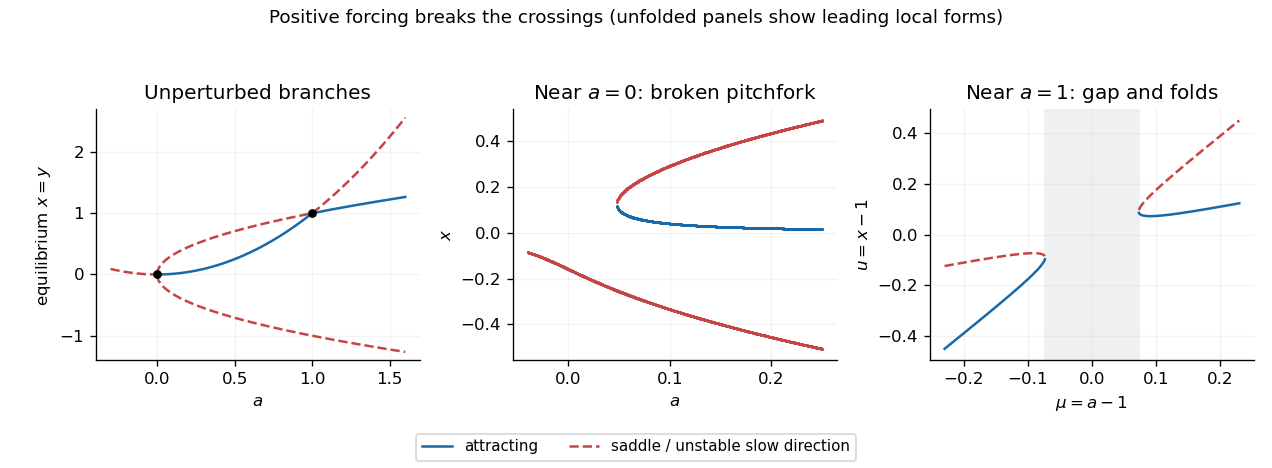
Fixed-point branches, local phase portraits and the positive-forcing unfoldings of the pitchfork and transcritical bifurcations
. Details. 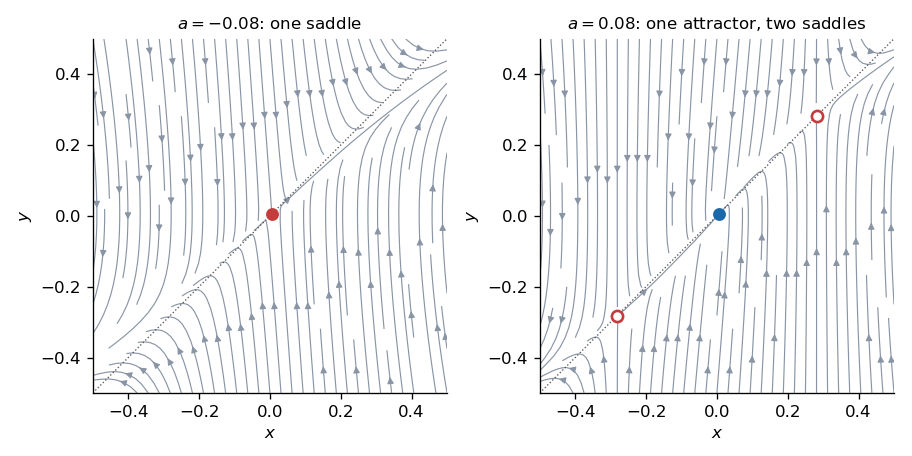


Past exam of the mathematics course of the University of Cambridge 2005 ii Paper 1 13I Solution Created 2026-09-24 Updated 2026-10-14
The data are read row by row into a vector of 84 prices. The first factor cycles through the six goods within each row; the second repeats each of the fourteen resort levels for six entries. Thus the linear regression fits one observation per resort-good cell, after taking natural logarithms. With treatment coding, its underlying statistical model isfor resorts and goods . This is an additive two-way analysis of variance on log prices, equivalently a multiplicative resort/goods model on the price scale, with no interaction. There are fitted parameters and .
In a balanced complete table, the fitted log price is the resort row mean plus the goods column mean minus the grand mean. Thus every resort coefficient is its row mean minus the Algarve row mean, and every goods coefficient is its column mean minus the meal column mean. The intercept is the fitted mean log price for a meal in Algarve, not necessarily the observed log price in that cell. Exponentiating coefficients gives price multipliers: the beer coefficient corresponds to approximately times the meal scale, and car hire to times that scale. Likewise the Sorrento resort effect gives a common factor relative to Algarve, if the no-interaction model is valid.
The standard errors are computed from with . Balance gives goods-contrast standard error and resort-contrast standard error . Each reported t statistic is its estimated coefficient divided by its standard error. Under the Gaussian model and the corresponding zero-coefficient null, it has a Student t-distribution with 65 degrees of freedom; the reported probabilities are two-sided tail probabilities. All goods contrasts are strongly significant, largely reflecting unlike goods and units of purchase. Among the resort contrasts, Costa del Sol, Majorca, Florida, Sorrento, Sicily and Madeira have unadjusted probabilities below . This is six separate comparisons with Algarve, not a simultaneous ranking guarantee or an omnibus test of all resorts. Multiple comparisons and model adequacy must be considered before declaring a universal cheapest resort.
The residual standard error measures variation on the log scale; is a typical multiplicative one-standard-deviation factor. Under the lognormal distribution, estimates the conditional median/geometric mean price, while the arithmetic mean has the additional factor . The reported means 96.2 percent of the observed log-price sum of squares around its overall mean is explained. It does not mean resorts alone explain that fraction, nor that 96.2 percent of variation on the original price scale is explained.
With only one observation per cell, unrestricted goods-by-resort interactions cannot be estimated separately from residual error. The model assumes comparable quoted items, approximately common log-error variance, independent errors and common resort multipliers across goods. Residuals can reveal failures, such as a particular resort having unusually costly taxis but ordinary prices for other goods. The intercept's test against zero concerns a fitted baseline geometric price of one pound; it is not an assessment of the overall model's validity.
There are unlisted articles, also show them or only show them.