
Past exam of the mathematics course of the University of Cambridge 2001 ia Paper 3 8D ii Created 2026-09-24 Updated 2026-09-24
Past exam of the mathematics course of the University of Cambridge 2001 ia Paper 3 8D i Created 2026-09-24 Updated 2026-09-24
Past exam of the mathematics course of the University of Cambridge 2001 ia Paper 3 7E Solution Created 2026-09-24 Updated 2026-10-14
Lagrange's theorem states that for a subgroup of a finite group , ; in particular divides . This follows by partitioning into cosets, each in bijection with .
If is prime, take any . Its cyclic subgroup has order dividing , but its order is not one. Thus it has order and equals . HenceThis describes a single group isomorphism type for each prime.
Now let have order , and let be any subgroup. Choose the least positive integer with ; this exists because , even when is trivial. Divide with . Since , minimality forces , so divides . Likewise, dividing an exponent for any shows . Therefore .
Past exam of the mathematics course of the University of Cambridge 2001 ia Paper 3 6E Solution Created 2026-09-24 Updated 2026-10-14
A left group action of on a set is a map satisfying and . The group orbit of is , and its stabilizer subgroup is . The stabilizer subgroup contains the identity, is closed under products, and contains whenever it contains , so it is indeed a subgroup.
The orbit-stabilizer theorem for a finite group saysTo prove it, map a left coset to . This is well-defined because every element of fixes . Conversely, precisely when , which is precisely equality of the two cosets. Thus this map is a bijection between the cosets and the group orbit. Each coset has elements, by the bijection , and the cosets partition , giving the formula.
Apply this to the rotational symmetry group of a cube acting on its six faces. The action is transitive: rotations through right angles about coordinate axes can send the top face to each of the other faces. A rotation fixing a face must fix its outward normal, so it rotates about the axis through that face's center and the opposite face's center. Preservation of its square boundary permits exactly four angles modulo : . All four preserve the cube, so this face stabilizer subgroup has order four. The group is finite because a rotation permutes the six face normals and is determined by their images. The orbit-stabilizer theorem givesThese are orientation-preserving rotations; reflections are not being counted.
Past exam of the mathematics course of the University of Cambridge 2001 ia Paper 3 5F Solution Created 2026-09-24 Updated 2026-10-14
An eigenvalue of is a scalar for which a nonzero vector satisfies . Equivalently, , because the homogeneous linear system has a nontrivial solution exactly when its coefficient matrix is singular. This characteristic polynomial is the monic quadraticA nonzero quadratic has at most two distinct roots, proving the eigenvalue bound. Eigenvalues and diagonalization are taken over , also for a matrix with real entries.
For the matrix commutator, the cyclic trace identity follows directly from its entries:Hence . Factoring the characteristic polynomial as and comparing the coefficient of gives , with the eigenvalues counted with algebraic multiplicity. If both eigenvalues are zero, trace and determinant are zero. The Cayley-Hamilton theorem then gives ; no diagonalizability assumption is needed.
Now put . Since its trace is zero, its characteristic polynomial is and the scalar square of a traceless two-by-two matrix identity givesThis proves the scalar-square assertion for both real and complex entries. If , it gives . If , the two eigenvalues are the distinct nonzero numbers . Their eigenvectors are linearly independent: a nonzero vector cannot satisfy two different eigenvalue equations. They form a basis, making a diagonalizable matrix. Thus either the commutator is diagonalizable over or its square is zero. These alternatives need not be disjoint, since the zero matrix has both properties. Over the diagonalization assertion would require real eigenvalues; complex diagonalization is essential to the unrestricted statement.
Past exam of the mathematics course of the University of Cambridge 2001 ia Paper 3 4A Solution Created 2026-09-24 Updated 2026-10-14
Consider the globally smooth potential . Direct differentiation givesThus the differential one-form is the exact differential , proving exactness rather than only checking a necessary condition on its partial derivatives. Along any piecewise differentiable path, the chain rule gives . The fundamental theorem of calculus therefore makes the line integral depend only on its endpoints:
Past exam of the mathematics course of the University of Cambridge 2001 ia Paper 3 3C Solution Created 2026-09-24 Updated 2026-10-14
For a differentiable scalar function and a differentiable curve, the multivariable chain rule isLet . Choose to be an invariant of the method of characteristics. Then , so and a convenient choice is . For , the chain rule gives . Thus, writing the unknown in the new coordinates,Integrating with fixed yieldswhere is an arbitrary differentiable function on the relevant interval. This gives all local solutions on each patch where the specified change of variables is invertible: its Jacobian determinant is .
The axes need care because is undefined at and the Jacobian vanishes at . Reparameterizing gives the simpler chart expressionIt is the general solution on either component or , including when is differentiable there. Indeed is a nonsingular coordinate chart for , and the weighted Euler first-order equation reduces to .
For a patch crossing with , the characteristic invariant instead gives , with an arbitrary differentiable function on each sign component of . These chart descriptions must agree on overlaps. On the axes the original equation gives and on their separate components; a solution defined smoothly through the origin must have and compatible smooth limits, in particular . No boundary data select a particular arbitrary function.
Past exam of the mathematics course of the University of Cambridge 2001 ia Paper 3 2D Solution Created 2026-09-24 Updated 2026-10-14
A Möbius transformation is with . On the Riemann sphere, a zero denominator represents infinity, and when ; when , infinity is fixed. The numerator and denominator cannot vanish together because .
The matrix acts on homogeneous coordinates , so composition satisfies . The product is invertible since , proving closure. Composition is associative because these are maps of the sphere. The identity is , andis again a Möbius transformation. Thus the transformations form a group. Nonzero scalar multiples of a matrix give the same transformation, but the identity and inverse assertions concern the transformations themselves.
Write , with , and . If , then and . If , division givesHence the Möbius translation-scaling-inversion factorization isThe scaling coefficient is nonzero. At the reciprocal sends the translated zero to infinity; at infinity it sends infinity to zero. Thus the factorization holds on the entire Riemann sphere, including both exceptional points, and proves the stated generating property.
Past exam of the mathematics course of the University of Cambridge 2001 ia Paper 3 1F Solution Created 2026-09-24 Updated 2026-10-14
Put and . Direct matrix multiplication gives the two-dimensional Cayley-Hamilton theorem identity . If , determinant multiplicativity gives , hence . The identity then says . If , its trace is zero; otherwise a nonzero entry forces . Thus and .
Conversely, those two scalar relations give , so the same Cayley-Hamilton theorem identity implies . ThereforeThis is the square-zero criterion for a two-by-two matrix. If , determinant multiplicativity first gives , hence . Now and . Either , or a nonzero entry gives and hence ; in both cases . The converse follows by multiplying by . Consequently . A nonzero nilpotent matrix of this size therefore has nilpotency index two.
Past exam of the mathematics course of the University of Cambridge 2001 ia Paper 3 12B Solution Created 2026-09-24 Updated 2026-10-14
Let be two sufficiently regular solutions with the same source and boundary data, and set . Then and . Green's first identity givesThe left side is nonnegative, so it vanishes. Thus is constant on each connected component. Its normal derivative is zero, and the boundary condition then forces that constant to be zero. This proves at most one solution. The Poisson uniqueness with a nonnegative Robin normal coefficient proof never divides by , so it includes the points or boundary portions where .
For the exponential-sine modes, direct differentiation givesTheir sum is zero, so both modes are harmonic functions for every real .
For the square, the horizontal Dirichlet data suggest separation of variables in the form , where the positive integer makes the sine vanish at both horizontal edges. The Laplace equation gives , hence . At , the outward normal points in the negative direction. The Robin boundary condition is therefore , or . The right edge requires , fixing the remaining coefficient. The resulting separated Laplace mode with a Robin edge isThe denominator is positive for . The function satisfies the Laplace equation and all four boundary conditions directly; for example its left-edge value and derivative agree, giving the correct outward-normal Robin sign. It extends regularly to the corners.
On the left edge the uniqueness coefficient is ; on the other three edges it is with the prescribed Dirichlet value. The same Green's first identity argument applies to the square's piecewise smooth boundary, whose corners have zero boundary measure. Thus this is the unique regular solution, or equivalently the unique finite-energy solution with these boundary traces. Unbounded corner singularities are outside that boundary-value class.
Past exam of the mathematics course of the University of Cambridge 2001 ia Paper 3 11B Solution Created 2026-09-24 Updated 2026-10-14
The divergence theorem states that a continuously differentiable vector field on a bounded region satisfieswith outward unit normal and a sufficiently regular boundary; piecewise smooth boundaries are also allowed. For with constant , the left side is and the right side is . Equality for every constant vector gives the gradient volume-to-boundary identityFor the cone and its cap, the volume has and in cylindrical coordinates. Its volume is . Since ,The cap at has area , outward normal and , so its contribution to the surface integral is .
Parameterize the side by , , . The outward vector area element ispointing radially outward and downward from the region above the cone. The radial part integrates to zero around the circle. The vertical part of the side integral isAdding cap and side givesThe apex and circular rim have zero surface area. Alternatively, removing a tiny apex neighborhood and taking its radius to zero justifies applying the smooth-boundary theorem there; the additional flux vanishes because the scalar field is bounded.
Past exam of the mathematics course of the University of Cambridge 2001 ia Paper 3 10A Solution Created 2026-09-24 Updated 2026-10-14
For a one-to-one continuously differentiable change of variables with nonzero Jacobian determinant, the change of variables formula rule iswhere is the transformed region and the inverse map covers once. The absolute value is required even if the coordinate map reverses orientation.
Here are positive. For , , the inverse is and . On the first portion of , the bounds give , and because . Together these give ; conversely these inequalities imply and the original bounds. On the second portion, they give , and , hence , with the converse following similarly. The two triangles combine into the rectangle , sharing only the diagonal corresponding to .
Past exam of the mathematics course of the University of Cambridge 2001 ia Paper 2 9F Solution Created 2026-09-24 Updated 2026-10-14
Let the win probabilities in games 1,2,3 be . Independence makes a prescribed result pattern the product of its three win/loss probabilities. Taking a complement for event (a), inclusion-exclusion for overlapping pairs in (b) and (c), and disjoint exact-two patterns in (d) and (e), givesFor (b), a three-win outcome is counted three times in the pair sum and must be counted once, so subtract twice its probability. For (c), only the overlapping pairs 12 and 23 are allowed, so subtract the three-win intersection once. For (d), the two allowed exact patterns are 110 and 011. For (e), add 101 as well.
Substituting and gives the complete comparison:For (a) and (b), the differences are respectively and . For (c) and (d), the differences are and . For (e), by the additional hypothesis. Thus all maximizing orders follow with strict inequalities.
Past exam of the mathematics course of the University of Cambridge 2001 ia Paper 2 8B Solution Created 2026-09-24 Updated 2026-10-14
The term represents prey reproduction and limits growth by available food, giving carrying capacity in the absence of hunters. The loss represents encounters between prey and hunters. For hunters, is prey-supported growth and is mortality; their per-capita growth changes sign at prey population . The coordinate axes are invariant, and positive initial populations remain positive.
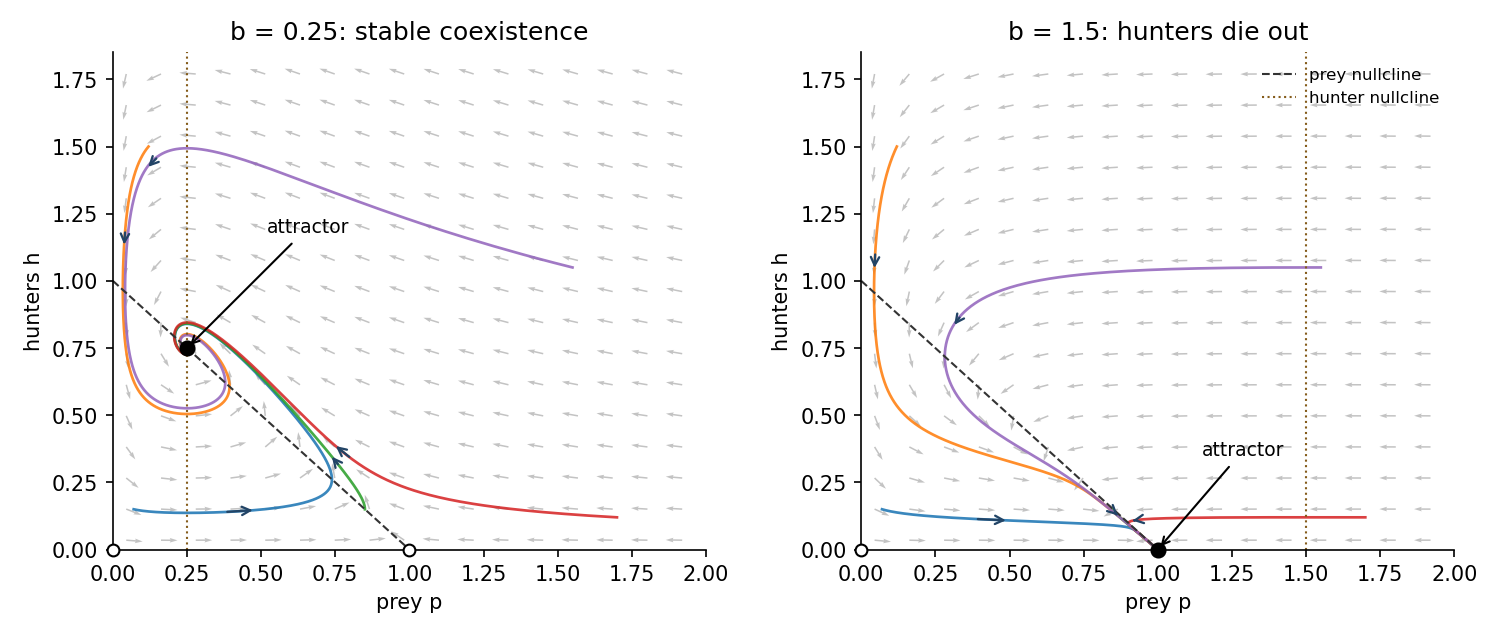
For , the physical equilibrium points are the origin, , and when . The Jacobian matrix isAt its eigenvalues are and , so the origin is always a saddle equilibrium, attracting along the hunter-only axis and repelling along the prey-only axis. At the eigenvalues areIt is a saddle equilibrium for and an asymptotically stable node for .
For , the coexistence Jacobian matrix isIts trace is negative and determinant positive. Its discriminant is negative, so is an asymptotically stable focus. Interior trajectories approach it in damped, counterclockwise oscillations in the plane. Both populations ultimately coexist.
To justify the global interior fate for this logistic predator-prey model, let and use the Lyapunov functionIt is nonnegative and its sublevel sets are compact inside the positive quadrant. Differentiation gives the explicit cancellationThe only invariant subset on which this vanishes is : remaining at requires . LaSalle's invariance principle therefore proves that every strictly positive initial state converges to this coexistence point.
For , the formal coexistence point has negative and is outside the physical state space. The only physical equilibria are the saddle equilibrium at the origin and the stable prey-only node. Since , positive prey has . Eventually with a fixed margin, so hunter population decays exponentially. When is sufficiently small, comparison with gives for every . Thus and for positive initial prey: hunters die out and prey reaches carrying capacity.
On the boundary, hunter-only initial data approach the origin; prey-only positive data approach in either parameter range. The sketches show representative values in the two requested ranges. Dashed and dotted lines are the prey and hunter nullclines; filled dots are attractors and open dots are saddle equilibria.

Past exam of the mathematics course of the University of Cambridge 2001 ia Paper 2 7B Solution Created 2026-09-24 Updated 2026-10-14
Write , where has . One eigenpair isBecause is real, conjugating gives . The eigenvector matrix has determinant , so the eigenvectors form a basis. Reality of then forces conjugate coefficients, giving .
Set . The forcing has the same basis decomposition,Equating the coefficient of in the linear system of differential equations yieldsFor , an integrating factor gives . The zero initial vector means , soTaking the real vector combination givesExact secular resonance occurs at : the forcing frequency matches the undamped homogeneous mode. For positive , damping prevents secular growth, and the late-time periodic amplitude is proportional to . Thus there is a resonant small-damping limit, but no unbounded resonant response at fixed .
Past exam of the mathematics course of the University of Cambridge 2001 ia Paper 2 6B Solution Created 2026-09-24 Updated 2026-10-14
Where is nonzero, the Wronskian identity becomes the first-order equationIts integrating factor is , giving . Integration proves the reduction of order formulaTaking gives the displayed representative in the question, with when . Changing the lower limit adds a multiple of and does not change the linearly independent solution modulo the known one. The scale of separately fixes the normalization of .
Differentiate the determinant and use the original second-order equation for each solution:This proves Abel's identity rather than merely quoting it.
For the specific equation, substituting , , leaves . Away from zero its normalized first-derivative coefficient is , soAlthough the equation is singular at zero, this expression extends analytically there. Near zero, is nonzero and the reduction of order integrand is regular. With the prescribed lower limit,The integrand through degree three isAfter integrating and multiplying by ,The condition fixes , and the lower limit already gives . Therefore the first three nonzero terms areThe representation genuinely solves the second-order equation: writing , differentiating its Wronskian gives . Its left-hand side is zero and near zero. Analyticity then extends the original unnormalized equation to zero itself. Its Wronskian with is nonzero for sufficiently small , proving linear independence. The vanishing Wronskian at the singular point zero does not contradict linear independence on a regular interval. The integral representation is used locally near zero, before the zero of at one.
Past exam of the mathematics course of the University of Cambridge 2001 ia Paper 2 5B Solution Created 2026-09-24 Updated 2026-10-14
For the homogeneous linear recurrence relation, substitute . Its characteristic equation of a linear recurrence is , with roots and . Taking real linear combinations givesThese two real sequences are linearly independent: their values at form a matrix with determinant . Thus their two constants account uniquely for arbitrary first two values.
Let and reindex as . In , each term with has coefficientThe term is , and the remaining term is . This explicitly proves that is the required particular solution, a discrete Green convolution for the period-six recurrence.
The unit-response coefficients have the homogeneous form just found. The values give zero cosine coefficient and sine coefficient , soSubtracting this particular solution from any other solution leaves a homogeneous recurrence. Thus the complete answer is
Past exam of the mathematics course of the University of Cambridge 2001 ia Paper 2 4F Solution Created 2026-09-24 Updated 2026-10-14
Use the equally likely release prior, and write for the probability that the guard names B when A is released. If B is released the guard cannot name B; if C is released the guard must name B. The law of total probability therefore givesA remains jailed and B is named precisely when C is released. Its probability is , so the conditional probability isIn (a) unbiased naming has , giving : the guard's claim is false and A's chances have not improved. In (b) preferentially naming B has , giving : that naming rule makes the claim correct. In (c) preferentially naming C has , giving : naming B then reveals that C is the released person, so A certainly remains.
This is the three prisoners problem. The observed name includes information about how the guard selects a name; it is not merely the event that B remains. With general release priors , the same calculation gives , making explicit where the equal-prior convention enters.
Past exam of the mathematics course of the University of Cambridge 2001 ia Paper 2 3F Solution Created 2026-09-24 Updated 2026-10-14
The side of the inscribed equilateral triangle has length . If is the distance of a chord midpoint from the center, a right triangle gives chord length . Thus a chord is sufficiently long exactly when .
(a) Uniform midpoint area puts the midpoint in the radius- disk with probability(b) Fix the first endpoint by rotational symmetry. Independence and uniformity make the angle of the second endpoint uniform on . Its chord length is , so the required event is . Hence(c) If the midpoint distance itself has uniform distribution on , the event has probabilityThese are three different probability measures on chords. Their different answers are Bertrand's paradox: specifying what is uniform is indispensable. Uniform area, uniform endpoints and uniform radial distance are not interchangeable sampling rules. Equality at the length threshold has probability zero in all three models.
Past exam of the mathematics course of the University of Cambridge 2001 ia Paper 2 2B Solution Created 2026-09-24 Updated 2026-10-14
The homogeneous characteristic equation is , so its solutions are and . Because the forcing contains the latter exponential, set . Direct differentiation reduces the inhomogeneous linear differential equation toA polynomial particular solution is , since . ThereforeThe exponentially growing first term cannot be canceled by the decaying second term, so boundedness at positive infinity requires . The initial condition sets . Hence
There are unlisted articles, also show them or only show them.