
Past exam of the mathematics course of the University of Cambridge 2001 ib Paper 1 12D Solution Created 2026-09-24 Updated 2026-10-14
A simple hypothesis specifies a single probability law, with no unknown parameter remaining. For a possibly randomized hypothesis test, let be its conditional rejection probability. Its test size is and its statistical power against the specified alternative is .
The Neyman-Pearson lemma states that for two densities with respect to a common measure, a likelihood-ratio test rejecting when , accepting when it is below , and randomizing on equality to obtain size , maximizes power among all tests of size at most .
Here the likelihood ratio isWriting , its logarithm apart from the constant is . This decreases until and then increases. In particular it is nonpositive for and positive for . The supplied normal-tail value and imply that the quantile defined by satisfies . Hence the threshold is above every central value on ; outside that interval the ratio is strictly increasing. The Neyman-Pearson lemma therefore selects precisely the two tails:The equality boundary has probability zero under both continuous laws, so no randomization is needed. Under the alternative density, the statistical power isThe central dip in the likelihood ratio is why checking the threshold against the entire central region, rather than assuming monotonicity in everywhere, is necessary.
Past exam of the mathematics course of the University of Cambridge 2001 ib Paper 1 11H Solution Created 2026-09-24 Updated 2026-10-14
Substituting in the homogeneous ordinary differential equation gives . ThusFor a Green's function decaying at the two ends, use on the side of zero and on the side of infinity. Their Wronskian is . The function must be continuous at , or its second derivative would contain a derivative of a Dirac delta. Its derivative jump must be one, to give the specified positive delta source. These two conditions yield the boundary-decaying Green kernel for an inverse-square differential operator:Its derivatives at the join are on the left and on the right, confirming the jump one. Away from the join each branch solves the homogeneous equation, and both endpoint conditions hold.
Integrate this Green's function against the forcing, whose support is between zero and one. For ,For , only the right branch contributes. ThereforeOn the first branch, and , so . The second branch is a multiple of the homogeneous solution , so its forcing is zero. At , both and agree, with values and , so there is no additional delta source. Finally as and as . A homogeneous solution obeying both boundary conditions has , establishing uniqueness.
Past exam of the mathematics course of the University of Cambridge 2001 ib Paper 1 10A Solution Created 2026-09-24 Updated 2026-10-14
Assume . On continuous functions on this compact interval, both proposed distances are finite and symmetric, and vanish on identical functions. For the supremum norm, zero distance plainly implies pointwise equality. For the L2 norm, if a continuous difference is nonzero at any point, it stays bounded away from zero on a subinterval of positive length. Its squared integral is then positive, so zero distance also implies equality.
For the first metric, the pointwise triangle inequality followed by the supremum gives . For the second, put , . The Cauchy-Schwarz inequality givesTaking square roots proves the required triangle inequality. Thus both are metrics.
The continuous-function space is complete in the uniform metric. If is a Cauchy sequence in , at each its scalar values have a limit , by completeness of the scalar field. Given , choose with for . Letting gives uniformly in . Hence there is uniform convergence. To see that the limit is continuous at , approximate it uniformly by one continuous and useThe outer terms can be made small uniformly, and the middle term is small near . This proves the needed uniform limit theorem and completeness.
For the second metric, let be zero on and one on ; its value at zero is immaterial to the integral. The supplied ramp functions are continuous and satisfyAlthough is not in the continuous-function space, the integral triangle inequality yields . Thus the sequence is Cauchy. If it converged in to a continuous , the same inequality would give . Continuity would then force on the negative half-interval and on the positive half-interval, contradicting continuity at zero. Therefore the continuous-function space is not complete in ; its limit in the larger L2 space is the discontinuous step.
Past exam of the mathematics course of the University of Cambridge 2001 ia Paper 4 9A Solution Created 2026-09-24 Updated 2026-10-14
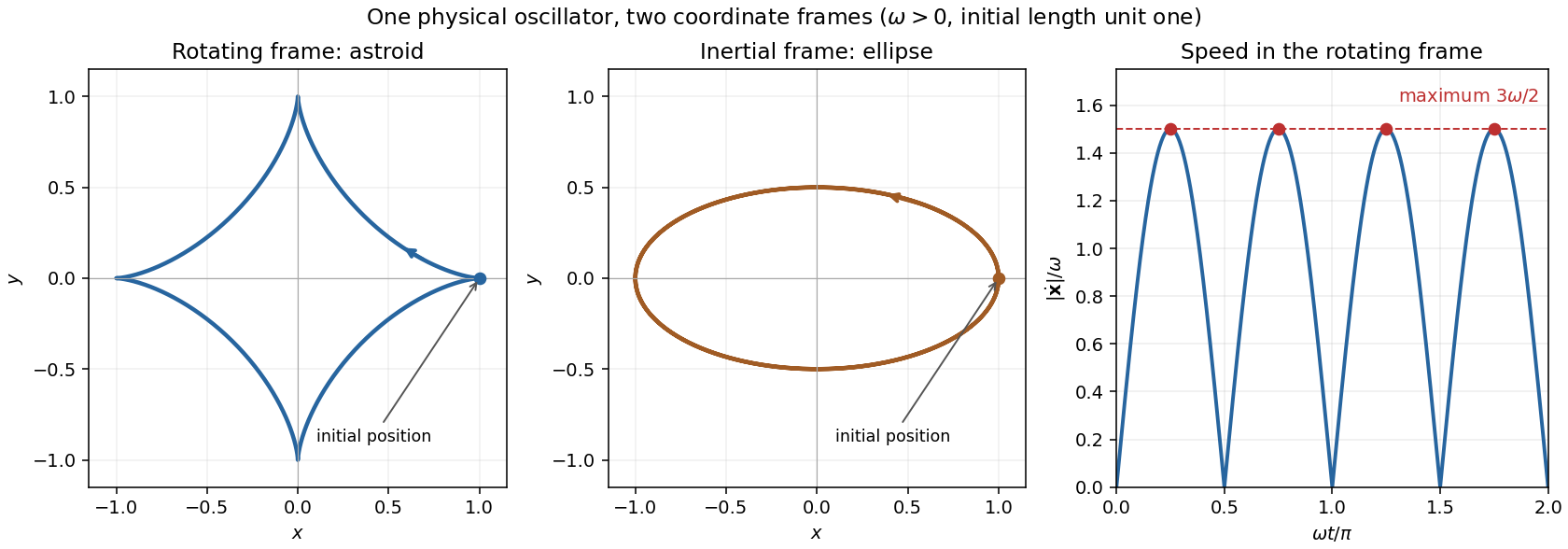
The equation of motion in a rotating frame with constant angular velocity isWith and , this becomesThe given initial data make . For the complex coordinate , the planar equations combine intoIts characteristic roots are and . Applying , gives . The triple-angle identities reduce this astroid motion of a harmonic oscillator in a rotating frame toIt traces an astroid. Differentiating gives the relative speedFor , its maxima occur at , withThis is speed measured in the specified rotating frame. The same physical motion has inertial complex coordinate , an ellipse; its initial velocity is the frame-rotation contribution even though the initial relative velocity is zero.

Past exam of the mathematics course of the University of Cambridge 2001 ia Paper 4 8E Solution Created 2026-09-24 Updated 2026-10-14
Mathematical induction consists of an induction base case and an inductive step for every positive integer . To derive it from the well-ordering principle, suppose the set of counterexamples were nonempty and take its least element . The base case excludes . If , minimality gives , and the step then gives , a contradiction. Hence there are no counterexamples.
For the stated integer congruence, the base case is . If , multiplication and givecompleting the induction.
The purported shifted-sum proof has a correct conditional successor calculation, but the base case is missing and false: at it would assert . An inductive step without a true induction base case cannot establish any instance.
Past exam of the mathematics course of the University of Cambridge 2001 ia Paper 4 7E c Created 2026-09-24 Updated 2026-09-24
Past exam of the mathematics course of the University of Cambridge 2001 ia Paper 4 7E b Created 2026-09-24 Updated 2026-09-24
Past exam of the mathematics course of the University of Cambridge 2001 ia Paper 4 7E a Created 2026-09-24 Updated 2026-09-24
Past exam of the mathematics course of the University of Cambridge 2001 ia Paper 4 6E Solution Created 2026-09-24 Updated 2026-10-14
For finite sets , the inclusion-exclusion principle statesTo prove it, count the contribution of an element lying in exactly of the sets. Its total coefficient isby the binomial theorem. An element in none contributes zero. Summing these elementwise counts proves the formula. Applying the same argument to indicator functions and taking expectations proves the corresponding probability formula.
Factor . An integer is coprime to this product precisely when none of its three prime factors divides it. Inclusion-exclusion applied to the multiples of those prime numbers among gives Euler's totient functionFor the survey, let be the three detestation events and use proportions as probabilities. The union is the reported total union with the only- group removed, so . The two-set inclusion-exclusion principle gives . Removing the all-three group leavesThe required proportion is 4%. The separately reported total proportion is consistent with, but unnecessary for, this calculation.
Past exam of the mathematics course of the University of Cambridge 2001 ia Paper 4 5E b Created 2026-09-24 Updated 2026-09-24
Past exam of the mathematics course of the University of Cambridge 2001 ia Paper 4 5E a Created 2026-09-24 Updated 2026-09-24
Past exam of the mathematics course of the University of Cambridge 2001 ia Paper 4 4A Solution Created 2026-09-24 Updated 2026-10-14
Put , define the center of mass , and let be relative position. Adding the two Newton's second law equations givesThe center of mass has constant velocity, by conservation of total momentum.
Subtracting the particle accelerations instead givesThus relative motion is a one-particle problem with the reduced mass , while center-of-mass motion is uniform. The same reduced mass appears in the kinetic energy decomposition .
Past exam of the mathematics course of the University of Cambridge 2001 ia Paper 4 3A Solution Created 2026-09-24 Updated 2026-10-14
For an attractive central force, the transverse acceleration vanishes. In polar coordinates,Thus the specific angular momentum is constant. Assume , so angle can parameterize the orbit, and put . Primes denote angle derivatives. The chain rule givesThe outward radial component of the attractive force is . Its Newton's second law equation is therefore , giving the Binet equationThe sign reflects being the positive inward force magnitude. Zero angular momentum produces radial motion and is outside this angular parametrization.
Past exam of the mathematics course of the University of Cambridge 2001 ia Paper 4 2E Solution Created 2026-09-24 Updated 2026-10-14
For nonnegative integers , prove the hockey-stick identity by mathematical induction on . The induction base case is . If the formula holds through , Pascal's identity givesThis supplies the inductive step.
A binary string containing exactly zeroes and ones has length . Choosing its one-positions gives possibilities. Different values of give disjoint collections, so counting binary strings with bounded ones yieldsThis includes : the strings are the empty string and the all-one strings of lengths one through .
Past exam of the mathematics course of the University of Cambridge 2001 ia Paper 4 1E b Created 2026-09-24 Updated 2026-09-24
Past exam of the mathematics course of the University of Cambridge 2001 ia Paper 4 1E a Created 2026-09-24 Updated 2026-09-24
Past exam of the mathematics course of the University of Cambridge 2001 ia Paper 4 12A Solution Created 2026-09-24 Updated 2026-10-14
A coaxial shell of radius and thickness has mass . Integrating squared radius against mass, the moment of inertia of a uniform solid cylinder about its axis isOn the smooth incline, no tangential contact force produces spin, so the initially stationary cylinder simply slides with acceleration . Therefore .
For rolling without slipping, let be uphill static friction and the downward translational acceleration. Newton's second law, the rotational torque equation, and the contact constraint giveWith , these give and . The rolling-time factor on a straight incline is consequentlyThe required friction is ; the stated no-slip motion presupposes sufficient static friction. At an instantaneously stationary contact point it does no work. Gravitational potential energy is shared between translational and rotational kinetic energy, explaining why rolling accelerates more slowly than the smooth slide.
Past exam of the mathematics course of the University of Cambridge 2001 ia Paper 4 11A Solution Created 2026-09-24 Updated 2026-10-14
Write for the conserved specific angular momentum. Zero specific orbital energy in the inverse-square Newtonian gravitational field givesDefine , the periapsis radius for a nonradial parabolic trajectory. ThenOn the outgoing branch, integrate from the periapsis time and put :The incoming branch has the opposite sign. Squaring gives the radius-time relation for a parabolic Kepler orbit, a version of the Barker equation:Here and are fixed by angular momentum and the time origin at periapsis. The relation applies on both branches, with ; it is not necessary to solve for the polar angle.
Past exam of the mathematics course of the University of Cambridge 2001 ia Paper 4 10A Solution Created 2026-09-24 Updated 2026-10-14
Let be the drop's mass, with constant mass density . Its volume-growth rule gives , hence and . The incoming mist is stationary, so the variable-mass system momentum balance isExpanding the derivative and substituting the accretion rate gives the accreting raindrop with quadratic drag equationsThe extra contribution is the momentum needed to accelerate collected matter from rest; omitting it would treat the growing drop as a constant-mass particle.
Set and . The chain rule givesTo justify the limiting value as well as its stability sign, use , as appropriate to volume growth. Divide by and integrate the resulting first-order equation:Thus remains between two positive constants, its initial value and . Since , the radius is defined for all increasing time and tends to infinity. The correction vanishes, proving the speed-radius attractor of an accreting raindrop:The strict inequality uses . The growing radius prevents a finite terminal velocity; instead the acceleration approaches this positive constant.
Past exam of the mathematics course of the University of Cambridge 2001 ia Paper 3 9C Solution Created 2026-09-24 Updated 2026-10-14
At a critical point of a twice continuously differentiable real function, the Taylor expansion isThe Hessian matrix is real symmetric, so an orthogonal eigenbasis diagonalizes its quadratic form. If every eigenvalue is positive, that form is bounded below by a positive multiple of , which dominates the remainder and gives a strict local minimum. If every eigenvalue is negative, the same argument gives a strict local maximum. If both signs occur, displacement along the corresponding eigenvectors produces values above and below , so the point is a saddle point of a scalar function. These exhaust a nonsingular Hessian matrix.
A singular Hessian matrix does not always make the classification impossible: nonzero eigenvalues of both signs still give a saddle. If the Hessian matrix is positive or negative semidefinite, higher-order terms in its null directions must be examined. For example, and have the same Hessian matrix at zero, but the first has a strict minimum and the second a saddle. The function has a non-strict minimum along a whole line.
For the given polynomial,A stationary point has and then . Hence the origin is always critical, and two additional points exist exactly for :The Hessian matrix isAt the origin it is , giving a strict local minimum for and a saddle for . At either extra critical point it has determinant , so both extra points are saddles.
At , complete the square:Along it is positive away from zero, whereas along it is negative away from zero. Thus the origin remains a degenerate saddle despite its nonnegative Hessian matrix. This is the parabolic quartic critical-point classification. The complete result isFor the local minimum is not global, since along the same parabola .
There are unlisted articles, also show them or only show them.