
For a natural transformation of set-valued functors, form the pushout by taking two copies of each and identifying the two copies of every element in the image of . Naturality makes all induced maps well-defined. If is outside that image, its two copies remain distinct. Thus the two maps agree after but differ at , proving is not an epimorphism. Conversely, componentwise surjective functions allow cancellation at every object, proving that is an epimorphism. This argument does not assume a natural choice of preimages.
Relative Poincaré lemma 2026-10-14
Let a neighborhood of a submanifold retract onto it by fiberwise radial contraction in a tubular neighborhood. If a closed differential form pulls back to zero on the submanifold, the radial homotopy formula gives , with vanishing along the zero section. Applying the homotopy operator to gives the primitive directly. This is the relative ingredient in the relative Moser theorem.
Homology sphere 2026-10-14
An integral homology -sphere is a space with the same integral homology as . Removing one point from a closed oriented integral homology sphere produces an acyclic space by the long exact sequence of the pair and the local orientation isomorphism in degree .
Lefschetz duality 2026-10-14
For a compact oriented -manifold with boundary, cap product with its relative fundamental class gives
For a closed connected manifold, cap product with gives the displayed isomorphism. The ordinary integral theorem results when the orientation system is trivial. Modulo two the sign representation is always trivial, so duality holds without an orientability assumption. In particular a nonorientable connected closed -manifold has and .
For a connected closed oriented four-manifold, Poincare duality identifies with . The universal coefficient theorem for cohomology identifies with because has zero Ext. Consequently is torsion-free and its rank equals that of .
For a continuous map of nonzero mapping degree between closed connected oriented manifolds of the same dimension, is injective in every degree. Pair a nonzero class with a complementary class using Poincare duality. Naturality gives , so . Over coefficients of positive characteristic the argument requires that the degree remain nonzero in that field.
Poincaré duality for noncompact manifolds 2026-10-14
Cap product with the locally finite fundamental class of an -manifold without boundary gives the displayed duality, including a possibly nontrivial orientation local system . It is the noncompact version of Poincare duality; for a compact manifold Borel-Moore homology is ordinary homology. Locally it is the relative fundamental-class calculation in an oriented coordinate ball; compatibility on overlaps and the Mayer–Vietoris sequence give the global statement. Since the chain complex of locally finite homology is zero in negative degrees, this duality implies for .
Graded Poincaré–Birkhoff–Witt theorem 2026-10-14
For a graded Lie algebra over characteristic zero, the associated graded algebra of its universal enveloping algebra under the word-length filtration is its graded symmetric algebra. Ordered homogeneous monomials form a basis, with exponent at most one on each odd Lie basis element. The defining graded commutation relations reorder every word, and the Jacobi identity resolves the triple-reordering ambiguities. In particular the primitive elements of a Hopf algebra of are precisely : in its associated graded algebra, a primitive polynomial of symmetric length greater than one would have a nonzero mixed term under the diagonal, which is impossible in characteristic zero.
Finite-source forced-plume quadrature 2026-10-14
For an axisymmetric top-hat plume model in uniform ambient density, use full kinematic fluxes and . The equations , conserve . Solve this invariant for , then integrate to obtain the displayed exact quadrature. It determines the transition from the near-source jet limit of the top-hat plume model to the distant pure plume. The two regimes cannot be added by linear superposition because the flux equations are nonlinear.
With two shared leads of electrical resistances , Ohm's law givesUsing the Pt100 local linear model, positive lead electrical resistance appears as a warmer temperature. At true , stipulated leads of each change into , producing : a calculated bias of about . Subtracting a measured loop correction works only while that loop electrical resistance remains appropriate; cable temperature changes can invalidate it.
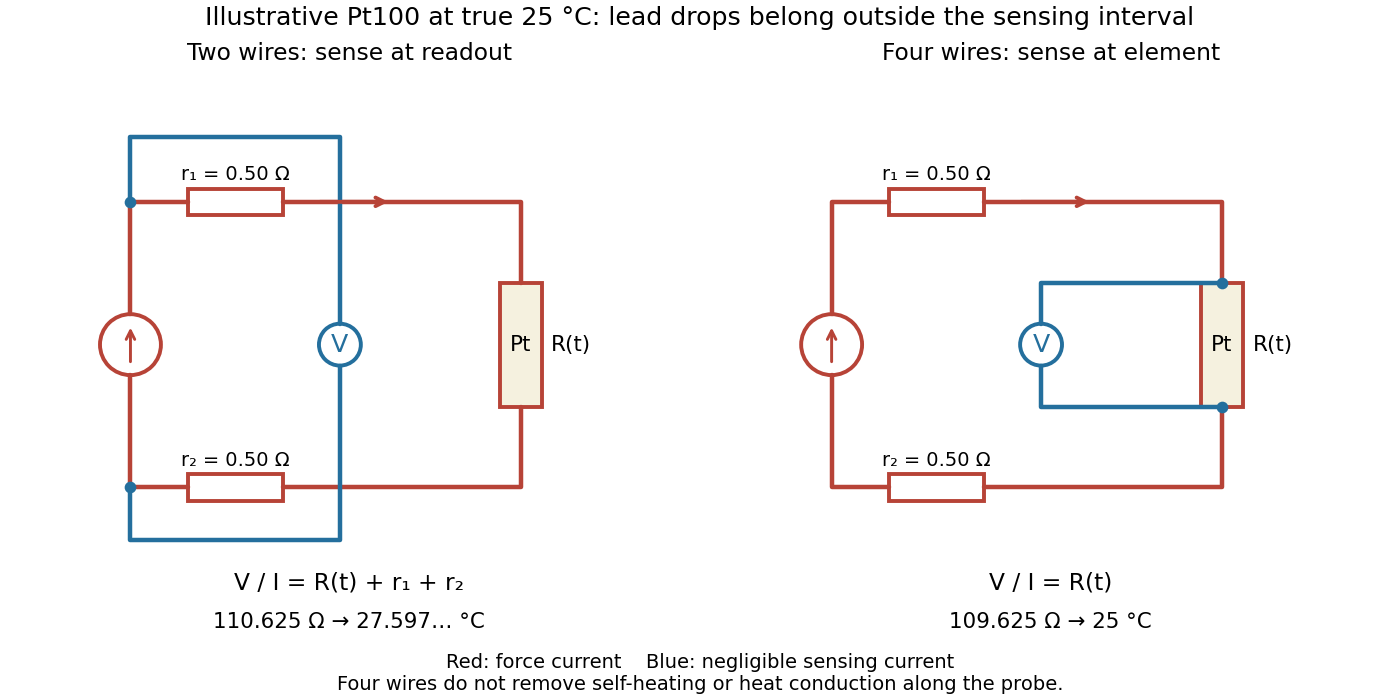

Four-terminal sensing separates the electric current and electric potential difference leads. Negligible sensing electric current suppresses sensing-lead drops; force-lead drops lie outside the interval. Real voltmeter loading, connections, and leakage still need checking.[ref]
For a stable offset from the thermoelectric effect, two signed electric potential differences obey and . The current-reversal calculation in four-terminal sensing yieldsAt stipulated , and , and recover exactly in this model. If the offset or sample temperature changes between readings, cancellation is incomplete. Reversal also leaves Joule heating unchanged because it depends on .
A 1998 NIST account describes stirred comparison baths, a reference SPRT with a 30 Hz resistance bridge, and a temperature-controlled reference resistor. The test IPRTs used a current source, a scanner, and an 8½-digit voltmeter. Separate current and voltage leads made each test probe a four-terminal device; readings in both current directions supplied voltage ratios to the reference resistor.[ref]
A New NIST Automated Calibration System for Industrial-Grade Platinum Resistance Thermometers by Gregory F. Strouse and others. A New NIST Automated Calibration System for Industrial-Grade Platinum Resistance Thermometers, §§3.1, 3.3 and 4.2, printed pp. 2–6: baths, readout, four-terminal devices and reversed current
Its program bracketed test readings with reference SPRT readings and repeated a block if bath drift was excessive. A check SPRT monitored the system; reference water-triple point measurements checked stability. Sensor depths were matched, and unfamiliar probes underwent immersion tests. Ice and water-triple point readings before and after calibration checked changes. Additional points could test the fitted curve. Reported calibration uncertainties excluded transport, subsequent drift, hysteresis, and the user's measurement system. These are controls and limits of that documented apparatus, not an accuracy promise for all platinum resistance thermometers.[ref]
The inference is a pair: reference temperature from the SPRT, test electrical resistance from the electrical readout. Record measuring electric current, wiring, immersion, and the stated reference scale with each pair. A bath controller's setpoint is not itself the calibrated reference temperature. Returning to a reference and checking intermediate points distinguishes a fitted relation from a reproducible calibration over the intended interval.
Industrial platinum resistance thermometer 2026-10-14
An industrial platinum resistance thermometer is a platinum resistance thermometer built for practical measurement conditions. The label Pt100 specifies a nominal reference electrical resistance, not an SPRT, a calibration certificate, or a universal accuracy. Calibrate the probe together with its readout when the desired result is the performance of the complete indicating system.
Standard platinum resistance thermometer 2026-10-14
A standard platinum resistance thermometer uses very pure, annealed platinum with strain-limiting construction. An industrial platinum resistance thermometer commonly uses supported wire or a film. Their response curves differ.[ref]
The word standard describes the instrument's metrological role. Calibrated SPRTs realize specified interpolation intervals of the International Temperature Scale of 1990 and transfer reference temperatures to other thermometers.[ref]
Mercury Thermometer Alternatives: Platinum Resistance Thermometers (PRTs) by National Institute of Standards and Technology. Platinum Resistance Thermometers, opening explanation: SPRTs as ITS-90 interpolation tools
They are primary standards for realizing that practical scale, but their electrical resistance alone does not determine absolute thermodynamic temperature without calibration. Primary thermometry such as the corrected gas thermometer obtains thermodynamic temperature from a physical law. A reference in a comparison bath may be an SPRT; an individually calibrated industrial platinum resistance thermometer can also serve as a working reference with an appropriate uncertainty. Plane-parallel stellar f-mode 2026-10-14
The plane-parallel Cowling displacement-pressure equations admit this stellar oscillation for every compatible equilibrium density and adiabatic sound speed profile. In the upward-displacement convention its horizontal amplitude is , its Eulerian pressure amplitude is , and its Lagrangian density and pressure perturbations vanish. Its displacement decays into the star but grows upward without bound, so a pure linear continuation to infinite height is not physical.
Meissner screening current 2026-10-14
In SI units, the magnetostatic Ampère law gives the current density supporting Planar London screening:Here is the vacuum permeability. The sign follows from in the chosen coordinates. Thus requires electric current along . Its own magnetic field opposes the imposed magnetic field inside the material. The electric current is distributed over a finite layer; its depth integral is the effective surface current densityThe units are for and for . Shrinking at fixed increases the surface current density, while this integrated surface current density stays fixed. The current sheet approximation is the large-length-scale limit of this layer, not a claim that an actual sample carries an infinitely thin electric current. It reproduces the magnetic-field jump across a surface current between the exterior and a field-free interior, with outward unit normal .
A photon hitting a resting mass has squared total energy invariant . Producing a larger mass and an outgoing photon requires this invariant to exceed if the photon has positive energy. The displayed threshold is therefore the limiting infimum as the final photon becomes soft, not an attained physical state with a zero-energy photon. Above threshold the outgoing photon energy in the centre-of-momentum frame is positive.
For a photon incident on a stationary Electron, producing an additional electron and positron leaves three massive particles in the final state. Four-momentum conservation gives for the centre-of-momentum energy. Its minimum is , so the incident threshold is . At threshold all final particles are at rest in their centre-of-momentum frame, which moves at relative to the target laboratory frame. This differs from a heavy-target threshold because the electron target's recoil cannot be neglected.
A damped mode does not alone imply oscillations in its ensemble power spectrum. Averaging its modulus squared gives the displayed formula. Equal independent initial variances, and , erase the oscillatory variance through . A coherent initial phase, as supplied by a regular growing adiabatic mode, selects one common oscillator phase and retains acoustic peaks. Its leading density and velocity oscillations are a quarter-period apart, and angular projection also preserves their correlated contribution.
Ionization-bounded nebula 2026-10-14
An ionization-bounded nebula contains enough absorbing material to trap the relevant ionizing photons, unlike a density-bounded region that ends before its ionization front. In dust-free hydrogen at steady photoionization equilibrium, the absorbed stellar photon rate equals the integrated Case B recombination rate. Escape, absorption by dust, and competition from other species must be accounted for before identifying the absorbed hydrogen rate with the entire stellar ionizing luminosity.
There are unlisted articles, also show them or only show them.