
Error function Created 2026-09-24 Updated 2026-10-14
The error function records the signed area under a Gaussian function between zero and a variable endpoint:For a negative real number , reversing the integration limits makes this integral negative. The normalization uses the Gaussian integral: the full area of is , so its positive half contributes one after multiplication by . The same definition extends to a complex number along any path from zero to , giving an entire function.[ref]
For example, , , and . A finite positive endpoint captures only part of the positive Gaussian integral; approaches one as but never reaches it at a finite real .
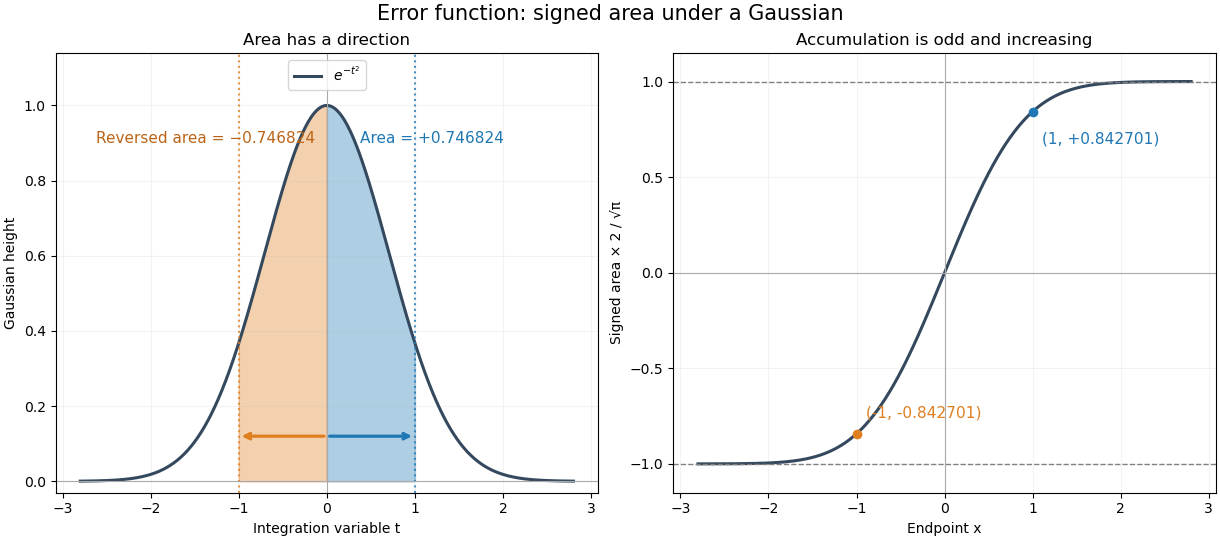

The useful idea is to name a recurring integral once instead of carrying it through every calculation. The error function and the normal distribution express probabilities and quantiles through this area, while an error-function diffusion front describes how diffusion smooths a sharp jump. The complementary error function retains the small area left in the tail.
The fundamental theorem of calculus givesThus the real-axis error function is strictly increasing, with values in . Its integrand is an even function, so the error function is an odd function, . The derivative also gives : the curve is concave for and convex for . These real-axis properties do not imply boundedness throughout the complex plane; the existing quadrant asymptotics of the error function describe a different behavior in other directions.
Gaussian curvature of a cone away from its vertex Created 2026-09-24 Updated 2026-09-29
Every regular cone parametrized by has zero Gaussian curvature away from its vertex. Its unit normal is independent of , whileis tangent, so two coefficients of the second fundamental form vanish and .
Symmetric rational function in two variables Created 2026-09-24 Updated 2026-11-05
Every rational function in fixed by exchanging and is a quotient of coprime symmetric polynomials. In a coprime presentation , symmetry givesUnique factorization implies and . The alternative would make both divisible by , contradicting coprimality, so .
Polynomial ring over a unique factorization domain Created 2026-09-24 Updated 2026-11-05
If is a unique factorization domain with fraction field , then is a unique factorization domain. A primitive polynomial irreducible in remains irreducible, hence prime, in the principal ideal domain ; Gauss lemma for polynomials brings divisibility back to .
Sectional curvature Created 2026-09-24 Updated 2026-10-06
Sampling an integer-shape gamma distribution Created 2026-09-24 Updated 2026-11-05
Let be a positive integer, , and independent uniform random variables on . Thenhas a gamma distribution of shape and rate , also called an Erlang distribution. The unit interval is essential: an unspecified uniform distribution on another interval would not give this algorithm.
For , . Each summand therefore has an exponential distribution with rate , and additivity of independent gamma distributions with a common rate proves the result. For , the output has expected value and variance . The formula directly covers integer shapes; replacing by a noninteger number of draws does not define a sampler for a general gamma shape.
Erlang distribution Created 2026-09-24 Updated 2026-11-05
The sum of independent exponential variables of rate has the Erlang distribution with densityConvolving with one more exponential proves the formula inductively.
Aubin-Lions lemma Created 2026-09-24 Updated 2026-11-05
A useful version of the Aubin-Lions lemma concerns Banach spaces with embeddingswhere the first embedding is compact and the second continuous. For and , a family bounded in whose distributional time derivatives are bounded in is relatively compact in . The exponents and embedding hypotheses must be stated; an unspecified suitable derivative bound does not identify a version of the theorem.
For a bounded Lipschitz domain , Rellich-Kondrachov compactness theorem and continuous dual embeddings giveConsequently boundedness of in and of in yields a strongly convergent subsequence in . The spatial bound prevents fine-scale spatial oscillations, while the derivative bound controls time translations. This is why the lemma lets a Galerkin method pass to nonlinear terms, for which weak convergence alone is often insufficient. On an unbounded spatial domain, the displayed spatial compact embedding can fail through translations.
Two Möbius bands attached to a torus Created 2026-09-24 Updated 2026-10-14
Attach Möbius bands to a torus along the classes and . If their core generators are , the resulting presentation isBecause the exponent vectors and form a unimodular basis of , eliminating givesThis group maps onto by and , so it is nonabelian.
Presentation complex Created 2026-09-24 Updated 2026-10-14
A group presentation gives a two-dimensional cell complex with one vertex, one oriented loop for each generator, and one 2-cell attached along each relator. Its fundamental group is the presented group.
Minimal surface equation for a graph Created 2026-09-24 Updated 2026-10-14
The graph of is minimal exactly whenEquivalently, it is the Euler--Lagrange equationfor the area functional .
Tangency to a plane along a curve forces zero Gaussian curvature Created 2026-09-24 Updated 2026-09-24
After a rigid motion, write the plane as and the surface locally as . Along the curve of tangency, and . Differentiating shows that the Hessian annihilates the nonzero tangent , so its determinant and therefore the Gaussian curvature vanish.
Mean-curvature comparison at tangential contact Created 2026-09-24 Updated 2026-09-24
Suppose two graph surfaces and are tangent at the origin, are oriented upward, and nearby. Then has a local minimum, so its Hessian matrix is positive semidefinite. At the common horizontal tangent plane,
Gaussian curvature of a graph surface Created 2026-09-24 Updated 2026-09-24
Poincare duality Created 2026-09-24 Updated 2026-09-28
Representable functor Created 2026-09-24 Updated 2026-10-03
Geometric minimum action Created 2026-09-24 Updated 2026-11-05
Geometric minimum action removes the time parametrization when minimizing the Freidlin--Wentzell action over both a path and its travel time. With a positive-definite diffusion covariance , write and . For an absolutely continuous curve , the free-time geometric cost isIt is invariant under increasing changes of the curve parameter. This is a free-time cost used in the quasipotential, not a replacement for the action at a prescribed finite arrival time.[ref]
The geometric minimum action method: A least action principle on the space of curves by Matthias Heymann and Eric Vanden-Eijnden. Sections 1.2–1.3, free-time variational problem and geometric reformulation
To derive the integrand, set in the time action. Its density becomesMinimizing over uses and gives the geometric expression. Where both norms are positive, the optimal speed satisfies . At equilibria the infimum may require an infinite travel time, explaining the usefulness of an arc-length-like parameter.
For gradient drift and , an uphill gradient curve has cost , while a downhill deterministic trajectory has zero cost. The factor two corresponds to noise ; changing to changes the action normalization.
Linear Fourier weight Created 2026-09-24 Updated 2026-09-24
The linear Fourier weight is .
Noise operator on the Boolean hypercube Created 2026-09-24 Updated 2026-10-03
The noise operator averages over a random correlated with by . It acts diagonally on the Fourier-Walsh transform:
Discrete derivative of a Boolean function Created 2026-09-24 Updated 2026-10-14
On the unbiased cube, the discrete derivative isFor the p-biased product measure, the normalization factor is .
There are unlisted articles, also show them or only show them.