
Dirichlet energy space with zero boundary at infinity Created 2026-09-24 Updated 2026-11-05
For a transient weighted graph, is the completion of the finitely supported functions in the norm . Its elements have finite Dirichlet energy and vanish at infinity in the energy sense.
Periodic orbit from a closed interval-covering walk Created 2026-09-24 Updated 2026-09-24
Every closed walkin a directed covering graph of an interval map has a point with and . This follows by successively pulling back through the covering relations and applying the fixed-point property of a closed interval. If the itinerary has least period and avoids shared endpoints, lies on an -cycle.
Longest-cycle attachment argument Created 2026-09-24 Updated 2026-09-24
Minimal subtraction scheme Created 2026-09-24 Updated 2026-11-05
The minimal subtraction scheme chooses counterterms that remove only the poles in the dimensional regulator , without additional finite terms.
Inverse function theorem Created 2026-09-24 Updated 2026-10-14
The inverse function theorem answers a practical question: can nearby outputs be used to recover nearby inputs uniquely and smoothly? Its useful surprise is that a nonlinear function can be tested using its linear derivative. If the first-order changes preserve all input directions, then, on a sufficiently small region, the nonlinear map can also be reversed. This is the basis for treating a nonlinear map as a coordinate transformation.
Precisely, let be continuously differentiable on an open subset of Euclidean space, let , and put . If is an invertible linear map, there are open neighbourhoods of and of such that is a bijection with a continuously differentiable inverse function . Thus this restriction is a diffeomorphism. In coordinates the test is , using the Jacobian determinant. The derivative of a local inverse map is obtained by inverting the Jacobian matrix, at the corresponding input. [ref]
For a one-dimensional example, has . Near , the inverse function is , and the inverse function rule gives . But has no inverse function on the whole real line, since and give the same output. The theorem supplies a local restriction, not global injectivity. At zero, the derivative test fails; the nonnegative branch still has a square root inverse, but that inverse has no finite derivative at zero. [ref]
https://www.jirka.org/ra/html/sec_ift.html. Jiří Lebl, Basic Analysis: the one-dimensional theorem and the square-root example
Here is a two-dimensional example with an invertible derivative everywhere and infinitely repeated outputs:The exponential function turns into a positive radius, while is the angle in polar coordinates. Restricting, for example, to and produces the reversible patch pictured below. On its image, with Cartesian coordinates and , the inverse function isThe arctangent selects the angle near zero. Without an angle restriction, for every integer , so there is no single global inverse function. This map is a local diffeomorphism but is not injective.
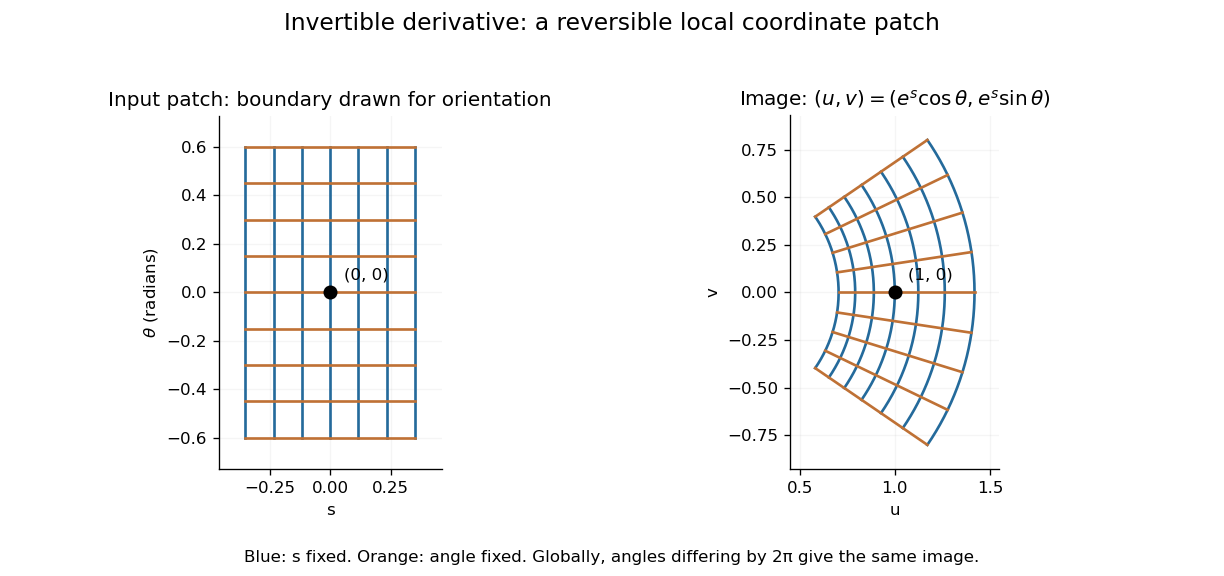
A small rectangular coordinate patch maps reversibly to a curved sector, despite global angle repetition
. Details. 
The short proof idea is to correct a guessed input using the inverse linear response. With , solving is equivalent to finding a fixed point ofAt , the derivative vanishes. Continuity makes a contraction mapping on a sufficiently small closed ball, which it maps into itself when is sufficiently close to . The contraction mapping theorem then gives existence and uniqueness there. Establishing the smooth dependence on completes the inverse theorem. This explains why the nonlinearity can be tolerated: its correction has a small local slope.[ref]
8.5 Inverse and implicit function theorems. §8.5: the contraction argument
Mean value inequality Created 2026-09-24 Updated 2026-10-03
Invertible linear map Created 2026-09-24 Updated 2026-10-14
Continuously differentiable function Created 2026-09-24 Updated 2026-10-03
Fréchet derivative Created 2026-09-24 Updated 2026-11-05
Let be normed vector spaces, open, and . The Fréchet derivative of at is a bounded linear map such thatThe approximation is uniform over directions: the error divided by the size of the whole increment must vanish, rather than merely vanishing on each fixed line. Boundedness of the linear map is part of the definition.
The Fréchet derivative is unique. If both satisfy the remainder condition, substitute for each fixed vector , divide by , and let to obtain . Existence also implies continuity of at , since and is bounded. In finite dimensions the Jacobian matrix represents this linear map; mere existence of directional derivatives need not supply one.
Spectral decomposition Created 2026-09-24 Updated 2026-10-14
A spectral decomposition expresses a linear operator through its eigenvalues and projections onto its eigenspaces.
Distinct eigenvalues imply diagonalizability Created 2026-09-24 Updated 2026-11-05
Eigenvectors belonging to distinct eigenvalues are linearly independent. Consequently, an -dimensional operator with distinct eigenvalues is diagonalizable.
Complex similarity of real matrices implies real similarity Created 2026-09-24 Updated 2026-11-05
Suppose real matrices satisfy for an invertible complex matrix . Then and . The real polynomial is not identically zero because its value at is nonzero, so some real makes invertible. This real matrix intertwines and .
Diagonalizability inherited from an invertible power Created 2026-09-24 Updated 2026-11-05
Let be invertible over an algebraically closed field. If is diagonalizable for an integer not divisible by the characteristic of a field (with no restriction on in characteristic zero), then is diagonalizable. Indeed, a nontrivial Jordan block has andThe first nonzero nilpotent term prevents this power from being diagonalizable.
Escaping bump counterexample to global uniform convergence Created 2026-09-24 Updated 2026-09-24
For a compactly supported nonzero function , the translates converge uniformly to zero on every compact subset of , while prevents uniform convergence on all of .
Crude incompleteness theorem Created 2026-09-24 Updated 2026-10-06
Every consistent recursively axiomatized extension of elementary arithmetic is incomplete. If it were complete, its theorem set would be decidable; representing that decision procedure and diagonalizing against it yields a contradiction.
Many-one completeness of the halting problem Created 2026-09-24 Updated 2026-09-24
Every recursively enumerable set many-one reduces to the diagonal halting set. If a program halts exactly on , the S-m-n theorem produces from an index for a unary program that ignores its input and performs that computation on . ThenConversely, a computable preimage of a recursively enumerable set is recursively enumerable.
Solvable affine algebraic group Created 2026-09-24 Updated 2026-11-05
An affine algebraic group is solvable when its derived series reaches the identity. A connected solvable affine algebraic group can be conjugated into an upper triangular matrix group by the Lie-Kolchin theorem.
Solvable Lie algebra Created 2026-09-24 Updated 2026-10-07
Finite-range dependent random field Created 2026-09-24 Updated 2026-11-05
A random field is finite-range dependent if collections indexed by sets farther apart than a fixed distance are independent. Sparse subsets of long paths then restore enough independence for path-counting arguments.
Level-set percolation Created 2026-09-24 Updated 2026-11-05
There are unlisted articles, also show them or only show them.