
Heavy-ball rate for a two-eigenvalue diagonal quadratic Created 2026-09-24 Updated 2026-11-05
Let with , choose , and put and . The two-by-two heavy-ball error propagation matrix for a scalar eigenvalue has characteristic polynomialAt , its middle coefficient is , giving a repeated root . At , the polynomial is , whose roots are complex conjugates with modulus . Thus the full propagation matrix has spectral radius exactly .
The repeated root can produce an error term , so the spectral radius is an asymptotic rate and does not assert a stepwise error bound with one fixed constant times . For , the parameters reduce to , and the identity-matrix problem is solved in one update. Values are outside the displayed rate convention.
Heat-kernel solution Created 2026-09-24 Updated 2026-10-14
For initial data on the real line, Fourier transformation or convolution with the fundamental solution gives
For a bounded function , the convolution is well defined at every positive time because the heat kernel has integral one. The error-function diffusion front uses a Heaviside step function initial condition and gives one smoothed interface. The heat equation with interval-indicator initial data instead has two interfaces; subtracting their two error functions produces the finite-interval profile.
Gaussian approximate identity Created 2026-09-24 Updated 2026-09-28
The centered normal densitiesform an approximate identity: for every , at almost every point where the Lebesgue differentiation theorem applies. Their Fourier transforms are in the angular-frequency convention.
Dulong-Petit law Created 2026-09-24 Updated 2026-10-20
In the classical high-temperature limit, each independent harmonic oscillator contributes to the heat capacity at constant volume, where is the Boltzmann constant. A three-dimensional crystalline solid with chemical atoms has vibrational normal modes in the bulk harmonic approximation. Its vibrational internal energy and heat capacity at constant volume therefore obeyHere is independent of temperature at fixed volume. Thus the Dulong-Petit law predicts for a real solid in this regime. Per mole of chemical atoms, rather than per mole of a compound's formula units,with molar gas constant and Avogadro constant . A formula unit containing chemical atoms consequently has a classical vibrational prediction of per mole of formula units.
For example, in this ideal classical model, one mole of chemical atoms heated at fixed volume from to gains vibrational internal energyThe heat capacity at constant volume stays the same even though the thermal part of the internal energy doubles. These temperatures illustrate the stipulated classical model; they do not assert that every real solid is classical at .
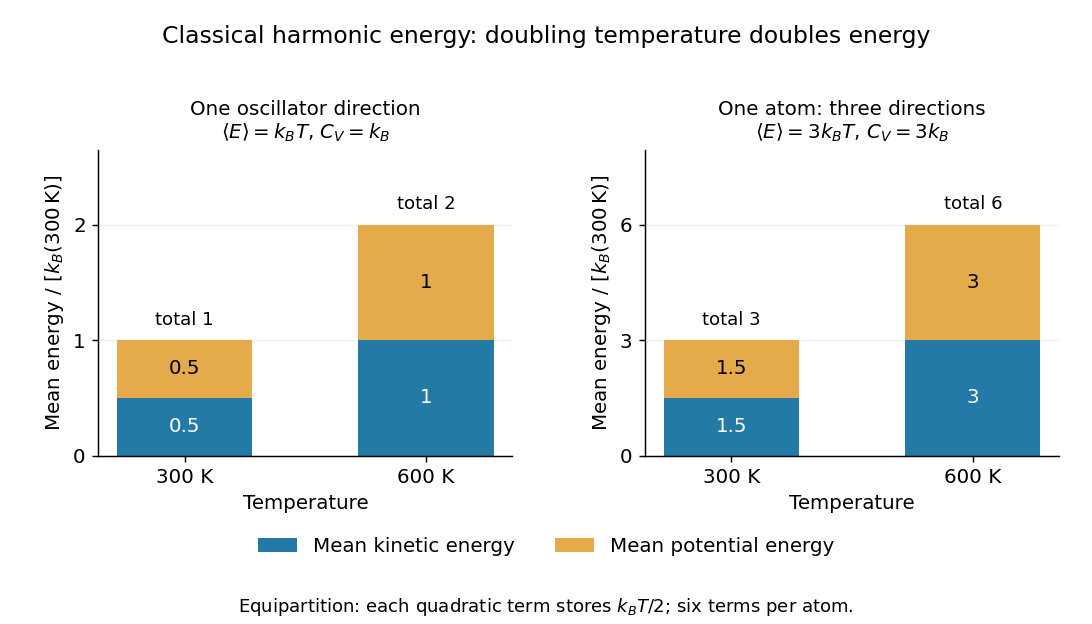

The proof outline is the equipartition theorem: one classical harmonic oscillator has a quadratic kinetic energy and a quadratic potential energy, each with mean . Their sum is , whose derivative with respect to temperature is . Summing over normal modes gives . The classical result does not require equal angular frequencies: each harmonic normal mode contributes the same amount once it is classical. Overall rigid motions give only a finite-size correction to the bulk count. This independence from the individual angular frequencies makes the Dulong-Petit law useful as a quick estimate of a solid's heating requirement.
Experiments on freely expanding solids often measure the heat capacity at constant pressure , whereas the harmonic prediction is for the heat capacity at constant volume . In a smooth single thermodynamic phase of a simple compressible material, the difference between constant-pressure and constant-volume heat capacities iswhere is the volumetric coefficient of thermal expansion and is the isothermal compressibility. Using measured as an approximation to requires this correction to be small compared with . [ref]
https://davidtong.org/teaching/statistical-physics/statmechhtml/S4#S4.SS4.SSS2. David Tong, Statistical Physics, section 4.4.2: relation between the two heat capacities
High temperature here means for the relevant vibrational normal modes, with reduced Planck constant and mode angular frequency . At low temperature, excitation across a quantum energy spacing is suppressed: modes with freeze out thermally, and the classical equipartition theorem fails. The Einstein model of a solid makes this loss of vibrational heat capacity explicit. The Dulong-Petit law is therefore an ideal high-temperature vibrational limit, not a statement that all solids have the same heat capacity at every temperature. Other contributions and departures from the harmonic approximation can matter even at high temperature. [ref]
https://davidtong.org/teaching/statistical-physics/statmechhtml/S3#S3.SS3. David Tong, Statistical Physics, section 3.3: solid vibrations, the classical limit and quantum freeze-out
Historically, Petit and Dulong's 1819 experiments compared the specific heat capacities of several elemental solids and found an approximately constant product with their relative atomic weights. Their original empirical regularity came before the classical harmonic explanation; it suggested that counting chemical atoms reveals a simpler pattern than comparing equal masses. [ref]
https://webserver.lemoyne.edu/giunta/PETIT.html. Petit and Dulong, Recherches sur quelques points importants de la Théorie de la Chaleur, Annales de Chimie et de Physique 10, 395–413 (1819), contemporary English translation hosted by Carmen Giunta
Total derivative along a ray Created 2026-09-24 Updated 2026-09-24
WKB method Created 2026-09-24 Updated 2026-11-05
The WKB method seeks a rapidly oscillating field in the formand determines the phase and slowly varying amplitude order by order in .
Normal mean-precision Gibbs sampler Created 2026-09-24 Updated 2026-09-24
For independent , a flat prior on , and an exponential prior of rate on , the full conditionals areandwhere the gamma distribution is parametrized by shape and rate.
Stationarity of the two-coordinate Gibbs sampler Created 2026-09-24 Updated 2026-10-03
Coupon collector problem Created 2026-09-24 Updated 2026-11-05
When independent uniform draws are made from types, the time until every type has appeared decomposes as a sum of independent geometric waiting times with parametersConsequentlyand Chebyshev's inequality gives in probability.
Lambertian surface Created 2026-09-24 Updated 2026-10-14
This idealized surface follows Lambertian reflectance, with projected-area dependence governed by Lambert's cosine law.
A Lambertian surface has direction-independent radiance. A perfectly reflecting Lambertian patch receiving normal flux emits specific intensity into its outward hemisphere.
Bond albedo Created 2026-09-24 Updated 2026-11-05
The Bond albedo is the fraction of total incident radiant power that a body reflects, summed over outgoing directions and over the incident spectrum. The absorbed fraction is . It is a global energy-budget quantity, so it appears directly in the planetary equilibrium temperature and must lie between zero and one for a passive reflecting body.
A bright appearance from one direction does not determine Bond albedo. Geometric albedo measures full-phase brightness, and the planetary phase integral supplies the angular weighting needed to connect that brightness to reflected power at a given wavelength. The spectral weighting also depends on the illuminating star: the same reflecting material need not absorb the same fraction of light from hot and cool stars.
Geodesic-preserving homothety that is not a local isometry Created 2026-09-24 Updated 2026-09-24
A nonunit Euclidean dilation sends straight-line geodesics to straight-line geodesics but scales their tangent inner products. Preservation of geodesics alone therefore does not imply local isometry.
Elliptic curve Created 2026-09-24 Updated 2026-09-24
An elliptic curve over a field is a smooth projective curve of genus one equipped with a specified -rational point . The chord-and-tangent law makes its rational points an abelian group with identity .
Forcing theorem Created 2026-09-24 Updated 2026-11-05
The forcing theorem has two complementary parts. The forcing definability lemma says that for each first-order formula , the relation on conditions and forcing names is definable in the ground model. The forcing truth lemma says that for a generic filter over a transitive ground model ,The definability part lets the ground model reason about possible extensions before a generic filter is chosen. The truth part then connects that internal reasoning to the actual generic extension. For example, a condition assigning the Cohen bit at the value one forces that value in every generic extension containing it.
Nested likelihood-ratio rejection regions Created 2026-09-24 Updated 2026-11-05
Likelihood-ratio tests of different null subspaces can have crossing rejection regions; comparing their quadratic-form geometry exhibits observations accepted by one and rejected by another.
Likelihood-ratio test for equality of two normal means Created 2026-09-24 Updated 2026-09-24
Analysis of deviance for nested generalized linear models Created 2026-09-24 Updated 2026-10-14
The deviance of a fitted generalized linear model isFor regular nested models, the deviance reduction is asymptotically chi-squared with degrees of freedom equal to the difference in fitted dimensions.
Whitening transformation Created 2026-09-24 Updated 2026-10-14
Whitening multiplies a model by a square root of its precision matrix so that the transformed errors have identity covariance.
Generalized eigenspaces for distinct eigenvalues form a direct sum Created 2026-09-24 Updated 2026-11-05
For a linear operator , the generalized eigenspacesbelonging to distinct eigenvalues are linearly independent. On the generalized -eigenspace, is invertible for because the nilpotent part has a finite geometric-series inverse.
Gaussian free field Created 2026-09-24 Updated 2026-11-05
The Gaussian free field is a centered Gaussian random field whose covariance is the Green kernel of a Laplace operator. It has discrete versions on graphs and continuum versions as a random generalized function on a domain.
There are unlisted articles, also show them or only show them.