
Magnetohydrodynamic shock Created 2026-09-24 Updated 2026-11-05
A magnetohydrodynamic shock is a discontinuity satisfying conservation of mass, momentum, energy, normal magnetic field, and tangential electric field.
Alfvén speed Created 2026-09-24 Updated 2026-11-05
Radical of an ideal Created 2026-09-24 Updated 2026-11-05
Homogeneous ideal Created 2026-09-24 Updated 2026-11-05
An ideal of a graded ring is homogeneous when it is generated by homogeneous elements of a graded ring, meaning elements that belong to individual graded components. Equivalently, whenever an element of the ideal is written as a finite sum of homogeneous components, every one of those components belongs to the ideal.
For the usual total-degree grading on , the ideal is homogeneous because its generator has degree one. In , the ideal is not homogeneous: it contains but does not contain its constant component one. The definition concerns arbitrary graded rings; it does not require that homogeneous elements be polynomials.
Reduction modulo an ideal Created 2026-09-24 Updated 2026-11-05
Ideal approximation theorem Created 2026-09-24 Updated 2026-11-05
Let be a Dedekind domain, let be distinct nonzero prime ideals, and choose nonnegative integers . There is a nonzero withChoose . The prime ideals are maximal, so their powers are pairwise comaximal. The Chinese remainder theorem gives for every , which gives exactly the requested prime-ideal valuations in a Dedekind domain. No restrictions are imposed on primes outside the list.
For example, has valuation two at the prime two and valuation one at the prime three in . Prescribed negative valuations can likewise be realized in the fraction field: first clear them by a common nonzero denominator, apply the integral version, and divide back. The Dedekind-domain hypothesis supplies the valuations and the comaximality used in this argument.
Prime-power ideal Created 2026-09-24 Updated 2026-11-05
Comaximal ideals Created 2026-09-24 Updated 2026-11-05
Intersection of ideals Created 2026-09-24 Updated 2026-11-05
Product of ideals Created 2026-09-24 Updated 2026-10-03
Principal ideal Created 2026-09-24 Updated 2026-11-05
In a commutative ring, a principal ideal is generated by one element:For example, every ideal of has the form , whereas in a two-variable polynomial ring over a field is not principal.
In a noncommutative ring, the two-sided ideal generated by consists of finite sums ; it need not equal the principal left ideal . In , the matrix unit generates the entire matrix ring as a two-sided ideal, since . The left ideal only contains matrices with zero second column. The side is therefore part of a principal-ideal statement outside the commutative setting.
Generating set of an ideal Created 2026-09-24 Updated 2026-11-05
In a commutative ring , a subset generates an ideal when every element of is a finite sum with and . This is the smallest ideal containing . Even when is infinite, each individual expression uses only finitely many generators.
For a general noncommutative ring, the two-sided ideal generated by instead consists of finite sums with . Left and right ideals use only the corresponding one-sided coefficients. For example, in has the two-element generating set but has no one-element generating set, by nonprincipal ideal generated by a prime and an indeterminate.
Primary ideal Created 2026-09-24 Updated 2026-11-05
A proper ideal of a commutative ring is primary when and imply for some positive integer . Equivalently, every zero divisor of the nonzero quotient ring is nilpotent. Its radical of an ideal is a prime ideal.
For example, is primary in when is prime and . In contrast, is not primary: , but and no power of three lies in . Requiring the ideal to be proper excludes the unit ideal, for which the elementwise implication would otherwise hold vacuously.
Hyperbolic polygon area Created 2026-09-24 Updated 2026-09-24
For a geodesic hyperbolic -gon of curvature with interior angles , triangulation or the Gauss--Bonnet theorem gives
Hyperbolic Pythagorean identity Created 2026-09-24 Updated 2026-10-14
The identity implies
The identity follows directly from the exponential definitions of the hyperbolic functions.
Small-argument expansion of the hyperbolic tangent Created 2026-09-24 Updated 2026-10-14
Gravitational scattering angle Created 2026-09-24 Updated 2026-10-25
The gravitational scattering angle is the change between incoming and outgoing asymptotic velocity directions.
Huber loss Created 2026-09-24 Updated 2026-10-18
The Huber loss is quadratic near zero and linear beyond a fixed cutoff; its derivative is the clipped Huber score.
For threshold , the Huber loss is the loss functionThe subtraction makes the values meet at ; the slopes also meet, so the Huber loss is continuously differentiable with Huber score as its derivative. It is a convex function, since that derivative is a monotone function. These quadratic and linear pieces define the original clipped location criterion.[ref]
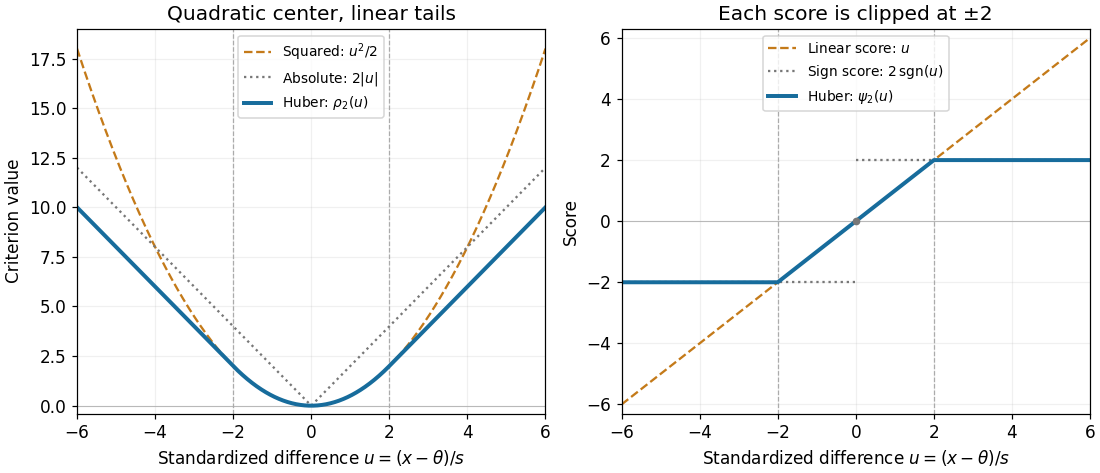

For , , , and , whereas the squared criterion at is . Increasing a standardized difference from to raises the Huber loss by , but raises the squared criterion by . The compromise preserves quadratic sensitivity to small differences while limiting the slope for large ones. This makes the Huber loss useful when ordinary observations should retain their detailed distances yet isolated outliers should exert limited pull.
For a fixed finite dataset and scale, taking large enough that every difference from the sample mean lies within recovers that sample mean. Toward the other extreme, for each fixed , as , connecting the criterion to median minimizes expected absolute loss. The normalization is essential: putting into the unscaled Huber loss gives zero everywhere, not a usable median criterion.
Whitehead theorem Created 2026-09-24 Updated 2026-09-24
A weak homotopy equivalence between connected CW complexes is a homotopy equivalence. The analogous statement holds for Kan complexes.
Hurewicz theorem Created 2026-09-24 Updated 2026-09-24
If a path-connected space is -connected for , then its first potentially nonzero homotopy group maps isomorphically to homology:
There are unlisted articles, also show them or only show them.