
Regular bipartite graph has a perfect matching Created 2026-09-24 Updated 2026-11-05
In a finite bipartite graph that is -regular graph with , edge counting gives equal vertex-class sizes and . Hall's theorem therefore supplies a perfect matching.
Hall induction through a tight set Created 2026-09-24 Updated 2026-10-14
Abelian variety Created 2026-09-24 Updated 2026-11-05
An abelian variety over a field is a complete, geometrically connected group variety; equivalently it is a connected projective algebraic group in the usual smooth variety setting. Its group operation is necessarily commutative, a consequence of rigidity rather than an extra condition hidden in the name. An elliptic curve with a chosen origin is a one-dimensional abelian variety; products of elliptic curves give higher-dimensional examples. The additive and multiplicative algebraic groups are not complete and hence are not abelian varieties. Their geometry links line bundles, torsion elements and the Jacobian variety of a curve to questions in number theory.[ref]
Quasi-tree Created 2026-09-24 Updated 2026-10-14
Hyperbolic group Created 2026-09-24 Updated 2026-10-14
A finitely generated group is hyperbolic when one, equivalently every, Cayley graph for a finite generating set is a Gromov-hyperbolic metric space.
Euclid lemma in a greatest-common-divisor domain Created 2026-09-24 Updated 2026-09-24
If and in a greatest-common-divisor domain, then . Indeed, the least common multiple of and is associate to and divides every common multiple; applying this to and cancelling proves the claim.
Real projective plane Created 2026-09-24 Updated 2026-09-24
Rank-one orthogonal projection Created 2026-09-24 Updated 2026-10-14
Paw graph Created 2026-09-24 Updated 2026-09-24
Ramsey number of a star Created 2026-09-24 Updated 2026-09-24
Off-diagonal graph Ramsey number Created 2026-09-24 Updated 2026-10-06
Linear independence of adjacency powers up to the diameter Created 2026-09-24 Updated 2026-09-24
If a connected graph has adjacency matrix and diameter , thenare linearly independent. For the largest index with a nonzero coefficient, choose vertices at distance ; the corresponding entries of all lower powers vanish, while by the walk count from powers of an adjacency matrix.
Gram-Schmidt orthogonalization for a symmetric bilinear form Created 2026-09-24 Updated 2026-11-05
For a symmetric bilinear form , the Gram-Schmidt process projection formula becomesIt produces orthogonal vectors whenever every denominator used is nonzero. A symmetric bilinear form can have nonzero vectors with zero self-pairing, so linear independence alone does not justify those divisions. For an inner product, positive definiteness excludes this obstruction.
For example, on let . Both standard basis vectors have zero self-pairing, so reordering them cannot provide the first pivot. Replacing them by and works: , and . Changing linear combinations can therefore be necessary, rather than merely reordering the input. This example also separates the existence of an orthogonal basis from the success of an unmodified pivot order.
QR decomposition Created 2026-09-24 Updated 2026-10-14
A reduced QR decomposition of an matrix over the real numbers with full column rank, , writes , where is with orthonormal columns and is a upper triangular matrix with positive diagonal. Applying the Gram-Schmidt process to the columns of constructs and records the coefficientsThis last column identity is exactly the matrix multiplication . The upper triangular matrix records that the th input uses only the first new directions, while its positive diagonal records the norms of the nonzero orthogonal projection residuals. Since , one also has ; denotes the transpose and the identity matrix. Over the complex numbers, use the conjugate transpose in these identities.
For the three-dimensional Gram-Schmidt process example, the exact matrices areFor example, the last column reconstructs asThe diagonal entries are approximately . Each is a norm of the new direction before it was scaled to length one.
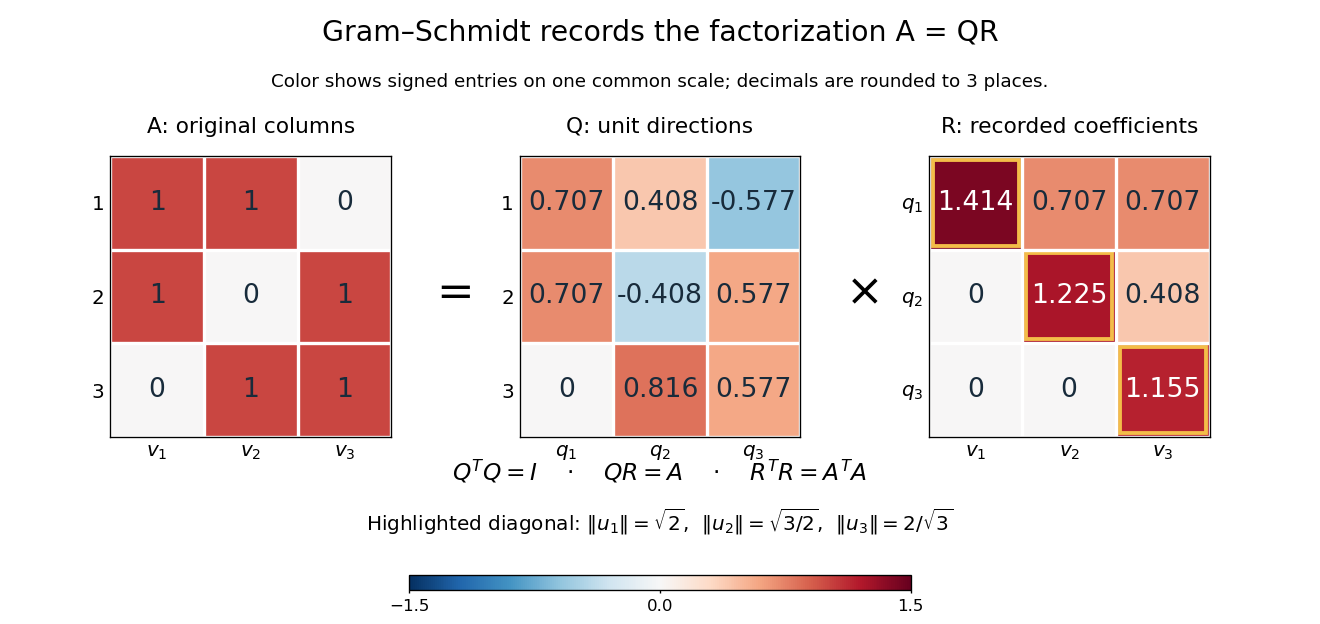
The computed QR factorization: input matrix , orthonormal columns of , and the upper triangular matrix of orthogonal projection coefficients
. Details. 
For a linear least-squares problem, the orthogonal projection of onto the column space of is . Hence the minimizing coefficients solve the linear system by back substitution. Let consist of the first two columns of the example; its reduced factors are and the leading block of . For , the linear system isThus , agreeing with the orthogonal projection computed above, and the minimum Euclidean norm of is . The QR decomposition separates building an orthonormal basis from recovering coefficients in the original basis.[ref]
https://ocw.mit.edu/courses/18-065-matrix-methods-in-data-analysis-signal-processing-and-machine-learning-spring-2018/resources/lecture-9-four-ways-to-solve-least-squares-problems/. Strang, MIT 18.065, Lecture 9: Four Ways to Solve Least Squares Problems
Hilbert series Created 2026-09-24 Updated 2026-11-05
Associated graded ring Created 2026-09-24 Updated 2026-11-05
Gowers-Cauchy-Schwarz inequality Created 2026-09-24 Updated 2026-09-24
Repeated Cauchy-Schwarz inequality gives
Three-party dense coding with a GHZ state Created 2026-09-24 Updated 2026-11-05
Quantum circuit preparation of a three-qubit GHZ state Created 2026-09-24 Updated 2026-11-05
Starting from , apply a Hadamard gate to the first qubit and then controlled-NOT gates from the first qubit to each of the other two qubits.
Bell measurement on one qubit and one leg of a GHZ state Created 2026-09-24 Updated 2026-11-05
There are unlisted articles, also show them or only show them.