
Space of germs of holomorphic functions Created 2026-09-24 Updated 2026-10-14
The space of germs over a domain has basic open sheetsfor holomorphic on open . The projection restricts to a homeomorphism on each sheet, and these projections form holomorphic coordinate charts.
Finite geometric series Created 2026-09-24 Updated 2026-10-14
A finite geometric series is a sum of consecutive terms of a geometric progression. With first term and terms, including for the empty sum,Unlike an infinite geometric series, this identity does not need . For example, . The number of terms is five; the largest exponent is four.
The cancellation behind the formula is especially useful to remember: multiplying by the common ratio shifts all terms one place. In , every interior term cancels, leaving . Division by gives the identity when ; at the sum is directly . The same argument works for complex numbers.
For integers and , the shifted version isThere are terms. All powers must be defined; if a negative exponent is present, must be nonzero. At this sum is simply . The finite trigonometric sum uses this identity with a complex exponential as the common ratio.
Finite sums of positive integers in a geometric progression already appear in Euclid's Elements, Book IX, Proposition 35. The argument there compares differences of proportional numbers; Joyce's guide rewrites its conclusion as the modern finite-sum formula. This historical result concerns finite sums, without asserting an infinite limit. [ref]
https://mathcs.clarku.edu/~djoyce/elements/bookIX/propIX35.html. Euclid, Elements IX.35, with David Joyce's guide to the algebraic form
Genus one curve Created 2026-09-24 Updated 2026-10-14
A genus one curve is a smooth projective curve of geometric genus one. Choosing a rational point makes it an elliptic curve.
Affine parameter Created 2026-09-24 Updated 2026-10-03
An affine parameter on a geodesic is one for which the coordinate equation has the form . Its affine changes , with , preserve this form.
Normal section of a surface Created 2026-09-24 Updated 2026-11-05
A normal section of a regular embedded surface at a point is its local intersection with a plane containing the normal line at and a chosen tangent line. Its curvature at measures the normal curvature in that direction. The plane need not contain the surface normal vector at other points of the section.
A stronger condition does imply a geodesic: if one fixed plane contains the surface normal vector at every point of a regular intersection curve, then its arc-length parametrization has acceleration in that plane and perpendicular to the curve tangent. It is therefore normal to the surface, by the ambient acceleration criterion for a surface geodesic.
A normal section need not have that stronger property. For , the plane contains the surface normal at the origin and gives . Away from , the determinant of , and the surface normal is . No change of parameter can then make the acceleration surface-normal, so this section is not a geodesic near the origin.
Ambient acceleration criterion for a surface geodesic Created 2026-09-24 Updated 2026-09-24
For a smoothly parametrized curve on an embedded surface in Euclidean space, the geodesic equations hold exactly when the ambient acceleration is normal to the surface.
Tangency invariance of an ambient-surface geodesic Created 2026-09-24 Updated 2026-09-24
Line in a Riemannian manifold Created 2026-09-24 Updated 2026-10-14
Complete geodesic Created 2026-09-24 Updated 2026-10-14
Surface covariant derivative Created 2026-09-24 Updated 2026-10-03
For a tangent vector field along a curve on an embedded surface, the surface covariant derivative is the tangential projection of its ordinary derivative:It is the covariant derivative induced by the surface metric.
Geodesic triangle Created 2026-09-24 Updated 2026-10-14
A geodesic triangle is bounded by three geodesic segments. On a surface its angle excess is the integral of the Gaussian curvature over the triangle.
It is the three-sided instance of a geodesic polygon.
Generic extension Created 2026-09-24 Updated 2026-10-03
If is a generic filter over a countable transitive model , the generic extension consists of the interpretations by of all forcing names in .
Random intercept Created 2026-09-24 Updated 2026-10-03
A random intercept gives every group a latent additive shift, inducing dependence among observations from the same group.
Normal modes of two equal masses between three springs Created 2026-09-24 Updated 2026-09-24
For equal masses , wall-spring constants , and coupling-spring constant , the small-oscillation mass and stiffness matrices areIf , , and , the squared normal frequencies are
Degenerate normal modes from permutation symmetry Created 2026-09-24 Updated 2026-11-05
Let a finite permutation group act on mechanical coordinates through permutation matrices , and let the mechanical mass matrix be a positive-definite matrix and the mechanical stiffness matrix a symmetric matrix. If and , thenEvery transformed normal mode therefore stays in the same squared-frequency eigenspace. A nontrivial irreducible representation of dimension carried by that eigenspace forces at least independent modes at that squared frequency.
For a multiplicity-free symmetry decomposition, Schur lemma makes the mass-normalized operator scalar on each irreducible representation subspace. If equivalent irreducible representations occur several times, a commuting operator can mix their copies. One diagonalizes the operator on this copy space; symmetry does not force all copies to have one common frequency.
For three equal masses with full exchange symmetry, and , where is the all-ones matrix. The collective normal mode has squared frequency . The two-dimensional sum-zero vector subspace has squared frequency , providing a degenerate pair. Stability additionally requires the relevant squared angular frequencies to be nonnegative.
Square-root splitting of nearly degenerate frequencies Created 2026-09-24 Updated 2026-09-24
Normal modes of a double pendulum Created 2026-09-24 Updated 2026-11-05
For equal lengths and mass ratio , the squared angular frequencies are , where is the upper mass, the lower mass, and . The equal-mass case admits particularly simple mode shapes.
Use the ideal model of the double pendulum, with both angles measured from the downward vertical. Around , the Taylor expansions and give the quadratic LagrangianHere both angles and their angular velocities are counted as small. Consequently the correction to is fourth order and does not enter . The Euler-Lagrange equations give . The mass matrix is not diagonal: an angular motion of the upper rod carries the lower mass too.[ref]
Classical Dynamics by David Tong. Classical Dynamics, chapter 2, §2.6.1, printed pp. 41–42, equations (2.130)–(2.132): equal-mass, equal-length linearized double pendulum
For a normal mode, put with fixed amplitude vector . The resulting generalized eigenvalue problem for small oscillations is . With , its characteristic equation isSolving this quadratic and using the second row, , givesThe lower-frequency normal mode has the rods in phase, with the lower angle times the upper one. The higher-frequency normal mode has opposite signs, corresponding to an oscillation phase difference of . These are ratios of absolute angles. The horizontal displacements are instead and ; their ratios are and respectively. Thus the lower mass moves horizontally opposite to the upper mass in the faster normal mode.
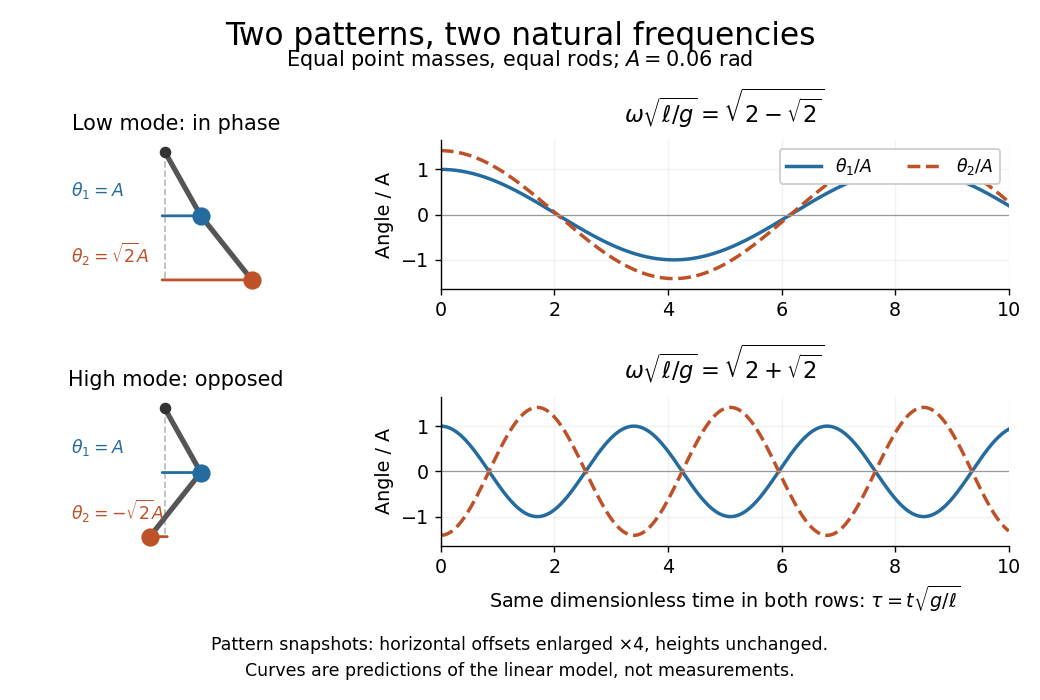

Both squared angular frequencies are positive. Their ratio satisfies , independently of , and . For a constructed model with and , the angular frequencies are approximately and , and the oscillation periods are and . Doubling both masses leaves these unchanged; multiplying both rod lengths by four doubles both oscillation periods.
The eigenvectors are not orthogonal in the ordinary dot product: . They satisfy mass-matrix orthogonality of normal modes, sinceWriting therefore removes the cross terms from both quadratic energies. The two normal coordinates satisfy . This is why the normal modes are useful: one coupled system becomes two independently evolving harmonic oscillators, and any small release can be decomposed into them. At larger angles, the discarded terms in the double pendulum equations of motion matter and this exact linear superposition no longer applies.
Mass-matrix orthogonality of normal modes Created 2026-09-24 Updated 2026-10-18
For symmetric stiffness matrix and positive-definite mass matrix , eigenvectors ofwith distinct squared frequencies satisfyThus normal modes are orthogonal in the kinetic-energy inner product.
Special linear group over a finite field Created 2026-09-24 Updated 2026-11-05
Projective general linear group action on the projective line Created 2026-09-24 Updated 2026-10-03
There are unlisted articles, also show them or only show them.