
Prefix sum Created 2026-09-24 Updated 2026-10-14
A prefix sum stores the accumulated sum through a specified position in a finite sequence or array. For inputs , include the empty sum and setFor the original input , the prefix array including is . A negative entry makes the accumulated sum decrease; a prefix sum does not have to be monotone. Conversely, the original entry is recovered by subtraction: .
The useful cancellation is that any contiguous block has sumBoth prefixes include the entries before ; subtracting cancels those entries. In the example, the sum from positions two through four is , recovered as . The arithmetic mean of that block is , obtained by dividing its sum by its length. Prefix sums therefore make many repeated questions about an unchanged array cheap: reuse accumulated totals instead of resumming every block.
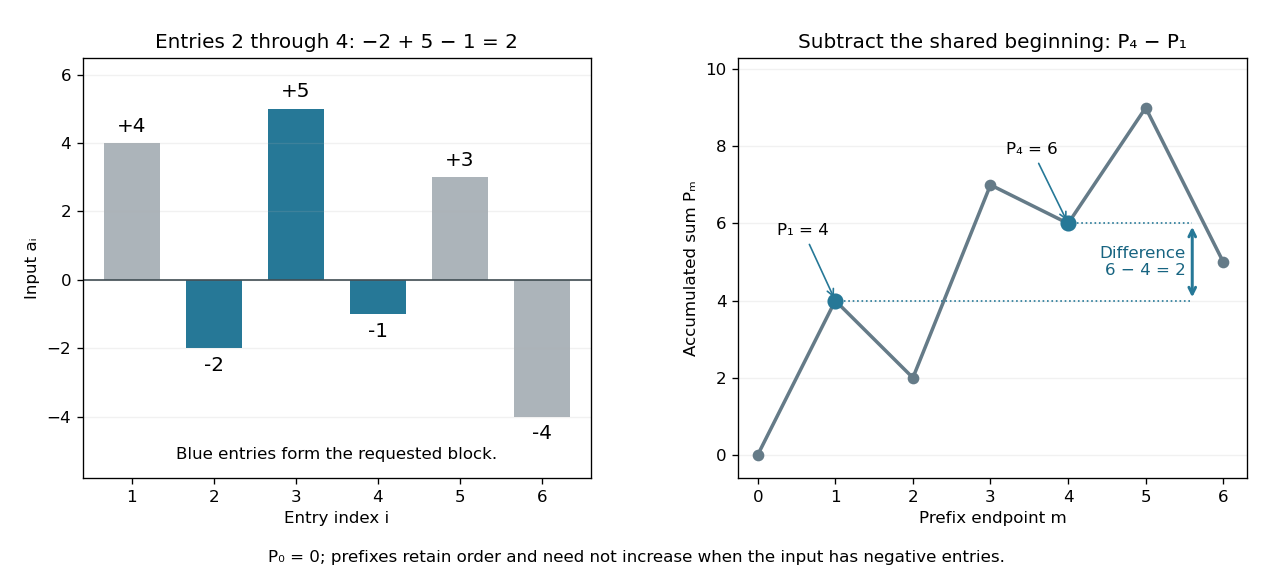

The sequential recurrence builds all prefixes in time complexity and storage; each block query needs two reads and one subtraction, hence time complexity. These counts assume constant-cost arithmetic and access to array entries. If one input changes, all later stored prefixes change, so this simple representation is most useful when queries outnumber updates. For integer inputs, sufficient numeric capacity must be retained; with floating-point arithmetic, subtracting large nearby prefixes can lose relative accuracy for a small block total. The exact mathematical identity does not eliminate representation error.
The apparently sequential recurrence also motivates a prefix scan: associativity permits a tree of partial calculations that yields all accumulated results in parallel. Guy E. Blelloch's 1990 technical report systematically develops this operation and its applications; its authored chapter version explains the two tree sweeps used to obtain all prefixes. [ref]
https://www.cs.cmu.edu/afs/cs.cmu.edu/project/scandal/public/papers/CMU-CS-90-190.html. Blelloch, Prefix Sums and Their Applications, CMU-CS-90-190, November 1990
. [ref]https://www.cs.cmu.edu/~guyb/papers/Ble93.pdf. Blelloch, authored chapter version, §§1.1–1.2: sequential scans and parallel tree sweeps
. Three-colourable two-thirds subgraph lemma Created 2026-09-24 Updated 2026-09-24
Induced subgraph Created 2026-09-24 Updated 2026-10-03
Sturm-Liouville eigenfunction expansion Created 2026-09-24 Updated 2026-11-05
For a regular self-adjoint Sturm-Liouville problem, choose its eigenfunctions orthogonal in the weighted Hilbert space . For real or complex in that space,The expansion converges in the weighted L2 norm. Pointwise, uniform or differentiated convergence needs extra assumptions; it does not follow from square integrability alone. The conjugation fixes the complex inner-product convention.
For the Dirichlet boundary conditions on with , , this is the Fourier sine series: and . The ordinary sine basis is therefore one instance of a general spectral expansion rather than an unrelated Fourier trick.
Dirichlet eigenvalue Created 2026-09-24 Updated 2026-10-14
A Dirichlet eigenvalue is an eigenvalue for an eigenfunction constrained to vanish at the endpoints of its interval or on the boundary of its domain.
Student t confidence interval for a centered regression intercept Created 2026-09-24 Updated 2026-10-06
In a two-parameter Gaussian simple linear regression centered at , the intercept estimator is . With residual standard deviation ,which gives the usual two-sided interval from the corresponding quantiles.
Model-theoretic algebraic closure Created 2026-09-24 Updated 2026-10-03
Strong-pseudoprime bases for a product of two primes with common predecessor divisor ten Created 2026-09-24 Updated 2026-09-24
Let for distinct odd prime numbers with . Exactly unit bases make a Fermat pseudoprime, and exactly of these make it a strong pseudoprime. The Fermat bases form under the Chinese remainder theorem for unit groups. If , then and is odd, so the th-power map sends five elements of each to and five to . The strong condition requires equal signs in both components, giving .
Two-dimensional conformal field theory Created 2026-09-24 Updated 2026-11-05
A two-dimensional conformal field theory is a quantum field theory with local conformal transformations. In Euclidean complex coordinates, infinitesimal transformations separate into holomorphic and antiholomorphic sectors, organized by two copies of the Virasoro algebra.
This symmetry strongly constrains correlation functions. A primary field's conformal weights fix its two-point dependence, while three-point functions are fixed up to constants; higher-point functions retain dependence on conformal cross-ratios. The operator product expansion combines local fields and records the remaining dynamical data. A free boson conformal field theory provides an explicit example. In string theory, this framework describes gauge-fixed worldsheet dynamics and connects the central charge to quantum consistency.
String embedding map Created 2026-09-24 Updated 2026-11-05
Bosonic string mass spectrum Created 2026-09-24 Updated 2026-09-24
Normal-ordering constant of a string Created 2026-09-24 Updated 2026-11-05
The normal-ordering constant is the zero-point shift in the quantum Virasoro generator. Closure of the target-space Lorentz algebra fixes and the spacetime dimension for the bosonic string.
Closed-string level matching Created 2026-09-24 Updated 2026-11-05
Closed-string level matching is the constraint that the left-moving and right-moving worldsheet sectors combine into an allowed periodic physical state. In an uncompactified free closed bosonic string, their zero-mode momenta agree and the condition reduces to equality of string oscillator levels, .
More generally, the constraint is equality of the full left and right zero-mode Virasoro generators, including momentum and winding contributions. On a compact circle, these contributions can compensate unequal oscillator levels, as in compact-circle closed-string level matching. Thus the two chiral polarization choices remain independent subject to the total constraint, while imposing equal oscillator levels in every winding sector would remove valid states.
Stress-free boundary condition Created 2026-09-24 Updated 2026-11-05
Weierstrass approximation theorem Created 2026-09-24 Updated 2026-10-14
Every continuous real-valued function on a compact interval can be approximated by polynomials with arbitrarily small error everywhere on the interval. More precisely, if and is continuous, then for every there is a polynomial withThe error is measured in the supremum norm, so one approximation works at every point. The degenerate interval needs only a constant function. A change of variable reduces the nondegenerate case to .[ref]
The Weierstrass approximation theorem (Georgia Tech handout). The Weierstrass approximation theorem, Theorem 0.3, printed p. 2: uniform polynomial approximation on the unit interval
This is useful because a polynomial is described by finitely many coefficients and can be evaluated with addition and multiplication. Its surprise is that the target need not be differentiable: the sharp corner of an absolute value function can be approximated by smooth polynomials. The Bernstein approximation of a corner below makes this visible. Approximating values, however, does not by itself approximate derivatives; Weierstrass approximation does not preserve derivatives gives a counterexample.
Boundary perturbation of a nearly spherical particle Created 2026-09-24 Updated 2026-09-24
Rotating sphere in Stokes flow Created 2026-09-24 Updated 2026-09-24
Papkovich–Neuber representation Created 2026-09-24 Updated 2026-09-28
Every homogeneous Stokes flow can be represented using a harmonic vector field and harmonic scalar as
Rotational Stokes flow between concentric spheres Created 2026-09-24 Updated 2026-09-24
For concentric spheres of radii , with the inner sphere rotating at angular velocity and the outer sphere fixed, the Stokes velocity isThe pressure is constant, and may be set to zero.
Kinematic reversibility of Stokes flow Created 2026-09-24 Updated 2026-10-14
For a fixed geometry, the steady Stokes equation maps to when all imposed boundary velocities and disturbance forces are reversed; is pressure relative to any unchanged hydrostatic pressure. Linearity of Stokes flow and Uniqueness of Stokes flow therefore reverse the entire velocity field. If the driving schedule and evolving geometry are retraced, fluid elements retrace their paths too. Reversing just one drive while leaving another applied force unchanged does not meet these conditions.
This reversal concerns the paths, while viscous dissipation remains positive: for a sphere, the required power is unchanged by . A reversed experiment must supply fresh energy. Inertia, Brownian motion and irreversible contact can prevent perfect retracing. Edward M. Purcell illustrated the mechanism with a viscous fluid flow demonstration in Life at low Reynolds number, American Journal of Physics 45, 3–11 (1977).
There are unlisted articles, also show them or only show them.